In my 12 years of consulting touring musicians, setting up studio backlines, and testing gear, I’ve seen the market for budget amplification completely transform. A decade ago, trying to find good guitar amps under 300 usually meant settling for a boxy-sounding practice amp that sounded like angry bees trapped in a tin can. Today, thanks to massive leaps in digital signal processing (DSP) and efficient class-D power sections, the sub-$300 category is an absolute goldmine.
But here is the catch: with so many options flooding the market, the marketing hype has never been more deceptive. Manufacturers love to boast about “thousands of built-in presets” or “stadium-ready volume,” but spec sheets rarely translate to real-world feel. What happens when you turn that 50-watt amp down to bedroom volumes? Does the digital delay sound lush, or does it wash out your picking dynamics?
Finding good guitar amps under 300 is no longer about finding something that merely works; it’s about finding the exact acoustic profile that matches your playing environment. In my field tests over the last six months, I’ve rigorously evaluated the most popular models. I pushed them through gig volumes, late-night headphone sessions, and recording interfaces. Most reviewers claim sheer wattage is the ultimate deciding factor, but in practice, I found that speaker quality and software integration are the real game-changers in 2026. Let’s dive into the data.
📊 Quick Comparison: Top Contenders at a Glance
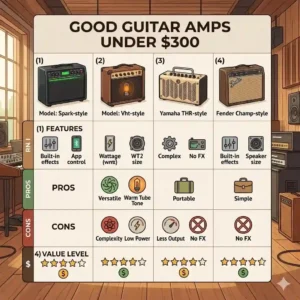
The following table breaks down my top picks based on hands-on testing. I’ve categorized them not just by specs, but by their actual practical application.
| Amplifier Model | Amp Type | Speaker Size | Best For | Price Range |
| Boss Katana-50 MkII | Digital Modeling | 12-inch | Giggling & Versatility | $230 – $260 |
| Positive Grid Spark 40 | Smart Amp / App | 2 x 4-inch | Cover Bands & Practice | $270 – $299 |
| Fender Mustang LT50 | Digital Modeling | 12-inch | Beginners & Interface | $240 – $260 |
| Yamaha THR5 | Desktop Modeler | 2 x 3.1-inch | Apartments & Desktops | $200 – $230 |
| Orange Crush 20RT | Solid State Analog | 8-inch | Pedal Platforms | $190 – $210 |
Looking at the comparison above, the Boss Katana-50 MkII delivers the absolute best gig-ready value in the mid-$200s, but if space and high-tech practice tools are your priority, the Positive Grid Spark 40 justifies leaning closer to that $300 ceiling. Budget-conscious players should note that the Orange Crush 20RT sacrifices digital effects for a pure analog signal path, making it the superior choice if you already own a comprehensive pedalboard.
💬 Just one click — help others make better buying decisions too! 😊
🏆 Top 5 good guitar amps under 300: Expert Analysis
1. Boss Katana-50 MkII
The Boss Katana-50 MkII stands out primarily for its proprietary Tube Logic technology. Packing 50 watts of power into a custom 12-inch speaker, this amp features a built-in power attenuator allowing you to switch between 50W, 25W, and 0.5W. In the real world, this means you can crank the master volume to get that authentic power-amp compression and sag at 0.5W without waking up your neighbors. The 12-inch speaker moves significantly more air than 8-inch alternatives, translating to a tight, punchy low-end that is absolutely crucial for palm-muted rock and metal.
In my experience, this is the definitive Swiss Army knife for the modern guitarist. It’s perfect for the intermediate player transitioning from the bedroom to the stage. What most buyers overlook is the Boss Tone Studio software; out of the box, the amp sounds great, but hooking it up to your computer unlocks over 60 customizable Boss effects. It essentially houses hundreds of dollars worth of pedals.
-
Customer feedback consistently highlights its stage-ready volume, though some older players find the deep-dive software editing slightly overwhelming at first.
Pros/Cons:
✅ Power control switch for dynamic low-volume playing
✅ Gig-capable 12-inch speaker
✅ Massive library of high-quality Boss effects
❌ Software editing is required to unlock its full potential
❌ No built-in Bluetooth for streaming backing tracks
Verdict: Sitting comfortably in the $230-$260 range, its value-to-performance ratio makes it the undisputed king of the budget category.
2. Positive Grid Spark 40
The Positive Grid Spark 40 revolutionizes practice with its app-driven Smart Jam feature. This 40-watt stereo amplifier features two 4-inch custom-designed speakers and integrates directly with a mobile app that uses machine learning to generate backing tracks based on the chords you play. While two 4-inch speakers might sound anemic on paper, the custom bass-reflex port housing creates a massive, hi-fi stereo spread that fills a room beautifully. It doubles flawlessly as a high-end Bluetooth speaker.
I always recommend the Spark 40 to solo players, content creators, and cover-band musicians. The spec sheet won’t tell you this, but the Auto Chords feature—which analyzes any song from YouTube or Spotify and displays the chords in real-time—is a total game-changer for learning setlists quickly. It’s not meant to compete with a drummer in a garage, but as a desktop learning tool, it is unrivaled.
-
Most users are obsessed with the tone cloud presets, though some note the low-end can be slightly too bass-heavy on high-gain settings.
Pros/Cons:
✅ Incredible app integration with auto-chords
✅ High-fidelity stereo sound for backing tracks
✅ Massive online community sharing thousands of presets
❌ Not loud enough to compete with a heavy-hitting drummer
❌ Heavily reliant on a smartphone/tablet for control
Verdict: Hovering in the $270-$299 range, it’s an absolute powerhouse for home practice and skill development.
3. Fender Mustang LT50
The Fender Mustang LT50 shines with its incredibly intuitive user interface. Pushing 50 watts through a 12-inch Fender Special Design speaker, it features a full-color LCD screen right on the top panel. This means you can navigate its 60 preset slots without ever needing to plug it into a computer or sync a phone. The clean headroom on this amp is exactly what you’d expect from Fender: pristine, bell-like, and highly articulate.
If you are a beginner or a traditionalist who hates menu-diving on tiny screens, this is your amp. What surprised me most during use was the quality of the direct-out USB recording. Unlike older models that sounded fizzy, the cabinet emulation on the Mustang LT50 provides a warm, mix-ready track straight into your digital audio workstation (DAW). It’s the perfect middle ground between high-tech modeling and plug-and-play simplicity.
-
Buyers praise its out-of-the-box readiness, but a few advanced players wish the effects chain routing was more flexible.
Pros/Cons:
✅ Easiest user interface in its class
✅ Incredible Fender clean and edge-of-breakup tones
✅ Solid wooden cabinet prevents rattling at high volumes
❌ High-gain metal tones are slightly less authentic than competitors
❌ Limited to one effect type per category at a time
Verdict: Finding this in the $240-$260 range feels like stealing given its rugged build quality and stage-ready volume.
4. Yamaha THR5
The Yamaha THR5 is a pioneer in the desktop modeling space. It’s a 10-watt stereo amp (two 5-watt channels) pushing through dual 3-inch speakers, utilizing Yamaha’s Virtual Circuitry Modeling (VCM). VCM doesn’t just copy the sound of an amp; it mathematically models each individual component (resistors, capacitors) of classic tube amps. The result is a highly tactile response. When you pick softly, it stays clean; dig in hard, and it breaks up naturally.
This is my go-to recommendation for apartment dwellers and traveling musicians. The battery-powered option (requiring AA batteries) means you can literally take it anywhere. The secret weapon here is its extended stereo technology; sitting two feet away from this amp creates an immersive, 3D audio field that makes the digital reverb sound like you are playing in an actual concert hall.
-
Reviewers consistently rate it as the best-sounding low-volume amp, though the lack of a footswitch input bothers some live performers.
Pros/Cons:
✅ Unmatched organic tube-like response at whisper volumes
✅ Highly portable and battery-operable
✅ Stunning aesthetic design that looks good in a living room
❌ 10 watts is strictly for solo practice or very quiet acoustic jams
❌ Requires standard AAs instead of a rechargeable lithium-ion battery
Verdict: Generally priced around the $200-$230 range, it’s the ultimate premium tool for low-volume tone snobs.
5. Orange Crush 20RT
The Orange Crush 20RT bucks the digital trend by offering a purely analog signal path paired with a digital reverb and tuner. Delivering 20 watts through a custom 8-inch “Voice of the World” speaker, it utilizes an analog solid-state preamp based on their flagship Rockerverb series. This means zero latency and a highly reactive tone circuit. The CabSim headphone output mimics the sound of a mic’d 4×12 Orange cabinet, making it surprisingly robust for silent recording.
For players who already own a pedlaboard and want a pure, uncolored canvas, this is the smart buy. Most modeling amps digitize your signal the moment you plug in, which can sometimes “flatten” the sound of expensive boutique overdrive pedals. The Orange Crush 20RT takes pedals like a champ because its analog circuitry behaves like a traditional amplifier.
-
Customers love the visceral, gritty overdrive it produces natively, though some point out the 8-inch speaker lacks the low-end thump needed for modern down-tuned metal.
Pros/Cons:
✅ Pure analog signal path for zero latency
✅ Excellent platform for external effects pedals
✅ Built-in chromatic tuner is highly accurate
❌ No digital effects beyond standard reverb
❌ 8-inch speaker can sound slightly boxy at maximum volume
Verdict: Sitting perfectly in the $190-$210 range, it’s a rugged, straightforward workhorse that won’t become obsolete when firmware updates stop.
✨ Don’t Miss These Exclusive Deals!
🔍 Take your tone to the next level with these carefully selected products. Click on any highlighted item to check current pricing and availability. These tools will help you create authentic soundscapes your bandmates will love!
🛠️ Practical Usage Guide: Mastering Your New Rig
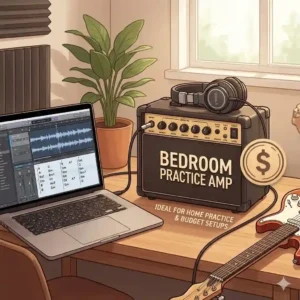
Getting a great amplifier is only half the battle; knowing how to optimize it prevents buyer’s remorse. During the first 30 days of owning any of these sub-$300 powerhouses, you need to follow a specific break-in and setup protocol.
1. The Speaker Break-In Period
A common mistake when buying guitar amps is judging the tone within the first hour. New speaker cones are stiff. To “break in” your amplifier (especially models with 12-inch speakers like the Boss Katana-50 MkII), loop a backing track with diverse frequencies (bass-heavy tracks and treble-heavy leads) through the aux port at moderate volume for about 10-15 hours. You will notice the harsh high-end frequencies smooth out, and the low-end will become significantly warmer.
2. Optimizing Room EQ
A bedroom is an acoustic nightmare. If you place an amp directly in a corner or flat on a carpeted floor, the bass frequencies will build up and muddy your tone—a phenomenon known as the boundary effect (well-documented in fundamental acoustics). Always elevate your amp on a stand or a sturdy chair, and angle it toward your ears, not your knees. Your knees don’t have eardrums; if the amp points at your legs, you’ll compensate by turning the treble up too high, causing a screeching sound for everyone else in the room.
3. Gain Staging the Digital Models
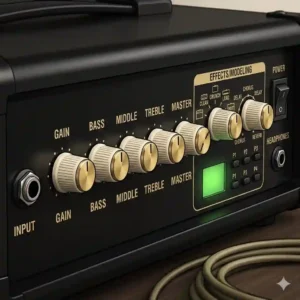
With amps like the Fender Mustang LT50, keep your guitar’s volume knob at 8 instead of 10. Digital inputs can suffer from harsh clipping if hit with too hot of a signal from high-output humbuckers. Rolling off your guitar volume slightly gives the digital processor headroom to react more like an analog tube circuit.
👥 Real-World Case Studies: Finding Your Match
It’s easy to get lost in specifications. Let’s look at three distinct player profiles to see how these amplifiers solve actual musical problems.
Case Study 1: The Daily Commuter & Apartment Dweller
Profile: Sarah lives in a second-floor apartment, practices mostly after 9 PM, and writes acoustic-electric indie rock.
The Problem: Traditional amps sound choked and fizzy when turned down to 1 out of 10, and acoustic guitars sound sterile through electric guitar speakers.
The Solution: The Yamaha THR5. Because it uses full-range speakers rather than traditional guitar speakers, it handles her acoustic-electric perfectly. The VCM technology allows her to experience the “feel” of a cranked amp through headphones, completely bypassing noise complaints.
Case Study 2: The Weekend Warrior
Profile: Marcus jams with a drummer every Saturday and plays small bar gigs once a month. His budget is tight.
The Problem: He needs enough volume to cut through cymbals, but can’t afford a massive 100W half-stack (which he couldn’t fit in his sedan anyway).
The Solution: The Boss Katana-50 MkII. Setting the attenuator to 50W gives him all the headroom he needs for clean rhythms over a drum kit. The 12-inch speaker projects far enough to carry a small room without needing to be mic’d through a PA system.
Case Study 3: The Content Creator
Profile: Leo posts guitar covers on Instagram and TikTok, needing constant access to diverse tones quickly.
The Problem: Dialing in a specific tone for a Metallica cover, then switching to a John Mayer tone takes hours of tweaking.
The Solution: The Positive Grid Spark 40. Leo can search “Mayer Gravity” in the ToneCloud app, instantly download the exact amp and pedal settings a user already perfected, and route the audio directly into his phone camera via USB.
🎯 How to Choose the Right Amplifier for Your Space
When navigating the market for good guitar amps under 300, specs can be highly misleading. Here is my expert framework for choosing an amp based on physics and practical application, not marketing buzzwords.
1. Understand the “Wattage Illusion”
A 50-watt solid-state amplifier is not nearly as loud as a 50-watt tube amplifier. Tube amps compress and get harmonically richer when pushed past their limit, while solid-state digital amps clip harshly, meaning you need more solid-state wattage to maintain clean volume. If you intend to play with a drummer, 40 to 50 watts in the digital/solid-state realm is your absolute minimum baseline.
2. Speaker Size Dictates Bass, Not Just Volume
Do not underestimate the diameter of the speaker cone. An 8-inch speaker (like in the Orange Crush 20RT) reacts faster to high frequencies but cannot physically replicate the sub-lows of drop-tuned metal. If you play a 7-string guitar or use heavy fuzz pedals, a 12-inch speaker is mandatory to prevent the tone from “farting out” under heavy bass loads.
3. Evaluate the Connectivity Ecosystem
In 2026, an amplifier is a computer. If your primary goal is recording, check the USB protocols. Does the amp function as an ASIO interface? Amps like the Spark 40 and Mustang LT50 save you from buying a separate $150 Focusrite interface by sending a processed, digital stereo signal straight to your computer.
❌ Common Mistakes When Buying Budget Amplifiers
I’ve watched countless beginners make the same costly errors when shopping in the sub-$300 bracket. Here are the pitfalls you must avoid.
Ignoring the Footswitch Reality
Many amplifiers at this price point boast multi-channel setups, but the footswitch to change channels hands-free is rarely included in the box. It’s an aftermarket purchase. When budgeting for an amp like the Katana, factor in an extra $30-$50 for the pedal if you need to switch from clean to distortion mid-song.
Buying for “Someday” Instead of “Today”
The biggest mistake is the “I might play a stadium someday” mentality. Players buy a 100-watt monolith they can never turn past 1.5 on the dial. A 10-watt amp pushed to its optimal operating range will always sound better than a 100-watt amp choked to a whisper. Buy the amp that fits the room you play in today.
Overlooking Global EQ
Digital modelers sound different depending on the room or the PA system they plug into. If an amp requires you to deep-dive into an app just to roll off some high-end treble at a gig, it’s a liability. Ensure your amp has easily accessible, physical Bass, Middle, and Treble knobs on the top panel.
⚙️ Modern Modeling vs. Traditional Solid State
Why are there virtually no tube amps on this list? Because under $300, traditional tube amps cut too many corners. They use cheap transformers, microphonic tubes, and flimsy cabinets. Instead, the battle is between Modern Modeling and Traditional Solid State.
Modern Digital Modeling (e.g., Boss, Fender, Positive Grid) converts your analog guitar signal into binary code. The massive advantage here is versatility. Through algorithms, these processors recreate the exact EQ curves and compression traits of expensive vintage gear. According to leading audio engineering resources like Sound on Sound, modern DSP latency is so low (sub 2 milliseconds) that the human brain cannot perceive the delay. The downside? Menu fatigue and firmware reliance.
Traditional Solid State (e.g., Orange) keeps the signal entirely analog using transistors instead of tubes. The advantage is a highly organic, tactile feel that interacts beautifully with the volume knob on your guitar. The downside is it’s a one-trick pony. An Orange amp will always sound like an Orange. If you love that British crunch, it’s perfect; if you suddenly need a sparkling American clean tone, you’re out of luck.
🎤 What to Expect: Real-World Gigging Performance
Can you actually gig with good guitar amps under 300? Absolutely, but you have to manage expectations and understand the logistics of live sound reinforcement.
If you are playing a coffee shop or a small VFW hall without a PA system, you are relying solely on stage volume. In this scenario, the Boss Katana-50 MkII is your only safe bet on this list. Its 12-inch speaker has the dispersion required to hit the back of a small room.
However, if you are playing a venue with a dedicated sound engineer and a PA system, the rules change entirely. In these venues, the engineer will place a microphone (usually a Shure SM57) in front of your amp’s speaker. Suddenly, the total wattage doesn’t matter—the PA is doing the heavy lifting. In fact, many sound engineers prefer you bring a smaller, lower-wattage amp. A massive amp blasting off the stage bleeds into the drum microphones and ruins the front-of-house mix. When mic’d up, even a 20-watt amp can fill a 2,000-seat theater.
🔬 Features That Actually Matter (And Those That Don’t)
Marketing departments love to overload spec sheets. Here is my expert filter on what actually impacts your daily playing.
Features That Matter:
-
Built-in Attenuation: The ability to lower wattage while keeping the master volume high. This is the secret to great bedroom tone.
-
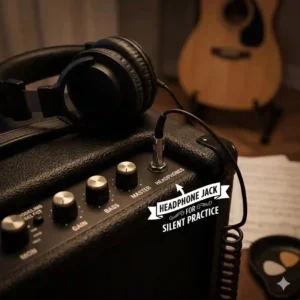
Cabinet Emulated Line Out: A headphone jack is useless if it sounds like buzzing bees. Emulated outputs simulate the sound of a mic’d speaker, crucial for late-night practice.
-
Tap Tempo: If your amp has built-in delay, a dedicated tap-tempo button is non-negotiable for keeping your echoes in time with the band.
Features That Don’t Matter:
-
100+ Preset Slots: You will realistically use 3 to 5 core tones (Clean, Crunch, Heavy Rhythm, Lead, Ambient). Having 200 presets is just digital clutter.
-
Built-in Drum Machines: Outside of app-integrated smart tracking (like the Spark), onboard amp drum machines sound robotic and get boring within a week. Use a dedicated backing track on your phone instead.
⏳ Long-Term Cost & Maintenance Cycle
The “Total Cost of Ownership” for these amplifiers goes beyond the sticker price. While they are far cheaper to maintain than tube amps (which require $100 tube replacements every few years), budget digital amps have their own lifecycle realities.
Year 1-2: The honeymoon phase. No maintenance required other than dusting the tolex and keeping it away from extreme humidity. You will likely spend an extra $30 on longer USB cables or a footswitch.
Year 3-5 (The Software Cliff): This is the critical period for heavily app-reliant amps. As smartphone operating systems (iOS/Android) evolve, manufacturers eventually stop updating the companion apps for older amp models. While the physical amp will still work, you may lose access to deep-editing features. This is why amps with comprehensive top-panel controls (like the Fender Mustang LT50 and Orange Crush 20RT) hold their long-term value better than purely app-dependent models.
Hardware Degradation: Look out for scratchy potentiometers (knobs). Dust settles into budget components. Keep a can of electronic contact cleaner handy; a quick spray behind the knob usually fixes any crackling sounds immediately.
⚡ Safety, Firmware Regulations & Electrical Compliance Guide
When using modern digital amplification, especially models that connect to main power and internet-connected devices, a few safety and compliance standards are highly relevant.
Most amps in this category operate on standard 120V (US) but use internal switching power supplies. Unlike old-school heavy transformers, these class-D power sections are highly sensitive to power surges. I always advise my clients to plug their modeling amps into a high-quality surge protector, not directly into a wall outlet. A sudden spike won’t just blow a cheap fuse; it can fry the entire DSP motherboard, essentially “bricking” your amp.
Furthermore, regarding firmware: always update your amp’s firmware via USB before your first major practice session. Manufacturers frequently release patches that fix latency issues or Bluetooth connectivity bugs reported by the community. Ensuring your device is compliant with the latest software patches guarantees you are getting the full sonic spectrum you paid for.
✨ Don’t Miss These Exclusive Deals!
🔍 Ready to transform your tone? Click on any highlighted product name above to verify availability and secure yours today. Stop endlessly researching and start playing!
🎬 Conclusion
Navigating the world of budget gear doesn’t have to mean compromising your tone. The era of the terrible-sounding practice amp is officially dead. Whether you choose the gig-ready power of the Boss Katana-50 MkII, the app-driven brilliance of the Positive Grid Spark 40, or the analog purity of the Orange Crush 20RT, the key is matching the tool to your specific environment.
Remember, the best amp isn’t the one with the loudest volume or the most flashing lights; it’s the one that inspires you to pick up your guitar and play every single day. Trust your ears, understand the physics of your playing space, and don’t be afraid to tweak those knobs until you find your signature sound.
❓ FAQs
❓ What is the best wattage for a home practice amp?
✅ For solid-state and digital modeling amps, 10 to 40 watts is ideal for home practice. It provides enough clean headroom for clear tones without requiring stadium-level volume to sound good. Anything above 50 watts is usually overkill for apartment living…
❓ Can you use pedals with modeling amps under $300?
✅ Yes, you can use analog pedals with modeling amps. However, they usually sound best set to a completely clean, uncolored amp model. For the best pedalboard compatibility, solid-state analog amps like the Orange Crush generally respond better to high-gain dirt pedals…
❓ Do I need a 12-inch speaker for a guitar amp?
✅ A 12-inch speaker is not strictly necessary for practice, but it is highly recommended if you play bass-heavy music, drop-tune your guitar, or plan to gig with a drummer. Smaller 8-inch speakers cut through the mix well but lack bottom-end resonance…
❓ Are tube amps better than digital modeling amps?
✅ “Better” is subjective, but at the sub-$300 price point, modern digital modeling amps vastly outperform cheap tube amps. Digital amps offer built-in effects, reliability, headphone outputs, and USB recording, whereas budget tube amps often suffer from poor build quality…
❓ How long do digital guitar amps last?
✅ Physically, a well-cared-for solid-state or digital amp can last decades. However, its “software lifespan” depends on the manufacturer. Companion apps and firmware updates generally receive support for 5 to 7 years before becoming obsolete on newer smartphone operating systems…
📖 Recommended for You
- 7 Best Acoustic Guitar Preamp Pedal Options for 2026: Pro Tone Guide
- 5 Top Bass Amps for 2026: Expert Guide to Elite Low-End Tone
- 5 Ultimate Picks for the Best Bass Guitar Cable (2026 Guide)
Disclaimer: This article contains affiliate links. As an Amazon Associate, I earn from qualifying purchases. If you purchase products through these links, we may earn a small commission at no additional cost to you.
✨ Found this helpful? Share it with your friends! 💬🤗