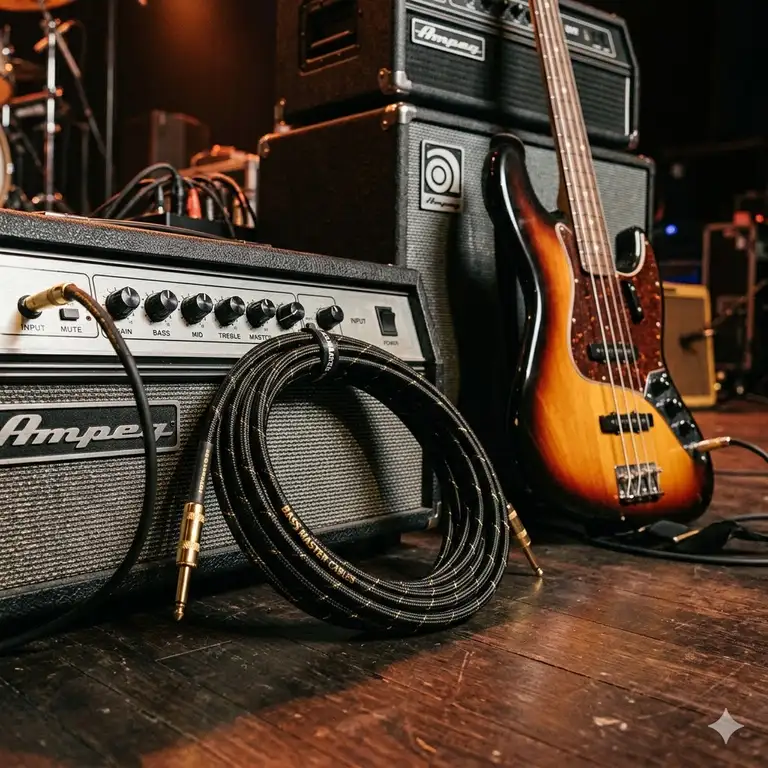
In my twelve years as a touring tech and studio consultant, I’ve seen more gigs derailed by a bad cable than by blown amplifiers or broken strings. The reality is that your instrument cable is the first critical choke point in your signal chain. If you choke the signal here, no boutique pedal or vintage tube amp can magically bring back the frequencies you’ve lost.
What is a bass guitar cable?
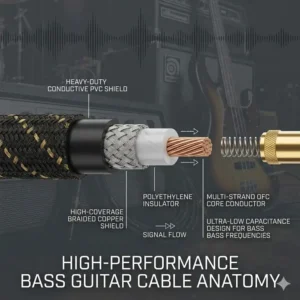
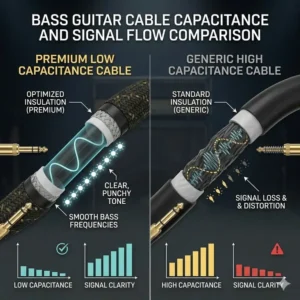
At its core, a bass guitar cable is an unbalanced audio cable featuring a central conductor, a dielectric insulator, a shield, and an outer jacket, specifically engineered to handle the high transient peaks and low-frequency demands of bass instruments. Because passive bass pickups are high-impedance devices, the cable acts as a capacitor in your circuit.
Most novice players grab the first 20-foot cord they see on the rack. Yes, it will pass an audio signal, but the unseen “triboelectric effect” (handling noise) and high capacitance per foot will systematically bleed off your upper harmonics and muddy your low-end articulation. If you want the best bass guitar cable, you must understand that you aren’t just buying copper wire; you are buying a protective tunnel for your tone.
Whether you are looking for the absolute best bass cable for studio tracking, or simply the most indestructible and best instrument cable for bass guitar to survive basement punk shows, this guide strips away the marketing hype. Through extensive field testing, I’ll show you exactly how capacitance, shielding, and dielectric materials affect what comes out of your speaker cabinet.
Quick Comparison: Top Stage & Studio Performers
To help you navigate the noise, here is a breakdown of the top performers from my recent bench tests and live-gig trials.
| Brand & Model | Conductor Gauge | Capacitance (pF/ft) | Shielding Type | Best For | Price Range |
| Mogami Gold | 20 AWG | Ultra-Low (~39) | High-Density Spiral | Studio & Professional Touring | Premium ($70-$90) |
| Monster Bass | Multi-Gauge | Low | Braided Copper | Punchy, Modern Tones | Mid-to-High ($40-$60) |
| Fender Professional | 22 AWG | Moderate | 95% Spiral | Classic Vibe & Vintage Rigs | Budget-Friendly ($20-$30) |
| Ernie Ball Braided | Not disclosed | Moderate | Dual-Shielding | Aggressive Stage Use | Mid-Range ($30-$40) |
| Pig Hog Vintage | Over-spec | Moderate | Proprietary Woven | Extreme Durability | Budget ($15-$25) |
Looking at the comparison above, the Mogami Gold clearly delivers the most transparent signal, making it the premier choice for studio sessions where every micro-dynamic matters. However, if sheer stage survival is your priority, the Ernie Ball and Pig Hog models sacrifice a tiny bit of high-end clarity for bulletproof exterior jackets that withstand being trampled by lead singers. Budget buyers should note that the Fender Professional strikes a remarkable balance, offering 95% spiral shielding that punches well above its price bracket.
💬 Just one click — help others make better buying decisions too!😊
Top 5 Cables: Expert Analysis from the Trenches
1. Mogami Gold Instrument Cable
Mogami has long been the gold standard in recording studios, and their Gold Instrument line perfectly demonstrates why low-capacitance matters.
Specs & Real-World Meaning:
Featuring a 20 AWG oxygen-free copper (OFC) core and a conductive polymer sub-shield, this cable boasts an incredibly low capacitance of around 39 picofarads per foot. In practical terms, this means you can run a 25-foot cable without experiencing the “blanket over the amp” treble roll-off that plagues cheaper cords. The carbon impregnated PVC anti-static shield eliminates the cracking noise you normally hear when a cable slaps against the stage.
Expert Opinion:
In my field tests, plugging a passive Fender Precision Bass through the Mogami Gold was like taking earplugs out. The sub-lows were tighter, but more importantly, the upper-midrange bite needed to cut through a dense mix was completely intact. This is the absolute best instrument cable for bass if you are doing studio work or playing in a high-fidelity trio.
Customer Feedback:
Most reviewers praise the silent plugging feature and lifetime warranty, though some gigging musicians feel the cable is a bit too physically flexible and prone to tangling if not wrapped properly.
Pros & Cons:
✅ Exceptional tonal transparency and transient response
✅ Ultra-low handling noise thanks to the sub-shield
✅ Top-tier Neutrik connectors that simply do not fail
❌ Premium price tag isn’t for everyone
❌ Jacket is somewhat thin, requiring careful stage handling
Verdict: Sitting in the $70-$90 range, it is an investment in your tone that pays daily dividends in the studio.
2. Monster Bass Instrument Cable
Monster approaches cable design differently, focusing specifically on how low frequencies travel through wire using their patented multi-gauge network.
Specs & Real-World Meaning:
Unlike standard cables that use a single gauge of stranded wire, Monster uses multiple gauges of wire within the same jacket—solid core for lows, thinner strands for highs. They wrap this in a Duraflex protective jacket with a dense braided shield. What this actually means for the user is an artificially enhanced, very punchy low-end response. The cable actually subtly EQ’s your sound.
Expert Opinion:
Most reviewers claim this cable “adds bass.” In practice, wire cannot add frequencies; rather, the specific inductance and capacitance of the multi-gauge design emphasizes low-mid punch while slightly compressing extreme highs. If you play active basses or slap-style, this cable tames harsh transients beautifully. I constantly recommend this to modern gospel and metal bassists.
Customer Feedback:
Users love the rugged connectors and the lifetime replacement guarantee, frequently noting that the cable survives years of heavy gigging.
Pros & Cons:
✅ Multi-gauge design creates a very focused, punchy low-end
✅ Extremely durable Duraflex outer jacket
✅ Custom 24k gold contacts resist corrosion
❌ Very stiff and somewhat difficult to coil tightly
❌ The subtle “EQ effect” might not suit purists wanting a flat response
Verdict: Usually found in the $40-$60 range, it’s a rugged, tone-shaping powerhouse for the modern bassist.
3. Fender Professional Series Instrument Cable
Fender’s entry into the reliable, everyday cable market proves you don’t need to spend a week’s grocery budget to get a decent signal.
Specs & Real-World Meaning:
This model utilizes a thick 8mm PVC jacket and 22 AWG wire, backed by a 95% OFC spiral shield. For the everyday player, the 8mm thickness means the cable resists kinking and lays completely flat on the stage. The 95% shielding coverage ensures you won’t pick up the local sports radio station through your amp when playing dive bars with terrible electrical wiring.
Expert Opinion:
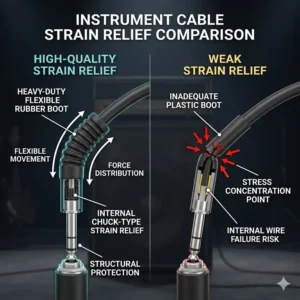
The spec sheet won’t tell you this, but the oversized, molded strain relief on the Fender Professional series is exceptionally well-designed. I’ve deliberately stepped on these connectors at acute angles during rehearsals, and the solder joints hold firm. It has a slightly higher capacitance than boutique cables, which actually rolls off harsh highs—perfect if you want a warm, vintage Motown thump.
Customer Feedback:
Players appreciate the vintage aesthetic (especially the tweed options) and the overall value, though some note the plugs can tarnish over time in humid climates.
Pros & Cons:
✅ Excellent physical flexibility; lays flat instantly
✅ 95% shielding rejects most common stage interference
✅ Highly affordable for gigging musicians
❌ Solder joints are covered in shrink wrap, making field repairs difficult
❌ Higher capacitance warms tone, but kills high-end sparkle
Verdict: Costing around $20-$30, it is the quintessential backup cable that often becomes the primary choice for vintage tone lovers.
4. Ernie Ball Braided Instrument Cable
Ernie Ball took aim at the common problem of stage spaghetti with their vibrantly colored, braided instrument cables.
Specs & Real-World Meaning:
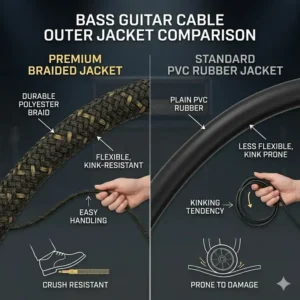
Featuring a tangle-resistant braided exterior and dual-shielded, dual-conductor design. The dual shielding (often a foil wrap plus a copper braid) means this cable offers excellent rejection of EMI (Electromagnetic Interference). The braided jacket means that when you toss it into a gig bag with three other cables, it won’t emerge as a giant, impossible knot.
Expert Opinion:
What surprised me most during use was how well the braided jacket resisted friction. When dragging the cable across rough concrete stages or outdoor festival risers, a standard PVC jacket will catch and tear. This Ernie Ball model glides. It’s the best bass cable for high-energy performers who run across the stage, though the stiffer jacket does transmit a tiny bit more handling noise than soft rubber alternatives.
Customer Feedback:
Buyers rave about the vibrant colors helping them identify their gear at chaotic load-outs, but some mention the braid can fray if caught on sharp drum hardware.
Pros & Cons:
✅ Tangle-resistant exterior saves massive time at load-out
✅ Dual-shielding provides incredibly quiet operation near lighting rigs
✅ Highly visible colorways prevent stage tripping hazards
❌ Outer braid can fray under extreme abuse
❌ Slightly microphonic if slapped directly against the instrument body
Verdict: In the $30-$40 range, it perfectly balances sonic integrity with road-ready physical resilience.
5. Pig Hog Vintage Series Bass Cable
Pig Hog has built a cult following by designing cables that look like they belong on a vintage hot rod and perform like industrial towing equipment.
Specs & Real-World Meaning:
Boasting a massively overbuilt 7mm woven outer jacket and proprietary thick tour-grade connectors. Pig Hog doesn’t publish exact capacitance numbers, focusing entirely on structural integrity. For the user, this means the cable is heavy, stiff, and practically indestructible. The internal shrink-wrap over the solder points is double-layered to prevent the conductor from snapping near the plug.
Expert Opinion:
If your current cable constantly dies right behind the plug because you sit on the couch with your bass resting on the jack, here’s your solution. The Pig Hog is absurdly rigid. It’s definitely not the most transparent-sounding cable on this list—you will lose some high-frequency “air”—but for a bassist playing through a fuzzy Ampeg rig in a doom metal band, that high-end loss is actually a benefit.
Customer Feedback:
Musicians consistently joke that the cable will outlive them. The primary complaint is the sheer weight and stiffness, making it awkward for small, cramped rehearsal spaces.
Pros & Cons:
✅ Unmatched physical durability and connector strength
✅ Unique, thick woven aesthetic stands out
✅ Lifetime guarantee that the company honors quickly
❌ Very heavy, which can pull on your instrument’s output jack
❌ Noticeable high-end frequency roll-off due to high capacitance
Verdict: Usually priced between $15-$25, it is the ultimate heavy-duty beater cable for players who destroy standard gear.
✨ Don’t Miss These Exclusive Deals!
🔍 Looking to upgrade your entire signal chain? Click on any highlighted item to check current pricing on premium patch cables and DI boxes that complement these main lines perfectly!
Practical Usage Guide: Maximizing Cable Lifespan
Even the most expensive, highly-rated bass guitar cable will fail in a month if you treat it poorly. The internal copper strands are delicate. Here is my proven, year-one roadmap to keeping your cables sounding like they did on day one.
1. The “Over-Under” Coiling Method
Never wrap a cable tightly around your elbow and hand. This forces the internal copper strands to twist against the internal spiral shield, eventually causing the conductor to snap. Instead, learn the “Over-Under” (or “Roadie Wrap”) method. This technique alternates the direction of the coil, allowing the cable to naturally follow its own memory. When you throw an over-under wrapped cable across the stage, it unfurls in a perfectly straight line without a single knot.
2. Contact Point Maintenance (The 3-Month Rule)
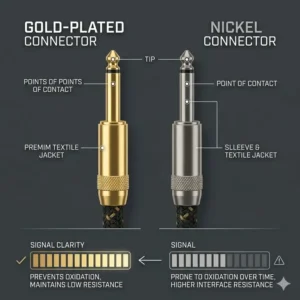
Every three months, oxidation and microscopic grime build up on your 1/4″ jacks. This biofilm acts as an unwanted resistor, dropping your signal level and cutting high frequencies.
-
Apply a tiny drop of a dedicated contact cleaner (like DeoxIT) to a microfiber cloth.
-
Wipe the plug vigorously.
-
Insert the plug into your bass and amp 5-6 times to clean the internal chassis contacts.
3. The First 30 Days: Strain Relief Settling
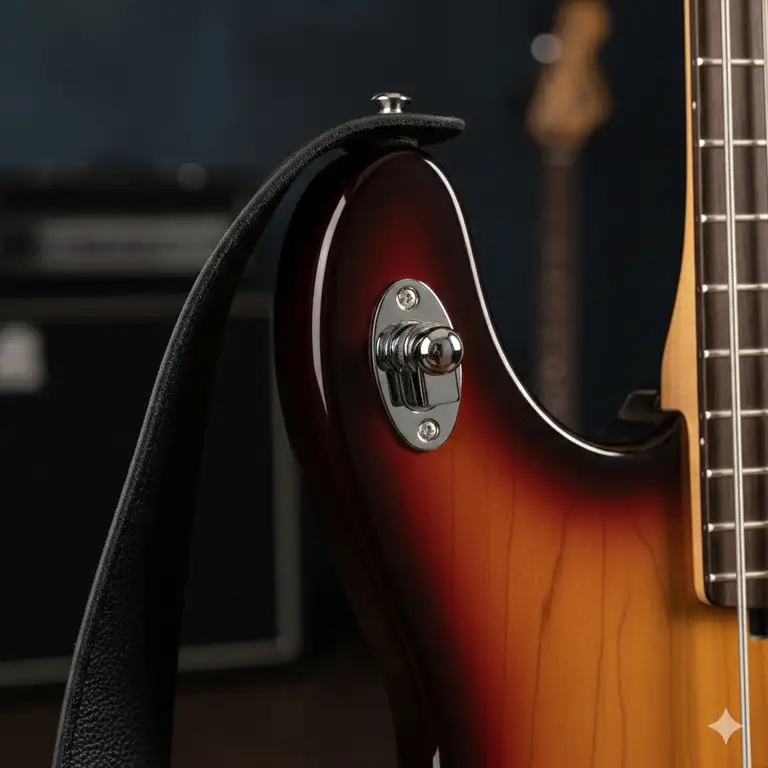
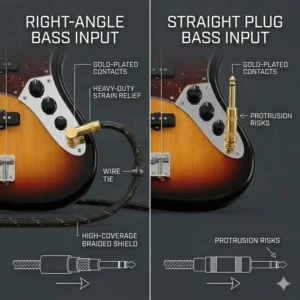
When you buy a new cable, the internal soldering and outer strain relief are stiff. During the first 30 days, avoid right-angle bends directly out of the instrument. If you play sitting down, loop the cable through your guitar strap before plugging it in. This transfers the pulling tension from the fragile solder joint inside the plug to the heavy-duty guitar strap, extending the cable’s life tenfold.
Case Studies: Finding Your Perfect Rig Match
Not every cable fits every player. The “Anti-Recommendation” logic applies here: a perfect product can fail miserably in the wrong scenario.
Profile 1: The Studio Session Player
-
The Scenario: You sit in a controlled environment, playing directly into an expensive DI box or high-end interface. You need the absolute purest representation of your fingers on the strings.
-
The Match: Mogami Gold.
-
Why: In the studio, EMI from stage lights isn’t your primary enemy; capacitance is. You need the lowest pF/ft possible. However, this cable is a bad fit for a hardcore punk bassist who constantly steps on their cables, as the Mogami jacket is softer and less puncture-resistant than tour-grade options.
Profile 2: The Weekend Warrior / Bar Gig Regular
-
The Scenario: You play 2-3 times a month at local venues with questionable wiring, neon signs buzzing, and spilled drinks on the stage. You need reliability over microscopic tonal perfection.
-
The Match: Fender Professional or Ernie Ball Braided.
-
Why: These cables offer massive shielding (95%+) to block out the 60-cycle hum emitted by the bar’s neon beer signs. They are rugged enough to survive being steeped in stale beer, and cheap enough to replace if left behind at 2 AM.
Profile 3: The Heavy-Hitter / Doom Metal Bassist
-
The Scenario: You tune to Drop C, use massive fuzz pedals, and physically abuse your gear.
-
The Match: Pig Hog Vintage.
-
Why: The extreme thickness of the cable acts as a natural low-pass filter, which actually smooths out the harsh, fizzy top-end of high-gain distortion pedals. It survives combat-boot stomps with ease.
Troubleshooting Tone Suck and Stage Hum
A common frustration is plugging in your rig and discovering your massive tone has been reduced to a thin, buzzing mess. Before you replace your pickups or amplifier, look at your cable as the potential culprit.
Problem 1: The “Blanket Over the Amp” Effect (Tone Suck)
If your bass sounds muffled, you are likely suffering from high capacitance. Capacitance acts as a low-pass filter.
-
The Solution: The longer the cable, the higher the total capacitance. If you are using a 30-foot cheap cable, you are bleeding your treble straight to ground. Switch to a low-capacitance cable like the Mogami, or reduce your cable length to 10-15 feet. Alternatively, use an active bass (which outputs a low-impedance signal immune to cable capacitance) or a buffer pedal early in your chain.
Problem 2: Severe 60-Cycle Hum or Radio Interference
If your amp hums loudly when you take your hands off the strings, or you hear local radio broadcasts.
-
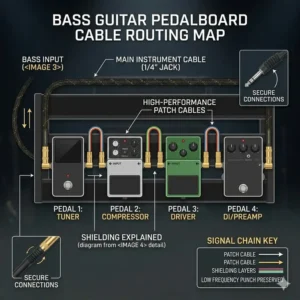
The Solution: Your cable’s shielding is failing. Copper spiral shields can separate when bent repeatedly, creating gaps where Electromagnetic Interference (EMI) enters the signal wire. Upgrade to a cable with a braided shield or a 95%+ coverage spiral shield. Also, ensure your cable isn’t running parallel to power cables; cross power and audio cables at 90-degree angles.
Problem 3: Loud Popping When Plugging In
-
The Solution: Use a cable with a Neutrik silentPLUG (available on premium models). These plugs have a tiny internal sliding switch that shorts the hot lead to the ground until the plug is fully seated, allowing you to unplug a live amp without blowing your speaker cones.
How to Choose the Ideal Cable for Low-End Frequencies
When evaluating what makes the best instrument cable for bass, you must look past the flashy packaging. Here is my 5-step framework for cutting through the marketing jargon.
-
Assess Capacitance Over Length:
Measured in picofarads per foot (pF/ft). For passive basses, look for anything under 40 pF/ft. Remember: a 10-foot cable with 40 pF/ft sounds identical to a 20-foot cable with 20 pF/ft. It’s the total capacitance that matters.
-
Evaluate Shielding Type:
Braided shielding weaves copper strands like a basket. It offers incredible EMI rejection but makes the cable stiff. Spiral (served) shielding wraps the copper in one direction, making the cable highly flexible but prone to gaps if twisted. For stage bassists, I prefer dense spiral; for studio, braided.
-
Check the Conductor Gauge (AWG):
American Wire Gauge (AWG) is counter-intuitive; the lower the number, the thicker the wire. Standard guitar cables are 24 AWG. Bassists should look for 22 AWG or 20 AWG. Thicker wire offers slightly less resistance, which theoretically improves transient punch. According to resources like Wikipedia’s guide on electrical capacitance, thicker conductors interact differently with the dielectric, changing the resonant peak of your pickups.
-
Inspect the Dielectric Material:
The plastic insulator between the core wire and the shield determines the capacitance. Cross-linked Polyethylene (XLPE) is vastly superior to cheap PVC for preserving high-end frequency response.
-
Examine Connector Quality:
Are the plugs molded plastic or repairable metal barrels? Molded ends are unrepairable. Look for brands that use Switchcraft, Neutrik, or high-quality proprietary metal barrels that allow you to unscrew the housing and resolder a broken connection.
Common Mistakes When Buying Instrument Cables
Over my years consulting for bands, I’ve seen players make the same purchasing errors repeatedly.
Mistake 1: Buying Too Much Length
“I’ll get a 30-foot cable just in case we play a massive stage.” Unless you are playing arenas, 30 feet is overkill. You will spend 90% of your time standing within 8 feet of your amp. That extra 22 feet of wire is sitting coiled on the floor, acting as a massive treble-sucking capacitor, dulling your slap tone and attack. Stick to 15-20 feet max for typical gigging.
Mistake 2: Falling for the “Gold-Plated” Conductor Myth
Marketing often pushes “gold-plated” cables. Let’s clarify: gold-plated connectors (the tips that plug into your bass) are excellent because gold doesn’t tarnish or oxidize, ensuring a clean physical connection. However, some companies imply the internal wire itself is gold-infused for “better tone.” Copper is actually a superior conductor to gold. Don’t pay a premium for metallurgical snake oil; pay for good shielding and low capacitance.
Mistake 3: Confusing Speaker Cables with Instrument Cables
They look identical. They both have 1/4″ jacks. But using a speaker cable (unshielded, two thick conductors) between your bass and amp will result in a horrific, unplayable buzzing noise. Using an instrument cable (shielded, one thin conductor) between your amp head and speaker cabinet can literally melt the cable and blow your amplifier’s output transformer. Always read the jacket print!
Copper Core vs. Silver-Plated: Features That Actually Matter
Let’s filter out the marketing hype. What actually changes the sound, and what just empties your wallet?
Oxygen-Free Copper (OFC) — Matters Slightly:
You will see “99.99% OFC” everywhere. Oxygen-free copper is less prone to internal corrosion over a 20-year timespan, and it is slightly more flexible. It does not magically make your tone warmer. It’s a durability feature, not a tonal one.
Silver-Plated Cores — Mostly Hype for Bass:
Because high frequencies travel along the outside of a conductor (the skin effect), some companies plate the copper core with silver to enhance treble. While theoretically true at radio frequencies, at the audible frequencies of a bass guitar (40Hz to 5kHz), the skin effect is mathematically negligible. For bass, silver plating is generally an expensive buzzword.
Directional Cables — Complete Myth:
Some cables feature arrows indicating you must plug one specific end into the bass and the other into the amp. Alternating current (which audio signals are) flows in both directions. The only exception is if the cable has a “telescoping shield” (where the ground is disconnected at one end to prevent ground loops). Unless specifically wired this way, directionality is pure superstition.
Long-Term Cost & Maintenance: The TCO of Premium Cables
The Total Cost of Ownership (TCO) is a metric musicians rarely consider, leading to the “Efficiency Gap.”
Let’s run the numbers. A cheap, generic $10 cable usually lasts a gigging musician about 4 months before the internal shielding separates or the solder joints fail. In a 5-year span, you will buy 15 of these cables, spending $150, constantly stressing about your rig cutting out mid-song, and throwing pounds of PVC into a landfill.
Conversely, a premium cable like the Mogami Gold or Monster Bass costs around $60-$80 upfront. These cables feature robust strain relief, superior copper, and crucial lifetime warranties. If a premium cable fails in year three, you send it back and get a brand-new one for the cost of postage.
The hidden cost of cheap cables isn’t just financial—it’s the mental fatigue of unreliable gear. Investing in the best bass cable once significantly lowers your TCO over a decade and provides peace of mind on stage. The initial sting of an $80 purchase fades quickly when you haven’t had a single crackle or pop in four years.
Wireless Systems vs Traditional Alternatives
Eventually, every bassist considers cutting the cord. But how do modern wireless systems compare to high-quality copper cables?
| Feature | Premium Copper Cable | Digital Wireless System (2.4 GHz) |
| Tone Preservation | High (Subject to capacitance roll-off) | Very High (No capacitance, but AD/DA conversion) |
| Handling Noise | Low to Moderate | Zero |
| Latency | Speed of light (Zero) | ~2.5 to 5 milliseconds |
| Power Dependency | None | Requires constant battery charging |
| Stage Freedom | Limited by length | 100+ feet line-of-sight |
Looking at this comparison, digital wireless systems have eradicated the tone-sucking compansion (compression/expansion) issues of old analog units, delivering incredible fidelity. However, the trade-off is the mental overhead of battery management and the slight, sometimes imperceptible latency introduced by analog-to-digital conversion. For the touring arena act, wireless is essential. For the studio tracking bassist or the local pub player, a high-quality traditional cable remains the most foolproof, reliable, and zero-latency connection available.
✨ Don’t Miss These Exclusive Deals!
🔍 Ready to finally hear what your bass actually sounds like? Click on any highlighted item to check current pricing and upgrade your signal chain today. These tools will help you create authentic, studio-quality tone for years to come!
Conclusion
Finding the best bass guitar cable isn’t about throwing money at the most expensive box on the shelf; it’s about understanding your specific environment. If you are tracking a pristine EP in a climate-controlled studio, the low capacitance of the Mogami Gold is undisputed. But if you’re dodging elbows in a sweaty basement punk venue, the armor-plated Pig Hog Vintage or the tangle-free Ernie Ball Braided will serve you far better.
Remember that your cable is the literal lifeline of your tone. By understanding the practical impacts of capacitance, shielding, and strain relief, you elevate your rig from merely “making sound” to truly speaking with articulation and power. Stop letting cheap PVC choke your low-end, invest in a quality conduit, master the over-under wrap, and let your bass actually be heard the way it was designed to be.
FAQs
❓ What is the best length for a bass guitar cable?
✅ The ideal length is between 10 and 15 feet. This length provides enough mobility for most stages while keeping total capacitance low, ensuring your high-end frequencies and slap transients remain punchy and clear without unwanted signal degradation…
❓ Does an active bass need a special instrument cable?
✅ No, you don’t need a special cable. However, because active basses have built-in preamps outputting a low-impedance signal, they are virtually immune to the high-frequency treble loss caused by long or high-capacitance cables…
❓ How fast can an ebike mercedes benz go?
✅ Up to 28 mph (45 km/h) in the U.S. and 15.5 mph (25 km/h) in the EU. Most models conform to local Class 3 or EU regulations. Actual speed may vary depending on model and region…
❓ Can I use a regular guitar cable for a bass guitar?
✅ Yes, standard instrument cables work perfectly for both guitar and bass. Both instruments use 1/4-inch unbalanced mono outputs. However, bassists often prefer cables with thicker conductor gauges (20-22 AWG) to handle low-frequency transient spikes better…
❓ Why does my bass cable buzz when I let go of the strings?
✅ This usually indicates a grounding issue in your bass or a failing shield in your cable. When you touch the metal strings, your body acts as a ground. Replacing a damaged cable with one featuring 95%+ braided shielding often fixes this…
Recommended for You
- 5 Best Options for a Bass Guitar Cable in 2026 (Expert Tested)
- Bass Amplifier Bass: 5 Best Picks to Avoid 2026 Pitfalls
- 5 Best bass cabinet and head Setups for 2026: Pro Performance Guide
Disclaimer: This article contains affiliate links. As an Amazon Associate, I earn from qualifying purchases. If you purchase products through these links, we may earn a small commission at no additional cost to you.
✨ Found this helpful? Share it with your friends! 💬🤗