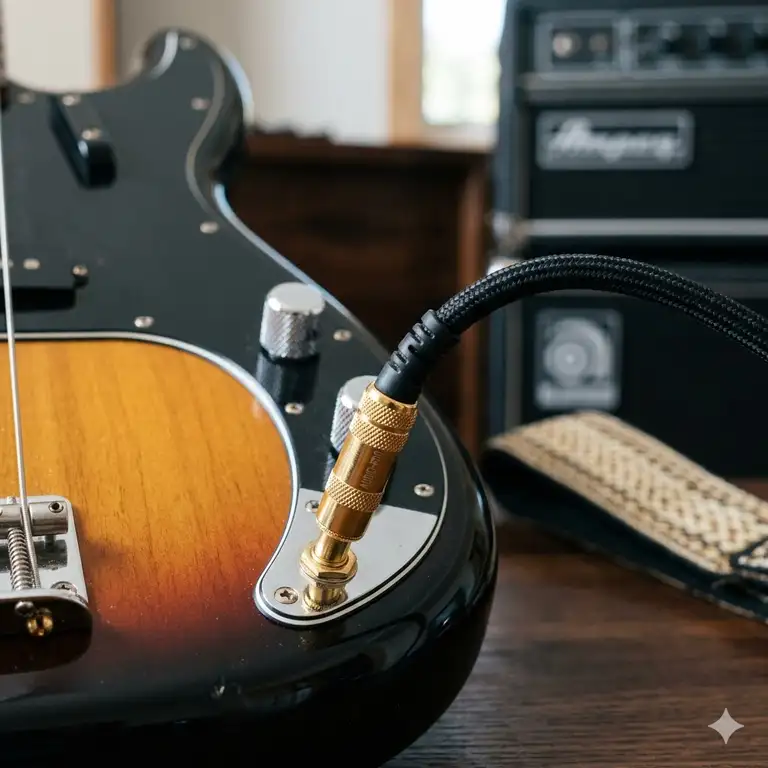
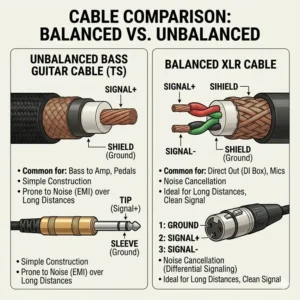
What is a bass guitar cable? At its core, a bass guitar cable is an unbalanced, shielded analog audio connector—typically utilizing a 1/4-inch TS (Tip-Sleeve) interface—designed to transmit the low-voltage, high-impedance electrical signal from your instrument’s pickups to your amplifier. While many players treat them as an afterthought, these cords are the literal lifelines of your tone.
In my ten years working as a touring tech and studio consultant, I’ve watched countless bassists obsess over their $2,000 instruments and boutique pedalboards, only to strangle their carefully sculpted low-end frequencies through a generic, bargain-bin wire. A sub-par connection doesn’t just introduce hiss; it fundamentally alters the resonant peak of your passive pickups through parasitic capacitance. Think of it like trying to drink a thick milkshake through a coffee stirrer.
Most marketing departments will tell you that a bass guitar instrument cable has “special low-end enhancing” properties. The spec sheet won’t tell you this, but physics dictates that a wire cannot add bass—it can only preserve what is already there or roll off the treble, making the lows seem more prominent. In my field tests across dozens of stages, the real difference comes down to mechanical reliability, shielding integrity against electromagnetic interference (EMI), and how well the dielectric material combats the triboelectric effect (handling noise). Let’s dive into the options that actually survive the rigors of real-world use.
Quick Comparison: The Heavyweight Contenders
| Product Model | Conductor Gauge | Shielding Type | Jacket Material | Best For |
| Mogami Gold Instrument | 18 AWG | High-Density Spiral | Carbon-Impregnated PVC | Studio Professionals |
| Monster Bass Instrument | Dual Solid-Core | Copper Braid | Duraflex Protective | Heavy Gigging |
| Pig Hog Vintage Woven | Proprietary | High-Density OFC | 8mm Woven Cloth | Budget Durability |
| Fender Pro Series | 22 AWG | 95% Spiral | Thick PVC | Casual/Bedroom Players |
| Ernie Ball Braided | Multiple Gauge | Dual-Shielded | Tangle-Resistant Braid | Stage Mobility |
Looking at the comparison above, the Mogami Gold Instrument delivers the best signal purity for critical studio environments, but if stage survival and heavy foot-traffic are your priorities, the Monster Bass Instrument‘s rugged Duraflex jacket justifies its bulk. Budget-conscious buyers should note that the Fender Pro Series sacrifices some high-end shielding for flexibility and a lower price point, making it ideal for home use but slightly risky for dive bars with bad neon lighting.
💬 Just one click — help others make better buying decisions too!😊
Top 5 Cables for Bassists in 2026: Expert Analysis
1. Mogami Gold Instrument Cable — The Studio Standard
The Mogami Gold Instrument Cable features carbon-impregnated PVC underneath its high-density spiral shield to completely eliminate handling noise.
This specific anti-static layer means that when you step on the cord or whip it across the stage, you won’t hear that annoying “thump” or crackle through your rig—something cheaper models fail to prevent. Paired with its incredibly low capacitance (around 39 pF/ft) and 18 AWG oxygen-free copper (OFC) core, it ensures zero high-end roll-off, keeping your slap-bass transients sharp and punchy.
In my experience, this is strictly for the audio purist. If you are tracking a session or playing a high-paying corporate gig, the absolute silence this provides is invaluable. However, here is my “anti-recommendation”: if you are a punk bassist thrashing around in muddy, beer-soaked DIY venues, this is a bad fit. The flexible jacket is tough, but at this price point, the risk of it being destroyed by a careless drummer’s cymbal stand is too high. Most customer reviews praise the “dead silent” background noise but lament the premium investment required.
Pros: Unmatched signal clarity, zero microphonics, lifetime warranty.
Cons: High investment cost, slightly less rugged than braided options.
Price Range & Value Verdict: Falling in the $60-$80 range, it offers exceptional long-term ROI for studio musicians who require pristine audio capture.
2. Monster Bass Instrument Cable — The Frequency Tailored Workhorse
The Monster Bass Instrument Cable utilizes dual solid-core conductors and multiple gauge wire networks specifically marketed to optimize low-frequency transmission.
What this translates to in practice is a slightly higher capacitance design that subtly rounds off harsh treble frequencies, making a passive P-Bass sound incredibly thick and focused in the mix. The Duraflex outer jacket is notoriously stiff, which means it resists slicing and crushing under heavy road cases.
I’ve used this bass cable extensively on road tours. What most buyers overlook is the custom connector design; the 24k gold contacts feature a specialized collet strain relief that locks into your instrument’s jack tightly. It is built for the heavy-handed player who tends to step on their own line. The tradeoff is memory retention—it can be stubbornly difficult to coil if you don’t use the over-under method. Feedback from real-world buyers consistently highlights its indestructible nature, though some complain about its stiffness.
Pros: Extremely durable jacket, tight connector fit, thick sound profile.
Cons: Stiff and difficult to coil, connector barrel can be too wide for recessed jacks.
Price Range & Value Verdict: Priced in the $40-$60 range, it’s the ultimate “buy it and forget it” tool for aggressive touring bassists.
3. Pig Hog Vintage Woven Instrument Cable — The Stage-Ready Bruiser
The Pig Hog Vintage Woven stands out immediately with its massive 8mm woven cloth outer jacket and proprietary thick copper wiring.
That 8mm sleeve isn’t just for vintage aesthetics; it acts as an incredible physical buffer against crimping. If a heavy bass cabinet gets rolled over this line, the internal dielectric insulation remains protected, preventing the hot wire from shorting against the ground shield.
For the weekend warrior or the garage band bassist, this is my top recommendation. It looks fantastic on stage, handles physical abuse beautifully, and lays flat without kinking. However, you must know that woven jackets absorb spilled liquids. If a beer tips over on it, it will smell like a brewery until you spot-clean it. Customers rave about the lifetime guarantee and the “beefy” feel, though a few note it’s heavier than standard rubber options.
Pros: Incredible physical protection, lays perfectly flat, great vintage look.
Cons: Cloth absorbs spills, heavier than standard PVC.
Price Range & Value Verdict: Sitting comfortably in the $20-$35 range, it punches way above its weight class in physical durability.
4. Fender Professional Series Instrument Cable — The Reliable Backup
The Fender Professional Series relies on a 22 AWG conductor wrapped in a 95% OFC spiral shield and a highly pliable PVC jacket.
That 95% spiral shield means you get excellent flexibility—allowing the cord to drape naturally without twisting your lightweight bass off its stand—while still blocking the majority of radio frequency interference (RFI). The 22 AWG core is standard, providing a reliable, unaltered tone for shorter runs.
I always keep two of these in my gig bag as emergency backups. They are the definition of a utilitarian tool. They don’t have the exotic materials of high-end lines, but the custom-molded ends with heat-shrink tubing offer robust strain relief right where failures typically occur: behind the plug. They are ideal for beginners, home studio setups, or casual gigging. Reviewers frequently mention that they are the best bang for the buck, though heavy giggers sometimes report premature wear on the outer rubber.
Pros: Very flexible, reliable strain relief, cost-effective.
Cons: Average shielding against heavy EMI, thinner jacket.
Price Range & Value Verdict: Usually found in the $15-$25 range, it offers massive value as a dependable daily driver or backup.
5. Ernie Ball Braided Instrument Cable — The Tangle-Free Innovator
The Ernie Ball Braided line features a dual-shielded design encased in a tightly woven, tangle-resistant braided nylon exterior.
This specific nylon braiding prevents the internal copper strands from developing “memory.” When you toss it into your gig bag in a hurry, it won’t emerge looking like a twisted bird’s nest. The dual shielding (a combination of foil and copper braid) is highly effective at rejecting 60-cycle hum from nearby power transformers.
From my perspective, this is the perfect middle-ground option for the active performer who moves around the stage a lot. The slick exterior glides smoothly over carpet and concrete without snagging. However, the custom aluminum connector housing, while beautiful, can get slippery if your hands are sweaty during a mid-set changeover. Buyer sentiment is overwhelmingly positive regarding the lack of tangles, though a few note the slick jacket slides out of looser input jacks.
Pros: Genuinely tangle-resistant, excellent hum rejection, stylish color options.
Cons: Slippery connector barrels, slightly rigid drape.
Price Range & Value Verdict: Averaging around the $25-$40 range, it delivers premium handling characteristics at a mid-tier price point.
✨ Don’t Miss These Exclusive Deals!
🔍 Take your tone to the next level with these carefully selected products. Click on any highlighted item to check current pricing and availability. These tools will help you create authentic, reliable sound your audience will love!
The First 365 Days: A Cable Maintenance Roadmap
When you invest in a quality bass guitar instrument cable, its lifespan isn’t just determined by the manufacturer; it is dictated by your daily habits. Most players assume these are indestructible wires, but the internal copper strands are actually quite fragile if subjected to constant tensile stress.
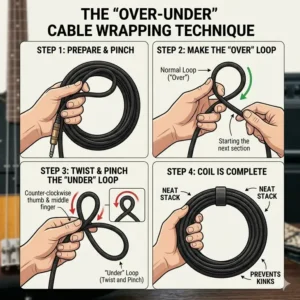
In the first 30 days, the biggest mistake you can make is “elbow wrapping”—winding the cord tightly around your forearm and palm. This forces the internal copper shield to twist violently against the dielectric core. By month three, this practice will cause the internal wires to snap, resulting in intermittent signal dropouts. Instead, you must learn the “over-under” wrapping technique. This method alternates the direction of the loop, ensuring zero torsion is applied to the wire. It takes practice, but it extends the lifespan of your gear indefinitely.
By the six-month mark of heavy gigging, oxidation becomes your primary enemy. The 1/4-inch jacks, even if nickel or gold-plated, will accumulate a thin layer of grime, sweat, and atmospheric oxidation. This microscopic film acts as a resistor, actively dulling your tone. I recommend using an electronic contact cleaner (like DeoxIT) and a lint-free cloth to polish the plugs every few months. Furthermore, inspect the strain relief sleeve where the wire enters the metal barrel. If you see the outer jacket pulling back to reveal the shielding underneath, it’s time to unscrew the barrel, snip the wire, and re-solder the connection before it fails mid-song.
Problem → Solution Guide for Gigging Bassists
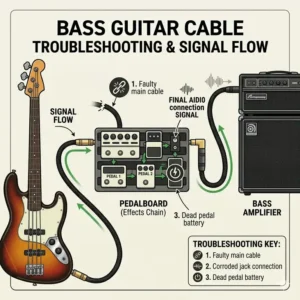
Every bassist will eventually face signal nightmares on stage. Here is a practical framework for diagnosing and solving the three most common connectivity issues using the right gear.
The Problem: “Microphonics” (The Stage Thump)
If you hear a loud, low-frequency thump through your amp every time you step on your line or drag it across the stage, you are experiencing the triboelectric effect. Friction between the internal insulation and the copper shield generates a small static charge.
The Solution: You need a wire with a conductive carbon or PVC sub-shield. Upgrading to the Mogami Gold Instrument eliminates this entirely because its carbon layer bleeds off the static charge before it reaches your amplifier.
The Problem: The “Tone Suck” (Loss of High-End)
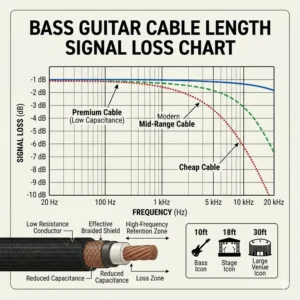
You plug in, and your snappy, bright bass suddenly sounds like it’s buried under a blanket. This isn’t your amp breaking; it’s high capacitance rolling off your treble frequencies, essentially acting as a passive tone control rolled down to zero.
The Solution: This almost always happens when running lengths over 20 feet with passive pickups. The fix is two-fold: shorten your run (switch to a 10-15 foot length) or use a low-capacitance option. Alternatively, introducing a buffered pedal early in your signal chain converts your high-impedance signal to low-impedance, driving long runs without treble loss.
The Problem: Intermittent Popping and Crackling
Your sound cuts in and out, accompanied by sharp pops when you move around.
The Solution: 90% of the time, this isn’t a broken wire; it’s a loose mechanical connection. Your instrument’s output jack contacts have lost tension. Before throwing away your bass guitar cable, take a small flathead screwdriver and carefully bend the tip contact of your bass’s input jack inward so it aggressively grips the plug.
How to Choose a Bass Cable That Doesn’t Suck Tone
Navigating the marketing hype requires understanding a few basic principles of electrical engineering. When selecting your next purchase, follow this expert framework rather than just looking at the price tag.
-
Evaluate Your Pickup Type: If you play an active bass (like a Music Man StingRay with an onboard 9V preamp), your instrument outputs a low-impedance signal. This means you are virtually immune to capacitance tone-suck. You can use a 30-foot, cheap line, and your tone won’t change. However, if you play a passive bass (like a vintage Fender Jazz), high-impedance signals are easily degraded. You must prioritize low-capacitance models (under 40 pF/ft) to retain your high frequencies.
-
Determine the Right Length: The longer the run, the higher the total capacitance. Never buy a 20-foot cord if you only stand 6 feet from your amp. A 10-foot or 15-foot length provides plenty of mobility for most small stages while preserving maximum signal fidelity.
-
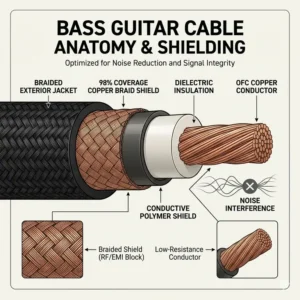
Assess the Shielding Requirement: If you play in venues with neon lights, older dimmer switches, or near heavy power transformers, electromagnetic interference will induce a 60-cycle hum into your signal. Look for braided shielding rather than spiral shielding. Braided copper covers up to 98% of the internal wire and offers superior rejection of outside noise, whereas spiral shields (often used for flexibility) can open up gaps when bent, letting noise in.
According to research detailed on high-authority engineering databases, the electrical conductivity of the copper matters less than the mechanical integrity of the shielding when it comes to rejecting stage noise. Don’t overpay for “oxygen-free” claims if the shielding itself is poorly constructed.
Common Mistakes When Buying Bass Cables
The most prevalent mistake I see among musicians is falling for the “Gold-Plated Tone” myth. Manufacturers love to advertise 24k gold-plated connectors, leading buyers to believe gold conducts audio signals better than standard nickel.
Here is the reality: gold is actually a less conductive metal than copper or silver (as referenced in basic materials science data from institutions like the IEEE). The sole purpose of gold plating is corrosion resistance. If you live in a humid, coastal environment or sweat profusely on your gear, gold prevents the jack from tarnishing. It does not magically improve your tone. Paying a massive premium solely for gold tips is a poor allocation of your budget.
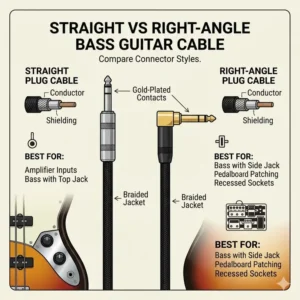
Another critical error is ignoring plug shape. Straight plugs are standard, but if your bass has a side-mounted output jack (like a Les Paul or many modern active basses), a straight plug sticking out creates a massive lever. If you bump it against a chair or your knee, it will crack the wood of your instrument or shatter the jack plate. Always buy a cord with one right-angle plug for side-mounted jacks. The straight end goes into your amp, and the right-angle sits flush against your bass body, keeping it safe from impacts and directing the wire safely through your guitar strap.
Features That Actually Matter (And Those That Don’t)
When looking at a spec sheet, it is crucial to separate the marketing fluff from the features that will actually impact your nightly gig.
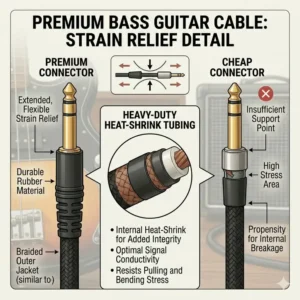
What Matters: Connector Strain Relief
The point where the flexible wire meets the rigid metal plug is the most vulnerable spot on any bass guitar instrument cable. Shrink-wrap tubing is good, but a mechanical chuck-style strain relief (like those patented by Neutrik) is the gold standard. These internal plastic teeth clamp down on the outer jacket as you screw the barrel on, ensuring that when you yank the cord, the stress is placed on the thick rubber jacket, not the delicate copper solder joints inside.
What Matters: Jacket Material (Dielectric)
The outer jacket determines how the cord lays on stage. Thick PVC provides excellent memory-free flexibility, while woven cloth offers superior abrasion resistance. Choose based on your environment—woven for dirty stages with rolling gear, smooth PVC or braided nylon for studio use where tangling is the main concern.
What Doesn’t Matter: “Directional” Cables
Some boutique brands sell “directional” cords, marked with arrows, claiming the signal flows better in one direction due to the molecular alignment of the copper. This is pseudo-science. Audio signals are alternating current (AC); the electrons flow back and forth, not in a single direction. The only time directionality matters is in a semi-balanced design where the shield is lifted (disconnected) at one end to prevent ground loops—but this is incredibly rare for standard instrument use and totally irrelevant for 99% of setups.
Long-Term Cost & The “Buy Once, Cry Once” Reality
Let’s look at the actual total cost of ownership over a 5-year period. Many beginners balk at spending premium money on a wire, opting instead for the cheapest option available.
| Purchasing Strategy | Initial Cost | Replacement Frequency (5 Yrs) | Total 5-Year Cost | Hidden Costs |
| Bargain Bin ($10) | $10 | 4-5 times (broken tips, shorts) | $40 – $50 | Ruined gigs, lost studio time, frustration |
| Mid-Tier ($30) | $30 | 1-2 times | $30 – $60 | Minor tone degradation over time |
| Premium Pro ($70) | $70 | 0 times (Lifetime Warranty) | $70 | Higher upfront hit, fear of theft |
Looking at the table above, the 5-year financial cost between buying cheap replacements and one premium Mogami or Monster is virtually identical. However, the hidden cost of the bargain strategy is severe. A cheap wire will inevitably fail during a soundcheck, a live performance, or a great studio take. The anxiety of unreliable gear is a massive tax on your performance. The “buy once, cry once” philosophy heavily applies here. If you buy a premium product backed by a lifetime, no-questions-asked replacement warranty, your total cost of ownership is capped forever. You are paying for peace of mind, not just copper.
✨ Don’t Miss These Exclusive Deals!
🔍 Take your tone to the next level with these carefully selected products. Click on any highlighted item to check current pricing and availability. These tools will help you create authentic, powerful sound your band will love!
Conclusion
Finding the right bass guitar cable isn’t about chasing magical tone dust; it’s about eliminating the mechanical and electrical bottlenecks between your fingers and your amplifier. Whether you choose the absolute silence of the Mogami Gold Instrument, the physical resilience of the Pig Hog Vintage Woven, or the tangle-free convenience of the Ernie Ball Braided, your decision should be based on your real-world environment.
Remember, the most expensive wire in the world won’t survive poor wrapping techniques or a neglected, oxidized input jack. Treat your connection with the same respect you give your instrument, invest in appropriate shielding for your stage environment, and keep your cable runs as short as practically possible. By applying the expert insights and maintenance habits detailed above, you can confidently step onto any stage knowing your low-end foundation is entirely secure.
Frequently Asked Questions
❓ What is the difference between a guitar cable and a bass cable?
✅ There is no electrical difference; they use the same unbalanced 1/4-inch TS connections and shielding. However, some marketed as bass-specific may feature slightly thicker wire gauges or stiffer jackets to survive heavy gigging and thick stage use…
❓ Does a bass guitar cable affect tone?
✅ Yes. High capacitance in a long run acts like a low-pass filter, rolling off high frequencies on passive basses. A low-capacitance wire preserves your full frequency spectrum, making your tone sound brighter and more articulate…
❓ How long should my instrument cable be?
✅ For optimal tone preservation with passive pickups, stay between 10 to 15 feet. Anything over 20 feet will begin to noticeably degrade high-end frequencies unless you are using an active bass or a buffer pedal…
❓ Why does my amp buzz when I plug in my bass?
✅ Buzzing is typically caused by electromagnetic interference (EMI) or a ground loop. If your wire has poor shielding or a broken internal ground connection, it acts as an antenna for room noise. Upgrading to a braided shield usually resolves this…
❓ Are gold plated connectors better for instruments?
✅ Gold plating prevents corrosion and tarnishing on the plug, which is great for humid environments or sweaty gigs. However, gold does not conduct electricity better than nickel or copper, so it does not directly “improve” your tone…
Recommended for You
- Bass Amplifier Bass: 5 Best Picks to Avoid 2026 Pitfalls
- Bass Amp Package: 5 Best Kits for Deep Tone in 2026
- 5 Best bass cabinet and head Setups for 2026: Pro Performance Guide
Disclaimer: This article contains affiliate links. As an Amazon Associate, I earn from qualifying purchases. If you purchase products through these links, we may earn a small commission at no additional cost to you.
✨ Found this helpful? Share it with your friends! 💬🤗