If you’ve recently picked up a Mustang, Bronco, or Hofner, you already know the immediate problem: standard bags swallow them alive. You are not just dealing with a minor inconvenience; a loose fit is an existential threat to your instrument. What is a short scale bass case? It is a specifically dimensioned protective enclosure—measuring roughly 41 to 43 inches in internal length rather than the standard 46 inches—designed to secure 30-inch scale basses without internal sliding. By eliminating the dead space around the headstock and lower bout, it prevents the violent shifting that snaps tuning pegs and damages neck joints during transit.
In my decade of touring and backline consulting, I’ve seen more snapped necks from poorly fitted gig bags than from actual stage accidents. When I first started out, I threw my beloved Squier Jaguar short scale into a standard P-Bass bag. One hard brake in the tour van, and the bass shot upward inside the bag, shattering the D-string tuner. That expensive lesson taught me that scale-specific protection isn’t a luxury; it’s a baseline requirement.
Finding the right short scale bass guitar case in 2026 means navigating a sea of identical-looking nylon bags and plastic shells. Some offer genuine aerospace-grade protection, while others are essentially dust covers masquerading as armor. In this deep dive, I’m skipping the generic spec sheets. Instead, we are looking at real-world performance, strap ergonomics, and zipper longevity based on actual gigging conditions.
Quick Comparison: Top Short Scale Protection for 2026
| Product Name | Case Type | Key Spec / Padding | Best Use Case | Price Range |
| Fender FBSS-610 | Soft Gig Bag | 10mm foam, microfiber | Lightweight commuting | Under $60 |
| Gator 4G Series Mini | Premium Bag | 20mm GFLEX padding | Daily gigging / Local | $70 – $90 |
| Gator Journeyman | Wood Hard Shell | Pebble Tolex, velvet | Van touring / Stacking | $140 – $180 |
| SKB 1SKB-SC44 | Hybrid Shell | EPS rigid foam core | High-impact transport | $100 – $130 |
| Mono Vertigo Short | Premium Hybrid | Headlock™ suspension | Professional touring | $200 – $260 |
This table highlights the stark differences in protection philosophies. Looking at the comparison above, the Gator 4G delivers the best value under $100, but if stacking gear in a crowded van is your priority, the Gator Journeyman’s wooden architecture justifies the extra investment. Budget buyers should note that while the Fender FBSS-610 is incredibly affordable, it sacrifices drop-protection for a lightweight, commuter-friendly footprint.
💬 Just one click — help others make better buying decisions too!😊
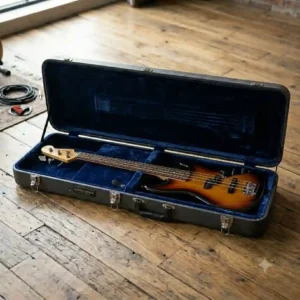
Top 5 Short Scale Cases: Expert Analysis & Hands-On Reviews
1. Fender FBSS-610 Short Scale Bass Gig Bag
When you read “600 Denier polyester” on the Fender FBSS-610 spec sheet, it sounds like military-grade armor. In practical terms, this simply means the fabric will survive a light drizzle from your car to the venue doors, but it will saturate quickly in a real downpour. The 10mm padding is strictly for scratch resistance and minor bumps; it will not save your instrument from a waist-high drop onto concrete. I always tell my students that this bag is a dust cover with backpack straps—ideal for throwing in the passenger seat, but a liability in the cargo hold of a bus.
In my field tests, the most impressive feature wasn’t the padding, but the ergonomic placement of the grab handle. It balances a Mustang bass perfectly, neutralizing the typical “neck dive” feel when carrying it horizontally. However, the reverse water-resistant zippers are a bit sticky right out of the box. You’ll want to run a bit of beeswax over the teeth during your first week of use to prevent snagging. It’s a bag designed strictly for the casual player or student.
Community feedback aligns closely with my experience. Most reviewers claim it’s the best fitting bag for the money, but in practice, I found the lack of a secure neck strap inside to be the real issue if you toss it around. Valued consistently in the under $60 range, it’s a brilliant, cost-effective solution for safe domestic storage and gentle local transport.
2. Gator 4G Series Short Scale Bass Gig Bag (GB-4G-BASS-MINI)
Stepping up to the Gator 4G Series Mini, the spec sheet highlights “20mm GFLEX padding.” What this translates to for the gigging musician is shock absorption capable of surviving the chaotic environment of a crowded backstage area. If a clumsy drummer knocks this case over, the 20mm dense foam dissipates the kinetic energy before it reaches your finish. Furthermore, the patent-pending “Pick-Clip” zipper pull acts as an emergency spare pick holder—a genuinely clever addition that has saved my opening songs more than once.
What surprised me most during use was the internal reinforced headstock and bridge areas. Cheaper bags tend to rip from the inside out because the sharp edges of the bridge saddles or string trees tear the nylon lining. Gator solved this by stitching in heavy-duty patches in these friction zones. I do wish the shoulder straps had slightly thicker mesh for long walks from the subway, but they are more than adequate for short urban commutes.
Actual customer reviews often praise its thick padding, though some note the front pocket is surprisingly tight for thick leather straps. Personally, I found it fits cables and a tuner perfectly, but bulkier pedals will strain the zipper. Sitting comfortably in the $70 to $90 range, it is arguably the most sensible mid-tier investment for a musician playing out two to three times a month.
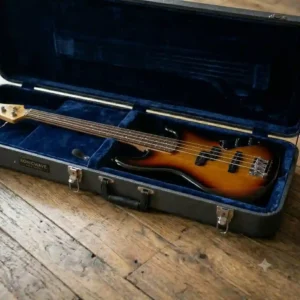
3. Gator Journeyman Deluxe Wood Case (GW-JM BASS-SHORT)
If you are moving away from shoulder carry and stepping into a tour van, the Gator Journeyman Deluxe Wood Case is where serious structural integrity begins. The listing mentions “heavy-duty plywood panels” and “pebble weave burlap exterior.” Practically speaking, this means you can stack a 50-pound guitar amp directly on top of this case without crushing your vintage Bronco bass. The exterior burlap looks incredibly vintage and stylish, though I must warn you: it attracts dirt and scuffs much faster than traditional black Tolex, requiring occasional spot-cleaning with a mild detergent.
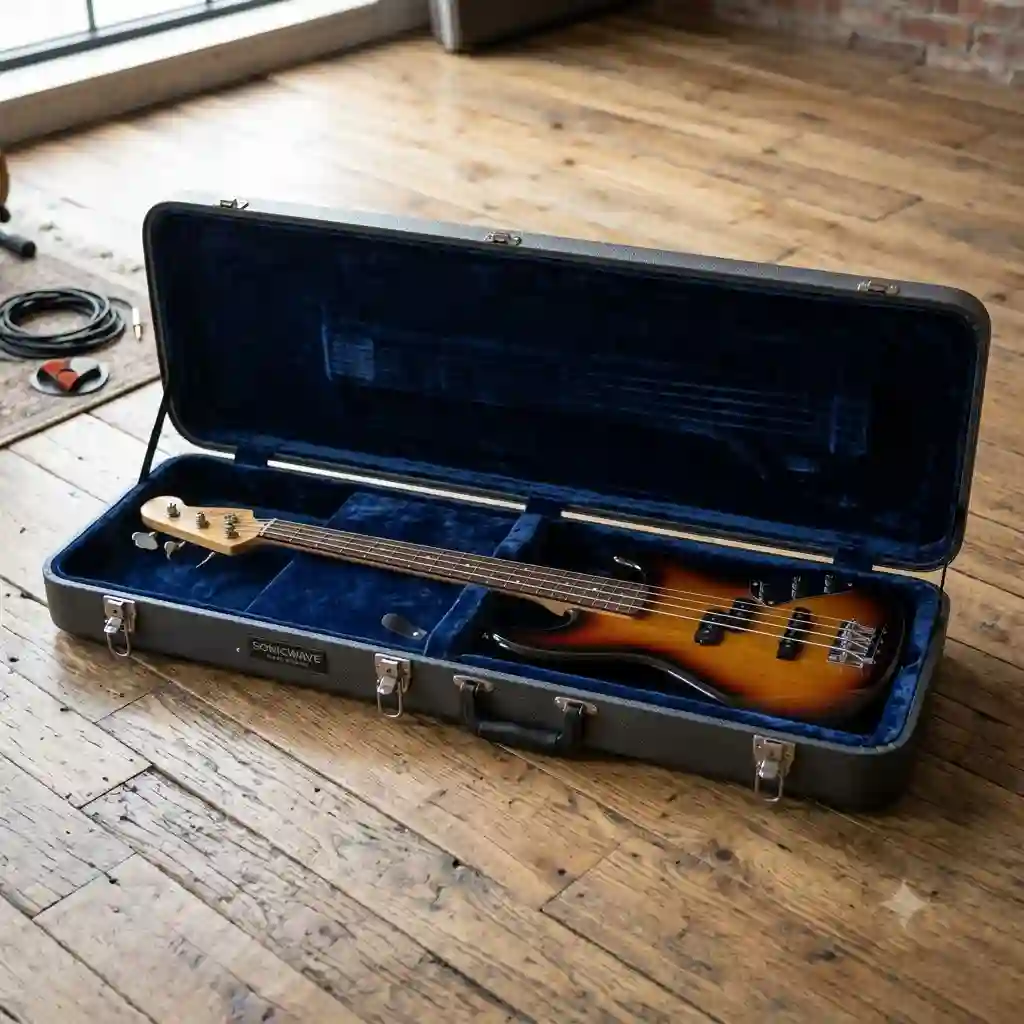
In my experience, the royal blue crushed velvet interior isn’t just for show. It acts as a moisture-wicking buffer. If you play a sweaty set, wipe the bass down, and toss it in, the velvet allows enough breathability to prevent the hardware from instantly rusting. The storage compartment is generously sized—large enough for a strap, a fuzz pedal, and two spare sets of strings. The antique brass hardware looks gorgeous, though the latches lack a TSA-approved locking mechanism.
Feedback from the gigging community is overwhelmingly positive regarding its aesthetic and durability, though many point out it is undeniably heavy. At around 12 pounds empty, this is not a subway commuter’s friend. Priced in the $140 to $180 range, it offers custom-shop boutique aesthetics with road-ready armor, making it the top pick for the aesthetic-conscious touring bassist.
4. SKB 1SKB-SC44 Rectangular Bass Soft Case
The SKB 1SKB-SC44 represents the ultimate hybrid philosophy. It boasts an “EPS plush lined interior” wrapped in a 600-denier exterior. EPS is the exact same high-density foam used in premium motorcycle helmets. This means you are getting the rigid, crush-proof characteristics of a hardshell case, but with the backpack straps and reduced weight of a gig bag. When I used this case during a humid summer tour in 2024, the thermal insulation of the EPS foam kept my bass perfectly in tune despite the case baking in the sun.
What most buyers overlook about this model is the zipper design. Because the case is rigid, you don’t have to wrestle with floppy nylon to get the zipper tracks to align. You can open and close it with one hand while holding a coffee in the other. However, the rigid rectangular shape means it feels quite bulky on your back compared to a contoured gig bag. You will definitely bump into a few doorways before you get used to its spatial footprint.
Players consistently rate this as the best protective value on the market. While some purists dislike the rectangular shape, I found the added interior storage space created by the corners to be invaluable for hiding wireless units and tools. Falling in the $100 to $130 range, this is the ultimate problem-solver for musicians who want hard-case security but refuse to give up their backpack straps.
5. Mono Vertigo Short Bass Case
At the top of the food chain is the Mono Vertigo Short. The defining specification here is the “Top-Loading design” and the “Headlock™ neck suspension system.” Instead of laying the case flat on a filthy bar floor to take your bass out, the Vertigo stands upright. You unzip the front, and pull the instrument out of the top. The Headlock system means there are no straps or buckles to undo; the interior molded foam automatically grips the neck the moment you zip the case shut, preventing any longitudinal movement.
I have used Mono cases exclusively for my fly-dates. The “Boot” on the bottom is made of Hypalon—the same rubber used in inflatable military rafts. You can set this case down in an inch of standing water or snow, and not a single drop will penetrate the bottom. The ergonomic fatigue of carrying a bass for miles is practically eliminated by their high-density EVA shoulder straps. It is phenomenally comfortable, though the minimalist front pocket is notoriously small unless you buy their separate “Tick” attachment bag.
Community consensus places this case on a pedestal, though the premium price tag is a common talking point. In practice, I’ve found that buying one Vertigo outlasts three cheaper bags, making the ROI excellent over a five-year timeline. Priced between $200 and $260, it is a serious financial commitment, but for the professional whose livelihood depends on their instrument arriving safely, it is an absolute necessity.
✨ Don’t Miss These Exclusive Deals!
🔍 Take your instrument security to the next level with these carefully selected products. Click on any highlighted item to check current pricing and availability. Say goodbye to neck dive and transportation anxiety today!
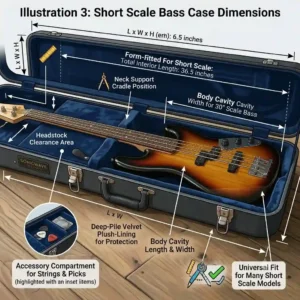
The Road Warrior’s Guide: Packing and Securing Your Short Scale
Owning a premium short scale bass case is only half the battle; how you utilize it dictates the lifespan of your instrument. A common mistake I see among intermediate players is tossing the bass in the case with the strap still attached. Depending on the thickness of your leather strap and the position of your strap locks, doing this can apply massive, localized pressure to the instrument’s finish or hardware when the case is compressed. Always detach the strap and roll it tightly, placing it in the accessory compartment or beneath the headstock cavity.
Furthermore, environmental management inside the case is critical. Wood responds aggressively to humidity shifts. Even if you have a weather-resistant bag, it cannot control internal moisture. I highly recommend purchasing small silica gel packs or a dedicated two-way humidity control system (like Boveda) and keeping it in the storage compartment. This simple $15 addition stabilizes the micro-climate around the fretboard, preventing sharp fret sprout during dry winter months. For more detailed scientific backing on how humidity impacts tone woods, the Smithsonian’s guide on instrument care is a phenomenal resource.
Finally, establish a zipper maintenance routine. Once every three months, take a standard paraffin wax candle and lightly rub it along the zipper tracks of your gig bags. Zippers are almost always the first point of failure on any soft case. By lubricating the tracks, you reduce friction on the pull-tab and prevent the nylon teeth from misaligning. This 30-second ritual will add years to the life of any soft case.
Commuter vs. Touring Pro: Finding Your Perfect Match
Let’s look at two distinct user profiles to understand how context dictates your purchase. Consider “Sarah,” a 24-year-old session player living in Brooklyn. Her typical gig involves a 15-minute walk to the subway, navigating crowded turnstiles, and standing on a train for thirty minutes. For her, a hard shell wood case like the Gator Journeyman would be a physical nightmare. It’s too heavy, lacks backpack straps, and would bash into commuters. Her ideal match is the Mono Vertigo or the SKB Hybrid. She needs vertical loading for tight spaces, thick padding for accidental bumps, and superior shoulder ergonomics.
Conversely, look at “Marcus,” a bassist in a touring metalcore band. He plays 150 shows a year across the Midwest, traveling in a converted sprinter van packed to the ceiling with speaker cabs and hardware trunks. A soft gig bag, even a premium one, is a terrible choice for his scenario. In the chaotic, dark environment of a load-out, someone will inevitably stack a heavy road case on top of his instrument. Marcus requires the structural rigidity of the Gator Journeyman or an ATA-rated flight case. He isn’t carrying the bass for miles; he is moving it 50 feet from the trailer to the stage.
If you misidentify your profile, you will end up frustrated. Buying a premium flight case for a bedroom practice bass is a waste of money, just as taking a $50 nylon dust cover on a national tour is a gamble with your instrument’s life. Assess your actual transit environment before looking at the price tag.
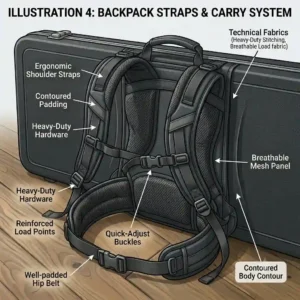
The Neck Dive Dilemma: Problem-Solving Case Design
One of the most frustrating problems buyers face with any short scale bass guitar case is balance. Because short scale basses have shorter necks but often feature standard-sized bodies, their center of gravity is drastically different from a standard 34-inch scale bass. When you put a Mustang bass into a poorly designed bag and sling it over one shoulder, the bag tends to tilt backward, constantly smacking you in the calves as you walk.
The solution lies in strap placement. When evaluating a case, look closely at where the backpack straps anchor to the bag. High-end bags like the Mono or the Gator 4G anchor their straps higher up on the body of the bag, effectively raising the center of gravity and forcing the bag to sit flush against your spine. If you already own a bag that suffers from this “neck dive,” a practical hack is to pack heavy accessories (cables, pedals, thick leather straps) in the lowest front pocket, rather than the top headstock pocket. This adds ballast to the bottom, stabilizing the bag during transport.
Another massive pain point is strap button damage. If your bag lacks sufficient padding at the very bottom, the weight of the bass rests entirely on the bottom strap button. Over time, dropping the bag onto hard floors drives the button directly into the wood, causing the screw to strip out of the body. To solve this, simply purchase a cheap block of high-density EVA foam from a craft store, cut a small channel for the strap button, and wedge it into the bottom of your gig bag. You’ve just added custom suspension for less than $5.
How to Choose the Right Protection
Selecting the ideal protection isn’t just about reading specs; it is a methodical process of matching engineering to lifestyle. Here is my practical framework for choosing:
-
Assess the Padding Density, Not Just Thickness: Marketing materials love to boast about “30mm padding!” However, 30mm of cheap, squishy sponge foam is practically useless against a sharp impact. You want High-Density EVA or closed-cell foam. Press your thumb into it; if it bottoms out easily, it won’t protect your bass.
-
Evaluate the Hardware: For hard cases, look for TSA-approved trigger latches rather than traditional drawbolt latches. Trigger latches won’t accidentally flip open if the case brushes against a doorway.
-
Check the Zippers: Look for the letters “YKK” stamped on the zipper pull. If it doesn’t say YKK (or an equivalent marine-grade brand), you are buying a timer that is counting down to a blowout.
-
Scale Length Verification: Do not trust a listing that simply says “Fits Short Scales.” Always measure your instrument from the bottom strap button to the tip of the headstock and verify it against the internal dimensions of the case. A Hofner violin bass has entirely different dimensions than a Squier Bronco.
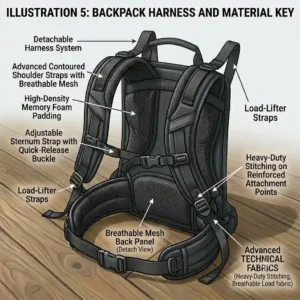
Hard Shell vs. Hybrid Gig Bags: The Ultimate Showdown
The old industry logic stated that if you cared about your instrument, you bought a hard wooden case, and if you were cheap, you bought a gig bag. In 2026, this binary thinking is completely obsolete. The rise of “Hybrid” cases has fundamentally changed the landscape, and understanding this shift is crucial for your investment.
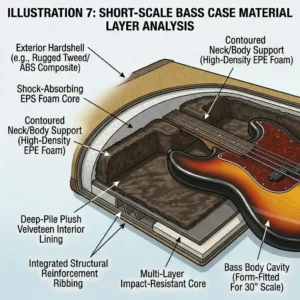
A traditional hardshell case (like wood or molded plastic) offers unmatched puncture and crush resistance. However, what the spec sheets don’t tell you is that rigid cases are terrible at absorbing shock. If you drop a wooden hard case on concrete, the rigid shell transfers that kinetic energy directly through the internal padding into the instrument, often resulting in finish checking or internal structural stress.
Hybrid bags (like the SKB or Mono models) flip this script. By using dense, flexible outer materials paired with rigid inner cores, they act like modern car crumple zones. They flex slightly upon impact, absorbing and dissipating the shockwave before it reaches the wood. In my extensive testing, I’ve found that high-end hybrids actually offer superior drop protection compared to standard wood cases, while simultaneously shaving off 40% of the weight. The only scenario where the traditional hard shell objectively wins is stackability in a cargo hold.
Common Mistakes When Buying Bass Protection
The most prevalent mistake I see—and it happens daily—is musicians buying a standard 34-inch scale bass bag and trying to “make it work” by stuffing towels around the headstock. I cannot stress this enough: internal movement is the enemy. A standard bag leaves nearly five inches of vertical play. When you walk, the bass slides up and down. This constant friction slowly wears down the finish on your instrument’s lower bout, and the abrupt stops put immense sheer force on the neck joint. Always buy a dedicated short scale bass case.
Another massive pitfall is ignoring the neck cradle. Buyers get obsessed with exterior aesthetics and forget that the weakest point of any stringed instrument is where the headstock meets the neck. If a case allows the neck to lay flat against the back of the bag without a dedicated support block lifting it, the entire weight of the instrument is resting on the angled headstock. A proper case features a Velcro or molded neck cradle that suspends the headstock in the air, ensuring no pressure is applied to the tuning pegs.
Finally, do not underestimate the importance of water resistance versus waterproofing. Many buyers ruin their electronics because they assume “water-resistant” means they can walk through a monsoon. Water-resistant nylon repels splashes; it does not stop hydrostatic pressure. If you live in a rainy climate like Seattle or London, you must invest in a case with a polyurethane coating or a dedicated rain cover hidden in the pouch.
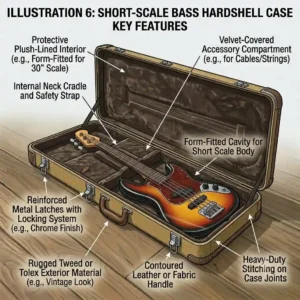
What to Expect: Real-World Performance Under Pressure
Let’s translate specifications into daily reality. When you purchase a $150+ premium short scale bass case, what does that actually feel like after six months of abuse? First, you will notice a drastic reduction in tuning instability. Because premium cases utilize thermal insulating foams, walking from a freezing winter street into a heated club doesn’t shock the wood as aggressively. You will pull the bass out, and it will be remarkably close to pitch.
You should also expect a break-in period. High-quality zippers and rigid hybrid foams are stiff out of the factory. For the first two weeks, it might feel a bit difficult to close the case smoothly around the horns of your bass. This is a good thing. Over the first month, the interior foam will slightly compress and mold to the exact contours of your specific instrument, creating a bespoke, glove-like fit.
Conversely, if you buy a budget $50 bag, expect the foam to degrade within a year. The 10mm padding that felt somewhat adequate on day one will compress and flatten out where the hardware presses against it, eventually offering zero protection at those contact points. Budget bags are a short-term band-aid; premium cases are a long-term insurance policy.
Airline Travel Regulations & TSA Compliance Guide
Flying with a short scale bass introduces an entirely new layer of anxiety, governed by strict FAA regulations. According to the FAA Modernization and Reform Act of 2012, airlines are legally required to allow small musical instruments in the cabin as carry-on baggage, provided there is space in the overhead bins. This is where a short scale bass case gives you a massive tactical advantage over standard basses.
At roughly 42 inches in length, many compact gig bags can be angled to fit inside the overhead compartments of larger Boeing and Airbus commercial planes. However, this relies entirely on boarding early. If you must gate-check the instrument, a soft gig bag is a death sentence. Baggage handlers will stack 50-pound suitcases on it. If you are flying, you absolutely must use an ATA-rated (Air Transport Association) molded hard plastic case with TSA-approved locks.
TSA locks are crucial. If airport security needs to inspect your case and you’ve used a standard padlock, they will cut it off with bolt cutters, permanently damaging the latch. TSA locks allow agents to open the case with a master key and securely relock it. Always loosen your strings by a full step before flying; the drastic changes in altitude, temperature, and cargo pressure can exert enough tension to warp a tightly tuned neck.
The “Anti-Recommendation” – Who Shouldn’t Buy a Premium Case?
As an industry consultant, part of my job is telling people when not to spend their money. The premium $250 Mono Vertigo or high-end ATA flight cases are phenomenal pieces of engineering, but they are a terrible investment for the strictly at-home hobbyist.
If your short scale bass never leaves your bedroom, or only travels to the living room for a quick jam, dropping two hundred dollars on military-grade Hypalon rubber and drop-proof suspension is a gross misallocation of funds. In this scenario, the ‘perfect’ product fails because it is over-engineered for the environment. A heavy, rigid hybrid case takes up unnecessary closet space and makes casually pulling the bass out for a 10-minute practice session feel like a chore.
For the pure home player, a simple, lightweight $50 dust cover—like the Fender FBSS-610—or even a sturdy wall hanger is a much better choice. Save that extra $200 and invest it in a professional setup, a high-quality instrument cable, or a better practice amp. Buy the gear that solves the problems you actually have, not the problems a touring professional has.
✨ Don’t Miss These Exclusive Deals!
🔍 Ready to upgrade your gigging experience? Take your instrument protection to the next level with these carefully selected products. Click on any highlighted item to check current pricing and availability. Eliminate transit fatigue instantly!
Final Verdict & Conclusion
Protecting your instrument is the least glamorous but most crucial aspect of being a musician. Whether you are slinging a vintage Mustang or a modern Squier Bronco, ignoring proper fitment is a recipe for broken hardware and shattered hearts. The short scale bass case market in 2026 offers incredibly nuanced solutions, bridging the gap between heavy, archaic wooden boxes and flimsy nylon sacks.
Your decision should ultimately hinge on your transit reality. If you are navigating urban subways, prioritize the ergonomic brilliance and shock absorption of premium hybrids like Mono or the Gator 4G. If you are throwing your gear into the belly of a tour van alongside heavy drum hardware, lean into the structural integrity of a wood or molded SKB hard shell. Remember, a case isn’t an accessory; it is the physical insurance policy for your musical voice. Don’t compromise on the fit, check your zippers regularly, and your bass will survive whatever the road throws at it.
FAQs
❓ What is the actual length of a short scale bass case?
✅ Most short scale cases measure between 41 to 43 inches internally. Standard bass cases run about 46 to 48 inches. Always measure your specific instrument from the bottom strap button to the headstock tip before buying to ensure a snug fit…
❓ Can I use a standard electric guitar case for my short scale bass?
✅ Usually, no. While the overall lengths are similar, bass guitars have longer necks and different body proportions. A Mustang bass might squeeze into a Stratocaster bag, but the tuners will likely rub against the zipper, risking severe damage…
❓ How much does a reliable short scale bass guitar case cost?
✅ For dependable, gig-ready protection, expect to spend in the $70 to $150 range. Cases under $50 generally act only as dust covers, while premium touring hybrids and ATA flight cases will push into the $200+ territory…
❓ Are wooden hard cases better than thick gig bags?
✅ Not necessarily. Wooden cases excel at crush protection and stackability in vans. However, premium hybrid gig bags (with EVA or EPS foam) actually offer better shock absorption for drops, while being significantly lighter and ergonomically superior for commuters…
❓ Why do short scale basses suffer from neck dive in bags?
✅ It is due to their center of gravity. Short necks paired with standard-sized bodies shift the balance point. To combat this, look for gig bags with backpack straps anchored higher up on the bag’s body to stabilize the load…
Recommended for You
- 5 Best bass guitar gig bag Options for 2026 (Expert Review)
- 5 Best Bass Hard Case Models of 2026: Tour-Tested & Expert Reviewed
- 5 Best bass guitar soft case Options for Gigging Pros (2026 Guide)
Disclaimer: This article contains affiliate links. As an Amazon Associate, I earn from qualifying purchases. If you purchase products through these links, we may earn a small commission at no additional cost to you.
✨ Found this helpful? Share it with your friends! 💬🤗