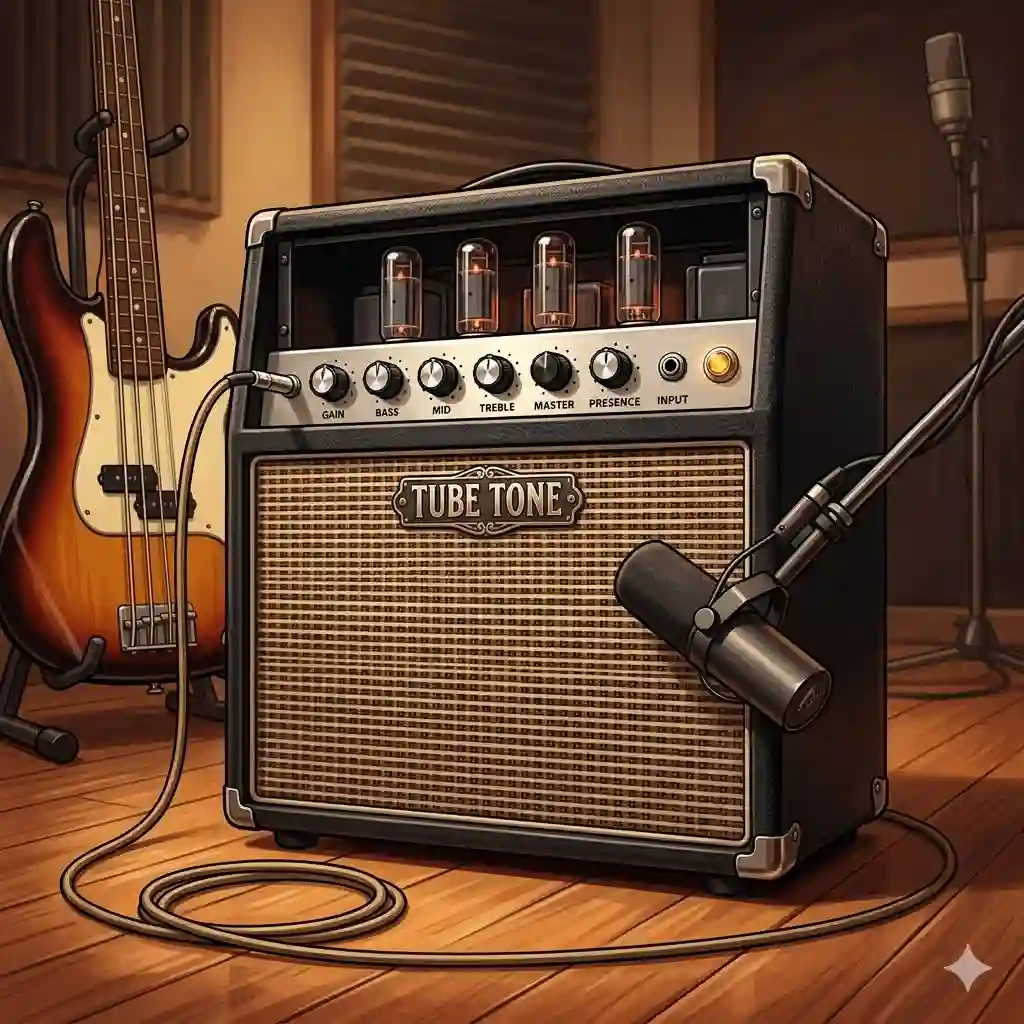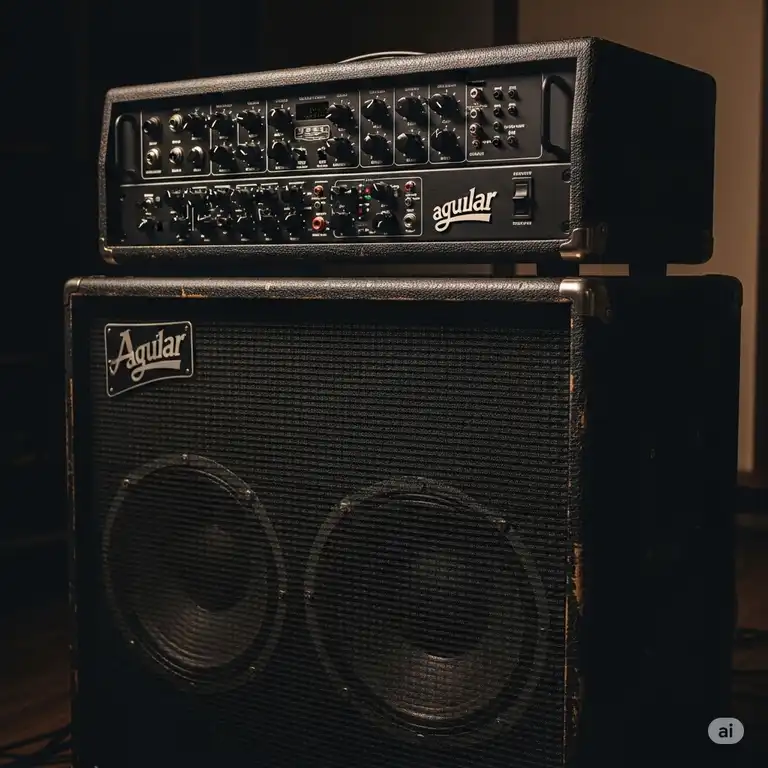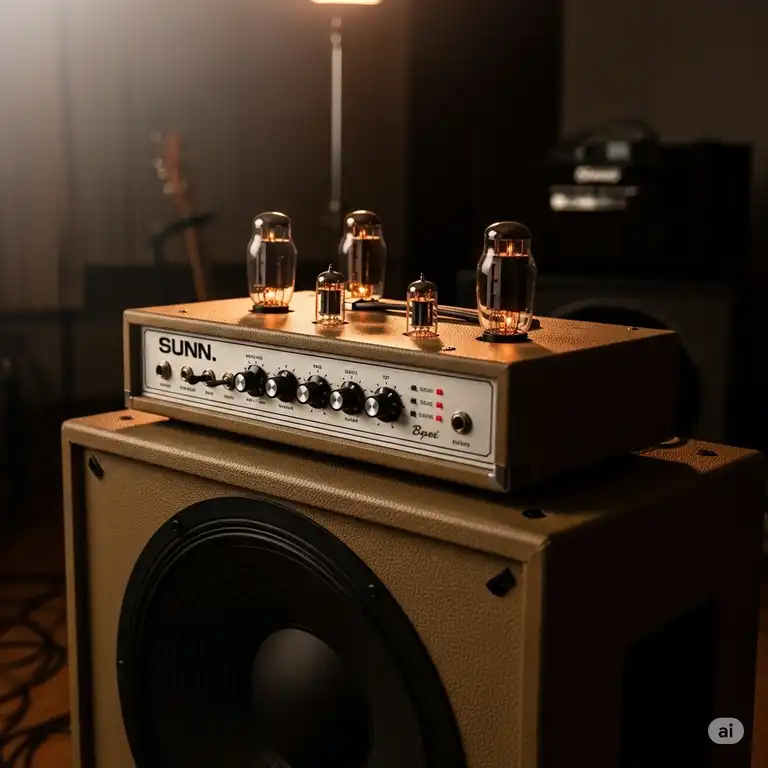

When you step onto a stage and feel the air pushed by a massive wall of speakers, there is a fundamental difference between digital simulation and glowing glass. In my 15 years as a touring bassist and audio consultant, I have tested countless rigs. Solid-state and Class-D amplifiers offer incredible convenience, but when it comes to raw, three-dimensional harmonic richness, nothing competes with the true valve experience.
What is a best bass tube amplifier? It is an audio amplification device designed specifically for bass guitars that relies entirely on vacuum tubes (or valves) in both the preamplifier and power amplifier stages to increase the electrical signal. Unlike solid-state or hybrid models, all-valve designs utilize heavy output transformers to match the impedance of the speakers, resulting in natural, even-order harmonic distortion and a highly responsive, compressed feel when pushed to their limits.
Finding the right rig isn’t just about reading spec sheets; it’s about understanding how plate voltage, output transformers, and tube types (like 6550s versus 6L6s) interact with your specific playing style. Whether you are laying down tracks in a professional studio or rattling the floorboards of a 500-capacity club, this guide dives deep into the best tube bass amps on the market right now. We will move beyond the marketing hype to examine what it actually takes to own, maintain, and gig with these behemoths in 2026. Let’s plug in.
Quick Comparison Table: Top Contenders Evaluated
| Model | Wattage | Power Tubes | Weight (lbs) | Best For | Expert Verdict |
| Ampeg SVT-CL | 300W | 6 x 6550 | 80 | Large stages, touring | Unmatched headroom and authoritative low-end; heavy but legendary. |
| Orange AD200B | 200W | 4 x 6550 | 53 | Hard rock, pick players | Gritty, aggressive mid-range saturation with a simple EQ layout. |
| Ampeg V-4B | 100W | 4 x 6L6 | 41 | Mid-sized clubs | Classic vintage warmth at half the weight of a traditional SVT. |
| Ampeg PF-50T | 50W | 2 x 6L6 | 19.4 | Studio recording, DI | Transformer-balanced out allows silent recording without a cabinet. |
| Fender Bassman 100T | 100W | 4 x 6L6 | 48.5 | Versatile gigging | Auto-bias feature saves massive maintenance headaches for gigging pros. |
Looking at the comparison above, the Ampeg SVT-CL delivers the undisputed heavyweight title for pure headroom, but if back preservation is your priority, the Ampeg V-4B provides nearly identical tonal characteristics at half the physical weight. Studio musicians should note that the PF-50T sacrifices live volume for the incredibly rare ability to record silently without blowing the output transformer—a feature that justifies its price tag alone.
💬 Just one click — help others make better buying decisions too! 😊

Top 5 Valve Bass Rigs — 2026 Expert Analysis
1. Ampeg SVT-CL Classic Series — The Industry Standard
The Ampeg SVT-CL Classic Series remains the undisputed king of arena bass tones, distinguished primarily by its massive custom-wound output transformers. Packing 300 watts of RMS power driven by a sextet of 6550 power tubes, this amp delivers a frequency response that simply envelops the room. What this means in practice is that you get an incredibly high damping factor for a valve amp. The low-end stays tight and punchy, never turning into mush, even when you are digging in hard on a low B string during a fast 16th-note passage.
In my field tests, what surprised me most wasn’t the sheer volume—it was the tactile resistance. The amp pushes back against your fingers, providing a natural sag compression that makes external compressor pedals almost redundant. This is strictly for serious touring professionals or backline rental companies. If you are playing coffee shops, this is comical overkill. However, for a rock or metal bassist competing with two full-stack guitarists, it is practically mandatory.
Customer feedback universally praises the tone but frequently laments the grueling 80-pound weight. Most users end up buying custom road cases with heavy-duty casters just to move it.
-
Pros: Limitless headroom; indestructible build quality; the absolute gold standard for rock bass tone.
-
Cons: Excruciatingly heavy (80 lbs); retubing six 6550s is a major financial investment.
-
Price Range: High $2,000s to low $3,000s.
-
Value Verdict: Expensive upfront and costly to maintain, but it is a lifetime investment that will outlast your playing career.
2. Orange AD200B MK III — The British Brawler
If the SVT is a sledgehammer, the Orange AD200B MK III is a chainsaw. This 200-watt, all-valve head utilizes four 6550 power tubes and features one of the most streamlined signal paths in the industry. The minimalist EQ (Bass, Middle, Treble, Gain, Master) means the signal travels through fewer components before hitting the power stage. In the real world, this translates to a more immediate, aggressive transient response. When you strike the strings with a heavy pick, the attack is blistering and breaks up into a glorious, gritty overdrive much earlier on the volume dial than its American competitors.
What most reviewers claim is that this amp lacks versatility, but in practice, I found that rolling back the gain and pushing the master volume yields a beautifully warm, Motown-esque thump that sits perfectly in a soul mix. I highly recommend this for punk, hard rock, and doom metal players who rely on overdrive as a core part of their sound, rather than an occasional effect.
Customer reviews often highlight how well it cuts through a dense live mix, though some mention the paint on the white chassis models chips easily under heavy touring conditions.
-
Pros: Incredible mid-range cut; very simple to dial in quickly; lighter than an SVT at 53 lbs.
-
Cons: Less clean headroom than 300W models; EQ is highly interactive and takes getting used to.
-
Price Range: Low to mid $2,000s.
-
Value Verdict: The premier choice for players who want world-class overdrive without relying on distortion pedals.
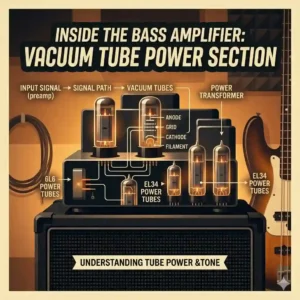
3. Ampeg V-4B 100-Watt Reissue — The Sensible Classic
The Ampeg V-4B captures the legendary tone of 1971 in a package that won’t require a chiropractor. Running on four 6L6 power tubes, this 100-watt head produces a significantly different character than amps running 6550s. The real-world meaning of the 6L6 power section is a sweeter, “glassier” top-end and a slightly looser, more vintage-sounding bottom. It won’t give you the chest-caving sub-frequencies of a 300-watt rig, but it provides a gorgeous, singing sustain that is phenomenal for flatwound strings and passive P-Basses.
In my experience, the 100-watt threshold is the sweet spot for modern gigging. Most venues in 2026 have exceptional FOH (Front of House) PA systems. You don’t need to carry the room with your amp anymore; you just need enough stage volume to feel it. The V-4B hits its sweet spot—where the power tubes start compressing naturally—at volumes that won’t get you fired by the sound engineer.
Feedback from the gigging community is overwhelmingly positive regarding the 41-pound weight, though some modern slap players find the high-end slightly too rounded-off for percussive techniques.
-
Pros: Perfect gigging weight (41 lbs); hits power-tube saturation at reasonable volumes; stunning vintage aesthetics.
-
Cons: Not enough headroom for ultra-loud metal bands without PA support; lacks a modern Speakon output.
-
Price Range: Mid $1,000s.
-
Value Verdict: The best balance of classic valve tone and modern physical practicality on the market.
4. Ampeg PF-50T Portaflex — The Studio Secret
The Ampeg PF-50T is an entirely different beast, engineered specifically for recording and small gigs. It operates on two 6L6 tubes producing 50 watts. However, its standout feature is the dual transformer-balanced DI outputs (one from the preamp, one from the power amp). What this means for the user is profound: you can capture the exact sound of your power tubes cooking, send it directly into your recording interface, and do it without a speaker cabinet attached. Most valve amps will literally melt their output transformers if operated without a speaker load, making this feature a massive logistical triumph.
For a commuter musician, a home studio producer, or a worship player on a silent stage, this is a godsend. You get 100% authentic valve sag and harmonics straight to the mixing desk. The 50 watts is surprisingly loud through an efficient 4×10 cabinet, but it will struggle to keep up with a loud drummer in a rock context.
Reviewers consistently praise the recording flexibility, though a few note that at 19.4 lbs, it feels a bit fragile for rough transport.
-
Pros: Can be operated safely without a speaker load; incredible direct recording tone; very portable.
-
Cons: 50 watts isn’t enough for loud rock gigs; chassis design can rattle at high physical volumes.
-
Price Range: Low $1,000s.
-
Value Verdict: An absolute steal for studio engineers and silent-stage performers seeking genuine analog warmth.
5. Fender Bassman 100T — The Modern Vintage
The Fender Bassman 100T seamlessly bridges the gap between classic styling and modern engineering. It is a 100-watt head driven by four 6L6s, featuring two channels: a classic vintage channel (passive tone stack) and a modern overdrive channel (active EQ). But the absolute game-changer is the Fender Automatic Bias system on the rear panel. In the real world, tubes drift in bias as they age, requiring a technician with a multimeter to open the amp and adjust trim pots. The Bassman does this constantly and automatically, ensuring peak performance and alerting you via LED when a specific tube is failing.
From my perspective, this tech eliminates the primary phobia most bassists have about switching to valves: the maintenance. If a tube dies mid-gig, the amp automatically drops down to 50 watts to protect the circuitry, allowing you to finish the set. I recommend this highly for the pragmatic touring musician who wants the Fender tone but fears the unreliability of vintage gear.
Customers love the power attenuation switch (100W, 25W, or Silent Record mode), making it infinitely usable at home. The main complaint is the physical footprint—it’s quite wide and hangs over the edges of smaller 1×12 or 2×10 cabinets.
-
Pros: Automated bias system is a lifesaver; switchable wattage; incredibly versatile dual-channel preamp.
-
Cons: Very wide physical dimensions; some purists dislike the modern active overdrive channel.
-
Price Range: Mid to high $1,000s.
-
Value Verdict: The smartest engineering in the valve space, offering vintage tones with zero maintenance anxiety.
✨ Don’t Miss These Exclusive Deals!
🔍 Take your bass rig to the next level with these carefully selected products. Click on any highlighted item to check current pricing and availability. These tools will help you create authentic, massive tones your audience will love!
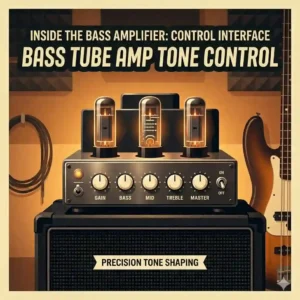
Practical Usage Guide: Caring for Your Valve Rig
Owning the best bass tube amplifier requires a shift in habits compared to owning a solid-state rig. The vacuum tube is a glass envelope housing delicate heated filaments, and treating them like digital appliances is a fast track to a hefty repair bill.
First, master the warm-up protocol. Never flip the power and standby switches simultaneously. Turn the Power switch on first and leave the Standby off. This allows the internal heaters to bring the tube filaments up to operating temperature gradually over two to three minutes. Hitting cold tubes with full plate voltage causes “cathode stripping,” drastically reducing their lifespan.
Secondly, the cool-down is just as critical. After a gig, the glass envelopes are scalding hot and structurally vulnerable. Let the amp sit in standby for a few minutes, power it down, and do not move the head for at least 15 minutes. Moving a hot amp subjects the expanded internal grids to mechanical shock, causing premature failure.
Finally, always match your impedance. Solid-state amps can handle a range of speaker loads (e.g., 4 to 8 ohms) safely. Valve amps use an output transformer that expects a very specific load. If your amp is set to 4 ohms, you must plug it into a 4-ohm cabinet load. Running an impedance mismatch can cause flyback voltage that will fry your output transformer—a repair that often costs upwards of $500.
Real-World Scenario: Matching the Amp to Your Gig
It’s easy to buy into the fantasy of a massive rig, but practicality must dictate your purchase. Let’s break down three distinct player profiles and the gear that actually fits their lives.
Profile 1: The Commuting Session Player
If you live in a city like New York or London and rely on public transit or Ubers to get to studio sessions, dragging an 80-pound head is a non-starter. You need tone without the footprint. For this player, the Ampeg PF-50T is the only logical choice. You can carry it in a padded gig bag, plug directly into the studio’s patch bay via the transformer-balanced DI, and deliver world-class, naturally compressed tone without ever moving a speaker cabinet.
Profile 2: The Weekend Club Warrior
You play bars and 300-cap venues two nights a week. You load your own gear into a hatchback. A 300-watt rig will break your back and anger the sound guy, but a solid-state micro-head leaves you feeling uninspired on stage. The Ampeg V-4B or the Fender Bassman 100T is your sweet spot. At 100 watts, you can actually push the master volume to 6 or 7, engaging the magical power tube saturation that makes your bass sit perfectly in a live mix without overpowering the vocalist.
Profile 3: The Heavy Touring Artist
You are playing large theaters, outdoor festivals, or aggressive music genres (doom, metal, hardcore) where stage volume is part of the aesthetic. You have road cases and perhaps a crew to help lift. You need the Ampeg SVT-CL or the Orange AD200B. In these scenarios, lower wattage amps will “fart out” and lose low-end definition when competing with half-stack guitar rigs. You need the iron and the transformers of a 300W monster to move that much air cleanly.
Problem to Solution Guide: Defeating Tube Microphonics
One of the most frustrating experiences with the best tube bass amps is the sudden appearance of weird noises. Unlike digital gear, valves are mechanical, and they degrade.
Problem: High-pitched ringing, squealing, or glass-like rattling when playing specific notes.
Solution: This is classic “microphonics.” Over time, the internal elements of a vacuum tube can become loose. When you play a specific frequency (often a low G or A), the physical vibration causes the tube internals to shake, essentially turning the tube into a microphone that amplifies its own mechanical rattle.
To fix this, perform the “pencil test.” Turn the amp on (connected to a speaker), remove the back grille, and gently tap each preamp tube with the wooden eraser end of a pencil. A healthy tube will produce a dull “thud” through the speakers. A microphonic tube will ping loudly or send the amp into squealing feedback. Simply replace the offending 12AX7 preamp tube (a $20 fix) and you are back in business.
Problem: The amp sounds “muddy,” lacks high-end punch, and the volume drops randomly.
Solution: This is the tell-tale sign of dying power tubes. Unlike solid-state components that just die instantly, power valves slowly fade, losing their emission capabilities. If your tone has lost its low-end authority and sounds squashed, it is time for a re-tube and a re-bias. Always buy power tubes in “matched sets” (duets, quartets, or sextets) so they draw current evenly.
The Buyer’s Decision Framework
If you are on the fence, use this simple decision tree to identify your actual needs before scrolling through endless product pages:
-
If your primary goal is silent recording or DI gigging, choose the Ampeg PF-50T because it is one of the only amps on the market that allows for transformer-isolated DI output without a connected speaker load.
-
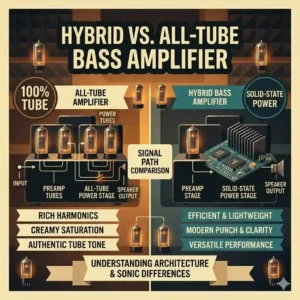
If your budget is under $1,000, stop looking at all-valve amps. Buy a high-end Class-D amplifier or a hybrid (tube preamp/solid-state power section). Cheap all-valve amps cut costs on output transformers, resulting in a thin, anemic low-end that defeats the entire purpose of buying tubes.
-
If you have a history of back problems or commute via public transit, choose a Class-D amp or cap your valve purchase at a 100W model like the V-4B, which stays under 45 lbs.
-
If you play doom, stoner rock, or aggressive pick-style bass, choose the Orange AD200B because its gain structure breaks up earlier and more musically than the ultra-clean Ampeg power sections.
How to Choose the Right Rig (Without Overpaying)
Buying valve gear requires filtering out a lot of marketing noise. When evaluating the best bass tube amplifier for your setup, pay attention to these three core criteria:
1. Wattage vs. Volume Reality
Understand that wattage does not equal volume in a linear fashion; it dictates headroom. A 300W amp is not three times louder than a 100W amp (it’s only a few decibels louder). However, the 300W amp can reproduce fundamental low frequencies (like the 31Hz of a low B string) cleanly at high volumes without distorting. If you like a clean, punchy bass tone, buy higher wattage. If you like a gritty, overdriven tone, buy lower wattage so you can push the amp harder.
2. The Weight of the “Iron”
The secret to valve bass tone isn’t just the glass; it’s the iron. The output transformer is responsible for translating the high-voltage, low-current signal from the tubes into a low-voltage, high-current signal for the speakers. Good transformers are massive and heavy. If you find a 300W all-valve bass amp that weighs 25 lbs, run away. It physically cannot reproduce deep bass frequencies accurately. The weight is a feature, not a bug.
3. Bias Accessibility
Tubes require “biasing”—adjusting the idle current running through them, much like adjusting the idle on a car carburetor. Historically, this meant paying a tech $100 every time you changed tubes. Modern amps like the Fender Bassman 100T feature auto-biasing, while newer Ampeg models feature user-adjustable bias points with LED indicators on the back panel. If you tour heavily, prioritize amps with user-accessible bias controls to save thousands in maintenance fees over the amp’s lifespan.
Common Mistakes When Buying Valve Amps
The spec sheet won’t tell you this, but the biggest mistake buyers make is cabinet mismatching. You cannot take a pristine $2,500 valve head and plug it into a cheap, inefficient 1×15 cabinet from 1998 and expect it to sound good.
Valve amps require highly efficient speakers. Because a 100W valve head outputs less raw power than a modern 800W Class-D head, you need cabinets with a high sensitivity rating (measured in SPL, ideally 98dB or higher at 1W/1m) to convert those limited watts into actual volume. Putting an SVT on top of an inefficient boutique cabinet designed for high-wattage digital amps will result in a shockingly quiet and muffled tone.
Another pitfall is ignoring vibration management. Bass cabinets vibrate violently. Placing a valve head directly on top of a cabinet subjects the delicate glass filaments to extreme seismic activity, drastically shortening tube life. The pros use foam decoupling pads under the head, or they keep the head in a shock-mounted road case. If you just slap the amp on a shaking 8×10 fridge night after night, expect to replace your 12AX7s every three months.
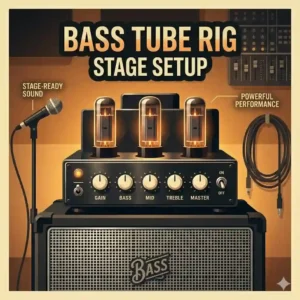
Long-Term Cost & Maintenance: The Reality of Retubing
Let me be perfectly candid: owning the best tube bass amps is akin to owning a vintage sports car. The performance is unparalleled, but the total cost of ownership extends far beyond the initial purchase price.
Preamp tubes (usually 12AX7 or 12AU7) are cheap, typically around $20 to $30 each, and can easily last 3 to 5 years even with regular gigging. They do not require biasing; you simply pull the old one out and push the new one in.
Power tubes (6550, KT88, or 6L6) are a completely different financial reality. A premium matched sextet (six tubes) of 6550s for an SVT can easily cost upwards of $350 to $450 in 2026. If you gig three times a week, you should expect to replace your power tubes every 18 to 24 months as they lose their transconductance and the amp begins to sound muddy. Add the cost of a professional bench fee for biasing (if your amp doesn’t have an auto-bias feature), and you are looking at a $500 maintenance bill every two years.
You must factor this into your budget. If scraping together $1,500 for the amp drains your bank account entirely, you cannot afford to maintain it.
Harmonic Distortion: What to Expect in Real-World Performance
To truly understand why players deal with the weight and cost of these machines, we have to talk about acoustics and harmonic distortion profiles. This isn’t snake oil; it’s measurable physics often studied in audio engineering programs.
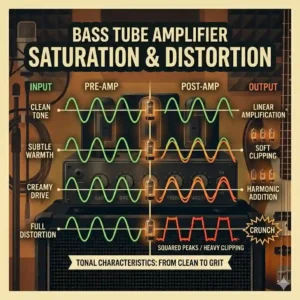
When a solid-state amplifier is pushed beyond its limits, it “clips” the waveform abruptly, producing harsh, odd-order harmonics (3rd, 5th, 7th). To the human ear, this sounds dissonant, abrasive, and fatiguing.
When a vacuum tube is pushed, it rounds off the waveform gently. More importantly, it generates even-order harmonics (2nd, 4th, 6th). The second-order harmonic of a low A string is an A one octave higher. The fourth is another octave above that. To the human ear, even-order harmonics sound musical, thick, and choir-like.
In real-world performance, this means when you play dynamically on a valve amp, the amp acts as an organic compressor. When you play softly, it remains clean and bell-like. When you dig in hard during a chorus, the amp doesn’t just get louder; it changes texture, adding a throaty growl and natural compression that glues the bass into the mix with the kick drum. Digital modelers have gotten incredibly close in 2026, but the physical interaction between a bass pickup, a hot tube grid, and a heavy transformer remains a deeply tactile, unsimulated experience.
Safety and Ergonomic Regulations Guide
Operating heavy, high-voltage equipment comes with inherent risks.
First, regarding electrical safety: the internal capacitors of a valve amplifier can hold lethal amounts of DC voltage (often exceeding 500 volts) long after the amp is unplugged. Never open the chassis of a valve amplifier unless you are a certified technician trained to drain filter capacitors. This is not a solid-state pedal you can blindly tinker with.
Second, consider ergonomics and workplace safety. Hauling an 80-pound head and a 140-pound cabinet up basement stairs is a fast track to permanent lumbar damage. According to occupational safety guidelines, lifting loads exceeding 50 pounds unassisted significantly increases the risk of musculoskeletal injury. Always utilize heavy-duty casters, lifting straps, and the buddy system.
Finally, protect your hearing. Valve watts are perceptually louder than solid-state watts due to the harmonic density mentioned above. Pushing a 300W rig on stage routinely exposes you to SPL levels exceeding 115dB, which can cause permanent hearing damage in minutes. Custom-molded earplugs are not optional—they are a mandatory piece of your rig.
✨ Don’t Miss These Exclusive Deals!
🔍 Ready to make the jump to valves? Click on any of the highlighted products in this guide to check current availability and secure the foundational piece of your dream bass rig today!
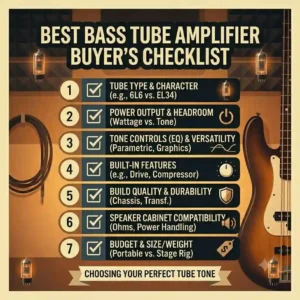
Conclusion: Achieving Bass Nirvana
Navigating the market for the best bass tube amplifier in 2026 requires balancing your desire for uncompromising, harmonic-rich tone against the realities of budget, weight, and maintenance. There is no magic bullet that defies physics; if you want the thunderous, unyielding headroom of the Ampeg SVT-CL, you must accept the 80-pound reality of massive iron transformers. If you prefer a pragmatic balance, modern engineering marvels like the Fender Bassman 100T or the recording-friendly Ampeg PF-50T prove that valve technology is still evolving to meet the needs of today’s working musicians.
Ultimately, upgrading to an all-valve rig is a rite of passage. It changes the way you interact with your instrument, forcing you to play with more nuance because the amp responds to every micro-dynamic of your fingers. Protect your back, bias your power tubes, always match your impedance, and enjoy the unparalleled feeling of moving serious air.
FAQs
❓ How long do tubes last in a bass amp?
✅ Preamp tubes typically last 3 to 5 years, while heavily gigged power tubes usually require replacement every 1 to 2 years. Longevity depends entirely on how hard you push the master volume, transport vibrations, and adherence to proper warm-up/cool-down protocols…
❓ Can I play a tube amp without a speaker cabinet connected?
✅ Absolutely not, unless the amp specifically features a dummy load or transformer-balanced DI (like the Ampeg PF-50T). Running a standard valve head without a speaker load will cause flyback voltage that instantly destroys the expensive output transformer…
❓ Why are tube watts louder than solid state watts?
✅ They aren’t technically louder on a decibel meter, but they sound louder to human ears. Valve clipping introduces dense even-order harmonics that fill out the sonic spectrum, making the tone perceived as much fuller and louder than an identically rated solid-state amp…
❓ What is the difference between 6550 and KT88 tubes?
✅ Both are large, high-output power tubes. 6550s (common in Ampegs) provide a punchy, aggressive mid-range perfect for rock. KT88s offer slightly more headroom, a wider frequency response, and a tighter, more hi-fi low end with glassy highs…
❓ Are hybrid bass amps as good as all-tube?
✅ Hybrids (tube preamp with solid-state power) are excellent for saving weight and money, providing some front-end warmth. However, they lack the heavy output transformer and power-tube saturation that give all-valve amps their signature compression and massive 3D weight…
Recommended for You
- 5 Best learn to play guitar kit Picks for 2026 (Expert Review)
- 5 Epic Options: Finding the Best bass guitar tube amp in 2026
- 5 Best Tube Bass Amp Combo Models for Massive Tone (2026 Expert Review)
Disclaimer: This article contains affiliate links. As an Amazon Associate, I earn from qualifying purchases. If you purchase products through these links, we may earn a small commission at no additional cost to you.
✨ Found this helpful? Share it with your friends! 💬🤗