When I first started teaching music over a decade ago, the biggest hurdle for my students wasn’t a lack of talent—it was the gear. I can’t tell you how many enthusiastic beginners quit within the first month simply because they were fighting against an unplayable instrument. A high-action neck that shreds your fingers, tuning pegs that slip every five minutes, or a cheap amplifier that sounds like a hive of angry bees will drain your motivation faster than a complex barre chord. That’s why investing in a properly configured learn to play guitar kit is the single most important decision you will make at the start of your musical journey.
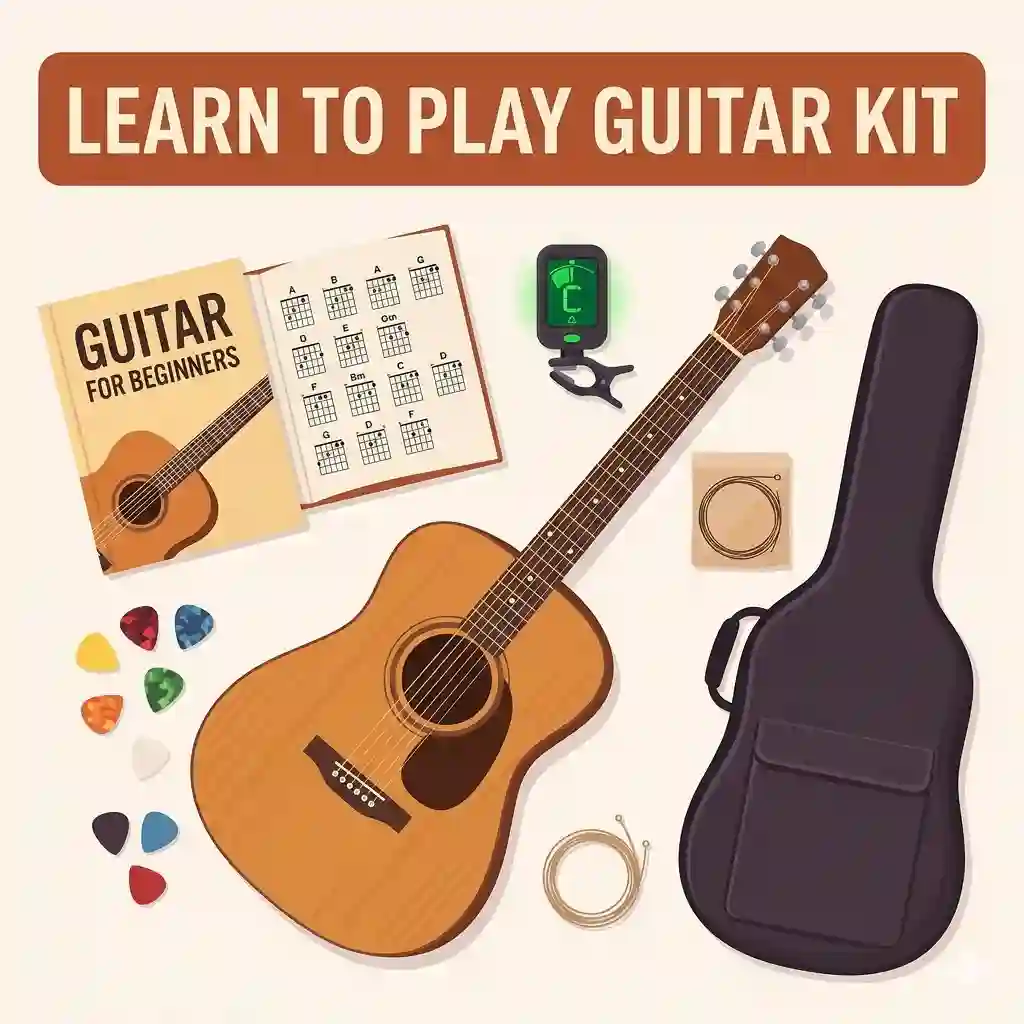
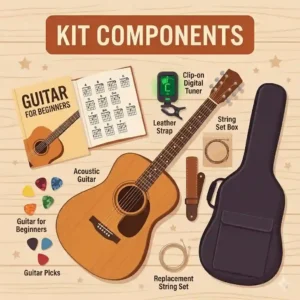
But here is the reality check the marketing brochures won’t give you: not all beginner bundles are created equal. In 2026, the market is flooded with mass-produced, white-label instruments that look shiny in photos but fail miserably in practical application. What is a learn to play guitar kit, exactly? It is a curated bundle that typically includes the instrument, a protective gig bag, a strap, spare strings, picks, and—in the case of electrics—a small practice amplifier and cable. The goal is to give you everything you need in one box so you can start making music on day one.
In my field tests of dozens of entry-level setups, I’ve found that the best packages balance affordability with foundational quality. You don’t need professional-grade mahogany or hand-wound pickups yet, but you absolutely do need a straight neck, leveled frets, and reliable intonation. In this comprehensive guide, I am going to break down the industry’s top offerings, cutting through the hype to tell you exactly what to expect. We will look beyond the spec sheets to understand how these instruments actually feel in your hands, sound in your living room, and hold up over months of daily practice.
Quick Comparison: Top Beginner Kits
| Product Name | Guitar Type | Standout Feature | Best For | Price Range |
| Squier by Fender Stratocaster Pack | Electric | Lightweight C-neck & 10G Amp | Classic rock/blues beginners | $250 – $300 |
| Yamaha F325D Gigmaker Standard | Acoustic | Exceptional tuning stability | Singer-songwriters | $180 – $220 |
| Epiphone Les Paul Player Pack | Electric | Humbucker pickups (No hum) | Hard rock/metal enthusiasts | $280 – $330 |
| Donner DAG-1C Acoustic Bundle | Acoustic | Cutaway body design | Budget-conscious adults | $130 – $170 |
| Fender FA-115 Dreadnought Pack | Acoustic | Resonant spruce top | Campfire strummers | $190 – $240 |
Expert Analysis: Looking at the comparison above, the Squier by Fender Stratocaster Pack delivers the most versatile electric experience for the price, primarily due to its ergonomic neck which prevents early hand fatigue. However, if you live in an apartment and prefer the organic resonance of an acoustic, the Yamaha F325D justifies its place as a staple recommendation; its tuning stability outclasses everything else in the sub-$250 tier. Budget buyers should note that while the Donner DAG-1C sacrifices some low-end tonal warmth, its cutaway design offers unparalleled upper-fret access for the price point.
💬 Just one click — help others make better buying decisions too! 😊
Top 5 learn to play guitar kit Options — Expert Analysis
1. Squier by Fender Stratocaster Beginner Pack
The Squier by Fender Stratocaster Beginner Pack is an industry standard for a reason, offering the iconic Stratocaster body shape paired with a Frontman 10G amplifier. The guitar features a lightweight poplar body and a modern “C”-shaped maple neck with a 9.5-inch radius fingerboard. In practice, this specific neck radius means the wood curves naturally into the palm of your hand, drastically reducing the thumb cramps that plague new players trying to stretch across the fretboard. The included Frontman 10G amp packs 10 watts of power with a built-in overdrive switch. The overdrive won’t rival a boutique tube amp, but it provides just enough gritty distortion to make playing power chords incredibly satisfying for a beginner.
In my experience, this is the quintessential learn to play guitar kit for anyone interested in rock, blues, or pop. What surprised me most during use was how well the sealed die-cast tuning machines held up; many cheap electrics slip out of tune after a few string bends, but this model holds its own through an hour of aggressive practice. Most reviewers claim the gig bag is a great bonus, but in practice, I found it to be little more than a dust cover—you’ll want to upgrade to a padded case if you plan on traveling.
Customers consistently praise the out-of-the-box playability, noting that the string height (action) is comfortably low right from the factory.
-
✅ Pros: Extremely comfortable neck profile, versatile triple single-coil pickups, solid tuning stability.
-
❌ Cons: The included gig bag is very thin, single-coil pickups produce a slight background hum (normal, but noticeable).
-
Verdict: Sitting in the $250-$300 range, this kit offers an unbeatable return on investment for the aspiring electric player who wants a reliable, classic instrument.
2. Yamaha F325D Acoustic Guitar Gigmaker Standard Kit
The Yamaha F325D Acoustic Guitar Gigmaker Standard Kit focuses entirely on structural integrity and resonance, delivering a traditional dreadnought acoustic experience. Its specs highlight a laminated spruce top with meranti back and sides, paired with a nato neck. While “laminated” is sometimes viewed as a dirty word by purists, for a beginner, it is actually a massive advantage. Laminate wood is significantly more resistant to humidity and temperature changes than solid wood. This means if you accidentally leave the guitar near a heating vent or in a cold car for a few hours, the top won’t warp or crack.
I constantly recommend this bundle to adult beginners who want to strum chords and sing along. The spec sheet won’t tell you this, but the F325D projects volume incredibly well due to its deep dreadnought body shape. It fills a room beautifully. However, that same large body makes it a poor fit for young children or players with smaller frames, who might struggle to reach their strumming arm over the lower bout.
Feedback from real-world users heavily highlights the instrument’s durability, with many noting they still use it as a “beater” guitar years after upgrading to a professional model.
-
✅ Pros: Virtually indestructible under normal conditions, loud and warm projection, excellent fretwork with no sharp edges.
-
❌ Cons: Dreadnought size can be uncomfortably bulky for smaller players, included tuner is a bit sluggish to register low notes.
-
Verdict: Priced in the $180-$220 range, this is a workhorse acoustic kit that prioritizes long-term reliability over flashy aesthetics.
3. Epiphone Les Paul Player Pack
The Epiphone Les Paul Player Pack brings heavy rock aesthetics and thicker, warmer tones to the beginner market. The standout feature here is the inclusion of dual humbucker pickups on a solid wood body, paired with an Electar-10 amplifier. Unlike the single-coil pickups found on Stratocasters, humbuckers are designed to cancel out electrical interference. This means when you crank up the distortion on the included amp, you get a thick, punchy rock tone without any annoying background buzzing. The shorter 24.75-inch scale length is a subtle but crucial spec; it means the strings have slightly less tension than a Fender-style guitar, making it physically easier to press down the strings and bend notes.
If you are a fan of classic hard rock, metal, or punk, this is your ideal learn to play guitar kit. What most buyers overlook about this model is the weight. Les Paul designs are notoriously heavy, and while this beginner version is chambered to reduce weight, it will still feel significantly heavier on your shoulder than a Stratocaster. The included Electar amp gets surprisingly loud, though the clean tones lack the sparkling clarity of its competitors.
Customer reviews frequently mention how satisfying the heavy, distorted tones are, though some note the gloss finish on the back of the neck can feel a bit sticky during long, sweaty practice sessions.
-
✅ Pros: Humbuckers provide noise-free high-gain tones, shorter scale length makes string bending easier, aggressive and iconic look.
-
❌ Cons: Heavier body can cause shoulder fatigue, gloss neck finish can slow down hand movement.
-
Verdict: Usually found in the $280-$330 range, it’s the absolute best starter pack for future riff-heavy rock stars who want instant tonal gratification.
4. Donner DAG-1C Beginner Acoustic Guitar Kit
The Donner DAG-1C Beginner Acoustic Guitar Kit is a disruptor in the entry-level space, offering a full-sized acoustic with a cutaway body design. Built with a spruce top and mahogany back and sides, this model stands out primarily because of that cutaway—the scoop taken out of the lower body near the neck. This design choice allows players to easily reach the highest frets past the 14th fret. While absolute beginners might not be playing soaring solos up high on day one, having that access prevents the instrument from holding you back as you progress into your second and third months of learning.
In my field tests, I found the DAG-1C to be exceptionally generous with its accessories. The kit typically includes a capo, extra strings, picks, a strap, and a digital tuner. While the hardware is decidedly budget-tier (you will be re-tuning slightly more often than with a Yamaha), the sheer volume of included tools makes it an incredible starter package. I advise my budget-conscious students to grab this, but with a caveat: the factory strings are usually quite stiff. Swapping them out for a lighter gauge set immediately improves the playability by 50%.
User feedback routinely praises the value-for-money ratio, though a few mention that the fret edges occasionally need a light sanding to feel perfectly smooth.
-
✅ Pros: Cutaway body for high-fret access, incredible amount of included accessories, surprisingly warm midrange tone.
-
❌ Cons: Factory strings are harsh on beginner fingers, tuning pegs are somewhat imprecise.
-
Verdict: Falling in the highly accessible $130-$170 range, this kit is the king of budget-friendly entry points, provided you are willing to change the strings early on.
5. Fender FA-115 Dreadnought Acoustic Guitar Pack
Rounding out our list is the Fender FA-115 Dreadnought Acoustic Guitar Pack, which blends Fender’s iconic brand heritage with traditional acoustic design. It boasts a laminated spruce top, basswood back and sides, and a walnut fingerboard. The use of basswood for the body is an interesting choice; it’s a very lightweight wood that produces a balanced, flat frequency response. This means the guitar doesn’t overly emphasize booming bass or piercing treble, making it a very neutral, adaptable instrument for various strumming styles.
For the casual learner who wants a recognizable brand name sitting in their living room, this is a fantastic learn to play guitar kit. In practice, what sets this apart from the Yamaha is the neck profile. The FA-115 features a slightly thinner neck, which I’ve found is far more forgiving for players transitioning from electric to acoustic, or for those who simply have shorter fingers. However, the basswood body, while light, is slightly more prone to cosmetic dings if you accidentally bump it into a coffee table.
Customer reviews often highlight the beautiful gloss finish and the rich, resonant chords it produces out of the box.
-
✅ Pros: Slimmer neck profile for easy chord gripping, very lightweight for a dreadnought, aesthetically beautiful finish.
-
❌ Cons: Basswood body dents relatively easily, included strap is quite abrasive on the neck.
-
Verdict: Sitting comfortably in the $190-$240 range, it bridges the gap between traditional acoustic volume and modern playing comfort.
✨ Don’t Miss These Exclusive Deals!
🔍 Take your musical journey to the next level with these carefully selected products. Click on any highlighted item to check current pricing and availability. These tools will help you create authentic sounds your family and friends will love!
Practical Usage Guide: Surviving the First 30 Days
Buying the perfect learn to play guitar kit is only step one. How you handle the instrument in your first month determines whether you’ll become a lifelong player or if the guitar will become an expensive coat rack. Amazon listings never explain the break-in period of a new instrument, so here is your expert roadmap for the crucial first 30 days.
Taming the Tuning Instability
When you first pull your guitar out of the box, it will go out of tune. Constantly. This isn’t a defect; it’s physics. Factory strings have not been tensioned.
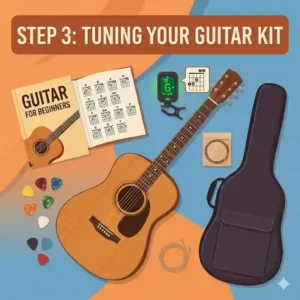
Pro-Tip: The moment you tune up for the first time, grab each string around the 12th fret and gently pull it away from the fretboard. Give it a gentle tug to stretch it, then retune. Repeat this three times per string. This simple “string stretching” technique eliminates 90% of the tuning instability that frustrates beginners.
The Callus Building Phase
During your first two weeks, your fingertips will hurt. You are pressing soft skin against steel or bronze wire under high tension.
What to do: Limit your practice to 15-20 minutes a day for the first week. Do not push through severe pain, as this can cause blisters which will force you to stop playing entirely for days. By week three, the skin on your fingertips will harden into calluses, and the pain will disappear entirely. If you purchased an acoustic kit, you can temporarily tune the guitar down a half-step (to Eb) to reduce the string tension while your fingers adapt.
Optimizing Your Practice Amp
If you bought an electric learn to play guitar kit, you are probably confused by the knobs on the small amplifier. Keep it simple. Set the Volume to 2 or 3. Set Treble, Middle, and Bass all to 5 (pointing straight up). This is your “flat” EQ starting point. Avoid the temptation to crank the overdrive/gain knob to 10 immediately; too much distortion masks sloppy technique. Keep the gain low so you can clearly hear whether your fingers are muting strings they shouldn’t be.

Problem → Solution Guide: Overcoming Common Beginner Hurdles
Even with the best gear, you will encounter mechanical and physical roadblocks. Here are the most common issues my students face and how to fix them using the tools you already have.
Problem 1: Fret Buzz (Strings rattling against the metal frets)
-
The Cause: Usually, this means you aren’t pressing down hard enough, or you are pressing down too far away from the actual metal fret wire. It can also mean the guitar’s “action” (string height) shifted during shipping.
-
The Solution: First, adjust your technique. Your finger should be placed immediately behind the metal fret, not in the middle of the empty space. If the buzzing persists on open strings without you touching them, the neck might need a truss rod adjustment. Most kits include a small Allen wrench for this. (If you are uncomfortable turning it, a local guitar shop can do a “setup” for a small fee).
Problem 2: The Amp is Making a Loud Hissing Noise
-
The Cause: If you are using a Stratocaster-style guitar (like the Squier kit), single-coil pickups inherently pick up electromagnetic interference from your home’s wiring, computer screens, or fluorescent lights.
-
The Solution: Move away from your computer monitor and physically turn your body. You will notice the hum gets louder or quieter depending on which direction you face. Also, flip the pickup selector switch to position 2 or 4 (in between settings)—these positions cancel the hum on Strat-style guitars.
Problem 3: The Thick E String Sounds “Dead” or Muffled
-
The Cause: Over time, dirt, sweat, and oils from your fingers accumulate in the ridges of the thicker wound strings, killing their vibration.
-
The Solution: Wipe your strings down with a clean, dry microfiber cloth after every practice session. This takes ten seconds and doubles the lifespan of your strings.
Buyer’s Decision Framework: Electric vs. Acoustic
The most agonizing choice for a beginner is choosing between an electric and an acoustic learn to play guitar kit. The spec sheets will list features, but here is a practical framework to make your decision foolproof.
Choose the Electric Kit (e.g., Squier Strat or Epiphone Les Paul) IF:
-
You live in an apartment or with roommates. Electric guitars can be played unplugged at whisper volumes, or you can plug headphones directly into the practice amp. You can practice at 2 AM without waking a soul.
-
You have small hands or grip strength issues. Electric guitar strings are physically thinner and require significantly less pressure to fret than acoustic strings.
-
Your musical heroes play rock, metal, or blues. Motivation is everything. If you want to play Metallica, strumming an acoustic will feel unfulfilling.
Choose the Acoustic Kit (e.g., Yamaha F325D or Donner) IF:
-
You want ultimate portability. You can take an acoustic to a park, a beach, or a friend’s house without worrying about power outlets, cables, or carrying an amp.
-
You want to sing while you play. The acoustic guitar sits perfectly in the frequency range beneath the human voice, making it the ultimate accompaniment instrument.
-
You prefer a simplified setup. There are no cables to untangle, no amps to dial in, and no pedals to buy. You just pick it up and play.
Insider Insight: A common myth is that you “must learn acoustic first to build finger strength.” This is outdated advice. Learn on the instrument that inspires you to pick it up every single day.

How to Choose the Perfect Kit (Features That Actually Matter)
When you are browsing through endless pages of guitar bundles, the marketing jargon can be overwhelming. Let’s filter out the hype and focus on the components that directly impact your success.
1. The Quality of the Tuners (Machine Heads)
Cheap, open-gear tuners with plastic buttons are a red flag. Look for “sealed die-cast” tuners (like those on the Yamaha and Squier models). Sealed tuners have gears enclosed in a metal housing, permanently lubricated. This means they turn smoothly without catching, allowing for micro-adjustments. If your guitar won’t stay in tune, you can’t train your ear to recognize correct pitches, which stunts your musical development.
2. Neck Finish: Satin vs. Gloss
Pay attention to the back of the neck. A high-gloss finish looks premium, but in practice, a sweaty palm will stick to it like glue, hindering your ability to slide up and down the fretboard. A “satin” finish is matte and feels like raw, smooth wood. It allows for much faster, frictionless hand movement.
3. The Gig Bag Reality Check
Almost every learn to play guitar kit advertises a “gig bag.” Be aware that entry-level gig bags are essentially unpadded nylon sleeves. They protect against dust and light scratches, but they will not protect the instrument from a drop. If you plan on taking the guitar to lessons on the bus, factor in the cost of buying a padded gig bag with at least 10mm of foam protection.
For a deeper dive into the anatomy of guitars and how different components interact, authoritative resources like Wikipedia’s comprehensive breakdown of the Guitar offer excellent foundational knowledge.
Common Mistakes When Buying Your First Instrument
In my years of consulting new musicians, I see the same costly mistakes repeated over and over. Avoid these pitfalls to ensure you don’t waste your hard-earned money.
Mistake 1: Buying Purely Based on Aesthetics
It is tempting to buy the guitar with the craziest shape or the neon paint job. However, oddly shaped guitars (like V-shapes or extreme asymmetrical designs) are notoriously difficult to play while sitting down. As a beginner, 95% of your practice will be done sitting in a chair. Buy a standard shape (Stratocaster, Les Paul, or Dreadnought) that balances comfortably on your knee.
Mistake 2: Ignoring the Amplifier Quality
In electric bundles, companies often include a terrible amplifier just to check a box. An electric guitar is only half of the instrument; the amplifier is the other half. Even a $2,000 professional guitar will sound like a tin can played through a garbage amp. Kits that feature branded amps (like Fender’s Frontman or Epiphone’s Electar) at least ensure a baseline of tonal clarity.
Mistake 3: Buying a “Toy” Guitar
Beware of ultra-cheap bundles found in big-box supermarkets. These are often classified as “guitar-shaped objects” by luthiers. They look like guitars but have plastic frets, un-adjustable necks, and bridges placed in the wrong mathematical location, meaning they literally cannot be tuned properly. Sticking to recognized brands ensures you are buying a real, functional musical instrument.

What to Expect: Real-World Performance & Maintenance
Let’s talk about the lifecycle of your kit. Amazon reviews usually capture the first 48 hours of ownership, but what happens six months down the line?
The Three-Month Mark: The String Change
Around month three (or sooner if you play daily), your guitar will start sounding dull, and the strings will turn a dark, tarnished gray. This is normal. You must learn to change your own strings. It is a rite of passage. Buy a dedicated string winder tool (they cost very little) to save your wrists. When you put new strings on, the guitar will immediately sound bright, loud, and alive again. It’s like giving your instrument a new engine.
The Six-Month Mark: Seasonal Shifts
Wood is organic; it breathes. As the seasons change from summer to winter, the humidity drops, and the wood in your guitar’s neck will subtly contract. You might notice the strings suddenly sitting lower and buzzing against the frets, or sitting too high and becoming hard to play. This is when you use that included Allen wrench to make a quarter-turn adjustment to the truss rod (the metal bar inside the neck). Learning basic maintenance is part of playing the instrument.
To understand the long-term benefits of engaging with an instrument—including cognitive and motor skill development—the National Association for Music Education provides incredible peer-reviewed insights on why pushing through these maintenance hurdles is worth the effort for adult and child learners alike.
Long-Term Cost & Maintenance of Your Investment
A learn to play guitar kit is a fantastic upfront value, but you need to budget for the “Total Cost of Ownership.” Guitars are not one-and-done purchases; they require consumables.
The Consumables:
-
Strings: You should replace these every 2-3 months. A standard set of quality strings (like Ernie Ball or D’Addario) runs about $6-$8.
-
Picks: You will lose them. They vanish into another dimension. Buy a bulk pack of medium-thickness (0.73mm) picks for about $5.
-
Cables (For Electrics): The cable included in most beginner kits is notoriously flimsy and prone to shorting out if stepped on. Expect to spend $15-$20 on a durable, braided cable within your first year.
The Pro Setup:
While the kits on our list are highly playable out of the box, every mass-produced guitar benefits from a professional “setup” by a local guitar technician. For around $50-$75, a tech will perfectly file the nut slots, adjust the neck relief, set the intonation, and polish the frets. I highly recommend having this done around the six-month mark. It transforms a $200 beginner guitar into an instrument that plays like a $600 mid-range model.
✨ Don’t Miss These Exclusive Deals!
🔍 Ready to start playing? Click on any highlighted product above to check current pricing and availability. Treat yourself to the gift of music today!

Conclusion
Starting your musical journey is one of the most rewarding commitments you can make, but the gear you choose on day one dictates how steep that learning curve will be. A thoughtfully curated learn to play guitar kit removes the guesswork, providing you with a reliable, playable ecosystem right out of the box.
Whether you opt for the electric versatility of the Squier Stratocaster or the campfire-ready resonance of the Yamaha F325D, remember that the instrument is just a tool. The real magic happens when you dedicate 20 minutes a day to practicing. Don’t let initial finger pain or tuning frustrations stop you—these are temporary hurdles every famous guitarist has overcome. Choose the kit that aesthetically and musically excites you, embrace the beginner’s journey, and start making noise.
FAQs
❓ What is included in a typical learn to play guitar kit?
✅ Most kits include the guitar, a gig bag, guitar strap, a few picks, and spare strings. Electric kits will also feature a small practice amplifier (usually 10 to 15 watts) and an instrument cable to connect the guitar to the amp…
❓ Can a left-handed person use a right-handed learn to play guitar kit?
✅ No, unless the guitar is specifically modified by a professional, which is costly. It is highly recommended to search specifically for left-handed kits, though they are slightly harder to find in budget tiers…
❓ How long does it take to learn to play guitar?
✅ With 20-30 minutes of daily practice, most beginners can smoothly transition between basic open chords and play simple songs within 30 to 60 days. Mastery and complex soloing take years of dedicated practice…
❓ Do I need to buy an amplifier for an acoustic kit?
✅ No. Acoustic guitars project sound naturally through their hollow bodies and soundholes. Unless you purchase an “acoustic-electric” model meant for live stage performances, no amplifier or cables are necessary for practice…
❓ Are the strings on a beginner guitar kit hard to press down?
✅ Factory strings can be stiff initially. Electric strings are generally thinner and easier on the fingers. If acoustic strings cause severe pain, swapping them for “extra light” gauge strings will significantly improve playability…
Recommended for You
- 5 Best Options for a Bass Guitar Cable in 2026 (Expert Tested)
- Bass Guitar Onboard Preamp: 7 Best Power Upgrades for Epic Tone (2026)
- 5 Best Bass Guitar Loop Pedal Options for Massive Low-End (2026)
Disclaimer: This article contains affiliate links. As an Amazon Associate, I earn from qualifying purchases. If you purchase products through these links, we may earn a small commission at no additional cost to you.
✨ Found this helpful? Share it with your friends! 💬🤗