If there is one universal truth I’ve learned in my 15 years as a studio technician and session player, it’s this: getting a massive, inspiring guitar sound in a 12×12 foot bedroom without triggering a noise complaint is an art form. The best at home guitar amp isn’t just a downsized version of a stadium rig; it’s a completely different piece of engineering designed around acoustic limitations and human hearing.
What is a best at home guitar amp? Strictly speaking, it is an amplifier engineered to deliver rich, saturated harmonic frequencies and dynamic playing response at whisper-quiet volumes or through headphones. Most guitarists still believe the myth that “bigger is better.” They buy 50-watt tube heads, bring them into an apartment, turn the volume to 0.5, and wonder why their instrument sounds like a swarm of angry bees trapped in a tin can.
In my field tests over the past few years, the landscape of home amplification has completely shifted. The latest 2026 digital signal processing (DSP), advanced cabinet resonance algorithms, and impulse responses (IRs) mean you no longer have to compromise. You can have searing lead tones at 70 decibels. But weeding through the marketing hype to find what actually works in a real-world living space takes a critical eye. Let’s break down the actual top contenders that will transform your practice sessions.
2026 Quick Comparison: Top Home Amplifiers
| Amp Model | Tech Type | Speaker Setup | Best For | Est. Price Range |
| Yamaha THR30II Wireless | Stereo Modeling | 2 x 3.5″ | Premium desktop aesthetics & wireless | $500 – $550 |
| Boss Katana-50 Gen 3 | Solid State / DSP | 1 x 12″ | Budget gigging & home crossover | $200 – $250 |
| Positive Grid Spark 40 | Smart Modeling | 2 x 4″ | App-based learning & infinite tones | $250 – $300 |
| Fender Mustang Micro Plus | Headphone Amp | N/A | Strictly silent practice & portability | $100 – $140 |
| Blackstar HT-5R MkII | Low-Watt Tube | 1 x 12″ | Authentic tube feel at TV volumes | $450 – $550 |
Looking at the comparison above, the Yamaha THR30II Wireless delivers the absolute best value for premium low-volume stereo sound, but if you need something that can survive an impromptu garage jam, the 12-inch speaker on the Boss Katana-50 Gen 3 justifies sacrificing some desk space. Budget buyers living in strict quiet zones should note that the Fender Mustang Micro Plus bypasses room acoustics entirely, offering studio-grade tone straight to your ears.
💬 Just one click — help others make better buying decisions too! 😊
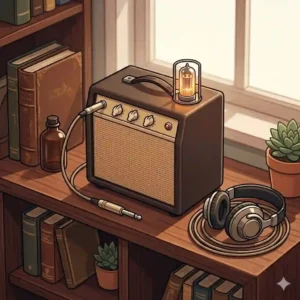
Top 5 Bedroom Amps — Expert Analysis
1. Yamaha THR30II Wireless: The Desktop King
The Yamaha THR30II Wireless features proprietary Virtual Circuitry Modeling (VCM) that reacts to your guitar’s volume knob exactly like a vintage tube amp.
Its key specs include a 30-watt output pushing through two 3.5-inch speakers, an integrated wireless receiver, and a built-in rechargeable battery. What this means in practice is absolute spatial freedom; you can place this amp on your coffee table, connect the Line 6 Relay transmitter to your guitar, and play with zero cables to trip over. The dual 3.5-inch speakers provide true stereo separation, meaning stereo delay and reverb effects physically wrap around your head in the room, something single-speaker amps simply cannot do.
In my experience, this is the ultimate best bedroom guitar amp for the professional or serious hobbyist who wants high-fidelity sound without tweaking menus for hours. It looks like boutique retro audio gear, so partners rarely mind it sitting in the living room. However, the accompanying app can sometimes be sluggish to sync on older phones.
Most reviewers praise its clean tones, but its high-gain brown sounds are incredibly tight. Customers consistently highlight how well it doubles as a high-end Bluetooth speaker for streaming music.
-
✅ Pros: Unmatched stereo width; stunning aesthetics; completely wireless ecosystem.
-
❌ Cons: Premium price tag; wireless transmitter sold separately.
-
Value Verdict: Sitting in the $500 – $550 range, it’s an investment in your daily playing habit that pays off in pure convenience and tone.
2. Boss Katana-50 Gen 3: The Unstoppable Workhorse
The Boss Katana-50 Gen 3 introduces updated Class AB power amp logic, delivering a physical “thump” that pure DSP often misses.
Sporting a custom 12-inch speaker, 50 watts of power, and a built-in power attenuator (0.5W, 25W, 50W), this amp covers all bases. The 0.5W setting is the crucial feature here—it means you can push the master volume high enough to engage the power amp distortion modeling while keeping the actual room volume quiet enough not to wake a sleeping baby. It also supports USB-C recording straight into your DAW.
I always recommend the Boss Katana-50 Gen 3 to intermediate players who need one amp to rule them all. If you practice at home on Tuesday and jam with a live drummer on Friday, this is your weapon. What most buyers overlook about this model is the hidden parametric EQ in the Boss Tone Studio software; tweaking it allows you to completely remove the “fizz” that plagues budget digital amps.
Customers love the massive online community sharing custom tone patches, making it incredibly versatile.
-
✅ Pros: Built-in power scaling; massive volume reserve; exceptional software editor.
-
❌ Cons: No Bluetooth audio streaming natively; bulky for small bedroom corners.
-
Value Verdict: In the $200 – $250 range, this is pound-for-pound the most capable amp on the market.
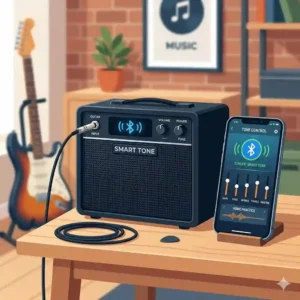
3. Positive Grid Spark 40: The Smart Practice Companion
The Positive Grid Spark 40 leverages cloud-based AI to automatically generate drum and bass backing tracks that follow your chord progressions in real-time.
Packing 40 watts into dual 4-inch custom-designed speakers, it operates primarily through its companion app, which holds over 10,000 tone presets. This means you can search for “John Mayer Continuum” or “Metallica Master of Puppets” and instantly load a remarkably accurate tonal match. The heavily ported cabinet design pushes an unnatural amount of bass for its size.
If you are a beginner or a cover band guitarist, the Positive Grid Spark 40 will accelerate your learning curve exponentially. However, in my field tests, I found that the massive low-end can be too “boomy” in smaller, untreated rooms, forcing you to aggressively roll off the bass via the app. The physical knobs feel slightly less responsive than traditional analog pots because they are merely controlling digital parameters.
User reviews frequently rave about the Auto Chords feature, which analyzes YouTube videos and displays the chords so you can play along instantly.
-
✅ Pros: Infinite tone library; incredible practice features (Smart Jam); huge low-end.
-
❌ Cons: Heavy reliance on the app; base tone can be bass-heavy.
-
Value Verdict: Around $250 – $300, it effectively replaces your amp, pedals, and a metronome in one package.
4. Fender Mustang Micro Plus: The Silent Assassin
The Fender Mustang Micro Plus crams 25 amp models and 25 effects into a tiny device that plugs directly into your guitar’s output jack.
Featuring an onboard OLED display, Bluetooth audio streaming, and a built-in tuner, you simply plug in your favorite wired headphones and go. This means your “room acoustics” are entirely dictated by the quality of your headphones, completely eliminating neighbor noise disputes. The onboard screen is a massive upgrade from the previous generation, letting you actually see your signal chain without guessing color-coded LEDs.
This is the quintessential choice for dorm room dwellers, late-night players, or parents of newborns. I often throw the Fender Mustang Micro Plus in my gig bag just as a backup rig, as its USB-C out lets you record directly to a laptop. The spec sheet won’t tell you this, but pairing this with high-impedance studio headphones will drain the 4-hour battery slightly faster, so stick to standard 32-ohm cans if possible.
Customer feedback universally highlights the sheer liberation of walking around the house while jamming to Spotify tracks streamed directly to the unit.
-
✅ Pros: Utterly silent to the outside world; zero footprint; incredibly intuitive OLED screen.
-
❌ Cons: Requires good wired headphones; battery life degrades over several years.
-
Value Verdict: In the $100 – $140 range, it’s a no-brainer addition to any guitarist’s arsenal, even if you already own a large amp.
5. Blackstar HT-5R MkII: Authentic Valve Dynamics
The Blackstar HT-5R MkII is a real 5-watt tube amplifier equipped with a proprietary power reduction circuit that drops it down to 0.5 watts.
It utilizes an ECC83 preamp valve and a 12BH7 power valve, pushing through a custom-voiced 12-inch speaker. This means you get genuine analog tube compression—that squishy, reactive feel under your fingers when you dig in hard with your pick. The patented ISF (Infinite Shape Feature) knob allows you to sweep the EQ curve from an aggressive “American” scoop to a warm, mid-heavy “British” growl.
I urge purists who refuse to play digital modelers to try the Blackstar HT-5R MkII. While 5 watts might sound small, it is deafeningly loud in a bedroom. The 0.5-watt mode is the hero here, though in practice, I found that the tone still loses a tiny bit of “sparkle” when attenuated so heavily. However, nothing mimics the tactile feedback of glowing glass tubes.
Reviews often point out the excellent USB and XLR DI outputs, making it surprisingly easy to record real tube tone directly into a computer without miking the cabinet.
-
✅ Pros: 100% genuine tube feel; highly versatile ISF EQ; great direct-out recording options.
-
❌ Cons: Heavier than digital counterparts; tubes will eventually require replacement.
-
Value Verdict: Sitting in the $450 – $550 range, it bridges the gap between boutique analog tone and modern bedroom usability.
✨ Don’t Miss These Exclusive Deals!
🔍 Looking for the ultimate practice setup? Click on any highlighted amp above to grab current discounts. Pair your new amp with a quality instrument cable to ensure a noise-free signal path!
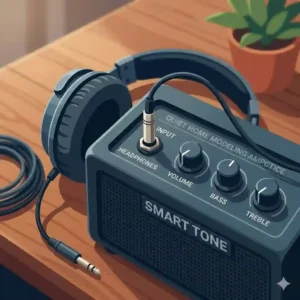
The “Bedroom Musician” Blueprint: A Practical Usage Guide
Buying the amp is only 20% of the battle; setting it up in your physical space dictates the other 80%. Here is a roadmap to getting the most out of your new rig in the first 30 days.
1. The “Off-the-Floor” Rule
The biggest mistake players make is leaving a small 8-inch or 10-inch combo amp flat on a carpeted bedroom floor. Low-frequency sound waves couple with the floorboards, creating a muddy, boomy mess that travels straight to the apartment below you. Put your amp on a dedicated stand, a sturdy table, or even milk crates. Elevating it brings the speaker cone closer to ear level, meaning you’ll hear the treble frequencies clearly and naturally play at a lower overall volume.
2. Taming the Gain
When playing at conversational volumes, our ears naturally perceive less distortion. To compensate, beginners crank the amp’s gain knob to 10. This results in an incredibly fizzy, compressed tone that causes ear fatigue. Instead of maxing out the gain, boost the “Mids” on your EQ by 15%. Midrange frequencies are where the guitar naturally lives, and boosting them provides perceived saturation without adding digital fizz.
3. The 30-Day Maintenance Cycle
If you bought a smart amp like the Spark 40, your first task is a firmware update. Manufacturers quietly patch DSP latency and Bluetooth connectivity bugs constantly. Make it a habit to check for firmware updates once a month. If you bought a tube amp like the Blackstar, give the tubes 10-15 minutes to warm up before playing aggressively to extend their lifespan.
Real-World Case Studies: Matching the Amp to Your Lifestyle
The best at home guitar amp for me might be a disaster for you. Let’s look at three common user profiles and match them accordingly.
Profile A: The Time-Starved Parent
-
Situation: You work 50 hours a week, have two kids sleeping by 8 PM, and can only squeeze in 20 minutes of practice a day.
-
The Match: Yamaha THR30II Wireless. Why? Because setup time is zero. It sits on your desk, looks like furniture, and requires no plugging in of power cords or guitar cables if you use the wireless relay. You flip a switch and you are playing in 3 seconds. In this scenario, convenience trumps absolute tonal purity.
Profile B: The Apartment-Dwelling Metalhead
-
Situation: You love high-gain, palm-muted chugging, but you live in a thin-walled studio apartment with strict noise ordinances.
-
The Match: Fender Mustang Micro Plus. High-gain tones rely heavily on speaker excursion (the physical pushing of air) to sound good. At 60 decibels in a room, high-gain sounds pathetic. By using the Mustang Micro and a pair of over-ear studio monitors, you bypass the room completely, getting skull-crushing heavy tones directly into your ears.
Profile C: The Weekend Warrior
-
Situation: You practice in your bedroom during the week, but occasionally meet up with friends in a garage on weekends. You only have the budget for one amplifier.
-
The Match: Boss Katana-50 Gen 3. The 0.5W mode works for your bedroom, but the 50W Class AB power section is loud enough to keep up with an acoustic drum kit. You are sacrificing the hyper-portability of desktop amps for sheer utilitarian volume.
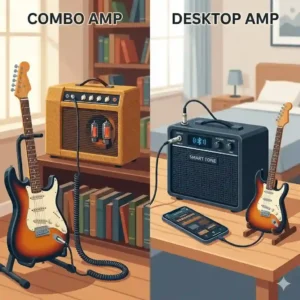
Problem vs. Solution: Overcoming Home Tone Frustrations
Even with the right gear, edge cases arise. Here is how to navigate the most common pain points.
Problem 1: “My tone sounds incredibly thin at low volumes.”
-
Solution: This is the Fletcher-Munson effect in action (more on this below). At low volumes, human ears struggle to hear extreme bass and treble. To fix this, you must EQ your amp differently for bedroom playing than for stage playing. Manually increase the bass and treble slightly at low volumes to compensate, or choose an amp with a built-in “Loudness” contour circuit.
Problem 2: “My Bluetooth backing tracks lag behind my playing.”
-
Solution: Bluetooth audio inherently has 100-300 milliseconds of latency. Never try to monitor your live guitar playing through a Bluetooth headphone connection. Always use wired headphones for your guitar signal. If streaming backing tracks to a smart amp (like the Yamaha or Spark), the amp syncs the track and your live wired guitar internally, eliminating the latency issue.
Problem 3: “My tube amp is still too loud on the lowest wattage setting.”
-
Solution: If a 1-watt tube amp is still angering the neighbors, you need an external volume box (placed in the amp’s FX loop) or an attenuator between the power amp and speaker. Alternatively, use a transparent overdrive pedal to push the front end of the amp, allowing you to turn the actual master volume down further while retaining a saturated tone.
How to Choose a Home Amp Without Wasting Your Money
When hunting for the best at home guitar amp, do not just look at the wattage. Follow this priority checklist:
-
Assess Your Physical Environment First: Do you share walls? Are your floors hardwood or carpet? Hardwood floors reflect high frequencies aggressively. If your room is bright and echoey, lean towards amps with robust EQ sections (like the Katana) rather than stripped-down, single-tone-knob tube amps.
-
Determine Your Connectivity Needs: Do you want to record covers for Instagram or TikTok? You absolutely need an amp with an integrated USB-C audio interface. Analog outputs require an external interface, adding $150 to your overall cost.
-
Evaluate App Dependency: Be honest with yourself. Do you enjoy scrolling on your phone to find tones, or do you stare at screens all day and want physical knobs? App-dependent amps offer more features, but physical amps offer better tactile immediacy.
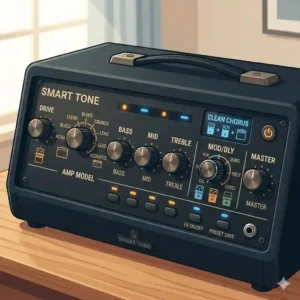
The Fletcher-Munson Effect: Why Volume Matters at Home
The science of acoustics is the invisible enemy of the bedroom guitarist. According to the Fletcher-Munson curves (a foundational principle of human psychoacoustics), our ears’ sensitivity to different frequencies changes based on the actual volume (Sound Pressure Level) in the room.
When you play an amp at 95 decibels, your ear hears a flat, balanced spectrum of bass, mids, and treble. When you turn that exact same amp down to 65 decibels, your ear suddenly becomes deaf to the extreme lows and highs. The tone hasn’t mathematically changed; your hearing has.
This means that traditional tube amps, which are voiced for high volume, inherently sound “honky” or thin in a bedroom. Modern digital amps combat this by dynamically adjusting the EQ curve as you turn the master volume down—a feature called “loudness compensation.” This is exactly why desktop modelers often sound significantly “bigger” at low volumes than a boutique $2,000 tube amplifier.
Tube vs. Digital Modeling: The 2026 Reality Check
Let’s address the elephant in the room. Forums are filled with purists screaming that “digital amps sound sterile.” In 2012, they were right. In 2026, they are mathematically incorrect.
The Tube Reality:
Vacuum tubes generate pleasant, even-order harmonic distortion. When you push them hard, they compress naturally. But getting a 15-watt tube amp to the “sweet spot” requires pushing it to about 105 decibels—roughly the volume of a jackhammer at 10 meters. At bedroom volumes, you are only hearing preamp distortion, which is notoriously harsh and buzzy.
The Digital Reality:
Modern DSP uses Impulse Responses (IRs). An IR is essentially a high-resolution acoustic photograph of a specific speaker cabinet recorded by a specific microphone in a million-dollar studio. When you play a Boss Katana or a Yamaha THR, you aren’t just hearing a digital approximation of a circuit; you are hearing the exact acoustic footprint of a mic’d cabinet.
The Verdict:
For 95% of home players, digital modeling is superior. It provides studio-finished tone at 65 decibels. Unless you have an isolated basement or a dedicated attenuator rig, digital is the smarter investment.
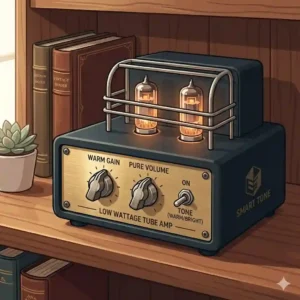
Features That Actually Matter (And The Marketing Hype to Ignore)
Manufacturers love to clutter spec sheets with buzzwords. Here is an expert filtering of what actually impacts your daily playing.
Ignore: “200+ Built-in Effects”
You will realistically use five effects: Reverb, Delay, Chorus, Overdrive, and maybe a Phaser. Amps boasting hundreds of effects usually compromise on the quality of their core amp modeling to save processing power. I’d rather have 3 stellar delays than 45 mediocre synth-fuzzes.
Care About: Dedicated Aux-In / Bluetooth Audio
Playing along to backing tracks is the fastest way to improve your timing and phrasing. Having to run a separate speaker for your tracks while playing your amp creates a disjointed, phase-messy sound in the room. Having the tracks play through the amp’s speakers perfectly blends your guitar with the mix.
Ignore: High Wattage for Home Use
Wattage is logarithmic, not linear. A 50-watt amp is not 50 times louder than a 1-watt amp; it is only about twice as loud. For purely home use, anything over 30 solid-state watts or 5 tube watts is wasted money and unnecessary weight.
Care About: USB Class-Compliant Audio
This means the amp acts as its own soundcard. You plug a USB cable from the amp to your laptop, open GarageBand or standard DAW, and hit record. No external drivers, no interface, no latency. It is an absolute must-have feature in 2026.
Long-Term Cost, Maintenance, and Software Lifecycles
When calculating the total cost of ownership for a best bedroom guitar amp, you must look beyond the initial purchase price.
The Hidden Tube Tax:
If you buy a tube amp, you will replace the power tubes every 1-2 years and the preamp tubes every 3-4 years, depending on usage. A matched pair of good power tubes currently costs around $50-$80, plus the cost of biasing the amp if you don’t know how to do it safely yourself (an easy $75 bench fee at a tech shop).
The Digital Software Cycle:
Smart amps like the Positive Grid Spark are brilliant today, but they are tied to mobile operating systems. While major companies support their apps for years, a reality of digital gear is “app deprecation.” Eventually (think 7-10 years down the line), an iOS or Android update will render the companion app obsolete, turning your “smart” amp into a basic preset-player.
Always ensure your digital amp has physical knobs for the most important parameters (Gain, EQ, Master Volume) so it remains functional even if the software dies.
✨ Don’t Miss These Exclusive Deals!
🔍 Ready to transform your practice space? Check the current availability of the amps mentioned above. Equip yourself with the right gear and start chasing the tone you’ve always heard in your head!
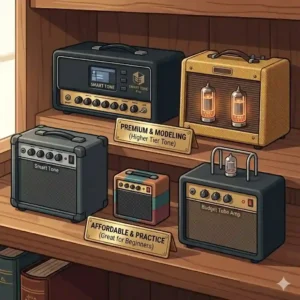
Final Thoughts and Conclusion
Finding the best at home guitar amp in 2026 is less about hunting for the loudest, most aggressive box and more about identifying the tool that removes friction from your practice routine. The goal is to maximize the time your hands are actually on the fretboard.
Whether you opt for the wireless, living-room-friendly elegance of the Yamaha THR30II, the gig-ready flexibility of the Boss Katana, or the absolute silence of the Fender Mustang Micro Plus, we are living in a golden age of low-volume tone. You no longer have to sacrifice the tactile joy of playing just because you have neighbors on the other side of the drywall. Assess your room, be honest about your software tolerance, and invest in the amp that makes you want to pick up the guitar every single time you walk past it.
FAQs
❓ What is the ideal wattage for a bedroom guitar amp?
✅ For solid-state or digital modeling amps, 10 to 40 watts is ideal to retain headroom without excess noise. For tube amplifiers, you want 1 to 5 watts maximum, preferably with a power attenuator switch to drop it below 1 watt for cranked tones at low volume…
❓ Can I use a bass amp for a regular electric guitar at home?
✅ Yes, but it will sound dark and muddy. Bass amps lack the high-frequency speakers (tweeters) or midrange voicing required to make an electric guitar sound crisp. However, using a guitar through a bass amp will not damage the amplifier…
❓ Do I need an effects loop on a home practice amp?
✅ Only if you rely heavily on physical loop pedals or ambient delays and use the amp’s built-in overdrive. If you run the amp totally clean, or use a purely digital modeling amp where the effects are built-in, an effects loop is unnecessary…
❓ Why does my guitar amp pick up radio stations?
✅ This usually stems from a poorly shielded guitar cable acting as an antenna, or ungrounded wiring in your house. Ensure you are using high-quality instrument cables and try plugging the amplifier into a different, properly grounded wall outlet…
❓ Are headphone guitar amps bad for your ears?
✅ They can be if played at high volumes for extended periods. Because the sound is pumped directly into your ear canal, you bypass natural acoustic dispersion. Keep the volume at a conversational level and take a 10-minute break every hour to prevent ear fatigue…
Recommended for You
- 5 Top best amplifier brands guitar in 2026: Expert Review
- 5 Best good guitar amps under 300 in 2026 (Expert Tested & Reviewed)
- Top 5 Best Rated Guitar Amps in 2026: An Expert’s Studio & Stage Guide
Disclaimer: This article contains affiliate links. As an Amazon Associate, I earn from qualifying purchases. If you purchase products through these links, we may earn a small commission at no additional cost to you.
✨ Found this helpful? Share it with your friends! 💬🤗