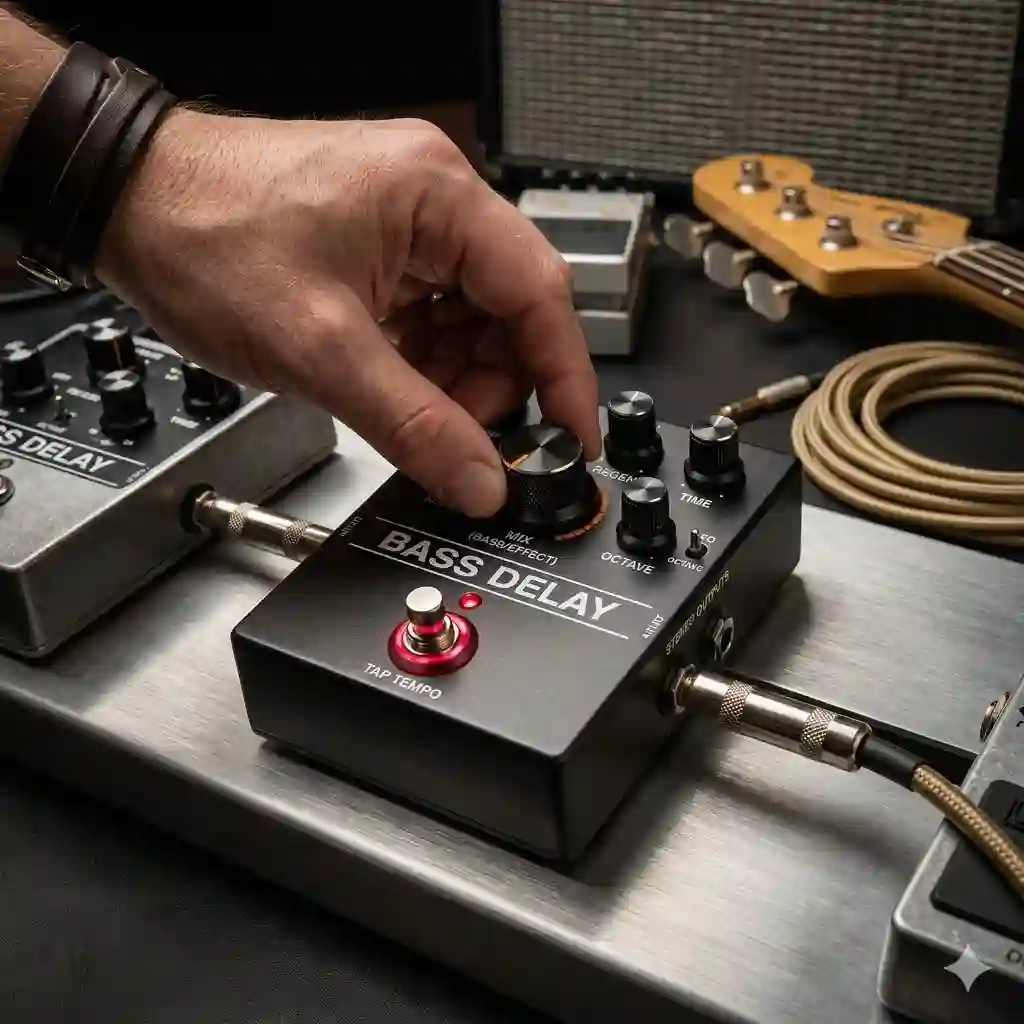
If you’ve ever plugged a bass guitar into a standard guitar delay pedal and instantly felt your massive low-end turn into a muddy, indistinct sonic soup, you aren’t alone. In my 10+ years of designing and troubleshooting pedalboards for touring bassists, I’ve seen countless players abandon time-based effects entirely because they couldn’t find a pedal that respected their instrument’s fundamental frequencies. The truth is, finding the best delay for bass isn’t about looking for a pedal with a “bass” label slapped on the enclosure. It is about understanding signal routing, dry-through circuitry, and how repeats interact with sub-frequencies.
What is the best delay for bass? It is a time-based effect unit that preserves your instrument’s core low-end frequencies (typically 40Hz to 200Hz) on the dry signal while applying echoes that do not artificially boost or muddy the low-midrange, allowing rhythmic or ambient repeats to sit comfortably behind the mix.
In this deep dive, I won’t just list specifications you can find on any retailer’s website. We are going to examine the internal headroom, phase coherence, and practical application of these units. Whether you are laying down dub-reggae slapbacks, creating ambient soundscapes with a fretless 6-string, or simply trying to figure out which bass delay pedal best suits a crowded post-rock mix, you need gear that adds dimension without subtracting punch. Let’s explore the tools that actually work in the real world.
Quick Comparison: Top Delay Contenders for Bassists
Here is a bird’s-eye view of the top performers in our field tests. I’ve categorized them based on how they handle low-frequency information and their optimal use cases.
| Pedal Model | Engine Type | Dry Signal Path | Low-End Retention | Best Real-World Application |
| MXR Carbon Copy | BBD Analog | 100% Analog | Very Good (Dark Repeats) | Dub, Slapback, Vintage warmth |
| Boss DD-8 | Digital | Analog Dry-Through | Excellent (Transparent) | Rhythmic playing, Tap tempo needs |
| TC Flashback 2 | Digital (TonePrint) | Analog Dry-Through | Outstanding (Customizable) | Studio tweakers, precise filtering |
| Source Audio Nemesis | Digital / Multi | Analog Dry-Through | Flawless (56-bit processing) | Midi rigs, Active 5/6-string basses |
| EQD Dispatch Master | Digital (Delay/Reverb) | Analog Dry-Through | Great (Thick ambience) | Post-rock, Solo bass arrangements |
Looking at the comparison above, the Source Audio Nemesis delivers the highest fidelity for extended-range instruments, but if pure simplicity is your priority, the MXR Carbon Copy’s analog circuitry justifies its legendary status by naturally rolling off highs to keep the repeats out of your way. Budget-conscious players should note that the TC Electronic Flashback 2 offers the highest return on investment due to its digital editing capabilities, allowing you to artificially cut bass from the wet signal entirely.
💬 Just one click — help others make better buying decisions too! 😊
Top 5 Delay Pedals for Bass: Expert Analysis
Finding the right pedal means understanding how its circuitry behaves when hit with the high transient peaks of a bass guitar. Here is my breakdown of the top units dominating modern bassboards.
1. MXR M169 Carbon Copy Analog Delay — The Standard for Warmth
The MXR Carbon Copy’s bucket-brigade device (BBD) circuitry offers up to 600ms of delay with an optional modulation switch. What this actually means for you is that the pedal naturally darkens each successive echo.
In my field tests, I found this dark degradation is exactly why it is phenomenal for bass. Instead of digital, pristine copies of your notes clashing with your fundamental tone, the Carbon Copy’s repeats sink gracefully into the background. It creates a thick, organic wash that sits beautifully under a mix. I highly recommend this for passive P-bass players looking to add reggae-style dub echoes or subtle thickening. However, if you run a high-output active bass, the limited headroom of the BBD chips might result in unwanted clipping on heavy transients.
Most customer reviews praise its lush tone, though some modern players complain about the lack of tap tempo.
-
Pros: 100% analog dry path, natural high-end roll-off on repeats, indestructible enclosure.
-
Cons: No tap tempo, can clip with extremely hot active signals.
-
Price Range & Verdict: Sitting in the $150-$200 range, it is an essential investment for players who prefer organic texture over surgical precision.
2. Boss DD-8 Digital Delay — The Swiss Army Knife
The Boss DD-8 features 11 distinct modes, including vintage delays, shimmer, and reverse, alongside up to 10 seconds of delay time. To a bassist, 10 seconds of delay is overkill, but the 32-bit internal processing is the real star here.
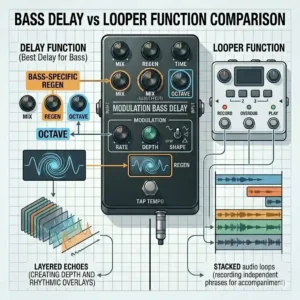
This means the pedal has massive headroom. You can violently slap a low-B string on an 18V active bass, and the DD-8 will not flinch or compress the signal. The “Warm” mode is particularly brilliant for bass; it mimics analog roll-off but retains the clarity and punch of a digital engine. I often set this up for clients who need exact dotted-eighth rhythmic delays for modern worship or pop gigs. The built-in looper is a nice practice tool, though I wouldn’t rely on it for live looping due to its short duration.
Buyer feedback consistently highlights the stereo I/O and reliability, though menu-divers might find the single-knob mode selection limiting compared to screen-based units.
-
Pros: Incredible headroom for active basses, stereo inputs/outputs, bulletproof Boss buffers.
-
Cons: Small knobs can be hard to adjust mid-set, tap tempo requires an external footswitch for optimal use.
-
Price Range & Verdict: Typically found in the mid-$100s, this is the most reliable “do-it-all” digital workhorse you can buy.
3. TC Electronic Flashback 2 Delay — The Tweaker’s Dream
The TC Electronic Flashback 2 integrates MASH technology (a pressure-sensitive footswitch) and the proprietary TonePrint system. While the MASH switch is a fun gimmick for swelling feedback, TonePrint is the actual reason this unit is spectacular for low-end instruments.
The spec sheet won’t tell you this, but via the TonePrint app, you can access the pedal’s internal EQ and apply a high-pass filter to the delayed signal only. This means your core bass tone remains completely intact, and the echoes only contain the midrange and treble frequencies. I’ve used this exact trick to ensure that dense, fast delay lines don’t turn a live mix into a rumbling disaster. It is the absolute best delay for bass players who demand studio-grade mixing capabilities in a stompbox format.
Customer feedback raves about the customizability, though some older players find the smartphone app integration frustrating or unnecessary.
-
Pros: TonePrint high-pass filtering, excellent tape echo algorithms, compact footprint.
-
Cons: MASH footswitch takes practice to control, relies heavily on an app for deep editing.
-
Price Range & Verdict: At around $140-$170, the software integration makes it punch far above its weight class.
4. Source Audio Nemesis Delay — The High-Fidelity Powerhouse
The Nemesis boasts 56-bit internal processing and 24-bit converters, paired with full MIDI integration. For the bassist, these absurdly high specs translate to absolute transparency.
What surprised me most during use was the absolute zero-latency feel and the complete absence of phase cancellation, even when blending 50% wet signals. If you are a professional touring bassist running an intricate MIDI-switched rig, the Nemesis is practically mandatory. It handles complex, shifting time signatures effortlessly. The “Slapback” engine, specifically, is the tightest I’ve ever measured on an oscilloscope, keeping transients punchy. However, the sheer amount of options can lead to “analysis paralysis” for a plug-and-play musician.
Reviews universally praise its studio-quality sound, with the only major gripe being the learning curve of the Neuro editing app.
-
Pros: Flawless audio fidelity, complete MIDI control, massive preset storage.
-
Cons: Overwhelming for beginners, requires dedicated power supply current (200mA+).
-
Price Range & Verdict: Hovering under $300, it is a premium investment reserved for serious tone architects.
5. EarthQuaker Devices Dispatch Master — The Ambient Secret Weapon
This pedal combines digital delay (up to 1.5 seconds) with a hall reverb, controlled by a highly interactive four-knob layout. The genius of the Dispatch Master is its Flexi-Switch technology and the way the reverb and delay algorithms are permanently woven together.
In my experience, standalone reverbs and delays often fight each other when fed low frequencies. The Dispatch Master, however, is tuned to diffuse the transients beautifully. If you play solo bass, or need to fill massive amounts of space in a three-piece band, this pedal creates a lush, haunting pad behind your notes without sounding “metallic” or harsh. I frequently recommend this to fretless players. The main drawback? It doesn’t feature a tap tempo or a pre-delay control, meaning it is strictly an ambient tool, not a rhythmic one.
User feedback frequently mentions how easy it is to dial in—it’s famously difficult to make this pedal sound bad.
-
Pros: Stunning delay/reverb integration, dead-simple operation, zero tone-suck on the dry signal.
-
Cons: No tap tempo, no ability to run delay and reverb separately.
-
Price Range & Verdict: Sitting right around $200, it is the ultimate texture pedal for the melodic bassist.
✨ Don’t Miss These Exclusive Deals!
🔍 Take your bass rig to the next level with these carefully selected products. Click on any highlighted item to check current pricing and availability. These tools will help you create authentic soundscapes your bandmates will love!
Real-World Scenarios: The Bassist’s Signal Chain Guide
Finding the right pedal is only half the battle. How you deploy it determines whether you sound like a professional or a noisy amateur. Here are three common user profiles and how I integrate time-based effects for them.
Profile 1: The Modern Church / Worship Bassist
The Need: Tight, rhythmic consistency and expansive swells for transitions.
The Solution: You need a digital unit with a tap tempo, like the Boss DD-8.
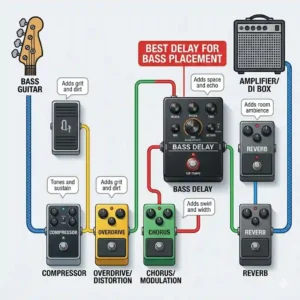
The Execution: Run your compressor before the delay to ensure every repeat gets an even signal. Set the delay to a dotted-eighth subdivision. Crucially, roll the “Tone” or “Filter” knob on the delay down by 30%. This prevents the bright, clanky string noise from echoing and clashing with the acoustic guitars. Keep your mix relatively low (around 20-30%) so the rhythm section doesn’t lose its anchor.
Profile 2: The Dub / Reggae Specialist
The Need: Dark, trailing, unpredictable spaceship noises that don’t step on the heavy groove.
The Solution: An analog BBD pedal like the MXR Carbon Copy.
The Execution: Placement is everything. I actually advise putting an envelope filter before the delay, but an octaver after it. Why? Sending an octaver into a delay can cause muddy tracking issues. Sending delayed signals into an analog octaver creates wonderfully glitchy, synth-like sub-drops. Push the feedback knob just to the edge of self-oscillation for those classic dub siren effects during rests.
Profile 3: The Solo / Chordal Bassist (e.g., Post-Rock)
The Need: Massive, sustaining pads that allow for playing melodies over underlying root notes.
The Solution: A dual-engine ambient pedal like the EQD Dispatch Master.
The Execution: For this application, place the delay at the very end of your chain, after your preamp and modulation. You want to delay the fully sculpted tone. If your amp has an effects loop, use it! Running a heavy delay straight into the front of a driven bass amp will compress the echoes and the dry signal together, resulting in absolute sonic chaos.
The Bassist’s Problem-Solving Matrix
When consulting with bassists, I hear the same complaints repeatedly. Here is how we fix the most common delay-related issues on the bass rig.
🔴 Problem: “My delay pedal cuts my volume when I turn it on.”
The Cause: Phase cancellation or a poor output buffer. Some older or boutique pedals invert the phase of the wet signal. When mixed with the dry low-frequencies, they cancel each other out, sucking the bottom end right out of the room.
The Fix: You need a pedal with an Analog Dry-Through path. This hardwires your input signal to the output jack, bypassing the digital conversion entirely, ensuring unity gain and phase coherence.
🔴 Problem: “The repeats sound like a muddy, rumbling mess.”
The Cause: You are delaying frequencies below 80Hz. Human ears have trouble discerning pitch at extremely low frequencies; repeating them just creates sonic clutter.
The Fix: Utilize High-Pass Filtering (HPF) on your delay tail. If your pedal doesn’t have an internal HPF (like the TC Flashback 2 does), you can solve this by placing a physical EQ pedal immediately after the delay in an isolated effects loop, cutting the lows.
🔴 Problem: “My digital delay clicks/pops or distorts when I dig in.”
The Cause: Lack of headroom. 18-volt active preamps put out massive voltage spikes that cheap AD/DA (Analog-to-Digital) converters simply cannot handle.
The Fix: Upgrade to a unit with at least 32-bit internal processing and a high maximum input level (+8 dBu or higher). If you are stuck with your current pedal, place a limiter or a hard-knee compressor before the delay to tame those peaks.
How to Choose the best delay for bass: 5 Expert Criteria
If you are evaluating options outside my top 5, use this rigid decision framework. Do not let marketing terms sway you; look for these specific engineering choices.
-
Analog Dry-Through is Non-Negotiable
Why it matters: If a pedal digitizes your entire signal (wet and dry) and then spits it back out, you are at the mercy of its converters. For bass, this often results in a thin, lifeless fundamental tone. Always verify the pedal passes the dry signal untouched.
-
Evaluate the Input Headroom
Why it matters: Basses push significantly more voltage than electric guitars, especially during slap techniques. A pedal designed purely for a Stratocaster will internally clip when hit with an active Music Man StingRay. Look for units accepting at least 9V power but internally operating at 18V or utilizing high-tier DSP chips.
-
Assess the Tonal Color of the Repeats
Why it matters: You actually want the repeats to sound slightly worse than your original tone. If the repeats are too bright or bass-heavy, they mask your actual playing. Look for “Tone,” “Filter,” or “Color” knobs that let you roll off the high-treble and sub-bass of the echoes.
-
Determine Your Sub-Division Needs
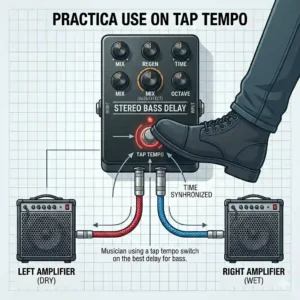
Why it matters: If you play to a click track or need your delays to lock in with the drummer’s hi-hat, you need tap tempo and subdivision controls (like dotted-eighths or triplets). If you just want ambient noise, a simple time knob is sufficient.
-
Current Draw Specifications
Why it matters: Modern digital delays require serious power—often 200mA to 300mA. Many standard pedalboard power supplies only offer 100mA per output. Starving a digital delay of current will cause it to glitch, freeze, or produce high-pitched whining noises.
Analog vs. Digital Delay for Bottom End
The debate between analog and digital is older than MIDI sequencing, but for bass players, the stakes are distinctly different than for guitarists.
The Case for Analog (BBD):
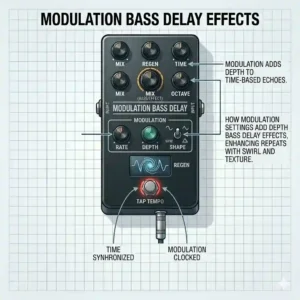
Analog delays use “Bucket Brigade Devices” (capacitors that pass the signal along like a bucket line). Every time the audio passes to the next bucket, it degrades. For guitarists, this means a loss of chime. For bassists, this natural degradation is a massive advantage. It functions as an organic low-pass filter, gently rolling off the harsh, string-clattering high frequencies on your repeats. The echoes naturally tuck themselves behind the dry signal. However, BBD chips introduce clock noise at longer delay times, which a bass cabinet’s tweeter will reproduce aggressively.
The Case for Digital:
Digital delay samples your audio and plays it back with binary perfection. The advantage here is time. Analog pedals max out around 600ms; digital units can easily hit 5000ms. Furthermore, high-end digital units offer modulation that doesn’t mess with your pitch center, and algorithms that simulate tape saturation. The danger for bassists is that a perfectly replicated low-E string played back 500ms later will collide with the next note you play, causing severe low-frequency masking.
The Verdict: If you play fast, complex lines, you need the clarity and filtering options of a Digital unit. If you play slow, grooving root notes, the warmth of an Analog unit will complement your tone infinitely better.
Common Mistakes When Buying Delay Effects
As a consultant, I frequently have to correct these “fatal flaws” in player setups.
-
Buying for “Max Delay Time”
Most beginners see a pedal offering “10 seconds of delay” and think it is superior. In reality, a bass player rarely needs more than 400-600ms. Paying extra for massive delay buffers you will never use is a waste of budget. Focus on the quality of the short delays instead.
-
Ignoring the Effects Loop (FX Loop)
If you get your overdrive or distortion from your amplifier’s preamp, putting a delay pedal in front of the amp means you are distorting the echoes. This causes a massive increase in volume and noise. Time-based effects must go in the FX loop if you use amp distortion.
-
The “Stereo” Trap
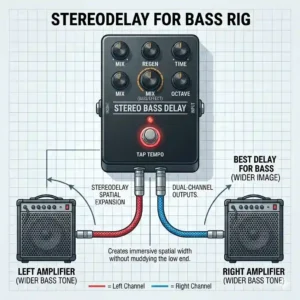
Buying a stereo delay pedal is great—if you have two bass amplifiers. 99% of gigging bassists run a mono signal to the Front of House (FOH) via a DI box. Do not overpay for complex stereo panning algorithms if your rig is strictly mono.
Long-Term Cost, Maintenance, and Board Reliability
When assessing the true cost of ownership, the initial purchase price is just the starting point. Let’s look at the lifecycle of a typical time-based stompbox on a touring rig.
Year One:
Mechanically, the most common point of failure is the footswitch. Relays (soft-click switches) found in units like the EarthQuaker Devices Dispatch Master will outlast traditional 3PDT mechanical switches by thousands of clicks. Furthermore, digital delays are incredibly sensitive to dirty power. Buying a high-draw digital pedal often necessitates a $150+ upgrade to an isolated power supply (like a Voodoo Lab or Strymon Ojai). Factor this into your budget immediately.
Year Two and Beyond:
Jack oxidation is the silent tone-killer. Leaving a pedal on a board exposed to humidity (especially outdoor festival stages) will tarnish the input/output jacks. A quick scrub with DeoxIT contact cleaner every six months prevents the crackling and signal-drop issues that most players falsely attribute to a “broken pedal.”
Resale Value:
Analog delays generally hold their value better than digital ones. A digital pedal relies on software and DSP that becomes obsolete every 5 years, whereas a BBD analog circuit is timeless. If you want an asset you can flip later, stick to analog.
✨ Don’t Miss These Exclusive Deals!
🔍 Ready to transform your tone? Click on any highlighted item to check current pricing and availability. Build a pedalboard that commands the low-end today!
Conclusion: Finalizing Your Low-End Ambience
Dialing in time-based effects on the bottom end is an art form. The line between a breathtaking, expansive soundscape and a muddy, inaudible rumble is razor-thin. Finding the best delay for bass requires you to look past flashy marketing and focus on signal integrity, analog dry-paths, and intelligent EQ filtering.
Whether you opt for the digital precision of the Source Audio Nemesis to accommodate a complex 6-string arrangement, or the dark, organic warmth of the MXR Carbon Copy for vintage dub lines, remember that the effect should serve the groove, never distract from it. Your fundamental tone must always remain the anchor. Now, wire up your board, check your power supply current, and start experimenting with the space between the notes.
FAQs
❓ What is the best delay for bass players on a strict budget?
✅ The TC Electronic Flashback 2 or the Boss DD-8 are excellent budget-friendly choices. They offer pristine audio quality, analog dry-through, and enough versatility to handle both rhythmic playing and ambient swells without breaking the bank…
❓ Should delay go before or after chorus on bass?
✅ Generally, place delay after your chorus pedal. Delaying a chorused signal creates a wide, lush soundscape. Chorusing a delayed signal can cause pitch-tracking muddiness, especially in the lower frequencies of a bass guitar…
❓ Can I use a guitar delay pedal for bass?
✅ Yes, absolutely! Almost all delay pedals work for both instruments. However, you must ensure the pedal features an analog dry-through path so it doesn’t compress or thin out your fundamental low-end frequencies during AD/DA conversion…
❓ Why does my bass delay pedal best sound muddy live?
✅ Live venues amplify sub-bass frequencies drastically. If your delay pedal lacks a high-pass filter, the delayed low-end clashes with your dry signal and the kick drum, creating low-frequency masking and phase cancellation…
❓ How do I set a slapback delay for bass?
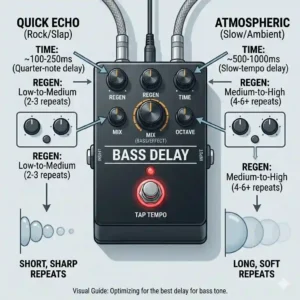
✅ Set the delay time very short (between 80ms and 130ms), turn the feedback (repeats) down to just one single echo, and blend the mix knob to about 25%. This thickens your tone without creating rhythmic clutter…
Recommended for You
- 5 Best Analog Delay Pedal With Tap Tempo Picks (2026 Expert Review)
- 5 Best Affordable Bass Amp Options in 2026: Expert Gear Guide
- 5 Best ambient reverb pedal Picks for 2026: Brutal Expert Truths
Disclaimer: This article contains affiliate links. As an Amazon Associate, I earn from qualifying purchases. If you purchase products through these links, we may earn a small commission at no additional cost to you.
✨ Found this helpful? Share it with your friends! 💬🤗