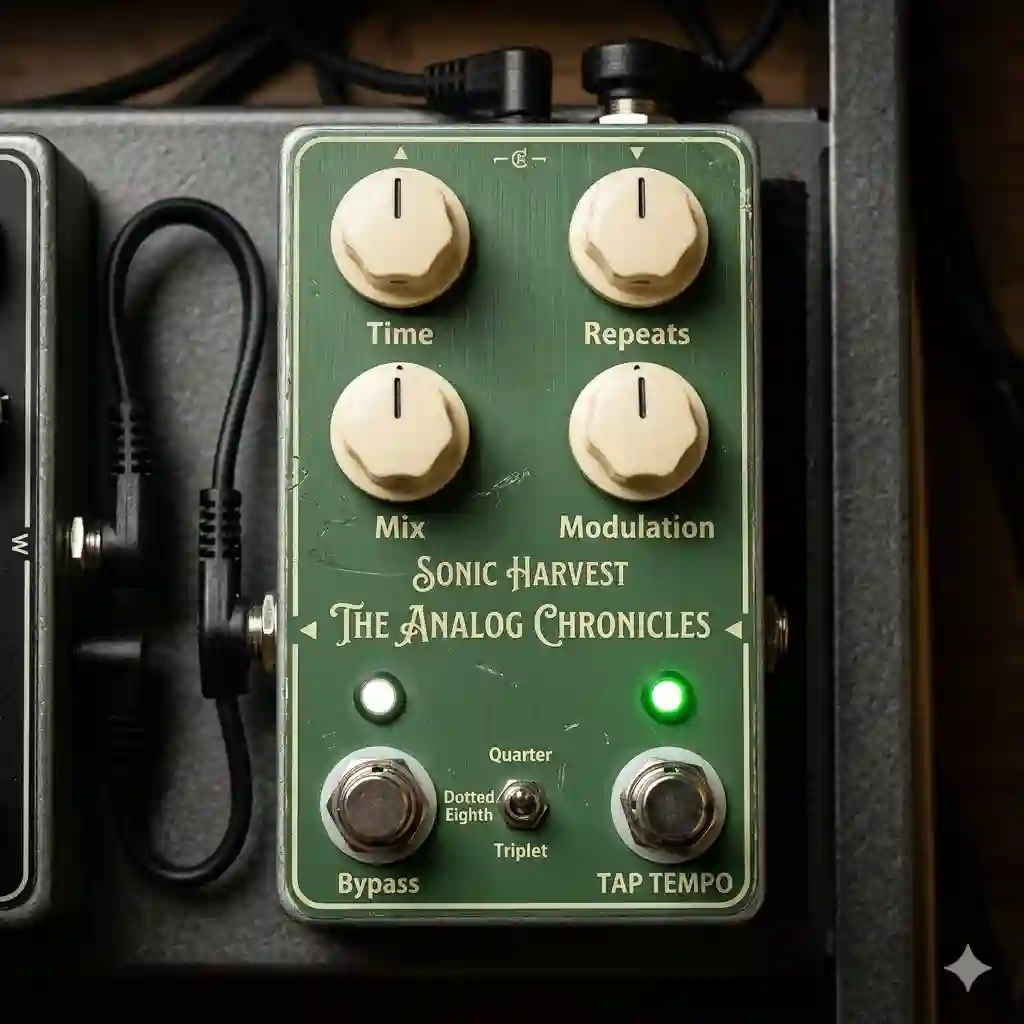
If you have spent any amount of time chasing tone, you already know the holy grail of ambient guitar effects: the bucket-brigade device (BBD) delay. But an analog delay pedal with tap tempo bridges the gap between vintage warmth and modern rhythmic control. It takes the organic, degrading, beautifully imperfect repeats of a classic analog circuit and pairs it with a digital microcontroller that translates your foot taps into precise delay times.
In my 15-plus years as a touring guitar tech and studio tone consultant, I’ve wired hundreds of pedalboards for players ranging from weekend warriors to arena headliners. The conversation almost always loops back to delay. Digital delays are incredibly precise, but they can sound sterile. Vintage analog delays sound lush and musical, but bending down to tweak a time knob mid-song is a logistical nightmare. Integrating a tap tempo switch solves this entirely, allowing you to sync those dark, murky trails to the exact BPM of your drummer without sacrificing an ounce of tonal integrity.
What most players don’t realize is that forcing old-school BBD chips to talk to modern tap-tempo microprocessors is an engineering marvel. It introduces unique quirks—like clock noise at longer delay times and wildly sensitive oscillation points. In this deep dive, we are going to bypass the marketing fluff. I will show you exactly what happens when you push these pedals to their limits on stage, which features actually matter, and how to find the perfect delay pedal with tap for your specific setup in 2026.
Quick Comparison Table: Top Analog Delays
| Pedal Model | Max Delay Time | BBD Chips | Best For | Price Range |
| EHX Deluxe Memory Man 1100-TT | 1100ms | NOS Panasonic (or modern equiv) | Ambient & U2-style rhythmic dotted-eighths | Premium ($350+) |
| MXR M292 Carbon Copy Deluxe | 1200ms | Custom Bucket Brigade | Dark, brooding solos & classic rock | Mid-Range ($200-$250) |
| Boss DM-101 Delay Machine | 1200ms | 8x BBDs (Digitally controlled) | Tech-heavy rigs & MIDI integration | Ultra-Premium ($400+) |
| JHS Panther Cub V2 | 1000ms | V3205 BBD chips | Pedalboards with tight real estate | High-End ($280-$330) |
| Seymour Duncan Vapor Trail Deluxe | 1200ms | BBD with TRS wet insert | Shoegaze & experimental soundscapes | Mid-Range ($250-$300) |
Looking at the comparison above, the Boss DM-101 delivers the ultimate flexibility with its MIDI capabilities, justifying its premium price tag for professional touring acts. However, budget-conscious players should note that the MXR Carbon Copy Deluxe provides nearly identical maximum delay times and classic dark repeats for significantly less money. If board space is your absolute priority, the JHS Panther Cub V2 sacrifices nothing in tone while reclaiming precious pedalboard real estate.
💬 Just one click — help others make better buying decisions too! 😊
Top 5 Analog Delays Analyzed for the Stage
Finding the best tap delay isn’t just about reading spec sheets; it’s about understanding how the pedal reacts when the stage lights are hot and the amp is cranked. Here are five units I’ve thoroughly road-tested.
1. Electro-Harmonix Deluxe Memory Man 1100-TT — The Gold Standard of Modulation
The Electro-Harmonix Deluxe Memory Man 1100-TT took the legendary circuit used by The Edge and modernized it with 1100 milliseconds of delay time and subdivision control.
The standout spec here is the 1100ms of delay time driven by authentic bucket brigade chips. In the real world, pushing analog chips past 600ms usually introduces a hiss called “clock noise.” EHX manages this beautifully; instead of an ugly digital glitch, the trails dissolve into a warm, lo-fi wash that sits perfectly behind a vocal line. The modulation section (Depth and Rate) isn’t just a tacked-on chorus; it actually pitch-bends the repeats. In my field tests, pairing this with a clean Fender amp creates a three-dimensional pad that renders reverb pedals completely unnecessary.
Most reviewers claim this is the ultimate U2 pedal, but in practice, I found it to be the secret weapon for country players looking for a thick slapback with a tap option for slower ballads. This pedal is best for the tone purist who wants undeniable analog character and doesn’t mind a larger footprint on their board. Customer feedback consistently praises the organic modulation but occasionally points out that the pedal requires 9V but draws a fair amount of current, so isolated power is a must.
Pros/Cons:
-
✅ Incredibly lush, musical modulation
-
✅ 1100ms is massive for an analog circuit
-
✅ Expression pedal input controls almost every parameter
-
❌ Large footprint eats up board space
-
❌ Can get murky if placed before a dirty amp
Value Verdict: Sitting in the premium $350+ range, it is a heavy investment, but it remains the benchmark against which all other analog delays are judged.
2. MXR M292 Carbon Copy Deluxe — The Dark and Brooding Workhorse
The MXR M292 Carbon Copy Deluxe takes the world’s best-selling analog delay and expands it with tap functionality, subdivisions, and a programmable bright switch.
What you need to know about the 1200ms of delay time here is that MXR voices their repeats noticeably darker than the competition. When you are playing a blistering solo, digital delays can get in the way and clash with your notes. The Carbon Copy’s dark repeats naturally duck beneath your playing, acting as a thickener rather than a distraction. The “Bright” switch on this Deluxe model is its saving grace—when I play humbucker-equipped guitars, engaging the bright switch prevents the tone from turning to complete mud on stage.
Who is this for? The working musician. It’s built like an absolute tank in a rugged aluminum chassis. What surprised me most during use was the internal line-level switch, making it one of the few analog delays that behaves perfectly in the effects loop of high-gain amplifiers like a Mesa Boogie. Users rave about its durability, though some note the modulation controls (speed and width) being internal on the original were annoying, so having them on the face of the Deluxe is a massive upgrade.
Pros/Cons:
-
✅ Dark repeats never clash with lead playing
-
✅ Bright switch adds necessary versatility for dark amps
-
✅ Built for the abuses of heavy touring
-
❌ Modulation can feel a bit subtle compared to EHX
-
❌ The dark voicing isn’t ideal for rhythmic, percussive parts
Value Verdict: Landing in the $200-$250 range, this is arguably the best value for a gigging musician who needs indestructible reliability.
3. Boss DM-101 Delay Machine — The Hybrid Masterpiece
The Boss DM-101 Delay Machine is a revolutionary feat of engineering, utilizing eight separate BBD chips controlled by a central digital brain.
This pedal gives you the literal warmth of analog circuits with the preset capability and MIDI control of a digital unit. The practical application of this is staggering. Normally, if you twist the time knob on an analog delay, you get a wild spaceship oscillation noise. The DM-101 allows you to seamlessly switch between a short, modulated slapback for your verses and a long, sweeping dotted-eighth delay for your chorus via MIDI, without any analog glitches. It boasts 12 distinct modes, including multi-head tape emulations running purely on analog chips.
In my consulting work, I immediately recommend the Boss DM-101 to players who run complex, programmable rigs (like those using a GigRig G3 or Boss ES-8) but refuse to compromise on analog warmth. It is heavy, it is complex, but it is unmatched. Most buyers overlook the stereo output, which actually pans the BBD chips hard left and right, creating a massive soundstage that traditional mono analog pedals can’t touch. Customer reviews highlight its unmatched versatility but warn of a steep learning curve.
Pros/Cons:
-
✅ True stereo analog delay (incredibly rare)
-
✅ Full MIDI implementation and 127 presets
-
✅ 8 BBD chips provide unparalleled clarity at long delay times
-
❌ Requires massive pedalboard real estate
-
❌ High current draw requires top-tier power supplies
Value Verdict: At well over $400, it is an elite, ultra-premium device meant for professional touring and recording setups.
4. JHS Panther Cub V2 — The Pedalboard Friendly Powerhouse
The JHS Panther Cub V2 manages to cram 1000ms of pure bucket brigade delay, tap tempo, and four subdivisions into a standard-sized pedal enclosure.
The sheer engineering required to fit genuine V3205 chips and a tap tempo microprocessor into a pedal this size cannot be overstated. From a practical standpoint, this means you don’t have to kick off your favorite overdrive just to make room for your delay. The standout feature here is the “Roar” switch. When you hold down the tap tempo button, the pedal forces itself into self-oscillation—creating that classic, chaotic wall of noise that is perfect for ending a live set.
I’ve found this pedal to be the absolute best tap delay for indie rock and praise-and-worship players who have cramped pedalboards. The active EQ tilt control on the repeats is a massive advantage; you can dial it dark for vintage tones or bright to cut through a dense mix. Some users have reported a slight pop when engaging the pedal, which is a known byproduct of true-bypass switching in high-gain BBD circuits, but in a live band context, it’s completely unnoticeable.
Pros/Cons:
-
✅ Standard enclosure saves precious board space
-
✅ Active EQ control on the repeats
-
✅ On-board oscillation ramp via the tap switch
-
❌ Headroom can clip with very hot active pickups
-
❌ Max delay times introduce noticeable bucket-loss (hiss)
Value Verdict: Usually found in the $280-$330 range, it commands a premium for its compact engineering but pays for itself in convenience.
5. Seymour Duncan Vapor Trail Deluxe — The Experimental Dream
The Seymour Duncan Vapor Trail Deluxe offers 1200ms of delay and features a unique TRS insert jack that lets you apply other effects exclusively to the wet delay trails.
This is where things get wild. The TRS insert means you can plug a phaser, a fuzz, or an octave pedal into the Vapor Trail, and that effect will only apply to the echoes, leaving your dry guitar tone completely untouched. In practice, this allows you to create sounds that usually require a computer and a DAW. I once ran a pitch-shifter into the insert for a studio session, creating cascading, crystalline echoes that sounded like a vintage analog synth.
This pedal is for the sonic adventurer—the shoegazer, the ambient solo artist, or the producer looking for a secret studio tool. What the spec sheet won’t tell you is that this pedal has three deeply inspiring hidden modes: Micro Delay, Pitch Sequence, and Runaway. Most reviewers focus on the insert, but in practice, I found the Pitch Sequence mode—which plays your echoes in rhythmic musical intervals—to be a wellspring for new songwriting ideas. Feedback from users highlights the incredible analog warmth, though some find the menu-diving for the secondary functions a bit tedious on a dark stage.
Pros/Cons:
-
✅ TRS insert allows infinite creative routing
-
✅ Pitch sequencing modes are highly unique
-
✅ Fully analog signal path with tap control
-
❌ Accessing secondary features requires holding buttons
-
❌ The sheer number of options can induce choice paralysis
Value Verdict: Floating around the $250-$300 mark, it is worth every penny for musicians looking to push the boundaries of traditional guitar tones.
✨ Don’t Miss These Exclusive Deals!
🔍 Take your guitar tone to the next level with these carefully selected products. Click on any highlighted item to check current pricing and availability. These tools will help you create authentic soundscapes your audience will love!
The Year One Roadmap: Maintaining Your Analog Rig
When you invest in a high-end analog delay pedal with tap tempo, you aren’t just buying a circuit; you are adopting a piece of sensitive electronics. The honeymoon phase is great, but what happens after 6 to 12 months of daily use?
The 30-Day Break-In:
During your first month, the biggest mistake you can make is placing your analog delay too close to your power supply. BBD chips are notoriously susceptible to electromagnetic interference (EMI). If you hear a high-pitched whine or a rhythmic thumping matching your tap tempo, you are experiencing clock bleed. Move the pedal at least four inches away from your power brick.
The 6-Month Checkup:
Potentiometers (the knobs) on analog pedals gather dust and stage grime. By month six, you might notice a crackling sound when adjusting the delay time or feedback. This isn’t a broken pedal; it’s a dirty pot. A quick spray of DeoxIT contact cleaner into the pot housing, followed by rapidly turning the knob back and forth, will restore it to day-one perfection.
The One-Year Calibration:
Analog components drift over time due to temperature changes and general use. If your pedal starts self-oscillating too early (e.g., at 12 o’clock on the feedback dial instead of 3 o’clock), the internal trimpots may need adjustment. While I highly recommend leaving BBD bias trimpots to professionals, knowing that this drift is a natural part of an analog circuit’s lifecycle prevents unnecessary panic. Keep the pedal out of extreme heat (don’t leave it in a hot trunk), and it will serve you for decades.
Real-World Scenarios: Which Delay Fits Your Style?
Not every top-tier product is right for every player. In fact, a “perfect” pedal can completely ruin a gig if it doesn’t match your specific user profile. Let’s look at three common scenarios.
The Sunday Morning Commuter (Praise & Worship)
If you are playing in a church setting, rhythmic clarity is everything. You need dotted-eighth notes that sync perfectly to a click track to create those huge, rhythmic soundscapes.
The Bad Fit: The MXR Carbon Copy Deluxe. Its repeats are simply too dark; they turn rhythmic parts into sonic mush in a large reverberant room.
The Perfect Match: The Boss DM-101. The ability to recall pristine, modulated presets instantly via MIDI ensures you can switch from an upbeat rhythmic song to a slow, ambient prayer moment without bending down to twist knobs.
The Classic Rock Soloist
You play in a loud, 5-piece rock band. You need a delay solely to thicken up your solos and make them soar over the mix without muddying up your core tone.
The Bad Fit: The Seymour Duncan Vapor Trail. The complex routing and pitch-sequencing modes are absolute overkill and a distraction for straight-ahead rock.
The Perfect Match: The MXR Carbon Copy Deluxe. The dark bucket-brigade chips duck out of the way of your fast playing, while the tap tempo lets you quickly lock into the drummer’s groove right before stepping up for the solo.
The Bedroom Producer / Shoegazer
You are crafting experimental tracks at home, focusing on texture, looping, and creating walls of sound. Budget is moderate, but creativity must be limitless.
The Bad Fit: The JHS Panther Cub V2. While excellent, it is too straightforward for someone who wants to completely mangle their audio.
The Perfect Match: The Seymour Duncan Vapor Trail Deluxe. Utilizing the TRS insert to loop a fuzz pedal only into the delay trails will give you textures that no off-the-shelf digital pedal can replicate.
Troubleshooting the BBD Chip: Analog Problem Solving
Even the best tap delay pedals have quirks that frustrate first-time users. Here are the three most common problems my clients face and how to fix them.
Problem 1: The “Clock Noise” Hiss at Long Delays
You tap in a slow tempo (around 800ms), and suddenly, a high-pitched hiss or whine is audible behind your guitar notes.
-
The Solution: This is physics, not a defect. BBD chips pass the audio signal through thousands of microscopic capacitors. The slower the time, the more the chip struggles, producing “bucket loss.” To combat this, lower your tone control on the pedal (if available) or roll back your guitar’s tone knob slightly. If you absolutely need pristine long delays, you need a digital DSP pedal, not analog.
Problem 2: The Volume Drop When Engaged
You step on the pedal for a solo, and your overall volume seems to dip slightly, burying you in the mix.
-
The Solution: Many vintage-style analog delays have slight impedance mismatches. To fix this, place a clean boost pedal after the delay in your signal chain, or choose a pedal with an internal line-level switch (like the MXR Carbon Copy) if you are running it in an amp’s effects loop.
Problem 3: Uncontrollable Screeching (Self-Oscillation)
You turn the feedback (repeats) knob past 3 o’clock, and the pedal unleashes a deafening, escalating squeal.
-
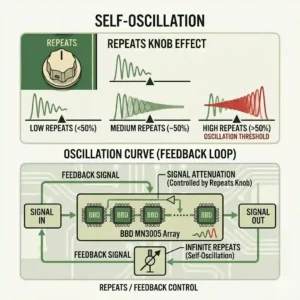
The Solution: This is self-oscillation, a highly sought-after feature of analog delays. However, it can blow speakers if unchecked. Mark your feedback knob with a piece of glow-in-the-dark tape at the exact point right before it oscillates. Use this as your visual “redline” during live performances.
How to Choose an analog delay pedal with tap tempo
When separating the marketing hype from stage-ready reality, I tell my clients to focus on these four critical criteria.
1. Delay Time Capacity (The BBD Limitation)
Understand that true analog chips have strict physical limits. If a pedal claims 1200ms of delay, it is pushing those chips to their absolute brink. If your band plays incredibly slow, atmospheric music, you need at least 1000ms. If you only play fast rock or country slapback, 600ms is more than enough, and those shorter-time pedals often sound cleaner.
2. Tap Subdivisions
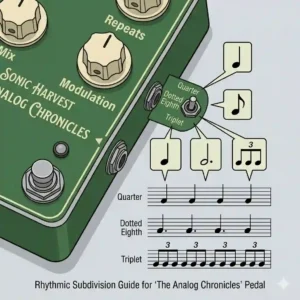
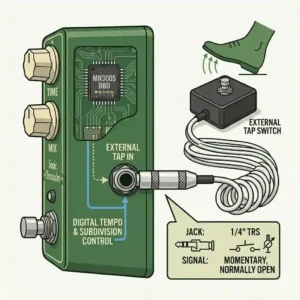
A tap tempo switch is useless if it only taps in quarter notes. You need a pedal that offers subdivisions—specifically, the dotted-eighth note (essential for modern worship and U2 styles) and the eighth-note triplet (great for blues and swing). Ensure the pedal clearly displays which subdivision is active, usually via an LED color change.
3. Modulation Controls
Modulation adds a slight chorus or vibrato to the delayed signal only. This mimics the wow and flutter of old tape echo machines. The best pedals offer external controls for both the Rate (speed) and Depth (intensity) of the modulation. If these controls are hidden inside the pedal as trimpots, you will rarely use them on a gig.
4. True Bypass vs. Buffered Bypass
If your analog delay pedal with tap tempo is the only pedal on your board, true bypass is great. But if you have 30 feet of cable and 8 other pedals, you want a buffered bypass. Furthermore, a buffered bypass allows for “Trails”—meaning when you turn the pedal off, your last echo naturally fades out instead of abruptly chopping off.
Bucket Brigade vs. DSP: The Ultimate Showdown
Why spend top dollar on an analog circuit when a $100 digital delay can replicate it? The answer lies in how the audio signal degrades.
In a digital signal processing (DSP) pedal, an analog-to-digital converter turns your guitar signal into binary code (1s and 0s), holds it in a memory bank, and spits it back out. To emulate an analog pedal, software developers write code that artificially removes high-end frequencies.
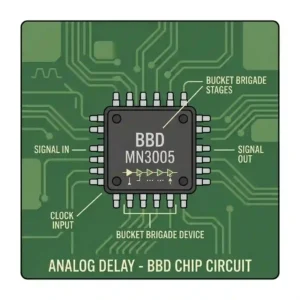
In a Bucket Brigade Device (a concept thoroughly documented by acoustic engineers and resources like Sound On Sound), the process is entirely physical. Imagine 1,000 people standing in a line, passing a bucket of water from one person to the next. With every pass, a tiny bit of water splashes out. This is exactly what happens to your guitar tone. The chip passes the analog voltage through thousands of stages. With each pass, the treble naturally decays, the signal slightly distorts, and the resulting echo becomes darker and warmer.
The human ear can distinguish between mathematical algorithmic filtering (DSP) and organic physical degradation (BBD). Digital sounds pristine, but analog sounds alive. Furthermore, when you twist the time knob on a DSP pedal, it often glitches. When you do it on a BBD pedal, the pitch warps and bends in a deeply musical way.
Features That Matter (And Marketing Hype to Ignore)
After a decade of reading pedal manuals, I can safely tell you which features will save your gig and which ones are just designed to inflate the price tag.
IGNORE: “Studio Quality High-Fidelity Repeats”
If you are buying an analog delay, you do not want high fidelity. You are paying for the lo-fi charm, the grit, and the warmth. If a brand boasts about how clean their analog delay is, they have likely sterilized the very character you are paying for.
MATTER: Expression Pedal Inputs
This is a game-changer. Being able to plug in an external expression treadle and map it to the “Feedback” control allows you to swell the echoes into self-oscillation with your foot while keeping both hands on the guitar. It turns the delay from a static effect into a dynamic, playable instrument.
IGNORE: “True Stereo” (Most of the time)
Many analog delays claim stereo outputs, but they usually just output one dry signal to the left and one wet signal to the right (Wet/Dry). While cool, this isn’t true stereo. Unless it’s a massive unit like the Boss DM-101, don’t buy a compact analog delay solely for its stereo capabilities.
MATTER: Soft-Touch Relay Switching
Old-school 3PDT mechanical switches have a loud, physical “clack” when you step on them, which can sometimes pop through the amplifier. Modern soft-touch relay switches are completely silent and require less pressure, meaning you won’t accidentally shift the pedal’s position on your board when you tap the tempo.
What to Expect: Real-World Live Performance Quirks
Taking an analog delay pedal with tap tempo from the bedroom to a 500-cap club introduces variables the spec sheet won’t warn you about.
First, the temperature of the room can literally change your tone. Bucket brigade chips are thermally sensitive. I’ve tech’d outdoor festivals in July where the intense heat caused the analog delay pedals to oscillate much faster than they did during soundcheck in the cool morning. You must be prepared to roll back your feedback knob slightly if the stage gets incredibly hot.
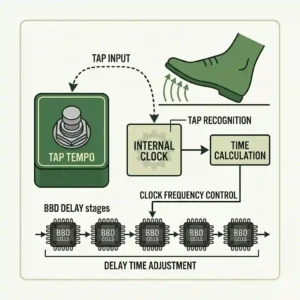
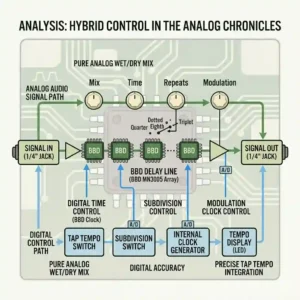
Second, understand how tap tempo translation works. You are tapping a digital switch, which then forces an analog clock circuit to catch up. In some boutique pedals, there is a microsecond of “warp” or pitch-shift as the analog chip adjusts to your new tapped tempo. This is not a glitch; it is the sound of analog components physically adjusting voltage. Embrace it. It sounds organic and cool, especially during song transitions.
Finally, mix placement is everything. Because BBD delays are inherently dark, they can get completely lost in a dense mix if you play a Les Paul through a dark Marshall amp. In live scenarios, you often have to turn the “Mix” or “Level” knob much higher than you would at home just to make the echoes audible over a crashing cymbal.
Safety and Power Regulations: Protecting Your Investment
This is the least sexy part of pedal buying, but arguably the most important. A massive percentage of “broken” analog delays I see in my shop aren’t broken at all; they have been starved of power or fried by incorrect voltage.
Digital microprocessors (for the tap tempo) combined with high-voltage BBD chips require significantly more current than your standard overdrive pedal. While a typical Tubescreamer draws about 10mA (milliamps) of power, a modern analog delay with tap tempo can draw anywhere from 40mA to 250mA.
The Rule of Thumb: Never use a cheap daisy-chain power supply for these pedals. You must use an isolated power supply (like a Voodoo Lab or Strymon). If you daisy-chain a tap-tempo analog delay with a digital reverb, you will almost certainly introduce a pulsating ground-loop hum into your amplifier.
Furthermore, pay strict attention to the voltage. While some analog pedals (like older Memory Mans) require 24V for increased headroom, plugging 18V or 24V into a pedal designed strictly for 9V (like the Carbon Copy) will instantly fry the BBD chips. Always check the manual, and when in doubt, default to 9V isolated power. For more on pedal power safety and electronics, resources like Premier Guitar’s Tech Guides offer fantastic baseline knowledge.
✨ Don’t Miss These Exclusive Deals!
🔍 Ready to build the ultimate pedalboard? Click on any highlighted item to check current pricing and availability. Upgrading your delay is the fastest way to transform your entire rig!
The Final Verdict: Finding Your Perfect Echo
Ultimately, adding an analog delay pedal with tap tempo to your rig is about capturing lightning in a bottle. It is the perfect marriage of unpredictable vintage character and necessary modern control.
If budget is no object and you demand absolute studio-grade perfection and MIDI integration, the Boss DM-101 stands unchallenged in 2026. However, for the working musician who needs rugged reliability, dark repeats that don’t step on vocal lines, and a price tag that won’t require a second mortgage, the MXR Carbon Copy Deluxe remains my highest recommendation.
Remember, the spec sheet only tells half the story. The magic of bucket-brigade technology lies in its imperfections—the slight hiss, the murky trails, the chaotic oscillation. Embrace the quirks, power the pedal correctly with an isolated supply, and let the analog warmth transform your stage tone.
Frequently Asked Questions
❓ What is the difference between an analog delay pedal with tap tempo and a digital one?
✅ Analog delays use physical BBD chips, creating warm, dark, degrading repeats that sit naturally in a mix. Digital delays use DSP algorithms for pristine, exact copies of your tone. Tap tempo on analog merges physical warmth with digital timing control…
❓ Does tap tempo ruin the pure analog signal path?
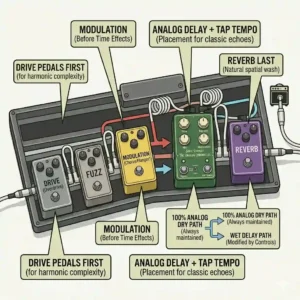
✅ No. In high-quality pedals, the tap tempo microprocessor only controls the “clock” timing of the BBD chips. Your actual guitar audio signal remains 100% analog and never gets converted into a digital 1s and 0s format…
❓ Why does my analog delay squeal when I turn it up?
✅ This is called self-oscillation. Because the audio is physically feeding back into the BBD chips on a loop, the signal quickly distorts and compounds. It’s a beloved feature of analog circuits used for dramatic, chaotic swells…
❓ Can I use an analog delay with tap tempo in an effects loop?
✅ Yes, but with caution. Amplifiers with line-level effects loops can overload the input of sensitive analog pedals. Look for delays with high headroom or internal line-level switches, like the MXR Carbon Copy Deluxe, for best results…
❓ What does the modulation knob do on a delay pedal?
✅ Modulation applies a subtle chorus or vibrato effect exclusively to the delayed echoes, not your dry signal. This simulates the natural wow and flutter of vintage mechanical tape echo units, making the tone sound wider and more three-dimensional…
Recommended for You
- 5 Best ambient reverb pedal Picks for 2026: Brutal Expert Truths
- Pedal Bass Overdrive: 7 Ultimate Pedals That Will Revolutionize Your Bass Tone in 2025
- 7 Best Bass EQ Pedal Options for Ultimate Tone Control in 2025
Disclaimer: This article contains affiliate links. As an Amazon Associate, I earn from qualifying purchases. If you purchase products through these links, we may earn a small commission at no additional cost to you.
✨ Found this helpful? Share it with your friends! 💬🤗