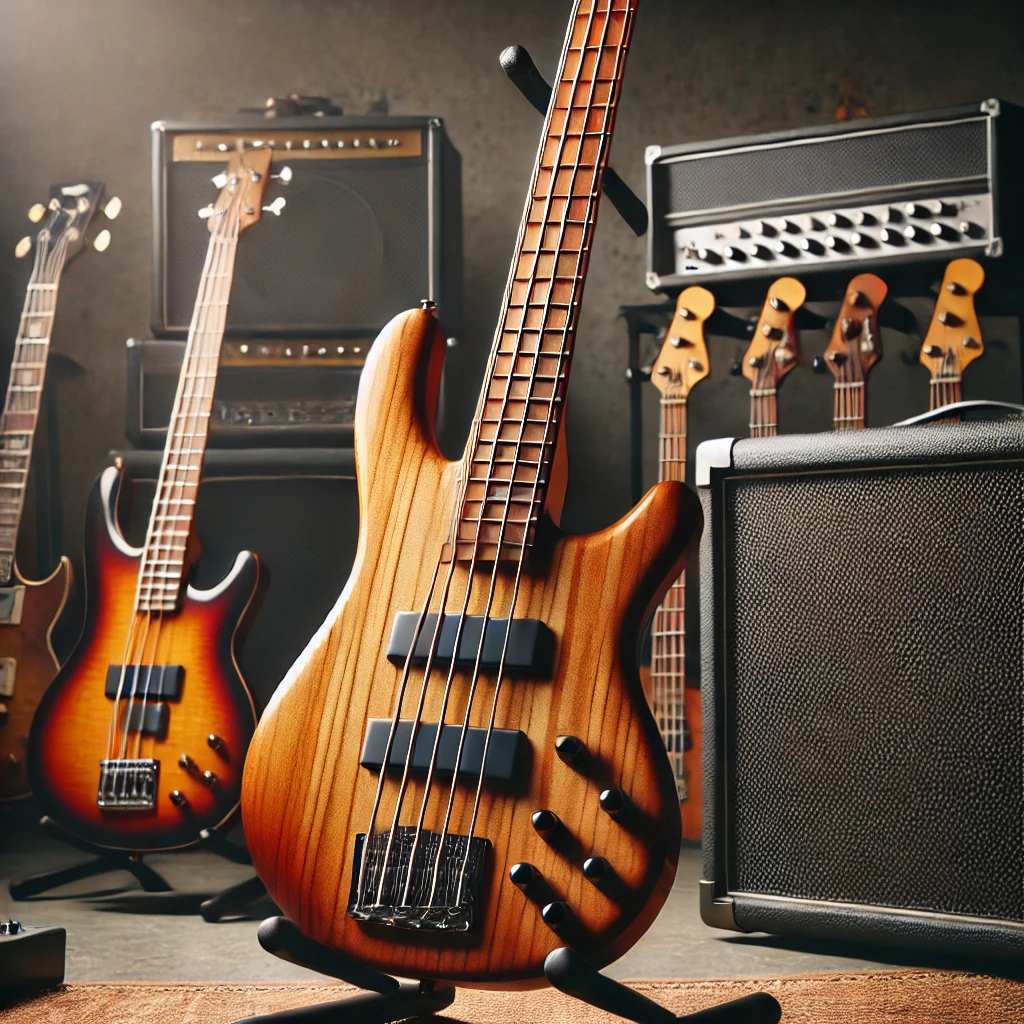
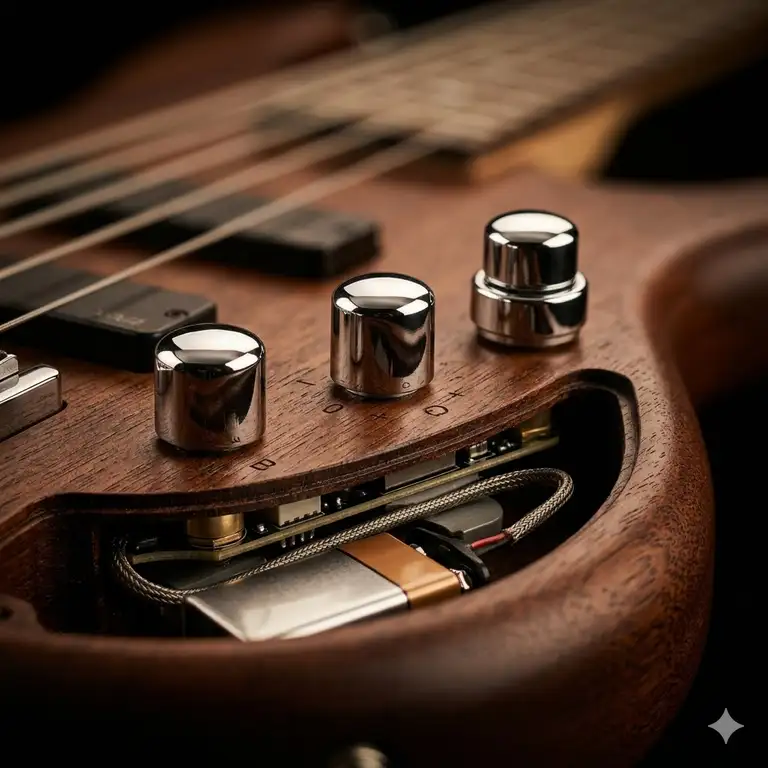
I’ve been there. You’re standing on stage, the lights are blinding, the crowd is expectant, and you dig into that low E string only to find… nothing. Well, not nothing, but your sound is thin, polite, and frankly, a bit boring. It’s like trying to start a campfire with a damp match. If you want your bass to growl, snap, and command the room, you probably need a bass guitar onboard preamp. 🎸
✨Was this helpful? Spread the word! 🚀
Think of it as the brain of your instrument. While your pickups are the ears that catch the vibration, the preamp is the voice that decides how that vibration is translated to the world. In my years of gigging and tinkering with electronics, I’ve learned that swapping out a mediocre circuit for a high-quality bass guitar active preamp is the single most effective way to breathe new life into an old instrument. It’s the difference between a standard coffee and a triple-shot espresso for your tone.
Understanding the Active Revolution
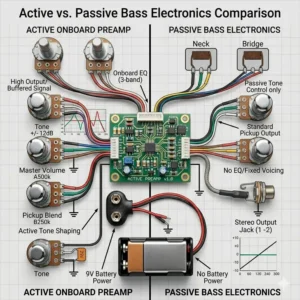
Before we dive into the gear, let’s look at why you’d even want an on board bass preamp in the first place. Most traditional basses are passive—meaning they don’t need a battery. They’re simple, reliable, and sound great. But they have limits. A passive tone knob can only cut high frequencies; it can’t add bass or boost mids.
An active system, however, uses a battery (usually 9V or 18V) to power a circuit that can both cut and boost frequencies. It also lowers the impedance of your signal, which means you can use a 50-foot cable without losing any high-end clarity. ⚡
Table 1: Passive vs. Active Bass Guitar Onboard Preamp Comparison
| Feature | Passive (Standard) | Active (Bass Guitar Onboard Preamp) |
| Power Source | None required | 9V or 18V Battery |
| Tone Control | Cut only (Treble roll-off) | Cut and Boost (Bass, Mid, Treble) |
| Output Level | Lower, vintage-style | Higher, more consistent |
| Cable Length Impact | Loses high-end over long cables | High-end remains clear and crisp |
| Versatility | Traditional, “baked-in” tone | Highly adjustable for any genre |
| Complexity | Simple wiring | More complex, requires space for battery |
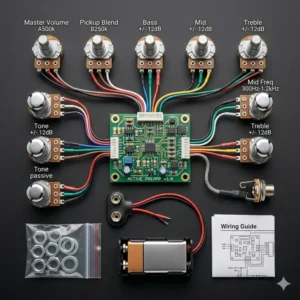
Top 7 Bass Guitar Onboard Preamp Systems: Expert Analysis
If you’re ready to upgrade, you shouldn’t just buy the first thing you see. I’ve scoured the current 2026 market to find the most reliable, tone-shaping powerhouses available. These are real products that have stood the test of technical scrutiny and player feedback.
1. EMG BQC System
The EMG BQC System is widely considered the gold standard for modern metal and rock players. This isn’t just a simple EQ; it’s a comprehensive tone-shaping suite. It features a master volume, a blend control, and a 3-band EQ. What makes it special is the semi-parametric mid-control, allowing you to choose exactly which frequency you want to boost or cut.
-
Technical Specifications:
-
Type: 3-Band Active EQ.
-
Power: 9V or 18V (for extra headroom).
-
Controls: Master Volume, Balance, Mid-Frequency (Variable), Treble/Bass concentric.
-
Input Impedance: 1 Megohm.
-
-
Customer Review Analysis: Users consistently praise the “dead quiet” operation. There is zero hiss, even when the treble is cranked. Some players find the installation a bit tight in smaller cavities due to the number of wires, but the “solderless” connectors are a massive plus.
-
Professional Applications: Ideal for high-gain settings where clarity is non-negotiable.
-
Pros: Solderless installation, incredible mid-range flexibility, ultra-low noise.
-
Cons: Pots feel a bit “light” to some players, requires significant cavity space.
2. Seymour Duncan STC-3P
If you want that classic “slap” sound with the push of a button, the Seymour Duncan STC-3P is your best friend. It’s designed specifically to enhance the natural voice of your bass while providing a “Slap Switch” that pulls the mids and boosts the lows and highs instantly.
-
Technical Specifications:
-
Type: 3-Band Active Preamp.
-
Frequency Centers: Bass (30Hz), Mid (650Hz), Treble (6kHz).
-
Power: 9V.
-
Feature: Proprietary Slap Switch on the volume pot.
-
-
Customer Review Analysis: Reviewers love the “musical” nature of the EQ. It doesn’t sound digital or harsh. The slap switch is a favorite for funk players who need to switch textures mid-song.
-
Professional Applications: Funk, R&B, and Modern Jazz.
-
Pros: Very musical EQ points, the slap switch is genuinely useful, high-quality components.
-
Cons: Not as “aggressive” as some other modern preamps.
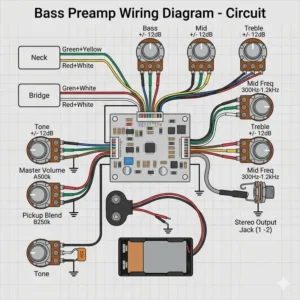
3. Aguilar OBP-3TK
The Aguilar OBP-3TK is often the choice for boutique bass builders. It’s a beast of a bass guitar active preamp. Why? Because it offers up to 18dB of boost at specific frequencies, providing massive headroom and a very “organic” feel.
-
Technical Specifications:
-
Type: 3-Band Onboard Preamp.
-
EQ Boost/Cut: +/- 18dB.
-
Bass: 40Hz, Mid: 400Hz or 800Hz (selectable), Treble: 6.5kHz.
-
Voltage: 9V or 18V.
-
-
Customer Review Analysis: Most users describe this as “transparent.” It makes your bass sound like your bass, only better. The ability to toggle between 400Hz and 800Hz for the mids is a game-changer for cutting through a thick mix.
-
Professional Applications: Recording sessions, session work, and high-end custom builds.
-
Pros: Massive headroom, very transparent tone, compact size for easy installation.
-
Cons: Requires soldering; not as beginner-friendly as solderless kits.
4. Bartolini HR-5.2AP/918
For those who prefer a warmer, more “vintage-active” sound, the Bartolini HR-5.2AP/918 is the king. Bartolini has been a staple in the bass guitar onboard preamp world for decades, and this pre-wired harness is their masterpiece.
-
Technical Specifications:
-
Type: 3-Band EQ Pre-wired.
-
Controls: Volume (Push/Pull Active/Passive), Blend, Mid (Push/Pull Frequency), Treble/Bass Stack.
-
Gain: Adjustable gain trim-pot on the module.
-
-
Customer Review Analysis: Customers rave about the “dark and smooth” character. It tames harsh pickups and adds a velvety low-end that is perfect for fretless basses.
-
Professional Applications: Jazz, Latin, and Fretless bass playing.
-
Pros: Pre-wired for easier installation, switchable active/passive mode, warm tonal character.
-
Cons: Can be too dark for metal or aggressive rock styles.
5. Darkglass Tone Capsule
The Darkglass Tone Capsule is a different animal. Unlike most preamps that have a Treble control, this one has two Mid controls (Lo-Mid and Hi-Mid). It’s designed to provide “weight” and “definition” rather than just “sparkle.”
-
Technical Specifications:
-
Type: 3-Band Preamp (Bass, Mid, Hi-Mid).
-
Bass: +-12dB @ 70Hz, Mid: +-12dB @ 500Hz, Hi-Mid: +-12dB @ 2.8kHz.
-
Power: 9V to 18V.
-
-
Customer Review Analysis: Users mention that this preamp makes their bass sound “expensive.” It adds a growl that is perfect for modern rock and djent.
-
Professional Applications: Modern Metal, Progressive Rock, and Heavy Fusion.
-
Pros: Unique mid-focused design, adds incredible clarity to low-tuned strings.
-
Cons: No dedicated Treble control might frustrate some old-school players.
6. Nordstrand 3B-5b
The Nordstrand 3B-5b is the “Swiss Army Knife” of the group. It is incredibly clean and designed to be as flat as possible when the knobs are in the center.
-
Technical Specifications:
-
Type: 3-Band Preamp.
-
Features: Active/Passive switch, Vintage Tone Control (VTC) option.
-
Input: High impedance to prevent pickup loading.
-
-
Customer Review Analysis: Players love the “honesty” of this preamp. It doesn’t color the sound unless you want it to. The addition of a passive tone control that works in active mode is a highly sought-after feature.
-
Professional Applications: All-around versatility, especially for players who use many different pedals.
-
Pros: Extremely transparent, very high build quality, versatile wiring options.
-
Cons: Can be a bit clinical for those looking for a “vibe.”
7. Fishman Fluence Bass Soapbar Preamp
Part of the Fluence ecosystem, the Fishman Fluence Bass Soapbar Preamp is often paired with their specific pickups but can be adapted. It offers multiple “voices” (Vintage, Progressive, and Funk) that change the fundamental response of the circuit.
-
Technical Specifications:
-
Type: Multi-Voice 2-Band or 3-Band.
-
Power: Rechargeable battery pack or 9V.
-
Voices: Voice 1 (Classic), Voice 2 (Modern), Voice 3 (Funk).
-
-
Customer Review Analysis: Users are blown away by the “Voice” switching. It’s like having three different basses in one. The rechargeable battery option is also a huge hit for the eco-conscious musician.
-
Professional Applications: Studio musicians who need to cover many genres in one day.
-
Pros: Incredible versatility, rechargeable options, dead-quiet digital-switching.
-
Cons: Best used with Fishman pickups; might be overkill for a simple setup.
✨ Don’t Miss These Exclusive Deals! 🔍
Take your bass tone to the next level with these carefully selected bass guitar onboard preamp systems. Click on any highlighted item to check current pricing and availability on Amazon. These upgrades will help you achieve the professional sound you’ve always wanted! 🎸✨
💬 Just one click – help others make better buying decisions too!😊
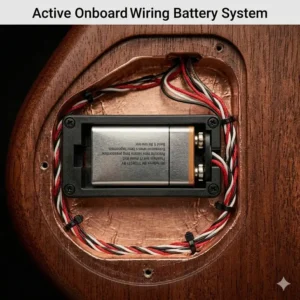
Table 2: Technical Specifications Matrix (Spec Matrix)
| Product | EQ Bands | Voltage | Solderless? | Mid-Frequency Control |
| EMG BQC System | 3 | 9-18V | Yes | Sweepable (Semi-Parametric) |
| Seymour Duncan STC-3P | 3 | 9V | No | Fixed (650Hz) + Slap Switch |
| Aguilar OBP-3TK | 3 | 9-18V | No | Switchable (400/800Hz) |
| Bartolini HR-5.2AP | 3 | 9-18V | Pre-wired | Switchable (250/500/800Hz) |
| Darkglass Tone Capsule | 3 | 9-18V | No | Dual Mids (500Hz & 2.8kHz) |
| Nordstrand 3B-5b | 3 | 9V | No | Switchable (400Hz/1kHz) |
| Fishman Fluence | 2/3 | 9V/USB | No | Multi-Voice Profiles |
The Anatomy of an On Board Bass Preamp
If you’re going to drop a significant amount of money on a bass guitar onboard preamp, you should probably know how the sausage is made. It’s not just a chip and some wires. It’s a delicate balance of electrical engineering designed to survive the sweat and vibration of a live show.
Headroom: Why 18V Matters
You’ll notice many of these preamps, like the EMG BQC System or the Aguilar OBP-3TK, can run on either one or two 9V batteries. When you run at 18V, you increase the “headroom.” Imagine headroom like the height of a ceiling. If you’re a tall player (a high-output signal), a low ceiling (9V) means you’ll bump your head and cause distortion (clipping). An 18V system gives you more room to breathe, resulting in a cleaner, more dynamic sound. This is especially vital for players who use a bass guitar active preamp with low-tuned 5-string or 6-string basses.
Impedance Matching
Passive pickups have high impedance. This makes them susceptible to noise and signal loss. The on board bass preamp acts as a buffer. It takes that high-impedance signal and converts it to low impedance. This is why active basses sound so “strong.” Even before you touch the EQ, the signal is more robust and ready to travel through your pedals and into your amp without losing its soul.
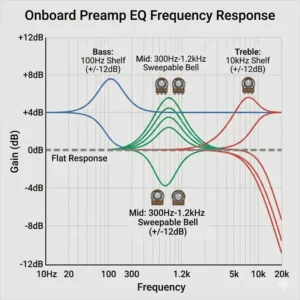
EQ Curves and Q-Factors
Not all Bass knobs are created equal. A “Bass” boost on a Bartolini HR-5.2AP/918 might feel like a warm hug, centered around 30Hz or 40Hz with a wide “Q” (meaning it affects a wide range of frequencies around the center). Meanwhile, the Darkglass Tone Capsule might have a tighter focus, giving you a punch in the gut rather than a warm hug. Understanding where your preamp’s frequencies are centered is the key to finding your signature sound.
Table 3: Tone Profile & Performance Metrics
| Product | Primary Tone Vibe | Best For… | Noise Floor |
| EMG BQC System | Hi-Fi, Modern | Precision & Aggression | Ultra-Low |
| Seymour Duncan STC-3P | Punchy, Bright | Slap & Pop | Low |
| Aguilar OBP-3TK | Natural, Thick | Boutique Clarity | Low |
| Bartolini HR-5.2AP | Warm, Vintage | Fretless & Jazz | Very Low |
| Darkglass Tone Capsule | Aggressive, Mid-forward | Metal & Hard Rock | Very Low |
| Nordstrand 3B-5b | Transparent, Raw | All-around Reliability | Ultra-Low |
| Fishman Fluence | Versatile, Sculpted | Studio Sessions | Dead Quiet |
Why Every Bassist Needs an Upgrade (The Benefits)
Is it worth the hassle of pulling your bass apart? In my experience, yes. Most factory-installed electronics in mid-range basses are “cost-saving” measures. They work, but they don’t inspire.
-
On-the-Fly Adjustments: Imagine you’re halfway through a set and the room is sounding “boomy.” Instead of running back to your amp, you just reach down and roll off the Bass knob on your bass guitar onboard preamp. Problem solved in two seconds.
-
Consistency: Active electronics ensure your bass sounds the same whether you’re plugging into a $5,000 rig or a cheap practice amp.
-
Recording Prowess: Modern recording engineers love active basses because the signal is clean, strong, and easy to mix. A bass guitar active preamp like the Nordstrand 3B-5b provides a signal that requires very little post-processing.
-
Rescuing Dead Strings: We’ve all been there—your strings are three months old and dead, but you have a gig. Boosting the Treble on your on board bass preamp can give those old strings a “fake” zing that gets you through the night.
Table 4: Benefits Quantification vs. Traditional Alternatives
| Benefit | Active Preamp | Passive Electronics | Impact on Player |
| Frequency Range | Full spectrum (20Hz-20kHz) | Limited by pickup | More sonic options |
| Signal Strength | Constant, high output | Variable, lower output | Better pedal performance |
| EQ Control | Independent Bass/Mid/Treble | Simple Treble Roll-off | Precision tone shaping |
| Interference | Shielded, low noise | Susceptible to RF/Hum | Cleaner recordings |
| Reliability | Depends on battery | Near-indestructible | Peace of mind vs. battery check |
How to Choose the Right One for You
Choosing a bass guitar onboard preamp is a personal journey. You need to ask yourself: “What is my bass missing?”
-
If your bass is too bright: Look at the Bartolini HR-5.2AP/918. Its smooth highs will help tame the “clank.”
-
If your bass gets lost in the mix: Go for the Darkglass Tone Capsule. Those dual mid controls will carve out a space for you between the guitars and the drums.
-
If you want a professional, “studio” sound: The Aguilar OBP-3TK is the way to go. It’s what the pros use for a reason.
-
If you are terrified of a soldering iron: The EMG BQC System is your savior. Plug and play, baby.
Budget vs. Premium: Does it matter?
In the world of electronics, you usually get what you pay for. A “budget” bass guitar active preamp might have a higher noise floor (hiss) or “bunched up” EQ controls where a tiny turn makes a massive, unpleasant change. Premium options have better components (resistors, capacitors) that ensure the boost is smooth and musical.
Table 5: Budget vs. Premium Comparison
| Category | Typical Components | Sound Quality | Longevity |
| Budget ($50-$80) | Standard PCBs, generic pots | Functional, can be noisy | 2-5 years |
| Mid-Range ($90-$150) | Brand name (Seymour Duncan) | Musical, lower noise | 5-10 years |
| Premium ($160-$250+) | High-end (Aguilar, Nordstrand) | Boutique, dead quiet | Lifetime |
Installation Tips from a Pro
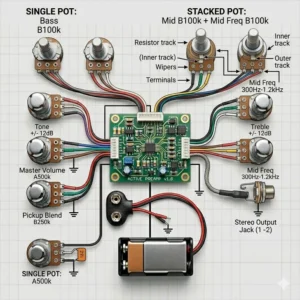
I’ve installed dozens of these things, and I’ve learned a few lessons the hard way. Here are my top tips for installing your new bass guitar onboard preamp:
-
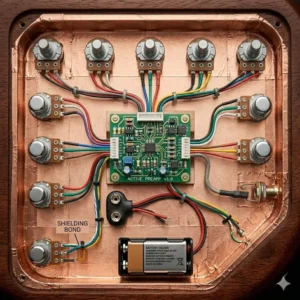
Shield Everything: While you have the guts of your bass open, line the cavity with copper tape. This creates a “Faraday cage” that blocks out radio signals and hum.
-
Measure Twice: Ensure your control cavity is deep enough for the preamp module and the battery. There’s nothing worse than finishing your wiring only to realize the cover won’t fit back on.
-
Use a Fresh Battery: Don’t use a half-dead battery from your TV remote. Start with a brand-new, high-quality Duracell or Energizer.
-
Label Your Wires: Use small pieces of masking tape to label which wire goes to which pickup. It will save you a massive headache later.
For more technical details on bass wiring, I highly recommend checking out Premier Guitar’s DIY section or the extensive forums at TalkBass. These resources are invaluable for the burgeoning luthier. 🛠️
Table 6: User Compatibility & Difficulty Level
| Preamp | Skill Level Required | Installation Time | Tools Needed |
| EMG BQC System | Beginner | 30-45 mins | Screwdriver only |
| Seymour Duncan STC-3P | Intermediate | 1-2 hours | Soldering Iron |
| Aguilar OBP-3TK | Advanced | 2-3 hours | Soldering Iron, Multimeter |
| Bartolini HR-5.2AP | Intermediate | 1 hour | Soldering Iron |
| Darkglass Tone Capsule | Advanced | 2 hours | Soldering Iron |
| Nordstrand 3B-5b | Intermediate | 1-2 hours | Soldering Iron |
| Fishman Fluence | Professional | 3+ hours | Full toolkit |
✨ Ready to Upgrade Your Sound? 🚀
Don’t let a weak tone hold your playing back. Click on any of our top-rated bass guitar active preamp recommendations above to find the best deals on Amazon and transform your instrument today. Your ears—and your audience—will thank you! 🎶
Conclusion: Take Command of Your Tone
In the end, your bass is your voice. Why settle for a whisper when you can have a roar? Whether you choose the high-tech versatility of the Fishman Fluence, the raw mid-power of the Darkglass Tone Capsule, or the legendary reliability of the EMG BQC System, adding a bass guitar onboard preamp is an investment in your creativity.
It’s about more than just knobs and wires; it’s about having the confidence that no matter the room, the amp, or the genre, your tone will be exactly where it needs to be. So, grab your soldering iron (or your screwdriver for those EMG fans) and start your journey toward the perfect sound. You won’t regret it. 🎸✨
Frequently Asked Questions
✅ Absolutely. Most onboard preamps are designed to work perfectly with standard passive pickups. They act as a buffer and EQ stage, essentially 'activating' your bass. Just ensure the pot values match the manufacturer's recommendations (usually 25k for active-pickup setups or 250k/500k for passive-pickup setups)...
✅ Typically, a 9V battery lasts between 250 and 500 hours of play time. However, this only applies if you unplug your cable when not playing! The input jack acts as a power switch; if the cable stays in, the battery drains...
✅ If you can solder or follow a diagram, yes. Systems like the EMG BQC are solderless and very beginner-friendly. For more complex systems like Aguilar or Nordstrand, you might want to visit a professional luthier if you aren't comfortable with electronics...
✅ It provides more headroom, not necessarily 'better' tone. 18V prevents the signal from clipping (distorting) when you boost the EQ or play aggressively. For most players, 9V is plenty, but 5-string players often prefer 18V for the low B string clarity...
✅ Yes, it's one of the best ways to upgrade a budget instrument. A high-quality preamp like the Seymour Duncan STC-3P can make a $200 bass sound like a $1,000 instrument by improving signal quality and tonal versatility dramatically... ❓ Will a bass guitar onboard preamp work with my passive pickups?
❓ How long does the battery last in a bass guitar active preamp?
❓ Can I install an on board bass preamp myself?
❓ Does an 18V preamp sound better than a 9V one?
❓ Is it worth putting a high-end preamp in a cheap bass?
Recommended for You:
- Best Pickups for Acoustic Guitars: 7 Top Picks for Studio Sound (2026)
- 7 Best Soundhole Pickup Options for 2026: Expert Guitarist Review
- 7 Best Acoustic Bass Pickup Systems for Thumping Tone in 2026
Disclaimer: This article contains affiliate links. If you purchase products through these links, we may earn a small commission at no additional cost to you.
✨ Found this helpful? Share it with your friends! 💬🤗