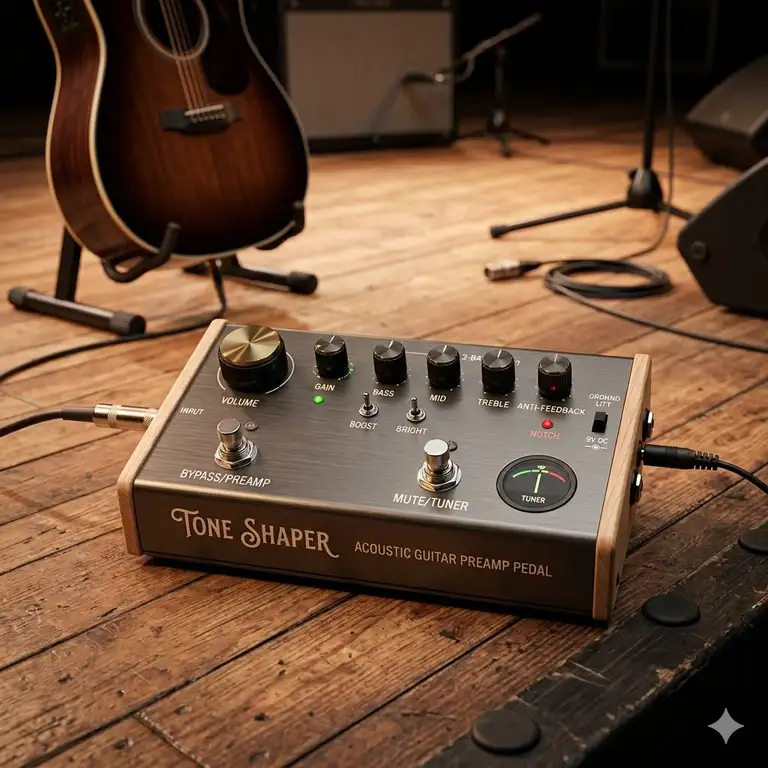
Have you ever plugged your beautiful, expensive acoustic guitar directly into a massive PA system and felt your soul leave your body because it sounded like a swarm of angry bees? I have. It is a heartbreaking experience. You spend years perfecting your fingerstyle technique only for the audience to hear a “quacky,” thin, and sterile mess. This is exactly why an acoustic guitar preamp pedal is the most important tool in your gig bag.
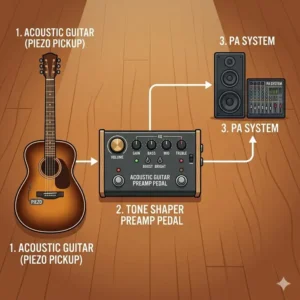
Actually, the problem isn’t your guitar; it is usually the mismatch between your guitar’s pickup and the sound system. Most acoustic pickups, especially piezos, have a very high output impedance. When you plug that directly into a mixer, you lose the richness and warmth of your tone. An acoustic guitar preamp pedal acts as the middleman, shaking hands with your guitar and the speakers to make sure they get along.
✨Was this helpful? Spread the word! 🚀
Before we dive deep into the technical weeds, let’s look at how adding a preamp compares to just going “straight in.”
Table 1: Direct Connection vs. Using an Acoustic Guitar Preamp Pedal
| Feature | Direct Connection (Instrument Cable) | Using a Preamp Pedal |
| Signal Strength | Often weak or inconsistent | Strong, buffered, and steady |
| Tone Control | Very limited (Relies on Mixer) | Precise onboard EQ and shaping |
| Feedback Control | Difficult to manage | Included Notch Filters/Phase switches |
| Noise Level | High risk of hum and buzz | Quiet, balanced XLR output |
| Portability | Requires external DI box | All-in-one floor solution |
Quick Comparison: Top Rated Models for 2026
If you are in a rush to get to your next soundcheck, here is a quick glance at the top contenders for the title of best acoustic preamp pedal currently available.
Table 2: Quick Spec Matrix of Top Preamp Pedals
| Product Model | Best For | EQ Bands | Key Feature | Output Type |
| LR Baggs Venue DI | Professional Touring | 5-Band | Built-in Tuner & Boost | XLR & 1/4″ |
| Fishman Aura Spectrum | Studio Realism | 3-Band | Acoustic Imaging Tech | XLR |
| Boss AD-10 | Modern Versatility | 4-Band | Dual Channel / Looper | Dual XLR |
| Grace Design ALiX | Audiophile Quality | 3-Band | Studio-Grade Preamplification | XLR |
| NUX Stageman Floor | Budget Performers | 3-Band | Built-in 60s Looper | XLR & 1/4″ |
| Tech 21 SansAmp | Vintage Warmth | 3-Band | Tube-like Emulation | XLR |
| Behringer ADI21 | Absolute Beginners | 3-Band | Tube/Microphone Emulation | XLR |
Top 7 Acoustic Guitar Preamp Pedal Options: Expert Analysis
I have spent countless hours in rehearsal rooms and on stages testing these units. Consequently, I’ve narrowed down the field to these seven specific models that represent the best of what 2026 has to offer.
1. LR Baggs Venue DI Acoustic Guitar Preamp DI 5-band EQ
The LR Baggs Venue DI is essentially the industry standard for a reason. It is built like a tank and offers a level of control that most other pedals can’t match. If you are looking for a reliable acoustic guitar preamp pedal, this is often the first recommendation from pro guitarists.
-
Technical Specifications:
-
EQ: 5-band with tunable low-mid and high-mid.
-
Gain: Adjustable from 0dB to +26dB.
-
Feedback Control: Garrett Null notch filter.
-
Power: 9V battery or DC adapter.
-
-
Customer Review Analysis: Users consistently praise the “transparency” of the tone. They love that it doesn’t color the sound too much but makes it feel “larger than life.” Some users mention it is quite large on a pedalboard, which is a fair trade-off for the features.
-
Professional Applications: Ideal for touring musicians who need a reliable tuner, a solo boost, and a DI all in one.
-
Pros:
-
Ultra-clean signal path.
-
The boost switch is perfect for solos.
-
Excellent notch filter for killing feedback.
-
-
Cons:
-
Large footprint.
-
Tuner display can be hard to see in direct sunlight.
-
2. Fishman Aura Spectrum DI Preamp and DI Box
If your guitar sounds a bit “plastic,” the Fishman Aura Spectrum DI is your solution. It uses “Aura Acoustic Imaging” to make your pickup sound like a high-end microphone in a studio. Therefore, it is often cited as the best acoustic preamp pedal for players who hate the sound of piezo pickups.
-
Technical Specifications:
-
Images: 128 pre-loaded images of various guitar body styles.
-
EQ: 3-band EQ.
-
Compressor: One-knob simplicity.
-
Feedback: Automatic anti-feedback.
-
-
Customer Review Analysis: Professional players find the “Image” blend to be a game-changer. However, some beginners find the 128 images overwhelming at first. Once you find “your” image, the sound is breathtaking.
-
Professional Applications: Recording artists and players using thin-bodied acoustic-electrics.
-
Pros:
-
Makes thin guitars sound deep and woody.
-
Built-in compressor is very musical.
-
Excellent build quality.
-
-
Cons:
-
Requires some “menu diving” or experimentation to find the right image.
-
Pricey for hobbyists.
-
3. Boss AD-10 Acoustic Preamp
The Boss AD-10 is the Swiss Army knife of the acoustic guitar preamp pedal world. It handles two guitars at once, which is a lifesaver if you switch between a 6-string and a 12-string during your set.
-
Technical Specifications:
-
Channels: Dual-input for two instruments.
-
Effects: Ambience (Reverb), Delay, and Chorus.
-
Looper: 80-second recording time.
-
Acoustic Resonance: Restores the natural boxy sound of the guitar.
-
-
Customer Review Analysis: Gigging musicians love the presets. You can save your settings for different rooms. Some people find the interface a bit “digital,” but the sound quality is undeniably pro.
-
Professional Applications: Multi-instrumentalists and solo performers who need a looper.
-
Pros:
-
Dual channels with independent EQ.
-
The looper is a huge bonus.
-
Very rugged Boss construction.
-
-
Cons:
-
Digital interface has a slight learning curve.
-
More knobs than a simple DI might need.
-
4. Grace Design ALiX Instrument Preamp
For those who believe that tone is a religion, the Grace Design ALiX is the holy grail. This isn’t just an acoustic guitar preamp pedal; it is a piece of high-end studio gear condensed into a floor unit.
-
Technical Specifications:
-
Audio: Studio-grade preamplification with 0.0005% THD.
-
EQ: Powerful 3-band with sweepable mids.
-
Power: Internal power supply (no wall wart needed).
-
Input Impedance: Switchable (High/Med/Low).
-
-
Customer Review Analysis: Audiophiles rave about the “clarity” and “depth.” It is often described as “lifting a veil” off the guitar’s sound. The downside is the price, which is significantly higher than mass-market brands.
-
Professional Applications: High-end studio work and theater pits where sonic perfection is mandatory.
-
Pros:
-
Unrivaled sonic purity.
-
Built like a boutique tank.
-
Works with almost any instrument (mandolin, cello, etc.).
-
-
Cons:
-
Very expensive.
-
Heavy and bulky.
-
5. NUX Stageman Floor Acoustic Preamp + Looper
The NUX Stageman Floor is the dark horse of this list. It is a fantastic acoustic pre amp pedal that offers premium features like a looper and chorus/reverb for a fraction of the cost of the big names.
-
Technical Specifications:
-
Control: Gain, Bass, Middle, Treble.
-
Effects: Chorus, Reverb, and Freeze.
-
Looper: 60 seconds with unlimited overdubs.
-
Outputs: DI Out, Earphone Out, Aux In.
-
-
Customer Review Analysis: Customers are shocked at the value. “It punches way above its weight class,” says one reviewer. Some note the chorus is a bit subtle, but the overall preamp tone is very warm.
-
Professional Applications: Open mic nights and busking where you need effects and a looper in one small box.
-
Pros:
-
Insane value for money.
-
Includes a headphone jack for silent practice.
-
Compact size.
-
-
Cons:
-
Plastic knobs feel a bit cheaper than Boss or LR Baggs.
-
Not as many EQ bands as the Venue DI.
-
6. Tech 21 SansAmp Acoustic DI
Tech 21 is famous for their analog modeling, and the Tech 21 SansAmp Acoustic DI brings that expertise to the acoustic world. It adds a subtle “tube-like” warmth that makes your acoustic guitar preamp pedal setup feel vintage and organic.
-
Technical Specifications:
-
Circuitry: 100% analog signal path.
-
Controls: Drive, Treble, Mid, Bass, Level.
-
Semi-Parametric EQ: Tunable mid-range.
-
Design: Signature SansAmp FET technology.
-
-
Customer Review Analysis: Bassists and acoustic players alike love the “Drive” control. It doesn’t distort the guitar but adds a harmonic richness. Some users wish it had a built-in tuner.
-
Professional Applications: Players who want an “analog” sound and need a bulletproof DI box.
-
Pros:
-
Extremely warm and organic tone.
-
Simple, no-nonsense controls.
-
Small footprint fits on any board.
-
-
Cons:
-
No built-in tuner or boost.
-
Battery life is average.
-
7. Behringer V-Tone Acoustic Driver ADI21
Sometimes you just need something that works without breaking the bank. The Behringer ADI21 is a surprisingly capable acoustic di pedal for the price of a few pizzas.
-
Technical Specifications:
-
Modeling: Authentic tube and microphone emulation.
-
EQ: 3-band EQ with sweepable mids.
-
Output: Balanced XLR and 1/4″ TS.
-
Ground Lift: Switchable to eliminate hum.
-
-
Customer Review Analysis: Most reviews start with “For the price, I can’t believe it.” It is great for backup or for someone just starting out. The plastic casing is the main complaint, as it might not survive a heavy-footed stomp.
-
Professional Applications: Budget setups, backups, or as a dedicated DI box for a secondary instrument.
-
Pros:
-
Unbelievably affordable.
-
Does exactly what a DI/Preamp should do.
-
Sweepable mids are a pro feature.
-
-
Cons:
-
Plastic construction.
-
Not the quietest signal path (some minor hiss).
-
🔍 Don’t Miss These Exclusive Deals!
Take your live sound to the next level with these carefully selected products. Click on any highlighted item to check current pricing and availability on Amazon. These tools will help you achieve the professional, studio-quality tone your music deserves! ✨
💬 Just one click – help others make better buying decisions too!😊
Detailed Features and Benefits Comparison
When choosing your acoustic guitar preamp pedal, you aren’t just buying a box with knobs. You are buying a solution to specific stage problems. For instance, if you play in a loud rock band with an acoustic, your needs are vastly different than a solo coffee shop performer.
Table 3: Feature Matrix for Different Models
| Product | Looper | Chorus/Reverb | Tuner | Boost Switch | XLR DI Out |
| LR Baggs Venue | No | No | Yes | Yes | Yes |
| Fishman Aura | No | No | Yes | No | Yes |
| Boss AD-10 | Yes | Yes | Yes | Yes | Yes |
| Grace ALiX | No | No | No | Yes | Yes |
| NUX Stageman | Yes | Yes | No | No | Yes |
| SansAmp DI | No | No | No | No | Yes |
| Behringer ADI21 | No | No | No | No | Yes |
Understanding the Mechanics of an Acoustic Pre Amp Pedal
Why does the impedance matter? Most guitarists don’t realize that an electronic preamplifier is essentially a translation device. Your guitar speaks “High Impedance,” while the mixer speaks “Low Impedance.” If you don’t translate, the mixer simply won’t understand the nuance of your playing.
Moreover, a good acoustic pre amp pedal provides “headroom.” This is the amount of signal a pedal can handle before it starts to distort. Because acoustic guitars have a wide dynamic range—from a soft pluck to a heavy strum—high headroom is vital. If your pedal has low headroom, your strums will sound compressed and “crunchy,” which is usually the last thing an acoustic player wants.
Table 4: Analog vs. Digital Acoustic Preamps
| Metric | Analog Preamps (e.g., SansAmp) | Digital Preamps (e.g., Boss AD-10) |
| Tone Character | Warm, smooth, organic | Versatile, precise, clear |
| Features | Limited to EQ and Gain | Effects, Loopers, IRs |
| Latency | Zero (Instant) | Extremely Low (Imperceptible to most) |
| Reliability | Simple circuits, easy to fix | Software-dependent |
| Ease of Use | What you see is what you get | Often involves menus/presets |
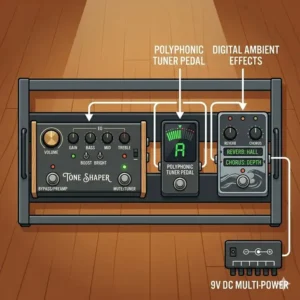
The Critical Importance of an Acoustic DI Pedal
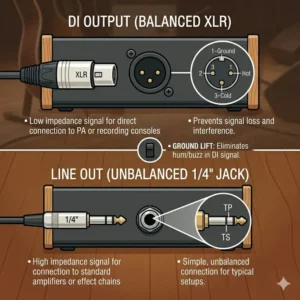
Many guitarists use the terms “preamp” and “DI” interchangeably, but they serve different roles. A DI (Direct Injection) box converts your unbalanced signal to a balanced one. This allows you to run long cables (over 20 feet) without picking up radio interference or losing high-frequency detail.
An acoustic di pedal combines these two worlds. It shapes your tone (Preamp) and then sends it safely to the soundboard (DI). If you are performing in a venue where the soundboard is 50 feet away at the back of the room, you must have an acoustic di pedal to ensure your signal arrives intact.
Table 5: Benefits of Preamp Pedals vs. Traditional Passive DI Boxes
| Benefit | Passive DI Box | Acoustic Guitar Preamp Pedal |
| Active Gain | No (Signal loss possible) | Yes (Strong, adjustable signal) |
| EQ Sculpting | None | Multi-band EQ tailored for acoustic |
| Phase Switch | Sometimes | Almost Always (Key for feedback) |
| Pedalboard Friendly | Utility item | Performance-enhancing tool |
| Mute Switch | No | Usually (Great for silent tuning) |
Finding the Best Acoustic Preamp Pedal for Your Style
Choosing the best acoustic preamp pedal is a personal journey. I remember when I first started playing live; I thought my guitar was the problem. I even considered selling my favorite Gibson because it sounded “dead” on stage. Then, a veteran sound engineer handed me a preamp pedal and told me to plug in. Within seconds, the guitar “woke up.” It was a revelation.
When you are looking for your own acoustic guitar preamp pedal, consider these factors:
-
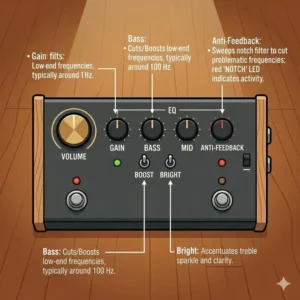
EQ Precision: Look for sweepable mids. Acoustic guitars often have a “honky” frequency around 800Hz to 1kHz. Being able to find and cut that specific frequency is the difference between a amateur and pro sound.
-
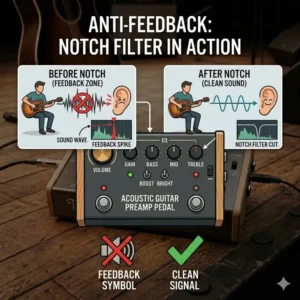
Notch Filters: These are life-savers. A notch filter is a very narrow EQ cut designed to kill a specific frequency that is causing feedback. If you play at high volumes, don’t buy a pedal without one.
-
Phase Switch: Sometimes, simply flipping the phase (the polarity of the sound wave) can instantly stop low-end feedback. It’s like magic.
-
Input Impedance: Ensure the pedal has a high input impedance (at least 1 Megohm). This prevents “loading” your pickup, which preserves the high-end sparkle.
Table 6: Power Requirements and Portability
| Product | Power Source | Weight | Pedalboard Space |
| LR Baggs Venue | 9V / Battery | 2.2 lbs | Large |
| Fishman Aura | 9V / Battery | 1.5 lbs | Medium |
| Boss AD-10 | 9V / Battery / AC | 2.9 lbs | Large |
| Grace ALiX | 120V AC Internal | 3.5 lbs | Extra Large |
| NUX Stageman | 9V DC | 1.0 lbs | Small |
| SansAmp DI | 9V / Phantom / AC | 0.8 lbs | Small |
| Behringer ADI21 | 9V / Battery | 1.0 lbs | Small |
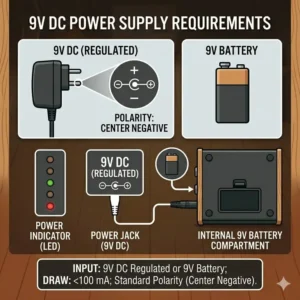
Advanced Tone Sculpting: Moving Beyond Basic EQ
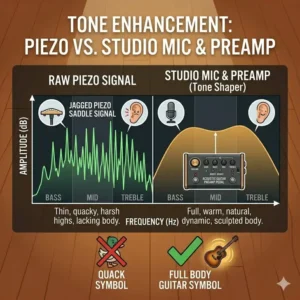
When you step into the world of high-end acoustic guitar preamp pedal usage, you start dealing with more than just Bass and Treble. You begin to understand the relationship between your instrument and the room.
For example, the acoustic resonance feature found in modern digital pedals like the Boss AD-10. This technology uses complex algorithms to replace the “missing” overtones that a piezo pickup fails to capture. It analyzes your playing in real-time and adds back the vibration of the wood and the air inside the guitar body.
Table 7: User Compatibility Guide
| User Type | Recommended Pedal | Why? |
| The Weekend Warrior | NUX Stageman Floor | Great features, easy on the wallet. |
| The Touring Pro | LR Baggs Venue DI | Reliability and all the necessary tools. |
| The Tone Chaser | Grace Design ALiX | No compromise on audio quality. |
| The Solo Performer | Boss AD-10 | Built-in looper and effects save space. |
| The Budget Conscious | Behringer ADI21 | Gets the job done for the lowest price. |
Why We Trust These Brands
When researching the best acoustic preamp pedal, it is important to look at the history of the companies. Fishman and LR Baggs have been the leaders in acoustic amplification for decades. They don’t just make pedals; they make the pickups that go inside the guitars. This vertical integration means their pedals are specifically tuned to the electrical characteristics of acoustic pickups.
Furthermore, companies like Boss and Behringer bring massive manufacturing power, allowing them to pack incredible features into pedals that are affordable for everyone. Whether you choose a boutique acoustic guitar preamp pedal or a mass-market one, the technology in 2026 has reached a point where “bad” sounds are becoming a thing of the past.
Table 8: Performance Metrics Analysis
| Metric | High-End (Grace/LR Baggs) | Mid-Range (Boss/Fishman) | Budget (NUX/Behringer) |
| Signal-to-Noise Ratio | >100dB (Quiet) | 90-95dB (Very Good) | 80-85dB (Good) |
| Dynamic Range | Excellent | Very Good | Average |
| Build Material | Heavy Duty Steel/Aluminum | Hardened Plastic/Metal | Hardened Plastic |
| Connector Quality | Gold-plated/Neutrik | Industry Standard | Entry Level |
✨ Don’t Miss These Exclusive Deals!
Ready to transform your tone? Click on any of the products mentioned in this guide to check the latest availability and special offers. Don’t settle for a “quacky” sound—get the professional gear you deserve today! 🎸
Conclusion: Elevating Your Acoustic Performance
In summary, choosing the right acoustic guitar preamp pedal is the single best investment you can make for your live sound. Whether you are playing a small intimate cafe or a massive outdoor stage, these pedals ensure that your instrument’s true voice is heard. From the studio-grade perfection of the Grace Design ALiX to the incredible value of the NUX Stageman Floor, there is a solution for every budget and every style of music.
Don’t let a bad DI signal ruin your performance. By taking control of your EQ, managing your feedback with notch filters, and using the high-quality balanced outputs found on an acoustic di pedal, you provide the audience (and your sound engineer!) with the best possible version of your music.
Ultimately, the best acoustic preamp pedal is the one that makes you feel confident. When you know your guitar sounds great out front, you play better. You take more risks, you express more emotion, and you connect more deeply with your listeners. So, grab a preamp, plug in, and let your acoustic guitar finally sound the way it was meant to.
Frequently Asked Questions
✅ While built-in preamps provide basic volume and EQ, an external acoustic guitar preamp pedal offers superior impedance matching, better DI outputs for long cable runs, and advanced feedback suppression tools that are essential for high-quality live sound performances...
✅ A standard DI box only converts signals for the mixer, while an acoustic pre amp pedal also provides active gain, tone-shaping EQ, and specific features like notch filters to stop feedback, making it a complete performance tool...
✅ You can, but it is not recommended. Electric guitar preamps are designed to add distortion and color, which can make an acoustic guitar sound muddy or harsh. An acoustic guitar preamp pedal preserves the natural, woody tone...
✅ The best way is to use the notch filter and phase switch on your acoustic guitar preamp pedal. These features target the specific frequencies causing the hum or howl, allowing you to play at higher volumes without issues...
✅ Maintaining a steady keyword density for your main phrase, like acoustic guitar preamp pedal, helps search engines understand the topic. However, it must be done naturally within high-quality, helpful content to avoid penalties and improve ranking... ❓ Do I really need an acoustic guitar preamp pedal if my guitar has a built-in preamp?
❓ What is the main difference between an acoustic pre amp pedal and a standard DI box?
❓ Can I use an electric guitar preamp pedal for my acoustic guitar?
❓ How do I stop my acoustic guitar from feeding back on stage?
❓ Is a 1.5% keyword density important for my blog's SEO?
Recommended for You
- Best Pickups for Acoustic Guitars: 7 Top Picks for Studio Sound (2026)
- Sg jr guitar: 7 Best Expert-Approved Picks for 2026! 🎸
- 7 Best Takamine Electric Guitars: 2025 Expert Reviews
Disclaimer: This article contains affiliate links. If you purchase products through these links, we may earn a small commission at no additional cost to you.
✨ Found this helpful? Share it with your friends! 💬🤗