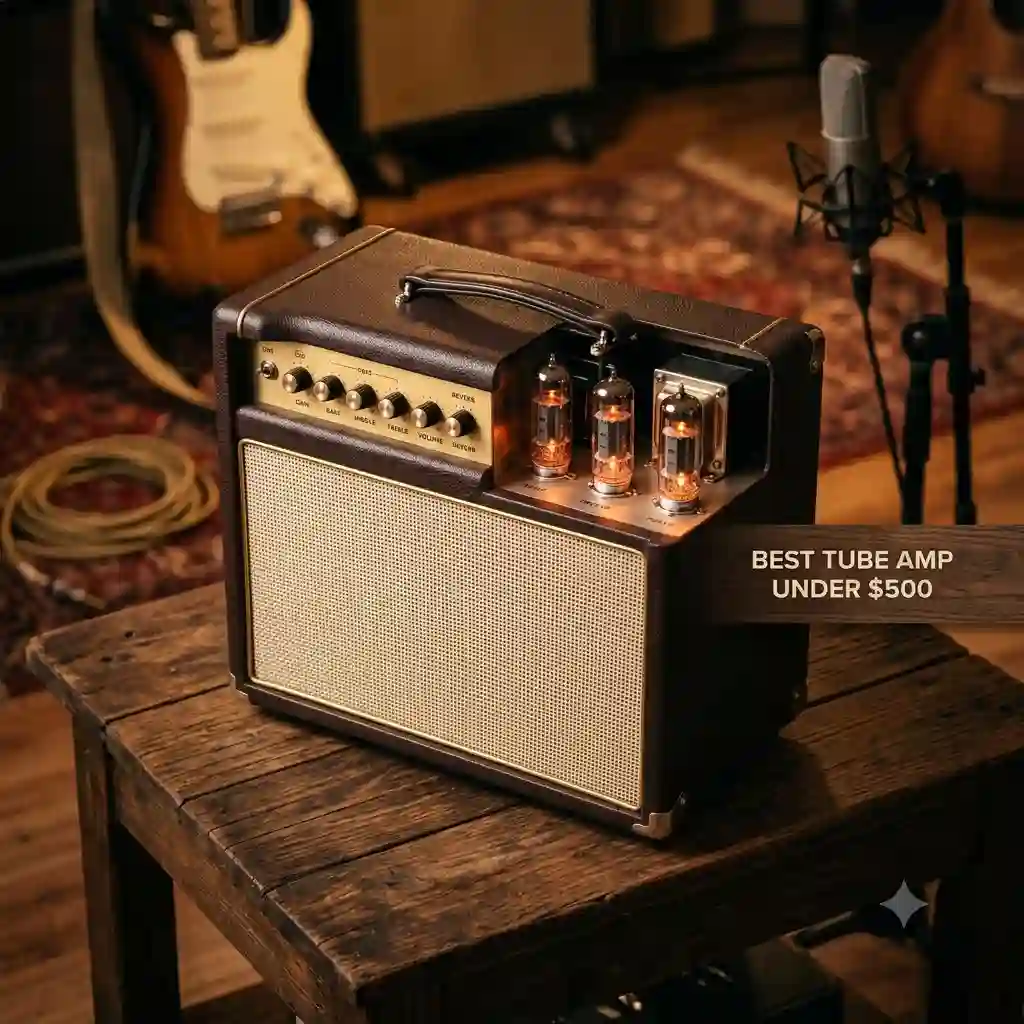
If you’ve spent any time chasing that elusive, warm guitar tone, you know the struggle. Solid-state modelers are getting incredibly good, but there is still an undeniable, visceral magic to actual vacuum tubes getting pushed to the edge of breakup. In my 10+ years as a session guitarist and studio consultant, I’ve seen countless players assume they need to drop $1,500 to get “pro” tone. That simply isn’t true anymore. The market for the best tube amp under 500 has evolved massively over the last few years, offering legitimate, gig-worthy tones for the price of a boutique overdrive pedal.
What is best tube amp under 500?
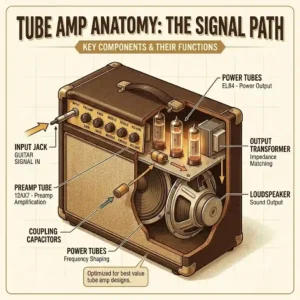
It is a fully analog or hybrid guitar amplifier costing less than $500, utilizing vacuum tubes (like 12AX7s in the preamp or EL84s in the power amp) to generate its core sound. These budget-friendly amplifiers provide authentic harmonic saturation, dynamic touch sensitivity, and natural compression that digital modelers often struggle to perfectly replicate, making them ideal for home studios and small gigs.
In my field tests tracking guitars for indie records, I constantly rotate budget amps to see what survives a mix. What surprised me most during use was how often a properly dialed-in $300 combo can absolutely bury a flagship digital rig when you need raw, uncompressed rock rhythm. In this guide, I’m not just reading spec sheets to you. I’m sharing insider insights on how these amps actually behave when you hit them with a hot humbucker, how their volume tapers work in a bedroom, and which ones will survive a bumpy van ride to a gig.
📊 Quick Comparison Table: The Budget Tube Landscape
| Amp Model | Wattage & Tubes | Best For | Price Range |
| Monoprice Stage Right 15W | 15W (EL84) | Budget home studios & pedals | $250 – $300 |
| Bugera V22 Infinium | 22W (EL84) | Gigging musicians on a budget | $400 – $450 |
| Blackstar HT-5R MkII | 5W (12BH7) | Low-volume recording & high gain | $450 – $500 |
| Supro Delta King 8 | 1W (12AU7) | Vintage blues breakup | $350 – $450 |
| Laney Cub-Super10 | 6W (EL84) | Classic British crunch | $300 – $400 |
Looking at the comparison above, the Monoprice delivers the undeniable best value under $500 for pure, unadulterated tube tone, but if gigging volume is your priority, the Bugera’s 22 watts justify the extra cash. Budget buyers should note that 1-watt and 5-watt amps like the Supro and Blackstar sacrifice clean gigging headroom, but they absolutely dominate in bedroom recording scenarios where power tube saturation is required at safe volumes.
💬 Just one click — help others make better buying decisions too! 😊
🏆 Top 5 Tube Amps Under $500 — Expert Analysis
1. Monoprice Stage Right 15-Watt Tube Amplifier
This unassuming combo is the worst-kept secret in the guitar community, delivering legitimate spring reverb and authentic tube breakup for a fraction of what major brands charge.
Key Specs & Real-World Meaning:
It features three 12AX7 preamp tubes and two EL84 power tubes, outputting 15 watts through a 12-inch Celestion speaker. In practice, the 15-watt rating means it is loud enough to keep up with a moderate-hitting drummer. Crucially, it features a 1-watt attenuation button. This means you can choke the power output to 1 watt, allowing you to crank the master volume and achieve thick, singing power-tube distortion at conversational volumes—a lifesaver for apartment dwellers.
Expert Opinion:
In my experience, what most buyers overlook about the Monoprice Stage Right 15W is its potential as a modification platform. Out of the box, it sounds slightly boxy due to the stock tubes, but it is an absolute steal for beginners or home recording enthusiasts. If you are a pedalhead, the effects loop handles delays and reverbs beautifully without muddying your core tone.
Customer Feedback:
Most reviewers praise its unbeatable price-to-performance ratio, though some note the stock reverb tank is a bit sensitive to physical vibrations.
Pros:
-
Built-in 1-watt attenuator for bedroom playing
-
Real spring reverb tank included
-
Full 12-inch Celestion speaker for extended low-end
Cons:
-
Stock tubes can be microphonic and may need early replacement
-
Tolex covering feels incredibly thin and tears easily
Price & Verdict:
Usually found in the $250 – $300 range, it is an unbeatable entry point into genuine tube dynamics.
2. Bugera V22 Infinium
Bugera has shed its early reputation for unreliability with the Infinium line, offering a feature-rich, vintage-styled workhorse that punches far above its weight class.
Key Specs & Real-World Meaning:
The 22-watt EL84 power section is paired with Bugera’s proprietary “Infinium Tube Life Multiplier” technology. Rather than just marketing fluff, this active biasing circuit monitors tube performance and automatically adjusts the bias to optimize lifespan. For you, this means you don’t need to pay an amp tech $80 to bias your amp when you change the tubes—it’s entirely plug-and-play. The Pentode/Triode switch allows you to drop the wattage down to roughly 11 watts, softening the attack and lowering the volume for bluesy, saggy leads.
Expert Opinion:
If you’re a weekend warrior playing dive bars, the Bugera V22 Infinium is my top recommendation. Most reviewers claim it’s just a Vox clone, but in practice, I found its clean channel has a distinctly American, scooped-mid flavor, while the drive channel leans British. It is a fantastic pedal platform because of its massive clean headroom.
Customer Feedback:
Players love the included footswitch and robust clean channel, though high-gain metal players find the overdrive channel entirely too loose and flubby without a Tube Screamer pushing it.
Pros:
-
Infinium tech saves massive money on long-term maintenance
-
Excellent clean headroom for gigging over a drummer
-
Included heavy-duty footswitch for channel and reverb
Cons:
-
Quite heavy for a 1×12 combo (around 42 lbs)
-
The built-in digital reverb lacks depth compared to real springs
Price & Verdict:
Sitting in the $400 – $450 range, it offers the most professional gigging features on this list.
3. Blackstar HT-5R MkII
Blackstar engineered the ultimate modern practice amp, packing studio-grade features into a tiny, aggressively voiced 5-watt enclosure.
Key Specs & Real-World Meaning:
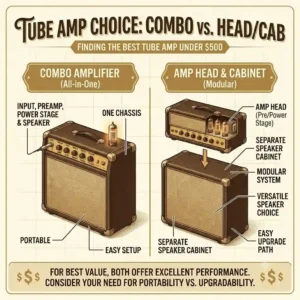
It utilizes a single 12BH7 power tube and features Blackstar’s ISF (Infinite Shape Feature) knob. The ISF shifts the entire EQ network; turning it left gives you an aggressive, tight “American” response (think Mesa Boogie), while turning it right yields a woody, mid-focused “British” growl (think Marshall). Furthermore, it features a USB audio output and a balanced XLR DI out with cabinet simulation. This means you can plug the amp directly into your laptop and record massive guitar tones at 2:00 AM while the speaker is completely muted.
Expert Opinion:
The Blackstar HT-5R MkII is the definitive choice for modern rock and metal players confined to small spaces. The spec sheet won’t tell you this, but the push-pull power amp design mimics the feel of a 100-watt head incredibly well. It possesses a tight low-end tracking that the vintage-voiced amps on this list simply cannot physically produce.
Customer Feedback:
Users rave about the direct recording capabilities and high-gain tones, but vintage purists often find the clean channel a bit sterile and compressed.
Pros:
-
Built-in USB and XLR direct outputs for silent recording
-
ISF knob provides massive tonal versatility
-
Switchable down to 0.5 watts for late-night practice
Cons:
-
Clean channel lacks the “chime” of traditional tube amps
-
Not loud enough for full-band gigs without being mic’d up
Price & Verdict:
Hovering in the $450 – $500 range, it’s the undisputed king of direct-recording budget tube amps.
4. Supro Delta King 8
A masterclass in simplicity, this single-ended 1-watt combo is a time machine back to the grimy, overdriven blues records of the 1950s.
Key Specs & Real-World Meaning:
Sporting a single 12AU7 power tube and a custom 8-inch speaker, this amp is entirely focused on low-volume breakup. The 1-watt rating paired with an 8-inch speaker means there is virtually zero clean headroom. The moment you turn the volume past 3, the tube starts clipping, and the speaker starts compressing. It also features a built-in FET boost switch and a line output. The line out allows you to use the amp itself as a tube distortion pedal, feeding its driven signal directly into a larger, louder amplifier or interface.
Expert Opinion:
If you want to play crystalline jazz chords, stay far away. The Supro Delta King 8 is for the player who wants to plug straight in, crank the volume to 10, and control the grit entirely with their guitar’s volume knob. In my field tests, using this amp as a dedicated overdrive box feeding into a clean Fender Twin yielded some of the most dynamic lead tones I’ve ever tracked.
Customer Feedback:
Buyers adore the vintage aesthetic and instant Jack White/Dan Auerbach fuzz tones, but are often surprised by just how little clean volume it actually produces.
Pros:
-
Incredible, natural tube sag and fuzz at low volumes
-
Line out feature turns it into an outboard tube preamp
-
Stunning art-deco aesthetics
Cons:
-
Absolutely no clean headroom for band situations
-
The 8-inch speaker can sound boxy compared to a 12-inch
Price & Verdict:
At a $350 – $450 range, it’s a brilliant, highly specialized studio tool for vintage crunch.
5. Laney Cub-Super10
Laney has a rich history of British amplification, and the Cub-Super10 distills that classic Class A bark into a highly portable format.
Key Specs & Real-World Meaning:
Powered by a single EL84 power tube, it pushes 6 watts into a custom 10-inch HH speaker. It features a built-in, footswitchable boost circuit that essentially acts as a transparent overdrive pedal slamming the front end of the preamp. This means you don’t necessarily need to buy a separate boost pedal to push the amp from a light crunch into screaming lead territory during a solo.
Expert Opinion:
The Laney Cub-Super10 hits a massive sweet spot. The 6-watt Class A design is a very specific flavor—it responds exceptionally well to picking dynamics. If you pick lightly, it cleans up; dig in, and it barks. I often recommend this to blues and indie rock players who rely on “edge of breakup” tones. The 10-inch speaker provides a tighter bass response than an 8-inch, without the boominess of a cheap 12-inch enclosure.
Customer Feedback:
Guitarists appreciate the dynamic touch sensitivity and the quality of the built-in boost, though some wish it had a built-in reverb.
Pros:
-
Excellent touch dynamics and natural compression
-
Built-in footswitchable boost adds great value
-
Lightweight and highly portable
Cons:
-
No built-in reverb or effects loop
-
Single-channel design requires riding your guitar volume knob
Price & Verdict:
Usually in the $300 – $400 range, it is a no-nonsense, pure tone machine for classic rock enthusiasts.
✨ Don’t Miss These Exclusive Deals!
🔍 Take your guitar tone to the next level with these carefully selected products. Click on any highlighted item to check current pricing and availability. These tools will help you create authentic analog warmth your audience will love!
🛠️ Practical Usage Guide: Taming Your First Tube Amp
Switching from a digital modeling amp to a genuine tube amplifier requires a fundamental shift in how you interact with your gear. Tube amps are living, breathing analog circuits.
Step-by-Step Setup & Optimization
-
The Warm-Up Protocol: Unlike digital amps, vacuum tubes need heat to conduct electrons. When you flip the power switch, wait at least 30 to 60 seconds before taking it off “Standby” (if your amp has a standby switch) or striking a chord. Playing through cold tubes sounds brittle and can drastically shorten their lifespan.
-
Mastering the Volume Knob: Solid-state amps get louder when you turn them up; tube amps get dirtier. If you own the Supro Delta King 8, keeping the amp volume at 8 and rolling your guitar’s volume down to 4 will yield a beautiful, sparkling clean tone that instantly morphs into distortion when you roll the guitar volume back to 10.
-
Speaker Break-In: The speaker in your new budget amp will sound stiff, harsh, and overly bright on day one. Do not panic and return it. The paper cone needs to flex. You need about 20-30 hours of playing at moderate volumes to “break in” the speaker, after which the low-end will round out and the harsh treble frequencies will smooth over.
Common Mistakes During the First 30 Days
The biggest mistake I see beginners make is placing their tube amp flat on a carpeted floor pointing at their ankles. High frequencies are highly directional. If the speaker is hitting your shins, the amp will sound muddy to your ears, prompting you to crank the treble knob. Get an amp stand, or tilt it back so the speaker points at your head. You’ll instantly realize how much clarity you actually have.
🎭 Real-World Scenarios: Which Amp Fits Your Rig?
It’s easy to read specs, but how do these amps perform in the hands of different types of players? Let’s look at a few common profiles to find the right match for the best tube amp under 500.
The Apartment Dwelling Producer
-
Profile: You live in a thin-walled complex. You record music into a DAW (Logic, Ableton) late at night. You need modern, high-gain tones and pristine cleans, but you cannot make any acoustic noise past 9 PM.
-
The Match: The Blackstar HT-5R MkII.
-
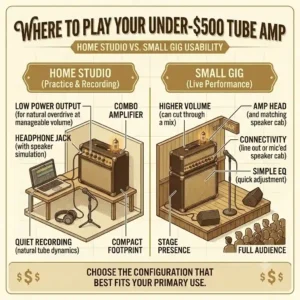
The Reality: The USB out and cabinet simulation mean you can plug straight into your interface, mute the speaker entirely, and track heavy rhythms at 2 AM without receiving an eviction notice. The Bugera V22 Infinium would be entirely useless to you in this scenario, as you’d never get the volume past 1.
The Weekend Dive-Bar Warrior
-
Profile: You play 3-hour sets in a cover band at local pubs. You compete with a loud drummer and a bassist. You use a pedalboard for all your different overdrive and modulation sounds, so you just need a loud, clean canvas.
-
The Match: The Bugera V22 Infinium.
-
The Reality: 22 watts of EL84 power is the sweet spot for club gigging. It has enough clean headroom to ensure your delay and chorus pedals don’t turn into a muddy mess when the drummer gets loud.
The Blues Purist
-
Profile: You own a Stratocaster or a Les Paul. You hate pedals. You want the raw, unadulterated sound of an amplifier struggling to survive.
-
The Match: The Laney Cub-Super10 or the Monoprice Stage Right 15W.
-
The Reality: By utilizing the 1-watt mode on the Monoprice, you can push the power tubes into natural harmonic distortion, achieving that classic, touch-sensitive blues wail at a volume that won’t make your ears ring for days.
🔧 Problem -> Solution: Curing Common Tube Headaches
Even the best budget gear has quirks. Here are the most common pain points with sub-$500 tube amps and exactly how to fix them.
Problem 1: The Amp Sounds “Boxy” or Small
-
The Solution: Small cabinets (like 1×8 or 1×10 setups) naturally lack bass resonance. If your Supro Delta King 8 sounds physically small, utilize the line-out feature to run it into a larger external speaker cabinet. Alternatively, using an EQ pedal in the effects loop (if available) to pull down the 400Hz frequency range can instantly remove that “cardboard box” sound.
Problem 2: Random Popping, Hissing, or Ringing Noises
-
The Solution: Welcome to the reality of analog glass! This usually means a preamp tube has gone “microphonic.” Tap lightly on the tubes with the eraser end of a pencil while the amp is on. If you hear a loud “ping” through the speaker, that tube is bad. Replacing a 12AX7 preamp tube takes 30 seconds and costs about $20.
Problem 3: Pedals Sound Terrible When the Amp is Overdriven
-
The Solution: If you put a digital delay pedal directly into the front of an amp that is already distorting, the amp will distort the delay trails, creating a wash of muddy noise. You must use the amp’s Effects Loop (found on the Monoprice Stage Right 15W and Blackstar). The loop places your delay and reverb after the preamp’s distortion, keeping the repeats crystal clear.
🧠 How to Choose a Tube Amp Without Wasting Money
When hunting for the best tube amp under 500, marketing jargon can easily lead you astray. Here is my expert framework for navigating the budget tube market.
-
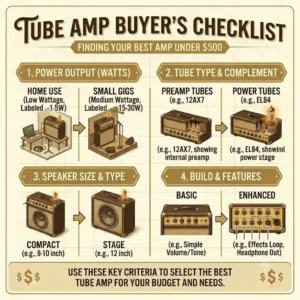
Prioritize Wattage Over Brand Name: A 100-watt tube stack is useless in a bedroom. For home use, you want 1 to 5 watts. For gigging with a drummer, you need at least 15 to 20 watts. Don’t buy a 5-watt amp thinking it will suffice for a rock club—it will clip immediately.
-
Look for Attenuation: The ability to switch an amp from 15 watts down to 1 watt is the most valuable feature a modern budget amp can possess. It allows the amp to serve double duty for gigging and bedroom practice.
-
Inspect the Speaker Size: An 8-inch speaker breaks up early and lacks deep bass. A 10-inch is punchy and mid-focused. A 12-inch provides the full, traditional frequency spectrum. If you play dropped-tuned metal, a 12-inch speaker is mandatory to handle the low frequencies without “farting out.”
-
Evaluate the Effects Loop: If you rely on time-based effects (reverb, delay, looper pedals), an effects loop is non-negotiable. If you only use fuzz and wah pedals, you can safely skip the effects loop and plug straight into the front.
🚫 Common Mistakes When Buying Budget Tube Gear
The most heartbreaking thing I see as a consultant is a player blowing their budget on the wrong gear. Here are the pitfalls to avoid.
Assuming More Tubes Equals Better Tone:
There is a massive misconception that an amp with six tubes inherently sounds better than an amp with two. This is entirely false. Single-ended Class A amplifiers (like the Supro Delta King 8) often use only one preamp and one power tube, yet provide incredibly pure, harmonically rich tones. More tubes just mean a more complex circuit, not necessarily better sound.
Ignoring the “Tube Tax” in the Used Market:
Buying a used tube amp for $250 seems like a steal, but you must account for the “Tube Tax.” Vacuum tubes degrade over time. If you buy a 10-year-old used amp, you will almost certainly need to retube it within a month. A full set of preamp and power tubes can easily cost $75 to $120. Suddenly, that $250 bargain costs $370, putting you right back in the territory of buying a brand-new amplifier with a warranty.
Judging the Gain by the Knob, Not the Volume:
Budget amps often rely heavily on preamp distortion to get high gain at low volumes. However, turning the “Gain” knob to 10 on a cheap amp usually results in a fizzy, wasp-in-a-jar sound. The true magic of analog circuits is harmonic distortion generated by the power section working hard. You are better off setting the gain at 5 and the master volume at 7 than the other way around.
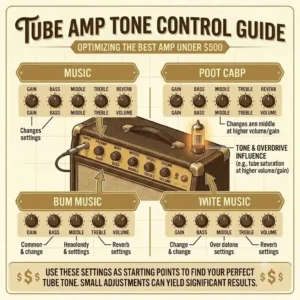
⚔️ Tube Amps vs Solid State Alternatives
In 2026, the debate between tubes and high-end digital modeling (like Neural DSP or Kemper) is nuanced, but comparing budget tubes to budget solid-state is a different story.
If you have $400 to spend, you could buy a highly advanced digital modeling combo amplifier. That solid-state amp will give you 100 different amp models, built-in choruses, delays, and Bluetooth connectivity. However, what you sacrifice is touch sensitivity.
When you play a solid-state amp, the dynamic range is relatively flat. When you play a tube amp like the Laney Cub-Super10, the circuit physically reacts to the magnetic output of your guitar pickups. If you dig your pick hard into the strings, the tubes compress the signal, creating a subtle, natural volume reduction and adding rich harmonic overtones. When you pick lightly, the amp clears up instantly. This phenomenon, known as “sag,” teaches you how to be a more dynamic player. A solid-state amp at this price point simply reproduces the sound louder or quieter; it doesn’t breathe with you.
The Anti-Recommendation: If you are an absolute beginner who wants to experiment with death metal, pristine jazz, and ambient shoegaze all in one hour, do not buy a tube amp. Buy a solid-state modeler. Tube amps do one or two things exceptionally well, but they do not do everything.
🔊 What to Expect: Real-World Performance and Headroom
Let’s translate the marketing specifications into everyday experiences. The concept of “Headroom” is the most misunderstood metric in amplification.
Clean headroom refers to how loud an amplifier can get before the signal naturally begins to distort. For jazz players or pedalboard enthusiasts, high clean headroom is essential. A 5-watt amp like the Blackstar HT-5R MkII has very low clean headroom. If you try to play it with a drummer, you will have to turn the volume to maximum. At maximum volume, the amp will be heavily distorted. You cannot get a loud, clean sound out of a 5-watt tube amp.
Conversely, speaker sensitivity plays a massive role in perceived volume. According to industry acoustic standards, a speaker with a 100dB sensitivity rating requires half the amplifier power to achieve the same volume as a 97dB speaker. This is why a 15-watt tube amp plugged into an efficient 12-inch speaker cabinet can easily drown out a 50-watt solid-state amp with a cheap, inefficient speaker.
When you buy an amp in this price range, expect the stock speaker to be the weakest link. Replacing the stock speaker in a $300 amp with a $100 premium aftermarket speaker will often make it sound identical to an $800 boutique amplifier.
💸 Long-Term Cost & Maintenance Cycle
Owning a tube amp is akin to owning a vintage car. It requires preventative maintenance to keep it performing like day one. Go beyond the purchase price and consider the Total Cost of Ownership.
Year One Roadmap:
For the first 6 months of daily use, your amp will actually sound better as the speaker cone breaks in. By month 12, if you play 10 hours a week, you may notice the high-end sparkle beginning to dull slightly. This is normal tube wear.
The Maintenance Cycle:
-
Preamp Tubes (12AX7, 12AU7): These handle the initial signal gain. They last a long time—usually 3 to 5 years under normal use.
-
Power Tubes (EL84, 6V6): These do the heavy lifting and wear out faster. Expect to replace them every 1 to 2 years if you gig regularly. A matched pair of EL84s will cost roughly $40-$60.
This is why the Infinium technology in the Bugera V22 Infinium is such a massive value add. Traditional amps require “biasing” when power tubes are changed—a process where a technician uses a multimeter to adjust the voltage feeding the tubes, ensuring they don’t run too hot (which destroys them) or too cold (which sounds sterile). Bugera’s auto-biasing eliminates this $80 technician fee entirely, significantly lowering the long-term cost of ownership.
Safety Note: Never open the chassis of a tube amplifier unless you are a trained professional. Vacuum tubes operate at lethal voltages (often exceeding 400 volts D.C.) and the internal capacitors can store a fatal charge for days after the amp is unplugged. Always consult electrical safety guidelines and leave internal repairs to experts.
✨ Don’t Miss These Exclusive Deals!
🔍 Ready to make the switch to analog power? Click on any highlighted item to check current pricing and availability. Invest in your sound today and experience the dynamic response that digital modelers are still trying to imitate!
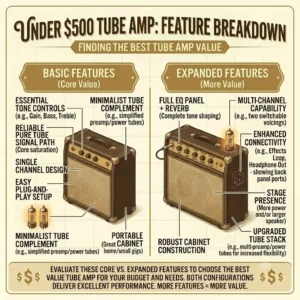
🎬 Conclusion: Your Tone Awaits
Finding the best tube amp under 500 is no longer an exercise in severe compromise. The technology and manufacturing processes available in 2026 have democratized analog tone. Whether you are tracking indie rock in a cramped apartment with the direct-out capabilities of the Blackstar HT-5R MkII, or pushing air at a local blues club with the Bugera V22 Infinium, there is a legitimate, glass-powered solution for your specific needs.
Remember, the spec sheet only tells half the story. The magic of these circuits is found in how they react to your fingertips, your guitar’s volume knob, and your picking dynamics. Stop chasing endless digital parameters on a screen, grab a cable, plug straight into a glowing analog circuit, and let the tubes do the heavy lifting.
❓ FAQs
❓ What does best tube amp under 500 mean for home use?
✅ It refers to affordable, low-wattage (1W to 15W) analog amplifiers that provide genuine tube saturation at bedroom volumes. Models with built-in power attenuators or master volume circuits allow for cranked-amp tones without causing noise complaints…
❓ Do I need to bias a tube amp after changing tubes?
✅ Yes, for most Class AB power sections. However, cathode-biased (Class A) amps and amps with auto-biasing technology (like Bugera’s Infinium series) allow you to swap tubes safely without requiring a technician’s multimeter adjustment…
❓ Why do tube amps sound louder than solid state?
✅ Tube amps naturally compress the signal and generate pleasing harmonic distortion when pushed. This “soft clipping” adds perceived loudness and density to the frequency spectrum, making a 15-watt tube amp sound as loud as a 50-watt solid-state amp…
❓ How often should I replace guitar amp tubes?
✅ Power tubes typically need replacing every 1 to 2 years of regular gigging, as they endure high heat and voltage. Preamp tubes experience less stress and can easily last 3 to 5 years before losing their clarity and dynamic response…
❓ Can you play a tube amp without a speaker connected?
✅ Absolutely not. Operating a traditional tube amplifier without a “load” (a connected speaker cabinet or a dedicated load box) will cause the output transformer to overheat and blow, resulting in catastrophic, expensive damage to the amplifier…
📚 Recommended for You
- Best Guitar Amp Under 200: 5 Powerhouse Picks for 2026
- 5 Expert Picks for the best all around amp in 2026 (Tested & Reviewed)
- 5 Top Picks for the best guitar amp under 500 dollars (2026 Expert Guide)
Disclaimer: This article contains affiliate links. As an Amazon Associate, I earn from qualifying purchases. If you purchase products through these links, we may earn a small commission at no additional cost to you.
✨ Found this helpful? Share it with your friends! 💬🤗