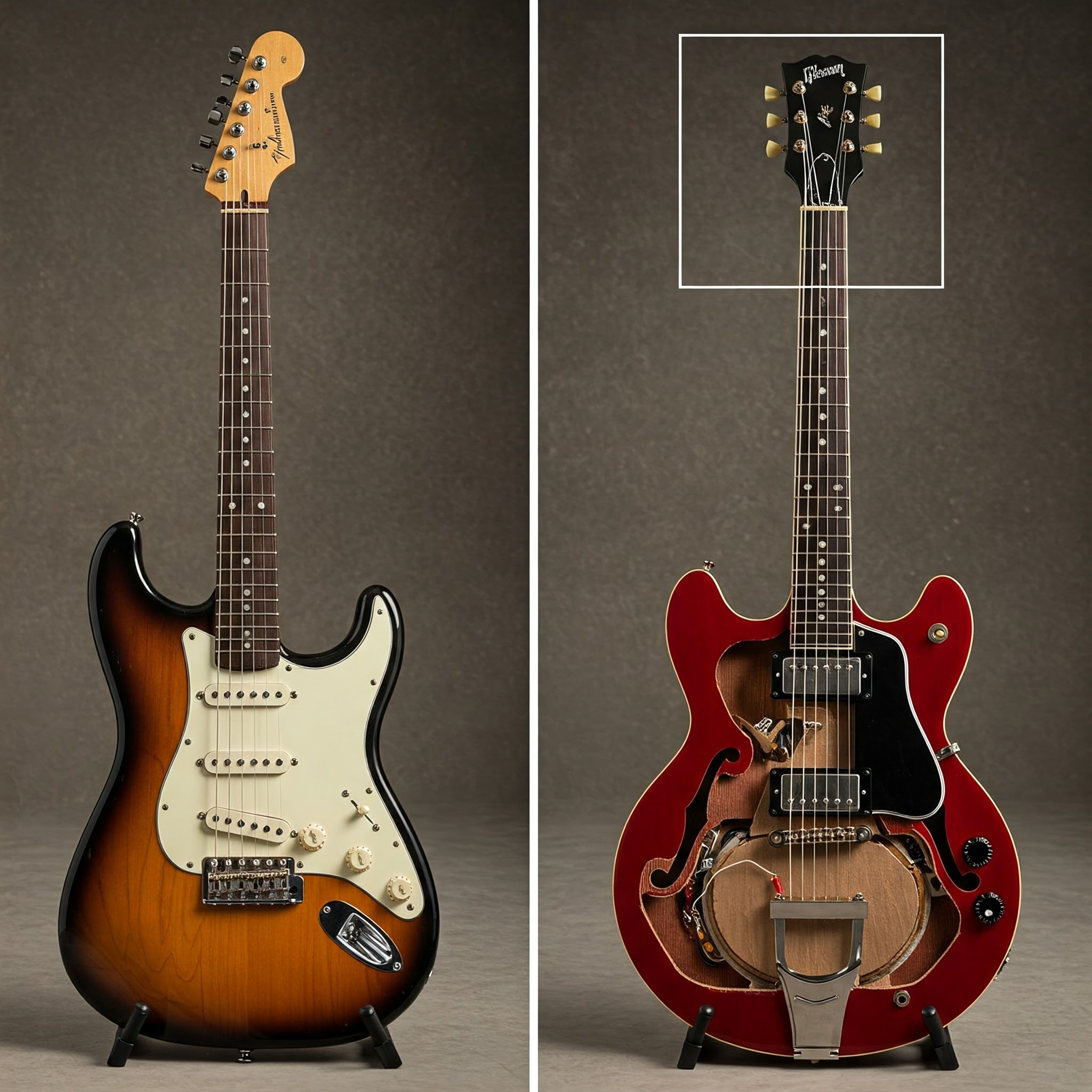
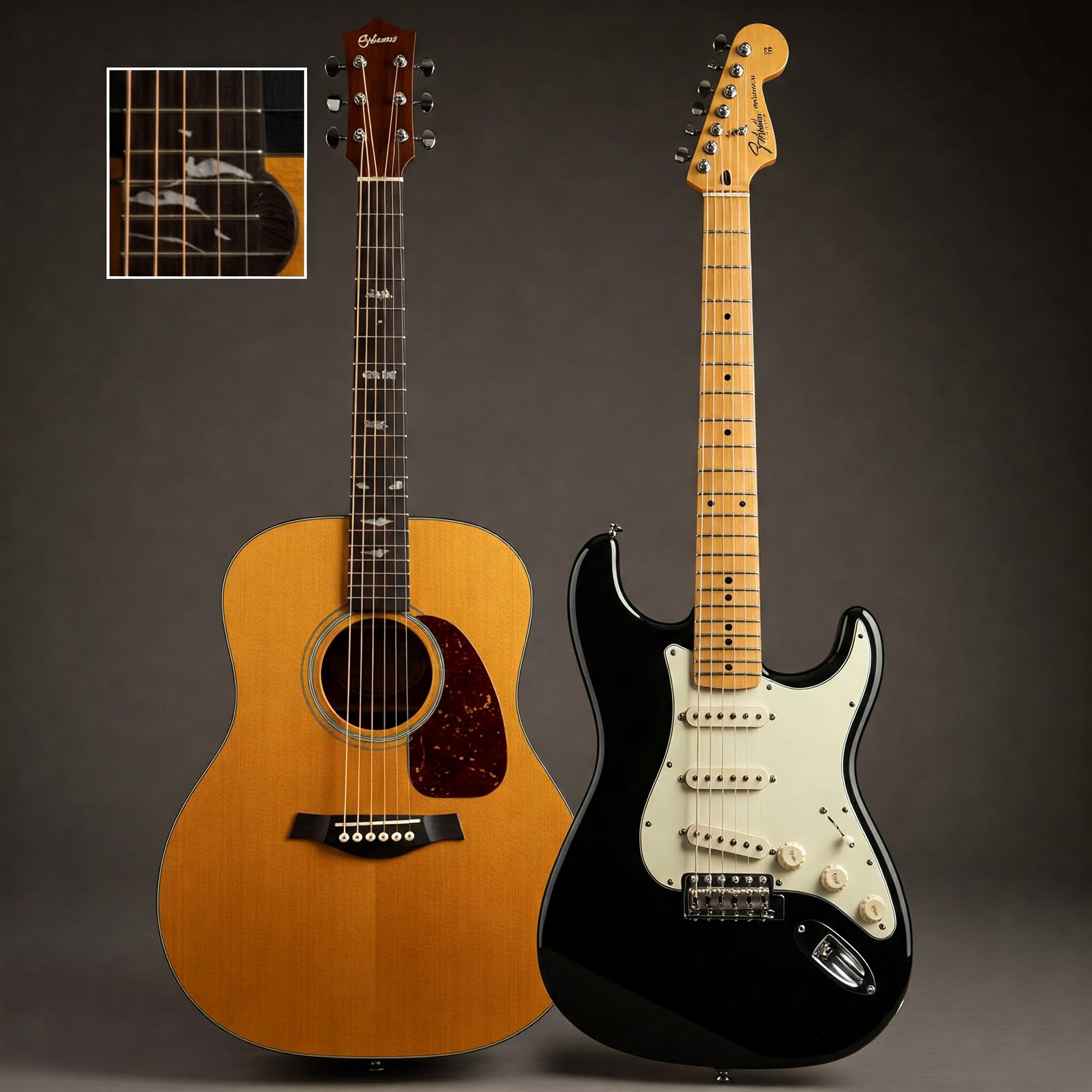
The Guitar Crossroads 🎸
Standing at the crossroads of your musical journey, you’re faced with a pivotal decision that will shape your path forward: acoustic guitar vs electric guitar. As a beginner guitarist with dreams of strumming your way to musical glory, this fundamental choice can feel overwhelming. However, understanding the unique qualities of each instrument type will ultimately help you make the right decision for your personal musical goals.
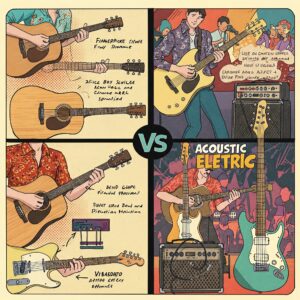
The acoustic guitar vs electric guitar debate has been ongoing for decades, with passionate advocates on both sides. Furthermore, many accomplished guitarists eventually master both types, recognizing that each offers distinct advantages and creative possibilities. In this comprehensive guide, we’ll explore everything you need to know about these two magnificent instruments, helping you navigate this important decision with confidence.
Whether you’re drawn to the raw, organic sound of an acoustic or the versatile, powerful voice of an electric guitar, this article will provide you with the knowledge to make an informed choice. Additionally, we’ll cover the essential gear, maintenance requirements, and learning considerations for both guitar types. Let’s dive into the wonderful world of guitars!
Understanding the Basics: What Makes Them Different? 🔍
Before we dive deeper into the acoustic guitar vs electric guitar comparison, let’s establish a fundamental understanding of what makes these instruments different from one another. Consequently, this knowledge will serve as the foundation for your decision-making process.
The Acoustic Guitar: Natural Sound and Self-Contained Design ✅
The acoustic guitar produces sound naturally through the vibration of its strings and the resonance of its hollow body. Moreover, the sound projects from the soundhole in the front of the guitar, requiring no external amplification to be heard. This self-contained design makes the acoustic guitar a truly portable instrument that can be played anywhere, anytime.
The construction of an acoustic guitar typically involves a wooden body with a hollow chamber, a soundhole, and metal or nylon strings. Furthermore, the wood type used for the top, back, sides, and neck significantly impacts the instrument’s tone and resonance.
The Electric Guitar: Amplified Sound and Solid-Body Construction ⚡
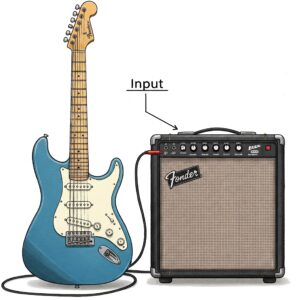
Unlike its acoustic counterpart, the electric guitar relies on electronic amplification to produce its sound. The vibrations of the strings are captured by magnetic pickups, converted into electrical signals, and then amplified through a guitar amplifier. Additionally, this electronic nature allows for a wide range of sound manipulation through effects pedals and amplifier settings.
Most electric guitars feature a solid body construction, though semi-hollow and hollow-body electric guitars also exist. Furthermore, the materials used in construction, the type of pickups, and the electronics all contribute to the instrument’s unique sound characteristics.

Sound Comparison: Tonal Characteristics That Define Each 🔊
The most obvious difference between acoustic guitar vs electric guitar lies in their sound. Therefore, understanding these tonal characteristics is crucial to determining which instrument aligns with your musical preferences.
Acoustic Guitar Sound: Warm, Natural, and Organic ✅
The acoustic guitar delivers a warm, natural sound with rich overtones and harmonic complexity. In addition, its sound is characterized by:
- 🌟 Strong attack and immediate response when strummed or picked
- 🌟 Bright, clear treble notes and full-bodied bass resonance
- 🌟 Dynamic range that responds directly to playing intensity
- 🌟 Unique wood resonance that develops and improves with age
The acoustic guitar sound is perfect for singer-songwriters, folk music, country, bluegrass, and unplugged performances. Nevertheless, it can be limiting for genres that require high volume or sound manipulation.
Electric Guitar Sound: Versatile, Powerful, and Customizable ⚡
The electric guitar offers an incredibly versatile sound palette that can be shaped and molded to fit virtually any musical style. Furthermore, its sound features:
- ⚡ Ability to produce clean, crystalline tones to heavily distorted sounds
- ⚡ Sustained notes that can ring out much longer than on acoustic guitars
- ⚡ Wide tonal variation through pickup selection and tone controls
- ⚡ Virtually unlimited sound possibilities through effects pedals and processing
The electric guitar excels in rock, blues, jazz, metal, and any genre where amplified sound, sustain, or effects are desired. However, it requires additional equipment to produce sound, making it less portable than an acoustic guitar.
Playability Factors: Comfort and Ease of Use 👐
Beyond sound, the physical experience of playing each type of guitar varies significantly. Consequently, these differences in playability may influence your choice based on comfort and ergonomics.
Acoustic Guitar Playability ✅
Playing an acoustic guitar often requires more finger strength, especially for beginners. Additionally, other playability factors include:
- ✅ Typically thicker necks and wider string spacing
- ✅ Higher action (distance between strings and fretboard)
- ✅ Heavier gauge strings that require more pressure to press down
- ✅ Larger body that may be less comfortable for some players
- ❌ Can be more challenging for beginners due to required finger strength
Electric Guitar Playability ⚡
Electric guitars are generally considered easier to play initially due to their physical characteristics. Furthermore, they offer:
- ⚡ Thinner necks and closer string spacing
- ⚡ Lower action for easier fretting
- ⚡ Lighter gauge strings that require less finger pressure
- ⚡ Smaller, contoured bodies that fit comfortably against the player
- ⚡ Less finger pain and fatigue during initial learning stages
For beginners concerned about finger pain or those with smaller hands, an electric guitar might offer a more comfortable starting point. Nevertheless, many teachers still recommend beginning with an acoustic to build proper technique and finger strength.
Cost Comparison: Initial Investment and Ongoing Expenses 💰
Budget considerations play an important role when choosing between acoustic guitar vs electric guitar. Therefore, understanding both the initial and long-term costs associated with each can help you plan accordingly.
Acoustic Guitar Costs ✅
The acoustic guitar typically has a lower overall cost of ownership due to its simplicity. Moreover, the cost factors include:
- 💰 Entry-level acoustic guitars start around $150-300
- 💰 Mid-range acoustics range from $300-800
- 💰 Professional acoustics can cost $1,000-5,000+
- 💰 Minimal additional equipment needed (just strings, picks, and a case)
- 💰 Lower long-term maintenance costs
For those on a tight budget who want to start playing immediately without additional purchases, an acoustic guitar represents the most straightforward option. Furthermore, a quality beginner acoustic guitar like the Yamaha FG800 Solid Top Acoustic Guitar offers excellent value and sound quality for beginners.
Electric Guitar Costs ⚡
The electric guitar requires more auxiliary equipment, resulting in a higher initial investment. Additionally, these costs include:
- 💰 Entry-level electric guitars start around $200-350
- 💰 Mid-range electrics range from $400-1,000
- 💰 Professional electric guitars can cost $1,200-3,000+
- 💰 Required additional equipment: amplifier ($100-300 for beginners)
- 💰 Optional equipment: effects pedals, cables, power supplies, etc.
- 💰 Higher potential for ongoing equipment purchases
While the initial investment is higher, the Squier by Fender Affinity Series Stratocaster Electric Guitar Pack with Frontman 15G Amplifier offers an all-in-one solution for beginners looking to start with an electric guitar, including the instrument, amplifier, and necessary accessories at a reasonable price point.
Quick Comparison Table: Cost Breakdown for Beginners
| Cost Factor | Acoustic Guitar | Electric Guitar |
|---|---|---|
| Entry-level instrument | $150-300 | $200-350 |
| Required accessories | $30-50 (strings, picks, strap) | $150-350 (amp, cables, strings, picks, strap) |
| Optional accessories | $20-100 (capo, tuner, case) | $100-300+ (effects pedals, stand, case) |
| Typical total starter cost | $200-400 | $350-700 |
🔥 Don’t Miss These Exclusive Guitar Deals! 🔥
Click on any highlighted product above to check current pricing and availability on Amazon. These carefully selected instruments provide the perfect starting point for your musical journey, whether you choose acoustic or electric!
Musical Style Considerations: Finding Your Sound 🎵
Your musical preferences and the styles you aspire to play should heavily influence your choice between acoustic guitar vs electric guitar. Additionally, certain genres naturally favor one type of guitar over the other.
Genres Best Suited for Acoustic Guitar ✅
The acoustic guitar shines in genres that emphasize natural, unplugged sound. Moreover, these include:
- 🎵 Folk and singer-songwriter music
- 🎵 Country and bluegrass
- 🎵 Classical and fingerstyle guitar
- 🎵 Acoustic rock and unplugged performances
- 🎵 Worship and church music
If artists like Ed Sheeran, Taylor Swift, John Mayer, or Jason Mraz inspire you, the acoustic guitar might be your perfect match. Furthermore, the acoustic guitar excels in intimate settings where its natural projection can fill a room without amplification.
Genres Best Suited for Electric Guitar ⚡
The electric guitar dominates genres that require amplification, effects, or distortion. In addition, these include:
- 🎵 Rock and hard rock
- 🎵 Blues and jazz
- 🎵 Metal and heavy music
- 🎵 Punk and alternative
- 🎵 Funk and R&B
Fans of guitarists like Jimi Hendrix, Eddie Van Halen, John Mayer, or Jimmy Page will naturally gravitate toward the electric guitar. Nevertheless, many versatile electric guitarists also incorporate acoustic guitars into their musical arsenal for different textures and dynamics.
Learning Curve: Which is Easier to Master? 📚
The learning journey differs between acoustic guitar vs electric guitar, with each presenting unique challenges and advantages for beginners. Therefore, understanding these differences can help set realistic expectations for your learning progress.
Learning on Acoustic Guitar ✅
Starting on acoustic guitar offers several educational benefits. Furthermore, the learning experience typically involves:
- 📚 Building finger strength and calluses more quickly
- 📚 Developing clean playing technique out of necessity
- 📚 Learning to control dynamics through picking/strumming intensity
- 📚 Mastering fundamental techniques without relying on effects
- ❌ Potentially more initial finger pain and slower progress on chords
Many teachers recommend starting on acoustic because it builds a solid technical foundation. Additionally, the skills developed on acoustic transfer well to electric guitar if you decide to switch later.
For beginners looking to learn on acoustic, the Fender FA-115 Dreadnought Acoustic Guitar Bundle provides a quality instrument with all the necessary accessories to start your learning journey, including a gig bag, strap, picks, and instructional material.
Learning on Electric Guitar ⚡
Starting on electric guitar can offer a more immediately gratifying experience. Moreover, the electric guitar learning curve features:
- 📚 Easier fretting and string bending due to lower action and lighter strings
- 📚 Less initial finger pain and faster chord progress
- 📚 Immediate gratification through amplified sound and effects
- 📚 Greater motivation when playing favorite rock/pop songs
- ❌ Potential to develop technique reliance on amplification and effects
For younger players, those with smaller hands, or beginners worried about finger pain, starting on electric might provide a more enjoyable entry point. However, it’s important to focus on developing proper technique regardless of which instrument you choose.
The Donner DST-100S Electric Guitar Kit is an excellent starting point for electric guitar beginners, offering a Stratocaster-style guitar with a comfortable neck profile, along with an amplifier and all necessary accessories at an affordable price point.
Portability and Practicality: Where Will You Play? 🏡
Practical considerations about where, when, and how you’ll play your guitar should influence your decision between acoustic guitar vs electric guitar. Consequently, lifestyle factors play an important role in determining which instrument will integrate best into your daily routine.
Acoustic Guitar Practicality ✅
The acoustic guitar offers superior portability and spontaneity. Additionally, practical aspects include:
- 🏡 Play anywhere, anytime without additional equipment
- 🏡 Perfect for impromptu jam sessions, parties, or outdoor playing
- 🏡 No need for power outlets or batteries
- 🏡 Generally more apartment and roommate-friendly (lower volume)
- ❌ Limited volume control options without amplification
If you envision yourself playing around campfires, in dorm rooms, or during travel, the acoustic guitar provides unmatched convenience. Furthermore, modern acoustic-electric guitars like the Yamaha APX600 Thin Body Acoustic-Electric Guitar offer the best of both worlds, with the ability to play unplugged or amplified for performances.
Electric Guitar Practicality ⚡
The electric guitar offers versatile volume control and practice options. Moreover, practical considerations include:
- 🏡 Ability to practice with headphones (with certain amps or interfaces)
- 🏡 Volume control from whisper-quiet to extremely loud
- 🏡 More comfortable practice for late-night sessions or shared living
- ❌ Requires access to power and additional equipment
- ❌ Less spontaneous due to setup requirements
For apartment dwellers or those who need to practice quietly, the electric guitar with a headphone amp solution provides excellent versatility. The Fender Mustang Micro Headphone Amplifier is a revolutionary pocket-sized device that plugs directly into your electric guitar, allowing for silent practice with high-quality tones and effects through headphones.
Versatility and Growth: Long-Term Considerations 🌱
As your skills develop, your musical needs will evolve. Therefore, considering the long-term versatility and growth potential of each guitar type can help you make a choice you won’t outgrow quickly.
Acoustic Guitar Long-Term Potential ✅
The acoustic guitar offers a specific kind of musical growth. Furthermore, its long-term considerations include:
- 🌱 Development of strong fingerstyle and strumming techniques
- 🌱 Focus on dynamics and expression through playing technique alone
- 🌱 Natural progression to singer-songwriter performance
- 🌱 Potential upgrade path to higher-end acoustic instruments
- ❌ Limited sonic experimentation compared to electric
Many lifelong acoustic players continually discover new techniques and styles, from complex fingerpicking to percussive playing. Additionally, acoustic guitar skills provide a solid foundation for any guitarist, regardless of future directions.
Electric Guitar Long-Term Potential ⚡
The electric guitar offers virtually unlimited creative possibilities as you grow. Moreover, its long-term potential includes:
- 🌱 Exploration of endless tonal variations through equipment
- 🌱 Development of specialized techniques like bending, tapping, and tremolo use
- 🌱 Natural progression to band playing and performance
- 🌱 Expandable system with new pedals, amps, and guitars
- 🌱 Greater genre flexibility as musical tastes evolve
The electric guitar can grow with you through various stages of your musical journey, from bedroom practice to garage bands to professional performance. Nevertheless, many advanced players eventually incorporate both acoustic and electric guitars into their arsenal for maximum versatility.
Quick Comparison Table: Acoustic vs Electric Key Differences
| Feature | Acoustic Guitar | Electric Guitar |
|---|---|---|
| Sound production | Natural resonance | Electronic amplification |
| Initial learning curve | Steeper (requires more finger strength) | Gentler (easier on fingers) |
| Starter cost | Lower ($200-400) | Higher ($350-700) |
| Portability | Excellent (no equipment needed) | Limited (requires amp and power) |
| Sound versatility | Limited (natural acoustic tones) | Extensive (effects and amp settings) |
| Volume control | Limited (playing technique only) | Complete (from silent to very loud) |
| Best suited genres | Folk, country, singer-songwriter | Rock, blues, metal, jazz |
🎸 Ready to Start Your Guitar Journey? Click Now! 🎸
Browse our carefully selected recommendations above to find your perfect instrument match. Whether you’re team acoustic or team electric, these quality guitars will provide years of musical enjoyment and growth. Don’t wait to begin your musical adventure!
Maintenance and Care: Keeping Your Investment in Top Shape 🔧
Different guitar types require different maintenance approaches. Therefore, understanding these requirements can help you choose an instrument that fits your willingness to perform regular upkeep.
Acoustic Guitar Maintenance ✅
Acoustic guitars require specific care due to their wood construction. Additionally, maintenance needs include:
- 🔧 Humidity control to prevent wood cracking or warping
- 🔧 Regular string changes every 1-3 months based on playing frequency
- 🔧 Occasional truss rod adjustments for neck relief
- 🔧 Cleaning of unfinished fretboards with appropriate oils
For acoustic guitar owners, investing in a D’Addario Humidipak Automatic Humidity Control System is essential for protecting your instrument from damage caused by humidity fluctuations, especially in dry climates or during winter months.
Electric Guitar Maintenance ⚡
Electric guitars have their own unique maintenance requirements. Moreover, these include:
- 🔧 Regular string changes every 1-2 months
- 🔧 Periodic cleaning of electrical components and contacts
- 🔧 Adjustment of pickup height and intonation
- 🔧 Maintenance of moving parts like tremolo systems
- 🔧 Amplifier maintenance and tube replacements (if applicable)
Electric guitar players should consider the MusicNomad Premium Guitar Care System, a comprehensive maintenance kit that includes everything needed to keep your electric guitar in top playing condition, from fretboard conditioner to specialized cleaners for hardware and electronics.
Making Your Decision: Practical Advice for Choosing 🤔
With all these factors in mind, how do you make your final decision between acoustic guitar vs electric guitar? Furthermore, here are some practical approaches to help you choose:
Try Before You Buy ✅
Nothing beats hands-on experience with both guitar types. Additionally, consider these steps:
- 👐 Visit local music stores to play both acoustic and electric guitars
- 👐 Ask friends if you can try their instruments
- 👐 Attend guitar workshops or classes where instruments might be available
- 👐 Consider renting before buying to test longer-term compatibility
Self-Assessment Questions ⚡
Ask yourself these key questions to clarify your personal needs. Moreover, be honest with your answers:
- 🤔 What music do I listen to most often?
- 🤔 Who are my guitar heroes and what do they play?
- 🤔 Where do I envision myself playing most often?
- 🤔 What’s my budget for initial investment?
- 🤔 How important is portability vs. sound versatility to me?
- 🤔 Am I concerned about disturbing others while practicing?
Consider Starting with Both ✅
If budget allows, starting with both instruments offers the best of both worlds. Furthermore, this approach provides:
- 🎸 Complete versatility from day one
- 🎸 Ability to develop different skills simultaneously
- 🎸 Freedom to match the instrument to your mood and musical goals
- 🎸 Understanding of how techniques transfer between instruments
Beginning players on a budget looking for this dual approach might consider the Donner DAG-1C Acoustic Guitar and Donner DST-1S Electric Guitar Kit, affordable quality instruments that together still cost less than many mid-range single guitars.
🔥 Begin Your Musical Adventure Today! 🔥
Browse our top recommended guitars and accessories by clicking on any highlighted product in this article. Each item has been carefully selected to provide the best quality and value for beginners embarking on their guitar journey!
Conclusion: Your Personal Guitar Journey Awaits 🌟
The acoustic guitar vs electric guitar decision ultimately comes down to your personal preferences, musical aspirations, and practical considerations. Furthermore, remember that there’s no wrong choice – both instruments offer rewarding paths to musical expression and creativity.
Many guitarists start with one type and eventually add the other to their collection as their skills and interests evolve. Additionally, the techniques and musical knowledge you develop on either instrument will transfer to the other, making your second guitar easier to learn.
Whether you choose the organic warmth of an acoustic or the versatile power of an electric guitar, the most important factor in your success will be consistent practice and enjoyment of the learning process. Moreover, with dedication and passion, either instrument can bring a lifetime of musical fulfillment and creative expression.
The guitar world welcomes you – now it’s time to pick up your instrument of choice and begin your musical journey!
More FQAs:
❓ Which is better for beginners: acoustic or electric guitar?
✅ Acoustic guitars are often preferred by beginners for their simplicity and portability, while electric guitars are easier on the fingers and offer more sound variety for different music styles…
❓ Do acoustic and electric guitars use the same strings?
✅ No, acoustic guitars typically use thicker, bronze or phosphor-bronze strings, while electric guitars use nickel or steel strings designed for magnetic pickups…
❓ Is an electric guitar harder to maintain than an acoustic?
✅ Electric guitars require more maintenance due to electronics, cables, and amps, while acoustic guitars have simpler upkeep involving occasional string changes and humidity control…
❓ Can you play the same songs on acoustic and electric guitar?
✅ Yes, most songs can be played on both guitars, but the tone and feel will differ; electric guitars allow effects and distortion, while acoustics offer a more natural, resonant sound…
❓ Which guitar is more versatile for different genres?
✅ Electric guitars are generally more versatile for genres like rock, jazz, and metal due to tone control and amp effects, while acoustic guitars shine in folk, country, and unplugged sessions…
Recommended for You:
- Bass Guitar vs Electric Guitar: 10 Exciting Facts Every Musician Should Know
- 7 Best Bass Guitar Strap Options for Ultimate Comfort and Style in 2025
- 10 Best Bass Combo Amp Options That Will Revolutionize Your Sound in 2025
Disclaimer: This article contains affiliate links. If you purchase products through these links, we may earn a small commission at no additional cost to you.