Introduction
Walk into any guitar shop and you’ll see two walls that look almost identical: hollow wooden bodies, round soundholes, six strings. Yet the classical guitar vs acoustic guitar choice is one of the most consequential decisions a new player makes, because it quietly decides how your fingers feel in week one, which songs sound “right,” and whether that guitar ends up played daily or parked in a closet.
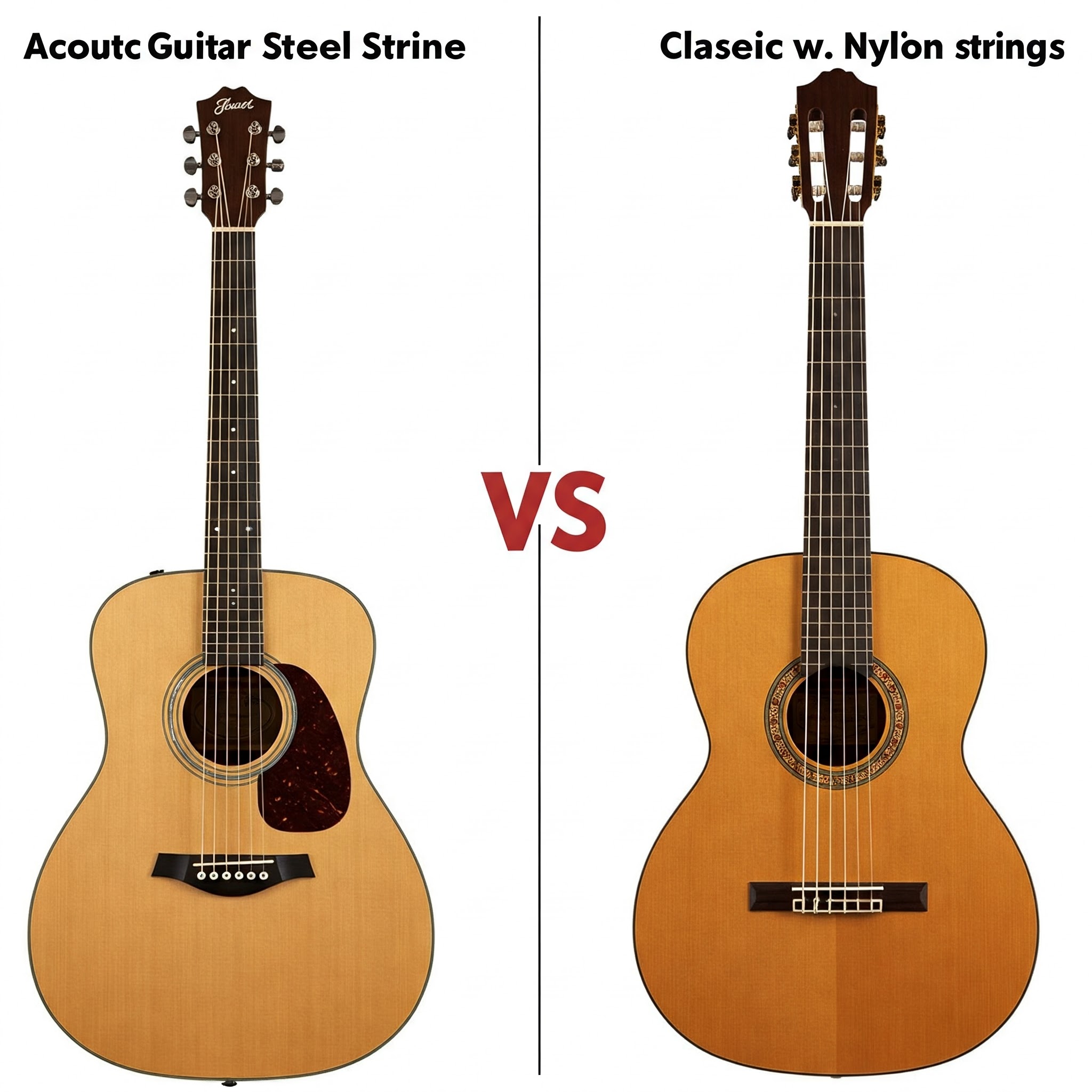
Here’s the short version: one uses soft nylon strings and a wide, flat neck; the other uses bright steel strings and a slimmer, faster neck. Everything else — tone, genre fit, comfort, maintenance, price — flows from that single difference. The classical guitar vs acoustic guitar question isn’t about which instrument is “better.” It’s about which one matches the music living in your head.
Quick note: this guide contains affiliate links. If you buy through them, we may earn a commission at no extra cost to you. Our picks are based on spec sheets, manufacturer data, and aggregated owner feedback — not on payment.
What Is classical guitar vs acoustic guitar?
The classical guitar vs acoustic guitar comparison describes two related instruments: the classical guitar uses nylon strings, a wide neck (about 52 mm at the nut), and fan bracing for a warm, mellow voice, while the steel-string acoustic uses higher-tension steel strings, a narrower neck (about 43 mm), and X-bracing for a brighter, louder sound.
If you want the deep history, the classical guitar’s evolution on Wikipedia traces how Antonio de Torres shaped the modern nylon-string design in 19th-century Spain. Below, we’ll stay practical: what each design means for your hands, your ears, and your wallet heading into 2027 — plus seven real guitars on amazon.com worth your money.
Quick Comparison: acoustic vs classical guitar at a Glance
Before we dive into individual models, here’s the big-picture acoustic vs classical guitar breakdown in one table.
| Feature | Classical (Nylon-String) | Acoustic (Steel-String) |
|---|---|---|
| Strings | Nylon trebles, wound basses | Steel / bronze-wound steel |
| Approx. total string tension | Roughly 75–90 lbs | Roughly double, often 150+ lbs |
| Nut width (typical) | ~52 mm (2 1/16″) | ~43 mm (1 11/16″) |
| Tone | Warm, round, intimate | Bright, punchy, long sustain |
| Truss rod | Often absent on traditional models | Standard |
| Finger comfort for beginners | Very gentle | Sore tips for 2–3 weeks |
| Typical genres | Classical, flamenco, bossa nova, folk fingerstyle | Pop, rock, country, folk, worship, blues |
| Best for | Fingerstyle learners, kids, nylon lovers | Strummers, singer-songwriters, band players |
Reading this table, the pattern is clear: classical guitars win on comfort and warmth, while steel-string acoustics win on volume, sustain, and genre range. The tension row is the hidden headline — roughly half the string load is why nylon feels so forgiving, and also why you must never swap string types between the two designs. If most of your playlist is Taylor Swift, Zach Bryan, or campfire strumming, the right-hand column is probably your home.
💬 One click helps other shoppers make an informed choice too! Share this comparison with a friend who’s shopping for a first guitar. 😊
Top 7 Guitars for the classical guitar vs acoustic guitar Decision: Expert Analysis
We chose these seven to cover both sides of the classical vs acoustic guitar divide — three nylon-string models (including one crossover), and four steel-string acoustics — across entry-level, mid-range, and high-end budgets. Every model is a real, currently listed instrument with a substantial body of owner feedback.
1. Yamaha C40II — the classroom-standard starter classical
The Yamaha C40II is the guitar many music teachers name first, and for good reason: it gets you a properly proportioned classical instrument at entry-level money.
It pairs a laminated spruce top with meranti back and sides, a nato neck, and a rosewood fingerboard and bridge. The 650 mm scale and 52 mm nut are true classical dimensions, which means the technique you build — thumb behind the neck, fingers arched over wide spacing — transfers directly to any concert classical you buy later. A laminated top won’t bloom with age the way solid wood does, but it shrugs off humidity swings in dorms and living rooms far better.
Based on comparing the specs, this is the right call for absolute beginners, kids moving up to full size, and adults who want to test their commitment before spending more. It is not the guitar for someone who already knows they love classical repertoire; the Cordoba C5 is a better long-term partner there.
Owner reviews consistently praise its tuning stability and build consistency for the price. The most common complaints are slightly high action out of the box and so-so factory strings — both cheap to fix.
Pros:
- ✅ Authentic classical dimensions for proper technique
- ✅ Laminated top handles humidity changes well
- ✅ Huge teacher and community support
Cons:
- ❌ Action often needs lowering for easier play
- ❌ Stock strings sound thin until replaced
Typically found around $150–$200 (check the current price), the Yamaha C40II is the best value entry into nylon-string playing.
2. Cordoba C5 — solid cedar warmth on a modest budget
The Cordoba C5 is the classic “first real upgrade” nylon-string guitar, and its secret is the solid cedar top.
Solid cedar responds quickly to a light touch, producing a warmer, more complex tone than the laminated tops at the entry level. The back and sides are mahogany, the nut is the traditional 52 mm, and the scale is a standard 650 mm. Importantly, Cordoba fits a truss rod in this model — a feature many traditional classical guitars skip — so a tech can fine-tune neck relief as the seasons change.
What most buyers overlook here is that cedar sounds “broken in” almost immediately, while spruce tends to take longer to open up. That makes the Cordoba C5 ideal for students who want satisfying tone right away, bossa nova and flamenco-curious players, and anyone who started on a budget classical and now feels limited by it.
Aggregated review sentiment highlights the gloss finish, the gold tuners, and the rich tone relative to cost. Guitar World named it a strong alternative to the Yamaha C40II for its build and tone, as noted in their beginner classical guitar roundup. The main criticism: cedar tops dent and scratch more easily than spruce.
Pros:
- ✅ Solid cedar top sounds warm from day one
- ✅ Built-in truss rod eases future adjustments
- ✅ Looks and feels pricier than it is
Cons:
- ❌ Soft cedar top marks easily
- ❌ No pickup for plugging into an amp
Usually priced in the $300–$400 range, the Cordoba C5 delivers the most tone per dollar in nylon-string guitars.
3. Cordoba Fusion 5 — nylon tone with a steel-string-style neck
The Cordoba Fusion 5 is a crossover guitar, built for players who love nylon tone but don’t want a wide classical neck.
Its nut narrows to 48 mm, and the fingerboard has a 16″ radius — a slight curve borrowed from steel-string design — so barre chords feel more familiar to acoustic and electric players. It adds a solid spruce top, mahogany back and sides, a Venetian cutaway for upper-fret access, side dot markers, and a Fishman undersaddle pickup with an onboard tuner (the exact Fishman system has varied by production run).
On paper, this means the Cordoba Fusion 5 solves the biggest pain point steel-string players report when trying nylon: the “bowling-lane” neck. It’s ideal for singer-songwriters adding nylon color to gigs, jazz and bossa players who plug in, and guitarists switching from steel who want an easier transition.
Reviews consistently report a balanced, articulate voice and a neck that feels instantly comfortable. A recurring caveat from classical purists: the narrower spacing makes advanced fingerstyle repertoire slightly more cramped.
Pros:
- ✅ 48 mm nut eases the switch from steel
- ✅ Cutaway and pickup make it stage-ready
- ✅ Solid spruce top for clear, lively tone
Cons:
- ❌ Narrower spacing frustrates strict classical technique
- ❌ Unplugged volume trails full-depth classical bodies
Expect roughly $450–$550 at the time of writing; the Cordoba Fusion 5 is excellent value if you’ll actually use the electronics.
4. Yamaha FG800 — the benchmark budget steel-string
The Yamaha FG800 is the steel-string guitar most often recommended as the best-value starter, and its solid spruce top is the reason.
At a price where many rivals use laminated tops, Yamaha gives you a solid spruce top over nato/okoume back and sides, with scalloped bracing designed to let the top vibrate more freely. In practice, that translates to a louder, more resonant dreadnought than you’d expect at this level — and a top that can actually mature tonally over years of playing. The neck has an adjustable truss rod, so action can be set comfortably low.
Based on comparing the specs and reviews, the Yamaha FG800 suits adult beginners who strum, teens moving off a starter pack, and experienced players wanting a beater guitar they won’t worry about. Its full dreadnought body is big, though; smaller players may find the Fender CD-60S or Taylor GS Mini easier to hold.
Aggregated owner sentiment is remarkably consistent: strong projection, stable tuning, and impressive consistency from guitar to guitar. The most frequent criticism is a plain look and a factory setup that benefits from a professional tweak.
Pros:
- ✅ Solid spruce top at a budget price
- ✅ Loud, balanced dreadnought voice
- ✅ Consistent quality control across units
Cons:
- ❌ Big body is bulky for smaller players
- ❌ Plain, no-frills cosmetics
Typically found around $200–$260, the Yamaha FG800 is the safest dollar-for-dollar steel-string buy.
5. Fender CD-60S — the comfiest neck under $250
The Fender CD-60S goes head-to-head with the Yamaha FG800, and it wins one specific battle: neck comfort.
It’s a dreadnought with a solid top (spruce on the standard version; an all-mahogany variant uses a solid mahogany top) and laminated mahogany back and sides. Fender’s “easy-to-play” neck features rolled fingerboard edges, meaning the sharp corners where the fretboard meets the neck have been softened. That sounds minor, yet for a beginner whose thumb hugs the neck for hours, it noticeably reduces fatigue. A walnut fingerboard and a slim neck profile round out the playability focus.
So who should pick it over the Yamaha? Players with smaller hands, teens, and anyone who’s tried a guitar and found the neck “chunky.” MusicRadar described the all-mahogany version as bright, articulate, and well balanced in its best acoustic guitars guide.
Owner reviews frequently mention how playable it feels from the box. The recurring critique is that its laminated back and sides sound slightly less rich than the Yamaha FG800 side by side.
Pros:
- ✅ Rolled fingerboard edges feel smooth
- ✅ Solid top brightens the tone
- ✅ Slim neck suits smaller hands
Cons:
- ❌ Slightly less bass depth than rivals
- ❌ Stock strings dull quickly
At roughly $200–$230, the Fender CD-60S is the comfort-first value pick.
6. Taylor GS Mini — big sound in a travel-friendly body
The Taylor GS Mini proves a compact guitar doesn’t have to sound like a toy.
It’s a scaled-down Grand Symphony with a 23.5″ scale and a 1 11/16″ nut. The shorter scale lowers string tension slightly, so steel strings feel a touch easier to fret — a genuine benefit for beginners worried about sore fingers. Versions vary: the GS Mini Sapele pairs a solid spruce top with layered sapele back and sides, while the GS Mini Mahogany uses a solid mahogany top for a warmer, drier voice. A sturdy gig bag is included, which matters for commuters and travelers.
Here’s what to weigh: the Taylor GS Mini costs more than double the budget dreadnoughts, but it’s a guitar many owners keep even after buying a high-end instrument. That makes it ideal for small-framed adults, students in dorms, frequent travelers, and anyone who wants one guitar they’ll never outgrow.
Aggregated reviews repeatedly describe it as punching far above its size, with clear projection and excellent intonation. The common complaints: it sounds smaller than a full dreadnought in a strumming circle, and the base model lacks electronics.
Pros:
- ✅ Compact body with surprisingly full tone
- ✅ Shorter scale reduces fretting effort
- ✅ Quality gig bag included
Cons:
- ❌ Less low-end boom than full-size bodies
- ❌ Premium price for a compact guitar
Usually priced around $550–$700, the Taylor GS Mini earns its price through longevity and portability.
7. Martin D-15M — all-solid mahogany, made in the USA
The Martin D-15M is our high-end pick, and it represents the steel-string tradition at its most honest and unvarnished.
Top, back, sides, and neck are all solid genuine mahogany, built in Martin’s Nazareth, Pennsylvania factory with A-frame X bracing in Sitka spruce, a bone nut, and a satin finish. All-solid construction is the key spec: every wooden surface vibrates and ages together, producing a woody, focused midrange with warm lows that sits beautifully under a voice. Mahogany tops tend to sound less sparkly than spruce, which is exactly why many singer-songwriters love them — they don’t compete with vocals.
Based on comparing the specs, the Martin D-15M is for committed players ready for a lifetime instrument, recording musicians who want a characterful voice, and anyone who found budget dreadnoughts too bright or “boomy.” It’s overkill for someone unsure they’ll keep playing.
Owner sentiment centers on its resonance, sustain, and understated vintage look. Critiques include the satin finish showing wear with heavy use and the lack of a pickup on the standard model.
Pros:
- ✅ All-solid mahogany construction ages beautifully
- ✅ Vocal-friendly, warm midrange voice
- ✅ US-made build with Martin resale value
Cons:
- ❌ Satin finish shows wear quickly
- ❌ No electronics on the standard model
Typically $1,700–$1,900, the Martin D-15M is a long-term investment rather than a starter.
Top 7 Comparison: Specs, Prices, and Best Uses
| Guitar | Type | Top | Nut Width | Electronics | Price Range | Best for |
|---|---|---|---|---|---|---|
| Yamaha C40II | Classical | Laminated spruce | 52 mm | No | ~$150–$200 | Yamaha C40II: first-time classical learners |
| Cordoba C5 | Classical | Solid cedar | 52 mm | No | ~$300–$400 | Cordoba C5: tone-focused upgraders |
| Cordoba Fusion 5 | Crossover nylon | Solid spruce | 48 mm | Yes | ~$450–$550 | Cordoba Fusion 5: steel players going nylon |
| Yamaha FG800 | Steel dreadnought | Solid spruce | ~43 mm | No | ~$200–$260 | Yamaha FG800: value-first strummers |
| Fender CD-60S | Steel dreadnought | Solid spruce/mahogany | ~43 mm | No | ~$200–$230 | Fender CD-60S: smaller hands |
| Taylor GS Mini | Compact steel | Solid spruce or mahogany | 1 11/16″ | No (base) | ~$550–$700 | Taylor GS Mini: travel and compact comfort |
| Martin D-15M | Steel dreadnought | Solid mahogany | 1 11/16″ | No | ~$1,700–$1,900 | Martin D-15M: lifetime instrument |
Looking at the table, the nut-width column tells the classical vs acoustic guitar story better than any marketing copy: 52 mm on the classical models, 48 mm on the Cordoba Fusion 5, and about 43 mm on every steel-string. Value hunters should notice that both the Yamaha FG800 and Fender CD-60S offer solid tops under $260, while the Cordoba C5 is the only nylon model in its bracket with a solid top. If budget allows only one upgrade, a solid top matters more than electronics.
✨ Ready to Pick Your Perfect Guitar? 🎸
🔍 Take your playing to the next level with this carefully curated lineup. Click a highlighted guitar to check current pricing and availability on Amazon. Whichever side of the nylon-or-steel debate you land on, these picks will help you sound good from your very first chord!
Your First 30 Days: A Practical Setup and Practice Guide
Buying the guitar is step one. The first month decides whether you keep playing, and the advice differs depending on which side of the classical guitar vs acoustic guitar fence you chose.
Week 1: Get the setup right 🔧
Budget guitars often arrive with high action (string height). A professional setup at a local shop usually runs somewhere in the $50–$90 range and can make a cheap guitar play like one twice the price. On steel-strings, the tech adjusts the truss rod and saddle; on traditional classicals without a truss rod, they lower the saddle or nut.
Week 1–2: Understand string settling
Nylon strings stretch for several days after installation, so a new classical will drift out of tune constantly at first. That’s normal, not a defect. Steel strings settle in hours. Either way, a clip-on tuner is non-negotiable.
Weeks 2–3: Manage finger pain
On a steel-string acoustic, expect sore fingertips for the first two to three weeks. Practice in short sessions — 15 to 20 minutes, two or three times a day — rather than one marathon. Classical players feel far less pain but often struggle with the wider stretches; keep your thumb low behind the neck.
Weeks 3–4: Build the right habits ✅
- Classical: learn rest strokes and free strokes, and keep your right-hand nails smooth and slightly rounded.
- Acoustic: learn the four core open chords (G, C, D, Em) and a basic down-up strum.
- Both: use a footstool or a strap so your posture stays relaxed.
Common first-month mistakes ❌
Pressing far harder than necessary, skipping a tuner, practicing with the guitar flat on your lap, and quitting during week two — the point where calluses are just about to form.
Real-World Scenarios: Which Guitar Fits Your Life?
Specs mean little until you map them to real people. Here are three realistic profiles and the reasoning behind each match.
🎓 Maya, 19, college student, $250 budget
Maya wants to accompany herself singing pop and indie songs in her dorm, practicing about 30 minutes most evenings. She strums far more than she picks. A steel-string is the right call because her music is built on bright, strummed chords. The Fender CD-60S fits best: its rolled fingerboard edges help with long sessions, and its price leaves room for a tuner, capo, and setup. If her budget stretched, the Taylor GS Mini would suit a cramped dorm room even better.
👨👧 Daniel, 42, parent learning alongside his 10-year-old
Daniel and his daughter are starting lessons together at a community music school, where the curriculum is note-reading and fingerstyle. Gentle nylon strings mean fewer tears from sore fingers, and the teacher’s materials assume classical dimensions. The Yamaha C40II for Daniel is a smart, low-risk start, while his daughter would likely need a smaller-scale classical (Yamaha makes 3/4 and 1/2 sizes) until she’s tall enough for full size.
🎤 Priya, 31, gigging singer-songwriter
Priya already plays steel-string at coffee shops but wants a warmer nylon color for ballads. She needs to plug in and doesn’t want to relearn chord shapes on a wide neck. The Cordoba Fusion 5 checks every box: 48 mm nut, cutaway, and a Fishman pickup. Later, for studio recording of her steel-string songs, the Martin D-15M would give her a vocal-friendly mahogany voice.
The takeaway from these profiles: genre and context should drive the decision first, budget second, and brand loyalty last.
Buyer Decision Framework: acoustic vs classical guitar difference in Practice
When people search the acoustic vs classical guitar difference, they usually want a verdict, not a lecture. This framework turns the specs into simple “if-then” choices.
If-then decision tree 🧭
- If you mainly want to strum chords and sing pop, rock, or country, choose a steel-string acoustic because its bright attack and sustain define those genres.
- If you want to read music, study classical, flamenco, or bossa nova, choose a classical because the repertoire and technique assume a nylon, wide-neck instrument.
- If finger pain is your biggest fear (or you’re buying for a young child), choose a classical because nylon’s lower tension is far gentler.
- If you love nylon tone but already play steel or electric, choose a crossover like the Cordoba Fusion 5 because the narrower neck keeps chord shapes familiar.
- If you travel or have a small frame, choose a compact steel-string like the Taylor GS Mini because the shorter scale and body reduce strain.
Priority checklist before checkout ✅
- Name three songs you want to play in six months.
- Confirm whether your teacher (if any) expects nylon or steel.
- Decide if you’ll ever need to plug in.
- Set aside part of the budget for a setup, tuner, and spare strings.
- Prioritize a solid top over cosmetics when you can.
If your answers split evenly, start with the instrument matching the three songs you named. Motivation beats theoretical versatility every time.
How to Choose in the classical vs acoustic guitar Decision: 7 Steps
Use these seven steps to narrow any shortlist in minutes.
- Define your music. Your favorite genre is the single strongest predictor of which guitar you’ll keep playing.
- Measure your hands against the neck. A 52 mm classical nut suits long fingers and fingerstyle; a 43 mm steel-string neck favors chord-heavy playing and smaller hands.
- Check the top: solid or laminated. Solid tops resonate more and improve with age; laminated tops are tougher and cheaper.
- Pick a body size you can hold comfortably. Dreadnoughts are loud but bulky; compact bodies like the Taylor GS Mini trade some bass for comfort.
- Decide on electronics now. Retrofitting a pickup costs more than buying an acoustic-electric version upfront.
- Look for a truss rod. It allows seasonal neck adjustments; steel-strings always have one, while many classicals don’t.
- Budget for setup and accessories. A professional setup often matters more to playability than a $100 price difference.
Following these steps keeps you focused on how the guitar will feel and sound in your hands, rather than on brand hype or headstock logos.
acoustic vs classical guitar difference: Strings, Necks, and Construction Explained
The acoustic vs classical guitar difference runs deeper than strings. Because steel exerts roughly double the tension of nylon, the two instruments are engineered differently from the inside out.
Steel-string guitars use X-bracing under the top and an adjustable truss rod inside the neck to resist that load, as outlined in Wikipedia’s overview of the steel-string acoustic guitar. Classical guitars typically use lighter fan bracing that lets a thin top vibrate under low tension, and traditional models skip the truss rod entirely.
| Construction Detail | Classical | Steel-String Acoustic | Why It Matters to You |
|---|---|---|---|
| Bracing | Fan bracing | X-bracing | Fan = warmth; X = strength and projection |
| Bridge | Tie-block (strings knotted) | Pin bridge (ball-end strings) | Restringing a classical takes more practice |
| Neck joins body | Usually at 12th fret | Usually at 14th fret | Steel-strings reach high notes more easily |
| Fingerboard | Flat | Slightly curved (radiused) | Curved boards make barre chords easier |
| Best for | Fingerstyle, warm tones | Strumming, versatile genres | Match construction to playing style |
This table explains why you can’t simply restring one into the other. Steel strings on a classical can lift the bridge or crack the top, while nylon on a steel-string sounds quiet and buzzy because the heavy bracing barely moves. In short, choose the instrument built for the sound you want, not the one you plan to convert.
What to Expect: Everyday Performance of classical vs acoustic guitar
Specs on paper become very real once you play for an hour. Here’s how the classical vs acoustic guitar experience differs day to day.
🔊 Volume and projection
A dreadnought like the Yamaha FG800 or Martin D-15M fills a room and holds its own around a campfire. Classical guitars are quieter and more intimate — ideal for apartments, late-night practice, and recording, but they can disappear in a group jam.
🎶 Tone and sustain
Nylon produces a rounded attack and shorter sustain, so melodies feel soft and vocal-like. Steel produces sparkling highs and long-ringing chords. Strum a G chord on each, and the steel-string shimmers while the classical blooms and fades.
✋ Feel under the fingers
Nylon strings are thicker but softer; steel strings are thinner but stiffer. Beginners often find nylon easier on fingertips yet harder on stretches, because of the wider neck. Steel is the opposite.
🌡️ Tuning stability
Nylon reacts more to temperature and humidity changes, so expect to retune more often. Steel holds pitch better once settled.
🎤 Playing with others
For a singer, steel’s brightness cuts through; a mahogany top like the Martin D-15M‘s softens that edge. Nylon blends beautifully with a single voice or in a duo, especially with the Cordoba C5‘s cedar warmth.
The practical upshot: neither guitar is objectively better. Each excels in the environment it was designed for.
acoustic guitar vs classical guitar for Beginners, Kids, and Adults
The acoustic guitar vs classical guitar decision shifts depending on who’s playing.
🧒 Kids (under about 12)
Nylon is usually the gentler choice. Lower tension means less fingertip pain, and many school programs teach on classical guitars. Size matters more than brand: a properly sized 1/2 or 3/4 classical will keep a child practicing longer than a full-size guitar they can’t reach around.
🧑 Teens
Teens almost always want to play the music they hear on streaming playlists, which is usually steel-string or electric. A comfortable steel-string like the Fender CD-60S respects that motivation, and its rolled edges help growing hands.
🧔 Adult beginners
Adults have more patience for finger soreness and usually know their musical goals. Strummers should start on the Yamaha FG800; fingerstyle and classical-curious adults should start on the Yamaha C40II or, if budget allows, the Cordoba C5.
👴 Older players and those with joint concerns
Lower tension matters here. A classical or a short-scale steel-string like the Taylor GS Mini, strung with light or extra-light gauge strings, reduces strain on fingers and wrists.
🔁 Players switching sides
Steel-string players exploring nylon will feel most at home on a crossover like the Cordoba Fusion 5; classical players moving to steel should expect a narrower neck and a few weeks of fingertip adjustment.
Common Mistakes to Avoid When Buying Your First Guitar
These pitfalls cost new players money and motivation — and they’re all avoidable.
- Putting steel strings on a classical guitar. It’s the most expensive mistake on the list. The extra tension can warp the neck or pull the bridge off. Always buy strings designed for your instrument type.
- Choosing by looks instead of music. A gorgeous classical won’t make strummed pop chords sound right, and a sparkling dreadnought won’t feel natural for classical études.
- Skipping the setup. High action is the silent killer of beginner motivation. A setup often matters more than the guitar’s price tag.
- Buying the cheapest “starter pack” guitar. Ultra-cheap models often have poor intonation, meaning chords sound out of tune even when the open strings are perfect.
- Ignoring body size. A full dreadnought can be uncomfortable for smaller adults and teens; a concert or compact body may be the smarter fit.
- Overspending on day one. A Martin D-15M is a wonderful instrument, but it’s a better second guitar than a first one if you’re unsure about sticking with it.
- Forgetting accessories. Budget for a tuner, picks (for steel), a strap or footstool, a gig bag if not included, and spare strings.
Avoid these, and even a modest-priced guitar will serve you for years.
Long-Term Cost and Maintenance
The sticker price is only part of the story in the classical guitar vs acoustic guitar comparison. Here’s what ownership looks like over time.
| Cost Factor | Nylon-String (e.g., Cordoba C5) | Steel-String (e.g., Yamaha FG800) | Best for |
|---|---|---|---|
| String set price | Roughly $8–$20 | Roughly $6–$20 (coated sets cost more) | Similar; coated steel lasts longer |
| Typical restring interval (regular player) | Every 2–3 months | Every 1–3 months | Nylon for fewer changes |
| Professional setup | Roughly $50–$90 | Roughly $50–$90 | Equal |
| Humidity sensitivity | High for solid tops | High for solid tops | Laminated tops for dry climates |
| Truss rod adjustments | Only if the model has one | Seasonal, easy | Cordoba C5 and steel-strings |
| Resale value | Moderate | Strong for known brands | Martin D-15M, Taylor GS Mini |
Over five years, running costs between nylon and steel are surprisingly close; the real difference is the purchase price tier you choose. Solid-top guitars on both sides need humidity care — a soundhole humidifier during dry winters prevents cracks that cost far more to repair. Meanwhile, premium brands like the Martin D-15M and Taylor GS Mini hold resale value well, which softens their higher upfront cost.
Simple maintenance schedule 🗓️
- After every session: wipe strings with a dry cloth (essential for steel).
- Monthly: check tuning stability and action.
- Seasonally: monitor humidity; adjust truss rods where applicable.
- Yearly: professional setup and fret check.
For background on how neck reinforcement works, see this explanation of the truss rod — it shows why steel-string necks handle seasonal tweaks so easily.
Features That Actually Matter (and Ones That Don’t)
Guitar marketing loves buzzwords. Here’s what deserves your money in the classical guitar vs acoustic guitar decision, and what doesn’t.
✅ Features that matter
- Solid top: the single biggest tonal upgrade at any budget. Both the Yamaha FG800 and Cordoba C5 prove you don’t need to spend much to get one.
- Good setup and playable action: directly affects how easy every chord feels.
- Neck dimensions: nut width and profile determine comfort more than any other spec.
- Truss rod: important for long-term stability on steel-strings and a nice bonus on classicals.
- Quality tuners: they keep you in tune and make restringing less painful.
❌ Features that matter less than you think
- Exotic back-and-side woods on entry models: at budget levels, the top does most of the tonal work.
- Fancy inlays and binding: beautiful, but they don’t improve sound or feel.
- Bundled accessories: cheap bundled tuners and straps are often replaced within months.
- Electronics you’ll never use: if you’ll only play at home, skip the pickup and put the money toward a solid top.
🤔 It depends
- Cutaway: essential for lead playing above the 12th fret, unnecessary for open-chord strumming.
- Body size: a personal comfort decision rather than a quality marker.
Focusing on the “matters” list will consistently get you a better guitar than chasing cosmetics.
FAQ
❓ Can I learn on a classical guitar and switch to an acoustic later?
✅ Yes. Chord shapes, scales, and music theory transfer directly. You'll need a few weeks to adjust to the narrower neck and higher tension of steel strings, and your fingertips will toughen up again, but nothing you learned is wasted…
❓ Is an acoustic-electric guitar worth it for a beginner in 2027?
✅ Only if you expect to play open mics, record, or join a band soon. Otherwise, a non-electric guitar with a solid top usually sounds better for the same money. You can buy an acoustic-electric version later when you need it…
❓ Which is better for fingerpicking pop and folk songs?
✅ A steel-string acoustic usually sounds closer to the recordings, since most pop and folk fingerpicking was played on steel. A classical gives a softer, warmer version that suits ballads and bossa-flavored arrangements beautifully…
❓ How much should I spend on a first guitar?
✅ Plan roughly $150–$300 for a dependable starter like the Yamaha C40II or Yamaha FG800, plus about $50–$90 for a setup. Spending a bit more for a solid top often pays off in motivation and resale value…
❓ Do classical and acoustic guitars use the same tuning?
✅ Yes. Both use standard E-A-D-G-B-E tuning, so any clip-on tuner works on either. The difference is in string material and tension, not pitch. Nylon strings just need retuning more often while they settle…
Conclusion
The classical guitar vs acoustic guitar choice comes down to one honest question: what do you want to hear when you play? If it’s warm, intimate melodies, classical repertoire, flamenco, or bossa nova — or you’re buying for a young child — a nylon-string guitar is your path. The Yamaha C40II is the low-risk starter, the Cordoba C5 is the tone-rich upgrade, and the Cordoba Fusion 5 bridges both worlds for players who want a slimmer neck and a pickup.
If your playlist is full of strummed pop, country, rock, or singer-songwriter music, choose steel. The Yamaha FG800 is the value benchmark, the Fender CD-60S is the comfort pick, the Taylor GS Mini is the compact keeper, and the Martin D-15M is the lifetime instrument for when you’re sure guitar is part of your life.
Whichever side you pick, budget for a setup, play a little every day, and push through that second week. Heading into 2027, there has never been a better selection of affordable, well-built guitars — the best one is simply the one that makes you want to pick it up.
🎸 Your First Chord Is Waiting — Make It Count! ✨
🔍 Click any highlighted guitar above to check current pricing and availability on Amazon. Pick the one that matches your music, grab a tuner, and start playing the songs you love this week!
Recommended for You
- Modern classical acoustic guitar: 7 Best Picks Compared (2027)
- blue guitar: 7 Best Picks Expert-Compared for 2027
- Bass Saxophone Guide 2026: 7 Real Picks (Beginner to Pro)
Disclaimer: This post contains affiliate links. As an Amazon Associate, I earn from qualifying purchases made through these links, at no additional cost to you.
✨ Found this article helpful? Share it with someone who needs it! 💬🤗