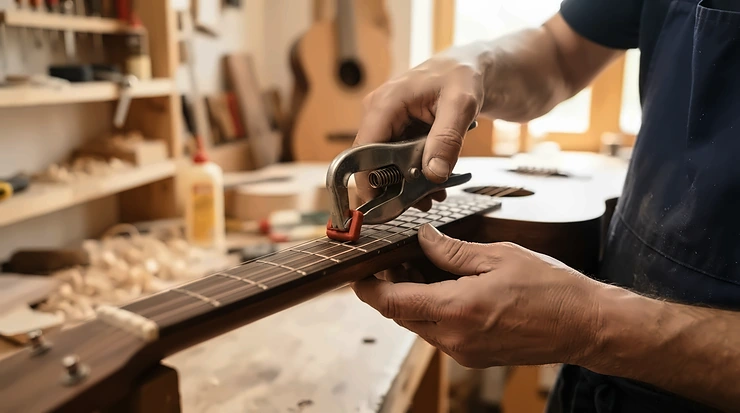
For most players, the Shubb C1 is the safest first capo, and the Kyser Quick-Change KG6BA is the better buy when the key changes between songs. The reason is that acoustic guitar capos for 2027 still differ on only three points: how hard the clamp presses, how well its pad follows your fretboard curve, and how quickly one hand can move it. Press too hard and strings go sharp; press unevenly and some of them buzz.
Five capos are matched to five situations below, drawing on MusicRadar and Guitar Player roundups, a Killer Guitar Rigs test on three guitars, a Hub Guitar comparison, retailer pages and several long-running player threads. No capo was clamped onto a guitar for this guide, so every comment about feel belongs to the reviewer or owner named beside it, and prices are ranges that may differ from what you see on Amazon.com.
Clamp pressure, fretboard radius and speed: what separates these capos
Lists of the best acoustic guitar capos tend to crown one winner, yet the reviews point to three differences that matter more than any ranking.
Pressure comes first. Hub Guitar’s comparison notes that a capo almost always shifts at least one string when it goes on, and Shubb’s own page blames hard pressing material and sideways pull for stretching strings sharp, thicker wound strings most of all. Spring triggers apply a fixed force. Screw, lever and micrometer designs let you dial it in, which is why Guitar Player credits the adjustable tension on the G7th Performance 3 ART with avoiding the string pull some spring capos cause.
Radius comes second. MusicRadar’s capo roundup points out that vintage-style guitars usually have rounder fingerboards while modern ones are flatter, and that 12-strings and traditional acoustics have wide necks, so the capo’s curve and width should match yours. A pad that is flatter or rounder than the neck presses unevenly, a mismatch Soundbrenner lists among the common causes of sharp strings. The ART pad on the G7th Performance 3 ART and the dual-radius design of the Ernie Ball Axis are two answers to it.
Speed is the third. A trigger capo moves with one hand and clips onto the headstock between songs, according to Hub Guitar; a screw or yoke design asks for more thought each time it moves but stays where you set it. In acoustic guitar capos reviews from MusicRadar, Guitar Player and Killer Guitar Rigs, the same three things get weighed against each other, which is why the picks below split by situation instead of by rank.
Tension control, one-handed use and price band for the five
Capo
Mechanism
Adjustable tension
One-handed
Price band
Kyser Quick-Change KG6BA
Spring trigger
No, fixed spring
Yes
Around $25
Shubb C1
Over-center lever, screw set per guitar
Yes
Lever, but slower to reposition
$22 to $25
G7th Performance 3 ART
Squeeze clamp with ART pad
Yes
Yes
From around $55
D’Addario NS Tri-Action
Trigger with micrometer dial
Yes
Yes
$23 to $26
Kyser Quick-Change KG12B
Spring trigger, 12-string body
No, fixed spring
Strong spring; two hands per Guitar Player
Around $25
Four of the five sit within a few dollars of each other, between $22 and $26, and the G7th Performance 3 ART is the outlier at more than double. That narrows the real decision to fixed spring force against adjustable tension, and the entries below begin from exactly that split.
Which capo for which player
Each entry starts from a situation and works back to the capo, because the best acoustic guitar capos for a campfire strummer and for a 12-string player are different products.
Open mics, church bands and living-room sing-alongs share one demand: the key changes, and the song doesn’t wait. That is the job the Kyser Quick-Change KG6BA was built for. Sweetwater lists it as a spring-loaded aluminum capo with padded arms at around $25, with 31 reviews on the page and no average rating shown, and Hub Guitar’s comparison rates the Kyser design the best affordable pick and a sensible one for beginners, adding that most spring capos clip onto the headstock when idle.
The trade-off is spring force. Killer Guitar Rigs tested a Kyser-built Fender version, the Kyser x Fender Quick Change, on a Martin 000-15M and reported that it pulled the strings sharp and that its soft foam cost some tone next to the G7th Performance 3 ART. That is a different version from the KG6BA, so it is a hint rather than a verdict. Anatomy of Tone, one writer’s blog, says the trigger’s downward pressure pushes strings sharp, and in an older Gibson forum thread one poster calls the spring far too heavy while another, who has used Kyser models since 1993, likes them most. Three sources agree on the sharp drift, which makes it the firmest finding here; the idea that the spring softens with use comes from a single poster.
A fixed spring means nudging the low strings flat every time the capo moves.
Current Kyser pricing is on Amazon.com.
Kyser Quick-Change KG6BASee current price, sizes and reviews on Amazon.
Moving a Shubb C1 up the neck takes more attention than flicking a trigger, and that single fact decides who should buy it. Anatomy of Tone’s author calls the tension screw on the back small and sometimes hard to adjust, and says that placing a Shubb high on the neck without pre-adjusting it can cause tuning problems; he thinks it works if you mostly play frets one to three. A poster in the Gibson thread, meanwhile, prefers his Shubb for recording because the tension is precise and it has the smallest profile of any capo he has used.
The hardware explains both views. Sweetwater describes nickel-plated brass with an over-center locking lever and a soft rubber pad meant to press without bending strings over the frets, at about $25 with 22 reviews on the page. MusicRadar puts the same capo around $22, labels it the best value of its group, and notes that tension must be set correctly and that replacement rubber sleeves are sold. Shubb’s own page describes a custom rubber that acts like a fingertip over a metal rod, with a one-time screw setup that repeats the same pressure each time. Sweetwater adds that no retuning is needed after attaching; that is a retailer claim, and MusicRadar’s warning about setting the tension is the same point from the other side.
Pros:
✅ Replacement rubber sleeves exist, per MusicRadar
✅ Compact, low-profile body
✅ Separate models for 12-string and classical guitars, per MusicRadar
Cons:
❌ Slower to move than a trigger capo
❌ Tension has to be set correctly for each guitar
Across the two sources the price lands between $22 and $25.
Shubb C1See current price, sizes and reviews on Amazon.
At around $55 and up in MusicRadar’s roundup, this is the priciest capo of the five, and it is also the one MusicRadar and Guitar Player both put in their top or premium slot. The ART pad adapts to the curve of the fretboard, the clamp squeezes on and releases with a button, and tension is adjustable. MusicRadar notes a lifetime warranty, and its only complaint is that the capo is not the lightest.
Killer Guitar Rigs ran it on a Stratocaster, an Epiphone Les Paul Jr. and the Martin 000-15M and described the tuning as “genuinely perfect every time,” while still calling it quite pricey for a capo. Anatomy of Tone’s author says it is the only capo he trusts through fast festival changes, though he still checks tuning each time and the article reads as strongly favorable. The Gibson thread is split: one poster calls it the best for fast, in-tune performance but a little heavy, another finds it slower to put on and prefers the Kyser.
Consider a hypothetical player who alternates between a vintage-style guitar with a rounder fingerboard and a modern flat-radius one. A capo that adjusts to the neck removes the need to re-set pressure on each guitar, and that is the argument for paying more.
The testers’ main complaint was cost.
See the current listing on Amazon.com.
G7th Performance 3 ARTSee current price, sizes and reviews on Amazon.
A tension screw with no stop is both the useful part and the irritating part of this trigger capo, going by owner comments gathered on Equipboard. The comments praise quick installation, a wide jaw that fits thicker vintage necks and higher frets, and a set-and-forget feel that some owners rate as faster to adjust than the Shubb. They also report that the screw can be lost during adjustment, that some players get buzz unless it is tightened a lot, that the thin plastic pick holder can break, and that the rubber pad is not replaceable.
Professional testers are warmer. Guitar Player’s reviewer calls the related NS Tri-Action Artist the best for acoustic players, finds that the micrometer dial gave consistent results with little or no retuning, and warns that the black finish may scratch and that it is bulkier and slower to reposition than a simple trigger capo. Killer Guitar Rigs, testing the D’Addario NS Artist, saw the guitars stay in tune when set up properly but had to readjust tension after moving frets, and judged it better for casual users than working musicians. Because both reviews cover the Artist version, check the exact model number, PW-CP-09 for this Tri-Action, before leaning on their notes.
Pros:
✅ Micrometer tension dial
✅ Integrated pick holder
✅ Wider jaw for thicker necks, per Equipboard owners
Cons:
❌ Tension readjustment when moving frets, per Killer Guitar Rigs
❌ Not for classical guitars or flat fretboards, per Equipboard
Retailers on Equipboard’s tracker show it between $23 and $26, and the same page shows the Amazon listing at 4.8 stars across more than 6,000 ratings, a far larger sample than any forum thread above.
D’Addario NS Tri-ActionSee current price, sizes and reviews on Amazon.
Twelve strings need a longer bar and a stronger spring than a six-string capo supplies, and the Kyser Quick-Change KG12B is built around that. Guitar Player’s roundup names it the best option for 12-string players, citing a long top bar suited to most 12-strings, a very powerful spring and a robust build, and notes that Kyser’s lifetime guarantee signals confidence in its durability. The same review warns that the strong spring takes two hands to operate and can pull lighter strings out of tune, so frequent retuning may follow with light gauges.
Buyers on Guitar Center rate it 4.73 out of 5 from 51 reviews, with 97% of respondents saying they would recommend it, at a price of $24.95. The comments on 12-string fit are mixed, though. The top review says it works great on a 12-string with no dead strings, while a 2-star reviewer with a Guild 12-string found it did not work well and recommended another brand, a 3-star reviewer says opening it takes a lot of grip, and two reviews list that it doesn’t fully clutch all strings. Fit therefore varies by guitar, which fits MusicRadar’s advice that wide 12-string necks call for a capo matched to their width and curve.
Alternatives exist. Shubb makes a 12-string model, and MusicRadar reviewed the Paige Clik 12-string cradle capo at around $18, though it flagged intonation challenges.
The 12-string version has its own listing on Amazon.com.
Kyser Quick-Change KG12BSee current price, sizes and reviews on Amazon.
Acoustic guitar types change the fit, and acoustic guitar strings change the pull
Not every acoustic guitar and capo pairing is equal, and acoustic guitar types differ more than most buyers expect. Wide-necked traditional acoustics, vintage-style round fingerboards and flat modern boards each press differently on the same pad, which MusicRadar treats as the main reason to match capo radius and width to the neck. Classical and nylon-string guitars are wider and flatter still: Equipboard lists the D’Addario NS Tri-Action as unsuitable for them, Shubb sells separate nylon-string models, and Guitar Player says the flat side of the Ernie Ball Axis suits nylon strings but a specialist nylon capo would be slightly better.
One design outside the five deserves a mention, the Paige 6-string Standard. Sweetwater lists it at around $40 as a yoke-style capo with screw-adjustable tension and a 16-inch radius that parks behind the nut. Killer Guitar Rigs found no noticeable buzz and manageable tuning issues across its three test guitars, and its testers noted the felt padding is safe for nitrocellulose finishes. The drawback is that yoke capos are slow to slide along the neck.
Strings matter as much as the capo, so the acoustic guitar strings on your neck belong in the decision. Shubb says hard pressing material stretches thicker wound strings sharp more than thin ones, and Soundbrenner points out that old strings exaggerate every capo problem, which is why fresh sets hold pitch better under a clamp. Light gauges on a 12-string add their own retuning, per Guitar Player.
What an acoustic guitar forum thread tells you after the reviews end
Roundups end at the checkout button; owner threads keep going and show how an acoustic guitar and capo settle together over months. In the Gibson forum thread, the posters split almost evenly: Shubb for accuracy and recording, the G7th for speed and stable pitch, a Kyser for habit, a Dunlop Victor for sound and simplicity. One poster who owns two Planet Waves NS capos finds the fretting arm easily knocked askew, says the screw can fall out, and reports that they will not close enough to fit a Gibson headstock. Another says some songs sound better transposed than capoed.
Read together with Anatomy of Tone and the Equipboard comments, a pattern emerges. Fixed springs pull sharp, which three sources report. Adjustable capos reward the player who sets pressure per guitar and per fret. Premium capos win praise for pitch and lose points for cost and weight. These are individual experiences rather than lab data, and most are years old, so treat them as a way to anticipate annoyances, not as a ranking.
Placement and pressure: habits that pull any capo sharp
Tune the open guitar first with a reliable tuner, so any later drift comes from the capo.
Raise pressure gradually until the strings ring clearly and stop there; use adjustable tension if the capo has it.
Place the capo just behind the fret wire, not on it. On the wire it can buzz and mute strings; too far back it needs extra pressure, which pushes strings sharp.
Retune after clamping, because even a well-placed capo often pulls some strings slightly sharp.
Replace old strings, and have the guitar set up if intonation problems appear without a capo too.
When you read acoustic guitar capos reviews, watch the version names. Killer Guitar Rigs tested a Fender-branded Kyser and the NS Artist, Guitar Player tested the NS Tri-Action Artist, and the Hub Guitar comparison dates from 2018. Each is a close relative of a capo above, not the same item, and the fit notes can change between versions.
Sharp strings, 12-strings and finish marks: quick answers on acoustic capos
❓ Why does my acoustic guitar go sharp with a capo on?
✅ Usually the clamp presses too hard or unevenly, bending strings over the fret. Place the capo just behind the fret, use only enough pressure to stop buzzing, then retune the strings that drifted. Old strings and a pad that doesn't match the neck radius make it worse.
❓ Which capo style works best on a 12-string acoustic?
✅ A trigger capo built for twelve strings, with a longer bar and stiffer spring, is the usual route, and Shubb also makes a 12-string model. Expect firmer grip effort and more retuning with light gauges, since twelve strings add tension and width.
❓ Can a capo damage an acoustic guitar's finish?
✅ Reviewers flag two risks: a black anodized finish that may scratch the neck, and a back cover that could slip on one trigger model. Felt or soft rubber pads that match the neck, plus gentle pressure, reduce both, and pads that fit the neck also protect the wood.
❓ Do classical or nylon-string guitars need a different capo?
✅ Yes. Classical necks are wider and flatter, so makers sell dedicated nylon-string models, and some steel-string capos are listed as unsuitable for classical guitars. Shubb and G7th both list nylon-string versions, so match the capo to the neck before buying.
❓ How far behind the fret should a capo sit?
✅ Just behind the fret wire, not on top of it. On the wire it can buzz and mute strings, while sitting too far back needs extra pressure to ring clearly, which pushes strings sharp. Tune first, clamp, then fix any string that drifted.
Choosing among the five: one rule that settles it
Match the capo to how often your hand has to move it. If it lives on frets one to three and you value accuracy, buy the Shubb C1. If you change keys mid-set and accept a little retuning, buy the Kyser Quick-Change KG6BA, or the Kyser Quick-Change KG12B for a twelve-string. If you rotate between guitars or gig often and the cost is acceptable, the G7th Performance 3 ART is the one reviewers rank first, while the D’Addario NS Tri-Action sits between them as a trigger with adjustable tension. Whichever of these acoustic guitar capos you take home, tune before clamping, place it just behind the fret and retune whatever drifts.
Compare the five on their Amazon.com listings before you decide.
Disclaimer: This post contains affiliate links. As an Amazon Associate, I earn from qualifying purchases made through these links, at no additional cost to you.
Whichever clamp you land on, tune first, set it just behind the fret, and let the song stay in the key you chose.