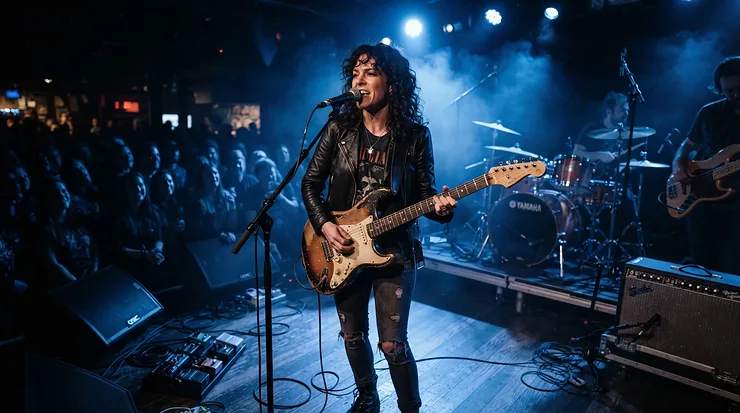
Most players shopping for guitar combo amps are really choosing between three tiers: about 15 watts of tube power, about 50 watts of modeling power, or 100 watts for the nights when a loud drummer or a bigger room is involved. Each tier solves a different problem, and the wrong one costs you either volume you can’t get or volume you can’t use at home.
This 2027 guide works from the room outward, from watts to tone type to pedal routing, then matches four real models to those choices. No amp was plugged in for it; the specs come from maker and dealer pages, and every judgment about feel belongs to a named reviewer at Guitar World, MusicRadar, Premier Guitar, Guitar Player or ELECTRIKJAM. Prices appear as ranges, so check the current price on Amazon.com.
How to narrow guitar combo amps by room, tone, pedals and extras
Four decisions do most of the work, and they go best in this order.
Name the loudest room you will actually play.Sweetwater’s wattage guide puts 5 to 15 tube watts at rehearsals and small gigs with a restrained drummer, and 20 to 45 tube watts at smaller bars and clubs. It calls 50- to 90-watt tube amps gig-worthy but too loud for an apartment. Modeling amps are a different case, covered in the next section.
Pick the tone engine. A tube combo gives you one voice and a handful of knobs. A modeling combo packs six to twelve amp voices, built-in effects, a headphone jack and a USB connection for recording. Players who switch genres mid-set or record at home get more from modeling; players who want one good clean tone and a pedalboard are usually happier with tube.
Decide where the pedals will live. Every combo here accepts pedals at its input. A loop is only needed when delay and reverb have to sit behind heavy preamp gain, and the pedal section below explains why.
Price the extras before you commit. Footswitches, Bluetooth adapters and covers are often separate purchases. Among the four amps reviewed below, only the Fender Blues Junior IV is described as shipping with a footswitch.
Are guitar amps rated in amps or watts? What the panel number really tells you
Watts. The “amps” in the question is a unit of electrical current, while the output power of a guitar amplifier, the signal it can push into the speaker, is quoted in watts. Every spec sheet behind this guide uses watts.
The number predicts loudness only loosely. Sweetwater points out that speaker efficiency matters and that doubling an amp’s wattage does not double its output; each doubling adds about 3 dB. By that rule, moving from the 50-watt to the 100-watt Boss Katana combo buys roughly 3 dB (my arithmetic from Sweetwater’s rule), a clear step but a modest one.
Amp type muddies the comparison further. Sweetwater is blunt that tube amps are not louder than solid-state amps of the same rating; their distortion is heard as volume, whereas a solid-state amp pushed to the same level sounds fizzy. ProSoundHQ’s wattage guide gives a starting point of about 20 tube watts or 40 solid-state watts for a club holding 50 to 100 people. Read together, those two sources explain why a 15-watt tube combo and a 50-watt modeling combo end up closer in usable volume than their ratings suggest.
Best digital guitar amps for medium venues: what 100 watts buys you
“Medium venue” has no standard definition, and the sources scatter. Laney’s blog notes that live you will almost always have a microphone in front of the amp, so the amp mostly needs to be heard on stage. A reader-requested piece on menga.net suggests about 60 watts for smaller rooms and 100 watts for open stages or outdoor gigs with a drummer, which is one writer’s opinion rather than a rule.
The digital combos worth a look at this size are the 100-watt ones: the Boss Katana-100 Gen 3 and the Line 6 Catalyst 100. Both can step down for practice. Andertons lists the Katana’s power control as 100, 25 and 0.5 watts, while Guitar Player describes the Catalyst’s rear switch as 50 watts, 0.5 watts or mute. Both can also feed a house PA: the Katana has a Line Out jack, and MusicRadar notes the Catalyst has a balanced XLR output with a ground lift.
Where they differ is the power section. MusicRadar notes that many modeling amps use Class D power, and says the Gen 3 Katanas keep a Class AB design; the same outlet lists the Catalyst 100 as Class D. MusicRadar’s reviewer still calls the Catalyst a good stage option, though he sees the 1×12 format as mainly a home amp. No spec sheet decides which one feels better under a drummer, so this is the one comparison worth settling with a store demo if you can.
The 100-watt models are heavier, too. MusicRadar puts the Catalyst 100 at about 32 lb, while the Boss Katana-50 Gen 3 is 11.6 kg, about 25.6 lb (my arithmetic), according to Thomann. The pages I found don’t give a weight for the Boss Katana-100 Gen 3, so confirm it before you carry it up a flight of stairs.
Can all guitar amps use effects pedals? Nearly all, and the loop is optional
Pedals plug into the input jack, so nearly any amp can use them. Harmony Central’s guide to effects loops says you can run every pedal into the front of an amp even when it has a loop, and nothing gets damaged. Whether you like the result depends on where your gain comes from, the pedals or the amp.
A loop sits between the preamp and the power amp. Harmony Central’s starting points: tuner, wah and gain pedals go in front; delay and reverb go in the loop, with reverb last, when the amp is producing its own gain. Some loops also offer a +4 level for rack gear and a lower instrument level for stompboxes, and the guide advises the lower setting for pedals. Andertons’ blog adds a warning that boost, overdrive and distortion pedals don’t belong in the loop, since the hotter signal can overload the power amp.
How the four amps handle this varies:
The Boss Katana-50 Gen 3 has no loop, according to Thomann’s spec list, but its Power Amp In jack lets a modeler or external preamp bypass the Katana preamp and use the power section alone, per Boss.
The Boss Katana-100 Gen 3 does have a loop, according to ELECTRIKJAM, whose reviewer recommends the 100 over the 50 for exactly that reason.
The Line 6 Catalyst 100 has a series loop that can also route a pedalboard straight to the power amp, per MusicRadar. Premier Guitar’s reviewer ran a delay pedal through the loop and a preamp pedal into the power-amp path, and liked both results.
The Fender Blues Junior IV takes its pedals at the input. Guitar World’s reviewer calls it a great pedal platform, and a Marshall forum poster mentions that a Blues Junior has no loop at all.
Where combo shopping goes wrong: loops, extras and watts
Buying the 50-watt model and wanting a loop later is the clearest case. ELECTRIKJAM’s reviewer says the Katana-50 Gen 3 has no loop and that the 100 does, and he considers the loop important for loopers and modulation pedals. One reviewer’s view, but it matches the Thomann spec list.
Extras add up quickly. The same reviewer reports that the Bluetooth adapter for the Gen 3 Katanas is sold separately, estimates it at about $100, and notes it enables wireless editing but not recording. The GA-FC foot controller is another purchase and, per MusicRadar, works with every Gen 3 Katana except the Katana-50 Gen 3. For the Catalyst, MusicRadar and Premier Guitar both report that the footswitch is extra, and MusicRadar adds that there is no Bluetooth. That is a consensus of two outlets.
Expectations about the Gen 3 upgrade also split reviewers. MusicRadar’s headline says “The Gen 3 feels like you are viewing the older iteration in 4K,” and Guitar World’s review credits the Katana-50 Gen 3 with warmer highs and a tighter low end. ELECTRIKJAM’s reviewer disagrees, calling the tone changes slight and saying he could recreate the new Pushed voicing on his older MkII. Buyers who already own a MkII should weigh that disagreement before upgrading.
Guitar combo amps reviews, compared by power, loop and price
Model
Power and modes
Speaker
Pedal path
Footswitch
Price range
Boss Katana-50 Gen 3
50 W Class AB; 25 W and 0.5 W steps
1×12
Front input or Power Amp In; no loop
Footswitch jack; GA-FC not supported
$300 to $350
Boss Katana-100 Gen 3
100 W Class AB; 25 W and 0.5 W steps
1×12
Front input plus a loop
GA-FC supported, sold separately
$400 to $450
Line 6 Catalyst 100
100 W Class D; 50 W, 0.5 W and mute
1×12
Front input; series loop or power-amp path
Sold separately
Around $400
Fender Blues Junior IV
15 W all-tube
12-inch Celestion A-Type
Front input
Included (Fat boost)
$750 to $790
Wattage and price don’t move together here. The tube combo costs roughly $300 to $390 more than the Boss Katana-100 Gen 3 (my arithmetic from the ranges above) and delivers a fraction of the rated power. What it sells is a single all-tube voice and a pedal-friendly input, not headroom. The two 100-watt modelers are the only ones with a pedal path beyond the front jack, which makes them the more flexible pair for a growing pedalboard.
Best guitar combo amps 2027: four models matched to the decisions
Each entry below ties back to one of the decisions above, so use the headings as a filter rather than a ranking.
A band-practice night and a late-evening living-room session ask different things of one amp, and the Boss Katana-50 Gen 3 is built around that split. It pairs 50 watts of Class AB power with a power control that steps down to 25 and 0.5 watts, a single 12-inch speaker and six amp characters that each carry a selectable variation, for 12 tones in all, according to Boss. Five effect categories can run at once, and USB-C with IR cabinet simulation plus a headphone output handle quiet recording.
Reviewers like the sound. Guitar World’s review credits the Gen 3 refresh with warmer highs and a tighter low end, though ELECTRIKJAM’s reviewer found the changes slight, as noted above. Dealer pages put it between $300 and $350. The ceiling is on stage: it stores four presets against eight on the 100-watt model (Andertons), and it has no loop.
Boss Katana-50 Gen 3See current price, sizes and reviews on Amazon.
Doubling the wattage is not the main reason to move up from the 50; the loop is. ELECTRIKJAM’s reviewer recommends the 100 for that reason, and he adds that the Cab Resonance selector and EQ Contour button also appear only on the 100 and above. The Bloom control stays on the Head and Artist models.
The rest of the stage kit is solid. It has 100 watts of Class AB power, a Line Out for a house PA, eight preset slots and IR-based cabinet sound on all audio outputs, according to Vintage King, Andertons and zZounds. Dealers show it between $400 and $450. Check current availability below, and budget separately for the GA-FC foot controller. Wireless editing needs the optional Bluetooth adapter, which ELECTRIKJAM estimates at about $100.
Boss Katana-100 Gen 3See current price, sizes and reviews on Amazon.
Around $400 puts the Catalyst next to the Katana-100 Gen 3, and the two trade differently. Adorama’s listing describes six Line 6 amp voicings arranged as six banks of two channels, twelve presets in all. The Catalyst uses a Class D power section, with a rear switch for 50 watts, 0.5 watts and mute, a series loop, an XLR output and MIDI in, per Guitar Player and MusicRadar.
Guitar World’s reviewer found recording over XLR or USB easy, and judged the optional two-button footswitch for A/B and boost to be all most players need. Premier Guitar’s review gives its reviewer’s complaints: some functions need the manual, there is no digital readout, and the boost did little on the high-gain voice above noon. One naming caution: Line 6 also sells the Catalyst CX 100, a separate version that zZounds lists with 12 amp voices. The Catalyst has no Bluetooth, according to MusicRadar.
Line 6 Catalyst 100See current price, sizes and reviews on Amazon.
Fifteen watts, three 12AX7 preamp tubes and two EL84 power tubes make up the Fender Blues Junior IV, a single-channel combo with a 12-inch Celestion A-Type speaker, as Guitar World’s review describes it. The reviewer reports more headroom and a bolder tone than earlier versions after Fender revised the preamp, plus a spring reverb with a natural decay.
American Songwriter’s reviewer found it clean and articulate at any volume setting and loud enough for rehearsals and small to medium gigs, while Guitar Player’s tester reported that it came through travel unscathed. Both are single reviewers, not a pattern. The included footswitch controls the Fat boost, and retailers cited in Guitar World’s 2022 review ran from about $750 to $790, so check the current price on Amazon.com. At 31.5 lb it is about 6 lb heavier than the Boss Katana-50 Gen 3 (my arithmetic).
Fender Blues Junior IVSee current price, sizes and reviews on Amazon.
Watts, loops and rooms: short answers before you buy
❓ Are guitar amps rated in amps or watts?
✅ Watts. Output power is quoted in watts, and amps are a unit of electrical current. Watts only loosely predict loudness, though: Sweetwater notes that doubling the wattage adds roughly 3 dB, and speaker efficiency and tube versus solid-state design change how loud an amp sounds.
❓ Can all guitar amps use effects pedals?
✅ Almost any amp with an input jack accepts pedals placed in front of it, even if the amp has an effects loop. A loop is optional; it mainly helps delay and reverb stay clean when the amp itself supplies the distortion.
❓ How many watts do I need for a medium venue?
✅ Sweetwater suggests 20 to 45 tube watts for smaller bars and clubs, and modeling amps usually need more rated watts for comparable volume. A 50- to 100-watt model with a power control covers both practice and gigs, with the PA or a microphone carrying the rest.
❓ Is a tube combo louder than a solid-state combo with the same wattage?
✅ Sweetwater says no: tube amps are not louder at the same rating, but their distortion is heard as volume, while a solid-state amp pushed to the same level tends to sound fizzy. Rated watts therefore don't compare cleanly across amp types.
❓ What is the difference between a combo amp and a head?
✅ A combo builds the amplifier and speaker into one cabinet, so it is portable and works straight from the box. A head holds only the electronics and needs a separate speaker cabinet, which adds cable, weight and cost but lets you swap cabs.
Match the amp to the loudest room, then to the pedals
Start with the loudest room you play, then the pedals, and the shortlist of guitar combo amps mostly writes itself. The Boss Katana-50 Gen 3 suits rehearsals and small rooms and drops to 0.5 watts at home. Among the best digital guitar amps for medium venues, the Boss Katana-100 Gen 3 and the Line 6 Catalyst 100 are the two with a loop and a line-level output: the Katana brings Boss effects and eight presets, the Catalyst brings XLR and MIDI. Players who want one tube voice and build their sound from pedals will find the Fender Blues Junior IV the simplest fit.
The best guitar combo amps for you are the ones whose loudest setting matches your loudest room and whose extras you won’t have to buy twice. Compare current availability on Amazon.com for each model before you decide.
Disclaimer: This post contains affiliate links. As an Amazon Associate, I earn from qualifying purchases made through these links, at no additional cost to you.
Settled on a wattage? Pair it with the right cables before the first rehearsal. 🎸