Spending more on delay pedals buys a different job, not a better echo. Guitar World’s 2026 roundup runs from an analog box under $50 that it calls excellent value to a studio-minded digital unit near $400, and each earns its slot for a different player. This 2027 guide sorts five real models by situation: a first echo around $100, an analog classic, a clean digital workhorse with tap tempo, a delay voiced for bass, and a granular ambient machine.
What follows is assembled from maker spec sheets, Guitar World’s roundup (last updated in March 2026), a Mixdown feature on ambient guitar and buyer reviews on Sweetwater and Thomann, so every opinion about feel is credited to the reviewer who gave it. Prices appear as ranges, and only where at least two pages agreed.
Voicing, tap tempo, bypass and low end: what really separates delay pedals
Four specs decide most of the fit, and none of them is the delay time printed on the box.
Voicing comes first. An analog or analog-voiced circuit lets each repeat fade darker; a digital circuit repeats the note cleanly. A Thomann reviewer of the JHS 3 Series Delay describes the split neatly: on the digital setting every repeat is identical but quieter, while the analog setting turns warmer and a little fuzzier as the repeats die away. A zZounds reviewer of the MXR Carbon Copy adds that an analog delay typically rolls off the high end of its repeats.
Tap tempo comes second. Guitar World’s 2026 roundup lists a tap input on the Boss DD-3T and on several pricier units, but not on the MXR Carbon Copy or the budget TC Electronic Echobrain. A player who changes tempo between songs should treat tap as a requirement, not a bonus.
Bypass is third. The same roundup lists buffered bypass on nearly every pick, while the JHS goes the other way with true bypass. Either works; it just helps to know which kind is already on your board.
Low end is fourth, and it matters most for bass and low-tuned guitars. Repeats pile on top of the dry note, so lows build up fast. A pedal with a way to trim the repeats solves that; one without needs a lower delay level.
Five pedals compared on time range, sync and power
Model
Voicing
Delay time
Sync and control
Bypass
Typical price range
JHS 3 Series Delay
Digital- or analog-voiced (toggle)
80 to 800 ms
None
True
$99 to $110
MXR Carbon Copy
Analog, bucket-brigade
Up to about 600 ms
None
Buffered or true (listings disagree)
$150 to $170
Boss DD-3T
Clean digital
12.5 to 800 ms
Tap tempo, three subdivisions
Buffered
$125 to $155
Fender Bassman Delay
Bass-tuned analog or digital DSP
Not on Fender’s page
Low switch, internal cut trims
True or buffered, switchable
$100 to $150
Chase Bliss MOOD MKII
Reverb, delay and slip, plus granular looper
Clock-based
MIDI, expression, presets
Buffered
Around $400
Two things jump out. Only the Boss DD-3T pairs a fixed millisecond range with tap, and only the Fender Bassman Delay gives you a low switch for the repeats; the JHS 3 Series Delay and MXR Carbon Copy trade both for simplicity. Price gaps follow the job rather than a quality ladder, since the cheapest and the dearest pedal here are not trying to do the same thing.
Best delay pedals by situation, matched to one player each
Each entry starts from the player and works back to the pedal.
Newcomers shopping for a first echo get a clear answer from Guitar World’s budget roundup (published March 2024), which ranks the JHS 3 Series Delay first. The magazine credits the solid build, simple controls and good time range, and its only complaint is that the pedal is not exciting to look at.
Mix, Time and Repeats knobs plus a Type toggle cover 80 to 800 ms. The toggle swaps a clearer digital-voiced echo for a darker analog-voiced one, and maxing Repeats in the analog setting gives bucket-brigade-style runaway, according to the description on retailer pages. Bypass is true bypass. The maker and Thomann put it between $99 and $110.
Buyer reports lean positive. Thomann reviewers call it a set-it-and-forget-it workhorse and a strong budget delay, and one reviewer from February 2025 prefers the warmer, fuzzier analog setting. The dissent comes from a single German-language reviewer from 2020, who reported a delay that did not work out of the box and wider quality-control trouble across four JHS pedals, though the same reviewer notes that support replied quickly. Among the four reviews that page displays, that is the only negative.
The practical limits are on the spec list: no tap tempo, no battery option, and a 9V DC adapter drawing 71 mA is required.
JHS 3 Series DelaySee current price, sizes and reviews on Amazon.
Analog delay darkens every repeat, and that is the whole appeal of the MXR Carbon Copy. Guitar World names it best analog in its 2026 roundup and credits the built-in modulation, distinctive sound and stackability, while noting that it suits some genres better than others. The audio path is bucket-brigade analog, the listed maximum is about 600 ms (one Sweetwater reviewer measured closer to 650), and a bright switch and a modulation switch round out the controls. Expect to pay between $150 and $170.
Bypass is a point where sources part ways: Guitar World lists buffered bypass, while zZounds retailer copy describes true hardwire bypass, so read the label on the unit.
Sweetwater shows 4.6 out of 5 from 137 reviews (the page’s own description says 4.5), with 64 percent giving five stars.
Pros:
✅ Sweetwater reviewers praise the warm repeats and the range from slapback to long, modulated trails.
✅ Guitar World points to the built-in modulation and the option to stack it with other delays.
Cons:
❌ No tap tempo, which some reviewers miss, and one found the maximum delay shorter than wanted.
❌ Multiple Sweetwater reviewers report a loud footswitch pop, and a few report failures after months or years of use; one 2016 reviewer’s unit stuck in bypass after three years.
Two more findings from that page change how you would use it. Some reviewers hear runaway feedback when the Regen knob goes past roughly 11 o’clock, and one reviewer found the repeats mushy behind an overdrive channel and better on a clean one. The modulation trim pots sit inside the case, and the power jack is on the output side, which one reviewer says complicates tight boards.
MXR Carbon CopySee current price, sizes and reviews on Amazon.
Tempo changes between songs are where a tap function earns its space, and the Boss DD-3T adds one to the classic DD-3 circuit. Guitar World’s roundup labels it best digital and praises the pristine delays, though that reviewer also notes the price is not far above the Boss DD-8, which offers more modes.
Delay runs from 12.5 to 800 ms in three ranges (50, 200 and 800 ms) plus a Short Loop that replays up to 800 ms. Holding the footswitch puts it into tap mode, or you can plug in an external switch; the Mode knob picks quarter-note triplet, dotted-eighth or quarter-note spacing. A Direct Out jack sends the dry signal separately, which suits wet/dry rigs. Power is a 9V battery (about 11.5 hours on alkaline, per the spec list) or a Boss PSA adapter at 45 mA, bypass is buffered, and Boss backs it with a five-year warranty.
Buyers on Thomann, where the pedal averages about 4.7 out of 5, praise the simplicity. One reviewer from 2022 describes it as friendly to amp and pedal chains and chose it over the Boss DD-8 on the guess that its single sound matched that pedal’s digital voice; another from 2021 calls it perfect for players who dislike complications. Treat those as two voices rather than a consensus.
If you want the repeats to fade into warmth, the MXR Carbon Copy is the better match; if you want them to stay crisp and tempo-locked, this is the pedal. The price sits between $125 and $155.
Spotted one that fits your board? Take a closer look at its Amazon.com listing and read the power details before committing.
Boss DD-3TSee current price, sizes and reviews on Amazon.
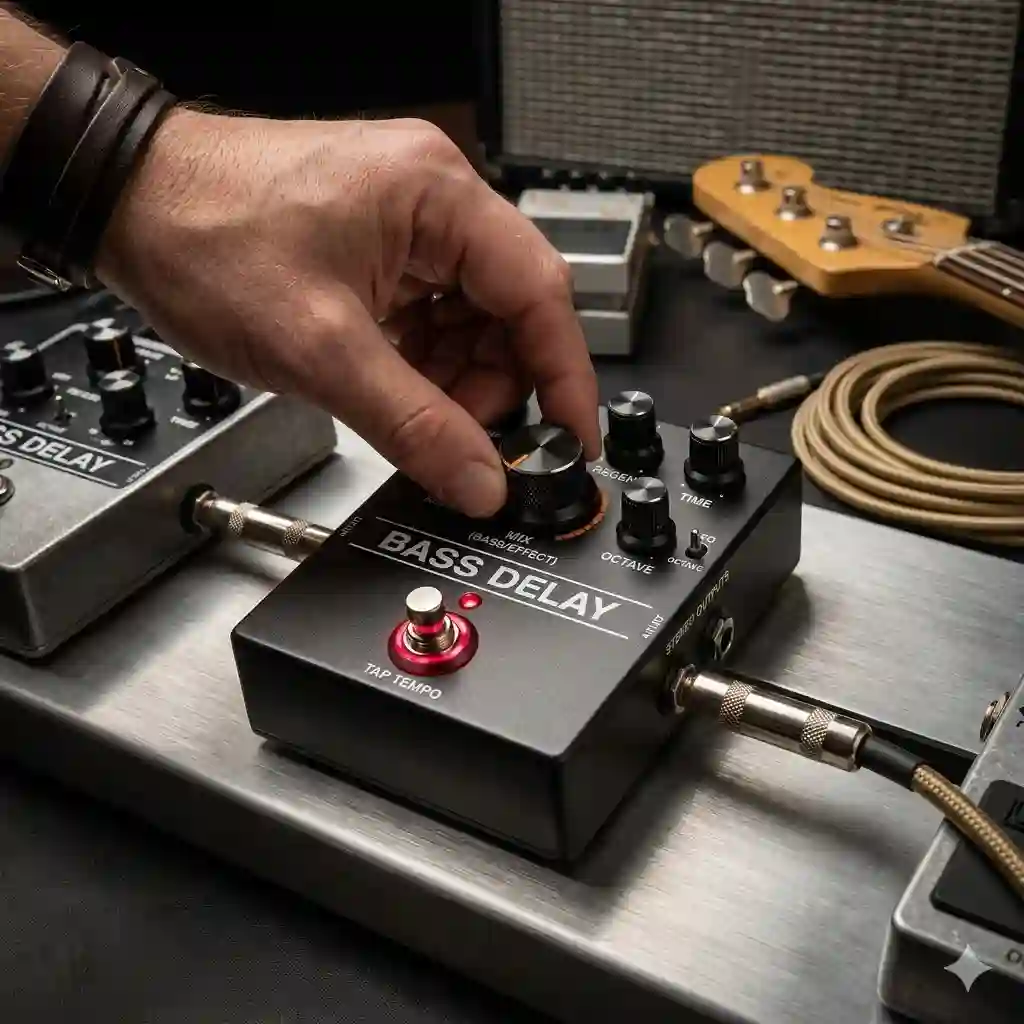
A bassist shopping for a bass delay pedal has one thing to protect: the low end. Fender’s product page frames the Fender Bassman Delay as delay engineered for bass, with two DSP algorithms (one analog-style, one digital-style) designed to repeat a bass signal, plus analog dry-through. A Low switch decides whether repeats fade lightly over the signal with the low end kept clear or duplicate the full signal for beat-repeat-style waves, and internal high-cut and low-cut controls shape the repeats further. The page adds a side-mounted pad switch for active basses and a soft-touch footswitch with true or buffered bypass and trails.
Thomann words the Low switch differently, as two switchable low-cut stages, and lists the pedal as available since November 2024. Retail pages put it between $100 and $150. On power, the sources disagree: Thomann marks battery operation as no, while American Musical’s spec sheet describes a rear compartment for one 9V battery. The manual is the tiebreaker.
Evidence from buyers is thin but friendly. Thomann shows 4.7 out of 5 from three ratings. A French-language reviewer from August 2025 reports no unwanted noise, including when the switch is pressed, and plans to see whether it stays quiet over weekly use plus 15 to 20 gigs a year. A German-language reviewer from January 2026 says it works well alone or after other effects in a bass setup, and calls the build excellent for an entry-level price.
It has no tap tempo, per Thomann’s listing.
Fender Bassman DelaySee current price, sizes and reviews on Amazon.
Ambient players do not want repeats so much as a place for notes to dissolve, and the Chase Bliss MOOD MKII is built for that. It pairs two channels: a wet channel with reverb, delay and Slip modes (the part designed by Old Blood Noise Endeavors) and an always-listening micro-looper from Drolo FX that samples, repeats and layers snippets of what you play. The MKII adds stereo operation and overdubbing, and its builder’s notes describe freezing the wet channel into ambient pads or secondary loops while the looper side becomes a delay. It carries MIDI, expression and CV control, presets, and dip switches. Launch coverage from MusicRadar, Guitar.com and Gearnews points to a price close to $400.
Mixdown’s ambient feature opens its list of seven with the original Chase Bliss MOOD, the earlier version, and says the writer cannot get to the bottom of what the pedal is doing even after watching many demos. Equipboard’s summary of reviews for the MKII lands in the same place: it lists the learning curve as the main drawback for beginners and points them to the manual.
Pros:
✅ Texture range from drones to birdsong-like tones, per Mixdown’s description of the original.
✅ Stereo and overdub support in the MKII, per Guitar Pedal X’s coverage.
✅ Full MIDI and preset control for recalling a sound.
Cons:
❌ A steep learning curve, per both Mixdown and Equipboard.
❌ A listing on ModularGrid quotes about 270 mA, so confirm that your power supply can feed it.
This is a creative tool rather than a delay you set once; it rewards players who like to twist knobs live, and Guitar.com’s review of the MKII is headlined around exactly that.
Chase Bliss MOOD MKIISee current price, sizes and reviews on Amazon.
Best delay pedals under 100: the cheaper boxes below the JHS
Guitar World’s budget guide says it kept most picks under $100, with a few creeping above. Four cheaper alternatives from that guide and the 2026 roundup are worth a look when the job is slapback or a touch of room rather than long washes.
The TC Electronic Echobrain is the budget pick in the 2026 roundup, an analog delay under $50 with buffered bypass and no tap; the reviewer calls it a great first delay and a sturdy build, but less versatile than the rest. The NUX Reissue Analog Delay is a bucket-brigade design under $65 with Delay Time, Blend and Repeat controls; the same writer finds it simple and affordable but not especially versatile. The Electro-Harmonix Slap-Back Echo does analog slapback at fixed 45, 65 or 100 ms, ships with a power supply and costs under $90, but does only that one thing. The TC Electronic Flashback 2 Mini reaches 800 ms with tape-style repeats out of the box and other delays through the Toneprint app, yet sits at the top of the budget range, a little above $100.
The JHS 3 Series Delay earns its extra money by covering long washes up to 800 ms as well as slapback.
Best ambient pedal reverb delay granular 2027: where the MOOD MKII sits
Granular pedals take in small slices of your playing and replay, stretch or layer them, which is why they read as textures rather than echoes. Mixdown’s September 2026 feature lists seven pedals for ambient guitar, and the notes on each show how different the options are.
The EarthQuaker Devices Avalanche Run is the more approachable reverb-and-delay option: a stereo unit with up to two seconds of delay, reverse modes, tap tempo, adjustable reverb tails and a looper, and the writer lists no drawbacks. The Meris Polymoon is a stereo delay with modulation that the writer calls beautiful and gooey, with a minor learning curve. The Hologram Electronics Infinite Jets responds to picking attack but is bulky and takes effort to master. The Empress ZOIA is a modular synth multi-effects unit that needs deep programming for its full potential.
Guitar World’s 2026 roundup adds the Source Audio Encounter as its best for soundscaping, with six delays, six reverbs and 128 presets (eight reachable on the pedal), and the Mooer Ocean Machine II as a gigging option with nine delays, nine reverbs and a two-minute looper; the reviewer flags a steep learning curve for the latter and non-intuitive menus for the former.
The pattern in those notes is consistent: the more a pedal can do for ambient work, the steeper the learning curve. The Chase Bliss MOOD MKII is the one here that leans furthest toward granular, while the EarthQuaker Devices Avalanche Run gives the most direct delay-plus-reverb path.
Best bass delay pedal checks: the low switch, the pad and a 400 Hz filter
Guitar World’s lesson on delay for bass advises keeping delays away from the low end unless you want that specific effect. For ambient delay the author rolls off below roughly 400 Hz with a high-pass filter, and warns that too much delay level can swamp a bass’s punch. Its pedal links include the MXR Carbon Copy, the Boss DD-3T and the Boss DD-200, but the text does not pitch them as bass-specific.
Three checks follow from that advice. First, can you cut lows in the repeats? Of the three guitar-first delays in this guide, none lists a low-cut for the repeats, while the Fender Bassman Delay does. Second, is there an input pad for an active bass? Fender lists one on the side of the Bassman. Third, does the dry signal pass through untouched? Fender’s page names analog dry-through.
None of the others is unusable on bass; they simply leave the filtering to you, whether with a lower delay level, a shorter feedback setting or an EQ elsewhere in the chain. On these checks, the best bass delay pedal in this guide is the Fender Bassman Delay.
Delay pedals reviews: what buyers and testers keep reporting
Rating averages carry different weight here. The MXR Carbon Copy has 137 Sweetwater reviews behind a 4.6 average, the JHS 3 Series Delay has 17 Thomann ratings at 4.5, and the Fender Bassman Delay has three Thomann ratings at 4.7. With that spread, only the first figure is solid; the other two are hints.
The repeating complaints are practical rather than tonal. Footswitch pop and the odd early failure show up in the Carbon Copy reviews, while the one serious quality complaint on the JHS page comes from a single reviewer. For the Chase Bliss MOOD MKII, both Mixdown and Equipboard point at the learning curve rather than the sound. Among the reviews read for this guide, praise clusters around feel: warmth for the analog-voiced pedals, clarity for the Boss DD-3T, and low-end control for the bass pick.
Where players and their echoes fail to match
Analog repeats into a heavy drive can turn mushy. One Sweetwater reviewer of the MXR Carbon Copy says exactly that behind an overdrive channel, so a high-gain player may prefer the clean repeats of the Boss DD-3T.
Expecting features the spec list leaves out is the second mismatch. Neither the JHS 3 Series Delay nor the MXR Carbon Copy has tap, and the JHS cannot run on a battery. Check what powers the pedal before you price out the rest of the board.
The third is buying a guitar-voiced delay for bass and running the level too high. Guitar World’s bass lesson warns that delay level can swamp a bass’s punch, which is why the low-cut and pad on the Fender Bassman Delay matter more than extra modes.
Power, bass and granular: quick answers on echo gear
❓ Are analog or digital delay pedals better?
✅ Neither wins outright. Analog repeats darken as they fade, which suits warm slapback and long trails; digital repeats stay clean and precise, which suits tempo-locked rhythms. Some pedals switch between analog-voiced and digital-voiced modes, so you can have both.
❓ What is the best delay pedal for bass?
✅ Pick one that lets you cut lows from the repeats, offers an input pad for active basses and keeps the dry signal untouched. Guitar World's bass lesson also suggests a high-pass filter near 400 Hz on ambient delay and a modest delay level.
❓ Do delay pedals need a power supply?
✅ Some compact pedals accept a 9V battery, while others take an adapter only, so read the listing. Current draw matters too: a simple delay pulls tens of milliamps, whereas a granular looper can draw several times that, so check your supply's output rating.
❓ What does a granular delay pedal do?
✅ It records small slices of your playing and replays, stretches or layers them, producing textures instead of clean echoes. Mixdown's ambient feature describes a granular delay and micro-looper as a source of sounds ranging from drones to birdsong-like tones.
❓ How much should I spend on a delay pedal?
✅ Guitar World's best-budget pick sits under $50, and solid analog or digital picks cluster around $100 to $160. Studio and ambient machines run roughly $300 to $400. Spend by job rather than by tier, since cheaper pedals handle slapback and basic echoes well.
Which echo to buy: a decision rule
Choosing among delay pedals comes down to the job first and the price second. For a first pedal on a small budget, my pick is the JHS 3 Series Delay, because it covers slapback to long washes in one box. For warm analog repeats, the MXR Carbon Copy is the established choice, with its pop and feedback quirks. For clean, tempo-locked delay, the Boss DD-3T is the simplest route. For a bassist, the Fender Bassman Delay is the one with a bass-specific control set. For ambient and granular work, the Chase Bliss MOOD MKII rewards patience and costs the most.
Read each listing’s power and delay-time details on Amazon.com before you order.
Disclaimer: This post contains affiliate links. As an Amazon Associate, I earn from qualifying purchases made through these links, at no additional cost to you.
Near-twin names run through every brand’s echo lineup, so match the exact model on the listing to the one you read about here. 🎸