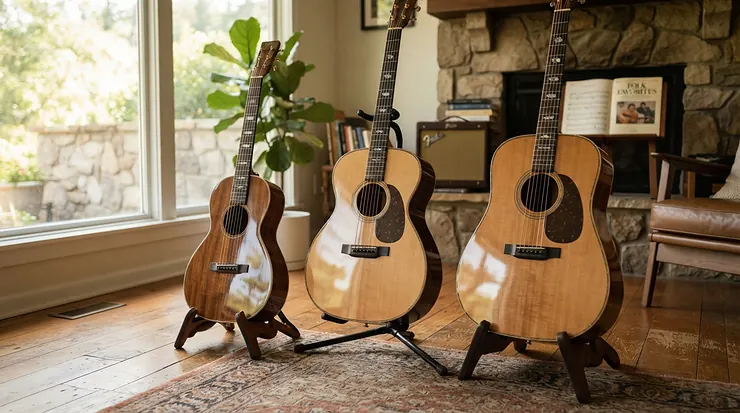
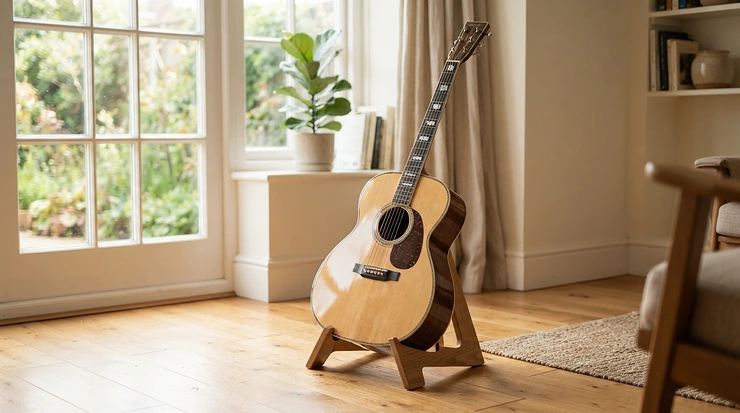
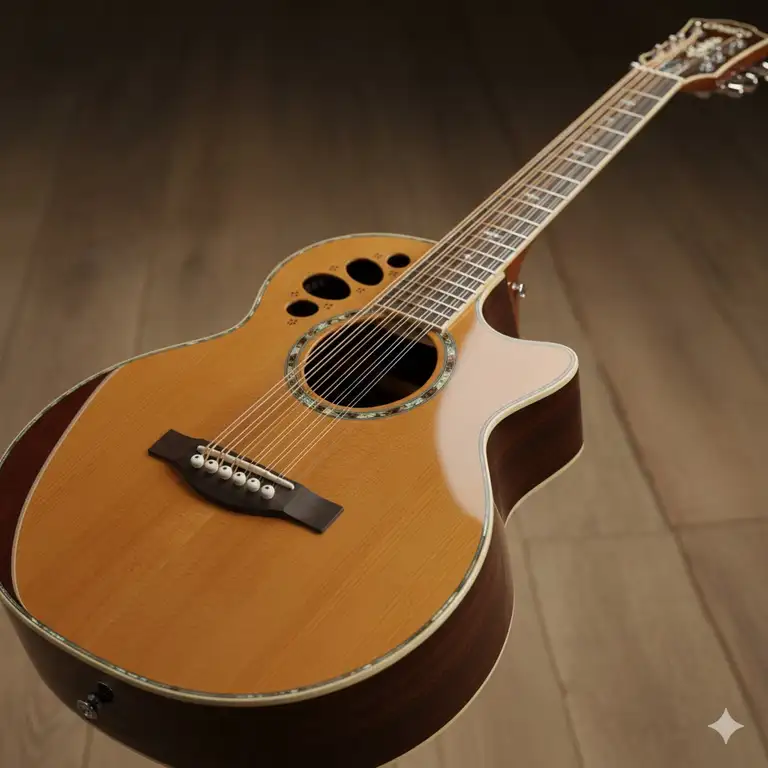
Why do 12 string acoustic guitars sound so much bigger than a six-string, and is that shimmer worth the extra tuning time? Each note is doubled: on the four lower pairs a thick string sits next to a thinner one tuned an octave higher, and the top two pairs are tuned in unison. That doubling is the chorus effect, and it is also why the neck is wider and the tension heavier. For 2027, the five models below each answer a different situation: an unplugged home player, a budget plug-in, a compact body, a band stage and a long-haul gigging guitar.
The findings rest on maker spec sheets, US dealer listings, Sweetwater’s review pages, Taylor’s own product page and a long-running player forum thread; no guitar was strung up or played for this guide, so every opinion about feel belongs to a named reviewer. Prices appear as ranges taken from dealer listings, and the current price on Amazon.com may differ.
Neck width, body depth and a pickup: what really separates these 12-strings
Lists of the best 12 string acoustic guitars tend to crown a single winner, but the spec sheets point to four differences that matter more than any ranking: neck width, body depth, whether there is a pickup, and how well the guitar holds its tuning.
Neck first. Guitar World’s 12-string buying advice says fretting two strings at once takes more pressure than on a six-string, so low action helps and the neck profile is worth trying before you commit. The Takamine GD30CE-12, the Taylor 254ce Plus and the Breedlove Discovery S Concert CE 12-String all land within a hair of 1.88 inches at the nut. The Fender CD-60SCE 12-String is narrower at about 1.77 inches, though some listings say 1.69, and the retail pages for the Yamaha FG820-12 don’t print the figure at all.
Body size decides how the guitar sits against you. The zZounds spec sheet for the Breedlove Discovery S Concert CE 12-String gives a 15.37-inch lower bout and a depth that grows from 3.58 inches at the neck to 4.17 at the tailblock. One dealer lists the Grand Auditorium body of the Taylor 254ce Plus at 16 inches wide and 4 5/8 deep, which works out to about 0.6 inch wider and under half an inch deeper (my arithmetic). The distributor for the Takamine GD30CE-12 gives its dreadnought a depth of 125 mm at the end, close to 4.9 inches.
The pickup question is simpler. Guitar World frames acoustics as the choice for portability and unplugged playing, such as folk and singer-songwriter work, and points players who need amplification toward electrics. Four of the five guitars here narrow that gap with a built-in pickup and preamp. Only the Yamaha FG820-12 goes without.
Stability closes the list. The same buying guide notes that tuning takes longer because neck tension shifts as you tune, that intonation is harder to control, and that string pairs should sit evenly at the nut and bridge. It also warns that cheap 12-strings may warp or develop a lifted belly under the extra tension, and it favors solid spruce or cedar tops for tone and sustain. Every guitar below has a solid spruce top.
Where the five land on neck, body and wiring
Model
Body
Top
Nut width
Pickup
Case or bag in listing
Dealer price range
Fender CD-60SCE 12-String
Dreadnought, cutaway
Solid spruce
About 1.77 in (some say 1.69)
Fishman CD-1
None
$350 to $400
Yamaha FG820-12
Dreadnought
Solid spruce
Not listed
None
Not mentioned
$430 to $480
Breedlove Discovery S Concert CE 12-String
Concert, cutaway
Solid spruce
1.89 in
Fishman Presys I
None
$450 to $650
Takamine GD30CE-12
Dreadnought, cutaway
Solid spruce
About 1.875 in
TP-4TD
None
$670 to $750
Taylor 254ce Plus
Grand Auditorium, cutaway
Solid torrefied spruce
1 7/8 in
ES2
Listings disagree
$1,400 to $1,500
Three things stand out. Only the Taylor 254ce Plus listing includes a bag or case at all, and even that is inconsistent between pages. The gap between the Yamaha FG820-12 and the Takamine GD30CE-12 runs from roughly $190 to $320 depending on the dealer (my arithmetic), and what it mostly pays for is a cutaway plus onboard electronics. The Breedlove Discovery S Concert CE 12-String has the widest price band, which reflects retailer-to-retailer differences.
Five situations, five guitars
Each entry starts from a situation and works back to the guitar. Which 12 string acoustic guitar best fits you depends more on where you will play it than on any spec line.
A guitar that lives on a couch or a porch and never meets an amplifier doesn’t need electronics, and that is the case for the Yamaha FG820-12. It is the 12-string twin of the six-string Yamaha FG820, with a solid spruce top, mahogany back and sides, a nato neck, a rosewood fingerboard, scalloped bracing and chrome die-cast tuners. Long & McQuade’s listing confirms there is no pickup or preamp, and it names a 10-47 light set as the factory strings. Dealer listings put it between $430 and $480.
Sweetwater buyers lean positive. One reviewer who plays solo gigs said he tried 12-strings from Martin, Guild and Taylor before choosing this guitar for the best sound for the money. Another set it against a friend’s older Yamaha FG720-12 and heard clearly more depth, crediting the new scalloped bracing for the bass response. Both are single reports, not a consensus, and the second compares against one specific older guitar.
The same pages call it a sensible pick for a 12-string beginner or intermediate player, again from one reviewer. A Long & McQuade owner who also owns several other Yamahas rated it highly and only wished it came with a Fishman pickup. Adding one later is a separate purchase and a shop visit. Current availability is a quick check on Amazon.com.
Yamaha FG820-12See current price, sizes and reviews on Amazon.
Wanting to plug in on a tight budget narrows the field fast, and the Fender CD-60SCE 12-String sits at the low end of this group, with dealer listings between $350 and $400. The spec sheet describes a single-cutaway dreadnought with a solid spruce top, scalloped X-bracing, mahogany back and sides, Fender’s “Easy-to-Play” neck with rolled fingerboard edges, a 25.3-inch scale and a Fishman CD-1 preamp with volume, bass, treble and a built-in tuner.
Listings disagree on two details. Fender’s page and several dealers give a 1.77-inch (45 mm) nut and a walnut fingerboard, while Guitar Center lists a 1.69-inch (43 mm) nut and a rosewood fingerboard. On a 12-string the nut width changes how crowded the chords feel, so compare it against the exact listing before ordering.
Review text for this exact model is thin: the zZounds page carries no reviews, so the case rests on the specs and on Guitar World’s verdict on a Fender sibling. It names the Fender California Deluxe Villager 12-String its best budget acoustic for the solid top, slim neck, onboard tuner and included gig bag.
Pros:
✅ Solid spruce top, pickup and tuner at the lowest price in this group
✅ Narrowest neck of the five
Cons:
❌ No case or gig bag in the box, according to zZounds
❌ Listings disagree on nut width and fingerboard wood
Fender lists a dual-action truss rod, which lets a technician correct bow in either direction.
Fender CD-60SCE 12-StringSee current price, sizes and reviews on Amazon.
Smaller players often find a full dreadnought a stretch, and Breedlove’s Concert shape is the answer here. The zZounds sheet lists a 25.5-inch scale, a solid Sitka spruce top, layered African mahogany back and sides, an ovangkol fingerboard, a soft cutaway and a Fishman Presys I under-saddle pickup with tuner. The model also ships in a European spruce version.
For anyone searching for a Breedlove 12 string electoacoustic guitar at the approachable end of the lineup, this is the Discovery S version, with dealers listing it between $450 and $650. A typical Breedlove 12 string guitar leans on two design ideas. Breedlove’s 12-string copy says every one gets its Bridge Truss, a brace linking the bridge plate to the heel block that takes load off the top, and its dealer copy describes a pinless bridge that lets strings anchor through the back, which speeds string changes.
The zZounds sheet for this model doesn’t list the truss, while a retailer page for the European-spruce version credits it with keeping standard tuning steadier. The truss is therefore probable rather than confirmed for the exact guitar you order.
Owner evidence is thin. Thomann’s pages show a few single comments, from buyers who call it easy to play with a lovely finish and who find the price fair for the sound. A zZounds buyer of the Breedlove Solo Concert 12, a different model, found the action slightly high but playable and the tuning machines stiff, which says something about the family and little about this guitar. No gig bag is included, per zZounds’ “Case: None.”
Breedlove Discovery S Concert CE 12-StringSee current price, sizes and reviews on Amazon.
Among Takamine guitars 12 string options at US dealers, the Takamine GD30CE-12 is the G-series cutaway dreadnought built for an amp: solid spruce top, quartersawn X bracing, a TP-4TD preamp with built-in tuner, three-band EQ and gain control, a synthetic bone nut and saddle, and a nut about 47.5 mm (1.875 inches) wide. Dealer listings run between $670 and $750.
Wood details depend on who you ask. zZounds, Guitar Center and Ted Brown say mahogany back and sides, while the US distributor’s page and Alto Music say okoume. The fingerboard splits the same way, rosewood on some pages and ovangkol on others. Treat the label on the listing you buy from as the answer.
Sweetwater’s reviews page shows 4.8 out of 5 from 20 reviews, 70 percent of them five-star and none below three. Reviewers praise the setup out of the box, the easy action, the clear amplified tone and an accurate tuner. The complaints are specific: one says the tuners leave much to be desired and won’t hold pitch, another retunes often though calls that normal for a 12-string, one reports neck bow, high action at the 12th fret and uneven string spacing at the bridge, and one finds the tone bright with little low end.
Pros:
✅ Preamp, tuner, three-band EQ and gain ready for a stage
✅ 4.8 of 5 across 20 Sweetwater reviews, nobody below three stars
Cons:
❌ Several reviewers raise tuning stability or setup
❌ The distributor lists no case in the box
Spotted the finish you want? Confirm availability on Amazon.com.
Takamine GD30CE-12See current price, sizes and reviews on Amazon.
Between $1,400 and $1,500, the Taylor 254ce Plus costs about double the Takamine GD30CE-12 (my arithmetic from the ranges above), so the build has to justify it. Taylor’s product page lists a solid torrefied spruce top, layered Indian rosewood back and sides, C-Class bracing, a 25.5-inch scale, a 1 7/8-inch nut and the ES2 pickup system. A staff answer says it is built in Tecate, Mexico, and ships with coated 10-47 lights.
Guitar World’s top acoustic pick is a different, higher-tier Taylor, the Taylor 652ce Builder’s Edition, praised for playability, finish and setup. That is a pointer to the brand’s approach rather than a verdict on this model.
Two details conflict across listings. One dealer shows a 1.687-inch nut, against Taylor’s 1 7/8. Taylor’s own page mentions both a padded gig bag and an AeroCase, and dealers split between the two.
Taylor’s page averages 4.2 out of 5 from only five ratings. Reviewers praise low action, a very straight neck and a 12-string they play daily. One two-star review calls it tinny, and Taylor’s reply suggests a service-center evaluation. A four-star reviewer says it doesn’t stay in tune long, and another found the pickguard misaligned. With so few ratings, those complaints can be called neither rare nor typical.
Taylor 254ce PlusSee current price, sizes and reviews on Amazon.
What 12 string acoustic guitars reviews keep reporting about tuning and setup
Across the review pages opened for this guide, two themes repeat: tuning stability and action. Sweetwater’s buyers of the Takamine GD30CE-12 raise both, Taylor’s own ratings include a tuning complaint, and the zZounds buyer of the Breedlove Solo Concert 12 wrote about stiff tuners. None of these is a verdict on a whole model, but they fit Guitar World’s warning that a 12-string shifts as you tune it.
Setup is where forum advice concentrates. In a 2008 Harmony Central thread on 12-string rules of thumb, members called a professional setup money well spent, suggested small truss-rod turns with time to settle between them, and gave a target near 3/32 inch of action at the low E for a guitar played like a fingerstyle six-string. A member with excessive relief and high action was told to stop and see an experienced tech rather than risk the truss rod. The thread is old and the advice anecdotal, yet it lines up with the Sweetwater reviewer who reported neck bow and high action on the Takamine GD30CE-12.
Strings come next. Light phosphor bronze around 10-47 at concert pitch was the common recommendation in that thread, with several members finding 9s too light and buzzy on low setups. Factory sets agree. Taylor’s staff answer lists coated 10-47 lights, the zZounds Takamine page shows .010-.047, and Long & McQuade’s Yamaha page lists a 10-47 set. D’Addario calls its D’Addario EJ38 10-47 Light its most popular 12-string set. Fender’s listings split, with Long & McQuade showing .010-.050 and another dealer a .012-.052 set, so read the label on the pack, because brands name “light” differently.
Tuning method matters too. Forum members tuned the main strings first, then matched each octave string by ear, and avoided fretting a main string at the 12th fret to match its partner because that pulls the note sharp.
Capos, bargain bodies and other ways a 12-string disappoints
A capo made for a six-string neck may not clamp a 12-string evenly. The same Harmony Central thread advised choosing one wide enough for the neck and named a Shubb 12-string model.
Bargain bodies are the bigger risk. Guitar World’s warning about warping and lifted bellies is the reason this guide stuck to solid-top guitars, and uneven pair spacing at the nut or bridge is worth checking by eye when the guitar arrives.
Cases add a cost. The listings for the Fender CD-60SCE 12-String, Breedlove Discovery S Concert CE 12-String and Takamine GD30CE-12 state no case, and the Yamaha FG820-12 listing doesn’t mention one, so a padded bag belongs in the budget. String changes take longer than on a six-string, which is the pitch behind Breedlove’s pinless bridge.
Gauge, tuning down and the first 12-string: straight answers
❓ Are 12-string acoustics harder to play than six-strings?
✅ Somewhat. Guitar World notes that fretting paired strings takes more pressure and that 12-strings have wider necks and higher tension, so low action and a comfortable neck profile matter. Expect sore fingertips early and consider light gauges while calluses build.
❓ What strings should a 12-string acoustic use?
✅ Light phosphor bronze sets around 10-47 are the usual starting point. A 2008 Harmony Central thread found 9s too light and buzzy, and Taylor's own staff answer lists 10-47 coated lights for its 12-string. Read the gauges on the pack, since brands label light differently.
❓ Why does a new 12-string keep drifting out of tune?
✅ New strings stretch, old strings misbehave, and neck tension shifts as each pair is tuned, so Guitar World says tuning takes longer than on a six-string. Tune the main strings first, match each octave string by ear, then recheck. Persistent drift calls for a setup check.
❓ Is an acoustic-electric 12-string worth it over an acoustic-only model?
✅ If you will ever play with a band, a worship team or at an open mic, yes, because a built-in preamp and tuner saves fitting a pickup later. For playing only at home, an acoustic-only guitar costs less, as the price table above shows.
❓ Can you tune a 12-string down, and will a capo still work?
✅ Members of a Harmony Central thread often drop a half step to a full step to ease neck tension and deepen the tone. They warn heavier strings may be needed and capos can pull octave strings out of tune, so choose a capo made for 12-string necks.
Decide on the pickup first, then the body
For most players weighing 12 string acoustic guitars in 2027, the pickup decision settles the rest. If you only play at home, my pick is the Yamaha FG820-12: solid spruce, no electronics to pay for, and a reviewer who preferred it to Martin, Guild and Taylor 12-strings at the shop. If you need to plug in, the Takamine GD30CE-12 has the strongest review record of the plug-in models, though its tuning complaints argue for a setup check on arrival.
Choose the Breedlove Discovery S Concert CE 12-String when a compact body matters more than a name, the Fender CD-60SCE 12-String when the budget is firm, and the Taylor 254ce Plus when the guitar will earn its keep on stage for years. Whichever you pick, budget for a gig bag and a pro setup. Check current availability on Amazon.com before you decide.
Disclaimer: This post contains affiliate links. As an Amazon Associate, I earn from qualifying purchases made through these links, at no additional cost to you.
Twelve strings reward patience, so give your first tuning session a full evening and enjoy the shimmer. 🎸