
The distinctive hollow resonance of an archtop acoustic guitar has captured the hearts of jazz musicians for nearly a century. Unlike traditional flat-top acoustics, these instruments feature carved tops and backs that create a unique tonal signature characterized by focused midrange, controlled bass response, and exceptional projection. Whether you’re seeking that classic swing-era chop or exploring modern jazz fusion, understanding the nuances of archtop acoustic guitar construction will help you make an informed decision.
✨Was this helpful? Spread the word! 🚀
From the legendary craftsmanship of John D’Angelico to modern innovations from Eastman and The Loar, today’s market offers remarkable variety in both budget-friendly and premium options. Professional jazz guitarists like George Benson, Pat Metheny, and John Pizzarelli have relied on these instruments to define their signature sounds, proving that the right archtop acoustic guitar can elevate your musical expression to new heights.
Quick Comparison: Archtop vs. Traditional Acoustic Guitars
| Feature | Archtop Acoustic Guitar | Flat-Top Acoustic |
|---|---|---|
| Sound Projection | Mid-focused, punchy | Full-range, balanced |
| Volume | Loud, cutting through mix | Moderate to loud |
| Best Genres | Jazz, blues, swing | Folk, country, rock |
| Construction | Carved top/back, f-holes | Flat top, sound hole |
| Price Range | $600-$8,000+ | $200-$5,000+ |
| Learning Curve | Moderate (unique feel) | Beginner-friendly |
Top 7 Archtop Acoustic Guitars: Expert Analysis
1. Eastman AR805CE – Premium Hand-Carved Excellence
The Eastman AR805CE represents exceptional value in the hand-carved archtop market, featuring a solid carved spruce top and flamed maple back and sides. This 16-inch hollow body delivers professional-grade acoustic projection with optional electric amplification through its Kent Armstrong floating pickup.
Key Specifications:
- Body: 16″ carved spruce top, carved maple back/sides
- Neck: Maple with ebony fingerboard
- Scale Length: 25″
- Electronics: Kent Armstrong floating humbucker
- Hardware: Gold-plated tailpiece and tuners
- Price Range: $2,400-$2,800
The instrument excels in both acoustic and amplified settings, making it versatile for jazz combos and solo performances. Customer reviews consistently praise its resonant acoustic voice and smooth electric tones, with many noting its superior projection compared to similarly priced competitors.
2. The Loar LH-700 – Vintage-Inspired Craftsmanship
Modeled after Golden Age archtops, The Loar LH-700 delivers authentic 1930s jazz tone at a fraction of vintage prices. Hand-carved from select AAA spruce and flamed maple, this instrument captures the essence of classic D’Angelico and Gibson designs while incorporating modern reliability features.
Key Specifications:
- Body: 17″ hand-carved solid spruce top, flamed maple back/sides
- Construction: Traditional parallel bracing
- Fingerboard: Ebony with mother-of-pearl flowerpot inlay
- Scale Length: 24.75″
- Finish: Hand-buffed nitrocellulose tobacco sunburst
- Includes: Deluxe vintage hardshell case
Musicians appreciate its immediate response and complex harmonics, particularly in chord-melody applications. The slightly shorter scale length provides comfortable string tension while maintaining rich fundamental tones.
3. D’Angelico EX-63 – Heritage Design Excellence
The D’Angelico EX-63 faithfully recreates the last guitar built by master luthier John D’Angelico, combining historical accuracy with modern playability. This non-cutaway archtop emphasizes pure acoustic projection and traditional jazz voicings.
Key Specifications:
- Body: 16″ laminated spruce top, maple back/sides
- Bridge: Floating ebony with compensation
- Tailpiece: Signature stairstep trapeze design
- Tuners: Grover Super Rotomatic
- Fingerboard: Ebony with traditional appointments
- Scale Length: 25.5″
The instrument’s balanced output across all strings makes it ideal for fingerstyle jazz and classical crossover applications. Its traditional construction methods result in focused midrange clarity perfect for cutting through ensemble arrangements.
4. Epiphone Broadway – Classic Jazz Box Value
For over 70 years, the Epiphone Broadway has been synonymous with affordable jazz guitar excellence. The modern incarnation features Alnico Classic PRO humbuckers and vintage-styled appointments that capture the spirit of the original New York-made instruments.
Key Specifications:
- Body: 17″ hollow body construction
- Pickups: Alnico Classic PRO humbuckers
- Hardware: Gold Frequensator Split Trapeze tailpiece
- Tuners: Wilkinson vintage-style
- Finish: Vintage Sunburst with multiple binding
- Includes: Premium gig bag
This guitar strikes an excellent balance between acoustic warmth and electric versatility, making it suitable for players transitioning from solid-body electrics to hollow body jazz guitars. Its comfortable neck profile accommodates both rhythm and lead playing styles.
5. Guild Artist Award (Benedetto Collaboration) – Master Luthier Heritage
The Guild Artist Award represents one of the most significant collaborations in archtop history, combining Guild’s manufacturing expertise with Robert Benedetto’s legendary design principles. Only 1,600 of these instruments were produced over 40 years, making them highly sought-after by collectors and professionals.
Key Specifications:
- Body: 17″ hand-carved spruce top, figured maple back/sides
- Construction: Traditional carved archtop methods
- Inlays: Mother-of-pearl and abalone split-block markers
- Pickup: Floating Benedetto S-6 humbucker
- Hardware: Engraved gold-plated appointments
- Certification: Signed by master luthiers
These instruments command premium prices due to their exceptional craftsmanship and limited availability. Professional jazz guitarists prize them for their acoustic power and electric sophistication, often comparing their performance favorably to vintage Gibson L-5 models.
6. Eastman AR503CE – Entry-Level Professional Quality
The Eastman AR503CE offers hand-carved solid wood construction at an accessible price point, making professional archtop tone available to developing jazz musicians and budget-conscious professionals.
Key Specifications:
- Body: 16″ carved spruce top, laminated flamed maple back/sides
- Electronics: Single mounted humbucker
- Bridge: Ebony floating bridge
- Tailpiece: Gold and rosewood trapeze-style
- Frets: 20 Dunlop 6130
- Nut Width: 1.75″
Customer testimonials frequently mention the instrument’s surprising acoustic volume and electric clarity, particularly noting its piano-like note articulation. The combination of solid carved top with laminated back and sides provides excellent feedback resistance in amplified situations.
7. The Loar LH-309 – Acoustic-Electric Versatility
The The Loar LH-309 combines vintage aesthetics with modern electronics, featuring a carefully positioned P-90 pickup that preserves the instrument’s acoustic character while providing excellent amplified tone.
Key Specifications:
- Body: 16″ hand-carved solid spruce top, select maple back/sides
- Electronics: Custom P-90 pickup
- Scale Length: 24.75″
- Hardware: Grover butterbean tuners
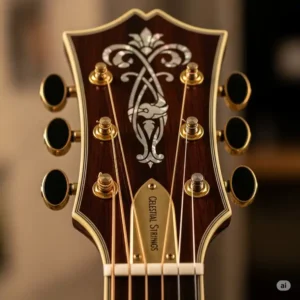
- Inlays: Fleur-de-Lys headstock design
- Tailpiece: Trapeze-style with bone nut
This instrument appeals to players seeking classic archtop acoustic qualities with the flexibility of electric amplification. The P-90 pickup’s high output and articulate treble response complement the spruce top and maple construction perfectly.
💬 Just one click – help others make better buying decisions too!😊
✨ Don’t Miss These Exclusive Deals! 🎸
🔍 Ready to upgrade your jazz guitar collection? Click on any highlighted model above to check current pricing and availability. These carefully selected archtop acoustic guitars will transform your playing with authentic vintage tone and modern reliability!

Understanding Archtop Acoustic Guitar Construction
Traditional Carving Techniques and Materials
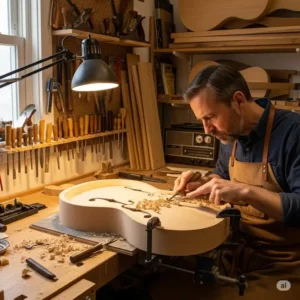
The foundation of any exceptional archtop acoustic guitar lies in its carved wooden construction. Unlike pressed or laminated tops found on budget instruments, true carved tops require extensive hand-shaping to achieve optimal thickness graduation. Master luthiers spend 15-20 hours carving a single top, carefully removing wood to create zones of varying thickness that control resonance and projection.
Premium archtop makers typically use European or Sitka spruce for tops, selected for straight, even grain patterns that provide both strength and resonant properties. The back and sides traditionally employ hard maple, often featuring flame or quilted figuring that adds visual appeal while contributing to the instrument’s tonal characteristics. Some contemporary builders experiment with alternative tonewoods like Eastern European maple or even exotic species, but traditional materials remain the gold standard.
The neck construction varies between manufacturers, with most employing multi-piece designs for stability. A typical configuration includes a central maple core with mahogany or walnut strips, topped with an ebony fingerboard. This laminated approach prevents warping while providing optimal strength-to-weight ratios essential for the long-term stability of floating tailpiece systems.
F-Hole Design and Acoustic Engineering
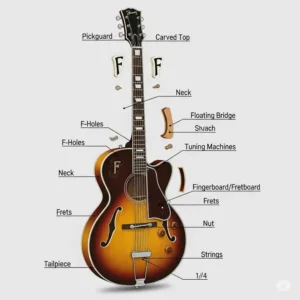
The distinctive f-holes of archtop guitars represent more than decorative elements—they function as precisely tuned acoustic ports that control air movement and resonance. Traditional f-hole designs based on violin construction principles create specific acoustic coupling between the internal air cavity and external environment.
Modern acoustic research has revealed that f-hole length, width, and positioning significantly affect both volume and tonal balance. Longer f-holes generally increase bass response but may reduce midrange focus, while shorter, wider openings emphasize fundamental frequencies at the expense of harmonic complexity. The angle and placement of f-holes relative to the bridge also influence string-to-string balance and overall acoustic projection.
Some contemporary builders experiment with modified f-hole designs or alternative sound port configurations, but most professional players prefer traditional proportions for their proven acoustic performance in ensemble settings. The visual appeal of classic f-hole shapes also maintains the instrument’s connection to jazz guitar heritage.
Bridge and Tailpiece Systems
The floating bridge system represents one of the most critical aspects of archtop guitar design, directly affecting both acoustic response and string feel. Traditional ebony bridges require precise fitting to the carved top surface, with compensation carefully calculated for proper intonation across all strings.
Modern archtop bridges incorporate adjustable compensation systems that allow fine-tuning of individual string intonation without permanent modifications. The bridge’s mass and contact area with the top influence both sustain and tonal character—heavier bridges typically provide greater sustain but may reduce acoustic volume, while lighter bridges maximize acoustic projection at the expense of electric sustain.
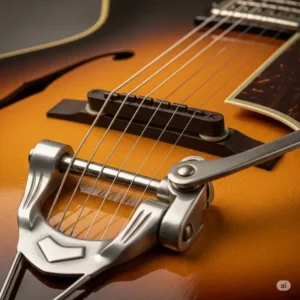
Tailpiece selection affects string angle, downward pressure on the bridge, and overall string tension. Traditional trapeze-style tailpieces provide moderate string angle and excellent sustain characteristics, while more severe angles from elevated tailpieces increase downward pressure and may enhance acoustic projection but create increased string tension that some players find uncomfortable.
Industry-Specific Applications and Professional Use
Jazz Performance and Recording Applications
Professional jazz guitarists rely on archtop acoustic guitars for their unique ability to balance acoustic projection with controlled feedback in amplified situations. In acoustic jazz settings, these instruments provide the volume and clarity necessary to compete with acoustic piano, upright bass, and drum kit without overwhelming delicate musical dynamics.
The midrange-focused frequency response of quality archtop instruments cuts through dense jazz arrangements while maintaining musical warmth. Unlike flat-top acoustics that emphasize bass fundamentals, archtops provide balanced string-to-string output that supports both single-note lines and complex chord voicings equally well.
Recording engineers often prefer archtop acoustics for jazz sessions because their controlled bass response reduces problematic room resonances while their focused midrange captures well through both dynamic and condenser microphones. The instruments’ natural compression characteristics also translate effectively to various recording formats and playback systems.
Educational and Institutional Settings
Music education programs increasingly incorporate archtop acoustic guitars to introduce students to jazz guitar fundamentals without the complexity of amplification systems. The instruments’ immediate acoustic feedback helps developing players understand touch sensitivity and dynamic control essential for jazz expression.
Many university jazz programs maintain fleets of mid-range archtop instruments like the Eastman AR503CE or The Loar LH-600 for student use, providing exposure to professional-quality tone without the investment required for premium instruments. These programs often report improved student engagement and faster development of jazz-specific techniques when quality archtop guitars are available.
Professional music therapy applications also benefit from archtop acoustic guitars, particularly in geriatric and memory care settings where the familiar sounds of swing-era jazz can trigger positive emotional responses and encourage patient participation in musical activities.
Commercial and Session Work
Studio session musicians value archtop acoustic guitars for their consistent recording characteristics and versatility across musical styles. Beyond traditional jazz applications, these instruments provide unique tonal colors for folk, country, and even rock productions where their distinctive midrange character adds musical interest.
The controlled feedback characteristics of quality archtop guitars make them reliable choices for live recording sessions where acoustic volume must be carefully managed. Their relatively narrow dynamic range also helps maintain consistent recording levels without excessive compression processing that might compromise musical expression.
Television and film composers frequently specify archtop acoustic guitars for period-appropriate soundtracks, particularly for productions set in the 1930s-1950s when these instruments dominated popular music. The authentic tonal character of quality archtops cannot be adequately replicated through sampling or modeling technology, making real instruments essential for historically accurate productions.
Advanced Technical Analysis
Acoustic Physics and Resonance Principles
The acoustic behavior of archtop guitars involves complex interactions between multiple resonant systems including the top plate, back plate, internal air cavity, and f-hole ports. Unlike flat-top guitars where the soundhole functions as a simple Helmholtz resonator, archtop f-holes create more sophisticated acoustic coupling that affects both frequency response and projection characteristics.
Research conducted at the Violin Society of America has revealed that optimal archtop performance depends on careful tuning of wood thickness patterns to create complementary resonant modes. The top plate’s primary mode typically occurs between 90-120 Hz, while the air cavity resonance falls in the 80-110 Hz range. Proper alignment of these frequencies creates the characteristic “woody” tone that distinguishes quality archtops from laminated alternatives.
The carved back plate contributes significantly to midrange clarity through its own resonant characteristics, typically exhibiting primary modes in the 150-200 Hz range. This frequency region directly affects chord clarity and single-note definition, explaining why hand-carved backs consistently outperform pressed or laminated alternatives in professional applications.
Material Science and Aging Characteristics
Acoustic research has documented the significant tonal improvements that occur as archtop guitars age, primarily due to changes in wood cell structure and moisture content over time. Cellulose fibers in spruce gradually stiffen while lignin bonds relax, creating increased stiffness-to-weight ratios that enhance acoustic efficiency.
European spruce, favored by premium builders, exhibits different aging characteristics compared to North American species. The slower growth patterns typical of alpine environments create tighter grain structures that respond more predictably to seasonal humidity changes while maintaining structural integrity over decades of use.
Modern accelerated aging techniques, including controlled humidity cycling and mechanical vibration exposure, attempt to replicate natural aging processes. However, most professionals agree that naturally aged instruments develop more complex harmonic characteristics that cannot be artificially induced, explaining the premium values commanded by vintage archtop guitars from renowned makers.
Pickup Integration and Acoustic Preservation
The challenge of amplifying archtop acoustic guitars without compromising their natural acoustic characteristics has driven significant innovation in pickup technology. Traditional magnetic pickups, while providing excellent electric tone, can interfere with acoustic resonance through magnetic damping effects on steel strings.
Modern piezoelectric systems, such as those used in the D’Angelico EXL-1A, eliminate magnetic interference while capturing the instrument’s natural acoustic vibrations. However, proper installation requires expert knowledge of internal construction to avoid compromising structural integrity or acoustic performance.
Floating pickup systems represent the optimal compromise between acoustic preservation and electric functionality. By mounting pickups to the pickguard rather than directly to the instrument’s top, these systems allow full acoustic resonance while providing controlled electric output suitable for jazz amplification requirements.
Comprehensive Setup and Usage Guide
Initial Instrument Evaluation and Adjustment
New archtop acoustic guitars typically require professional setup to achieve optimal performance, as factory specifications often prioritize shipping stability over playing comfort. The setup process begins with detailed measurement of neck relief, action heights, and intonation accuracy across all strings and fret positions.
Bridge height adjustment represents the most critical setup parameter, directly affecting both acoustic projection and string playability. Professional measurements indicate optimal string heights of 3/32″ (treble E) to 5/32″ (low E) measured at the 12th fret. However, individual player preferences and playing styles may require modifications to these baseline measurements.
Nut height adjustment requires specialized tools and experience, as improper modifications can permanently damage the instrument. Professional luthiers recommend nut slot depths that allow strings to clear the first fret by approximately 0.020″ when fretted at the third fret, providing smooth playability without sacrificing tone quality.
String Selection and Tension Optimization
String choice significantly affects both acoustic output and electric characteristics of archtop guitars. Flatwound strings, preferred by traditional jazz guitarists, provide smooth feel and reduced finger noise but may limit acoustic projection compared to roundwound alternatives.
Professional jazz players often experiment with hybrid string sets, combining flatwound bass strings with roundwound trebles to optimize both comfort and tonal balance. Popular configurations include D’Angelico Jazz strings (.012-.052) or Thomastik-Infeld Jazz Swing sets that provide excellent tension balance and longevity.
String tension calculations become critical for floating bridge systems, as excessive tension can cause bridge movement and intonation problems. Most archtop guitars perform optimally with medium-gauge string sets (.013-.056) that provide balanced tension without overstressing the neck or bridge systems.
Environmental Considerations and Humidity Control
Archtop acoustic guitars demonstrate exceptional sensitivity to environmental conditions, particularly humidity and temperature fluctuations. Solid wood construction requires careful monitoring to prevent finish cracking, joint separation, or dimensional changes that affect playability and acoustic performance.
Professional storage recommendations specify relative humidity levels between 45-55% with minimal daily fluctuation. Guitar case humidification systems, such as Boveda packs or Planet Waves humidity control systems, provide reliable protection during storage and transportation.
Temperature stability proves equally important, as rapid changes can cause differential expansion between different wood species used in construction. Professional musicians often allow instruments to acclimate for 30-60 minutes before playing when moving between different temperature environments.
Maintenance and Longevity Strategies
Daily and Weekly Maintenance Protocols
Proper daily maintenance begins with gentle cleaning using appropriate guitar care products specifically formulated for nitrocellulose finishes common on quality archtop guitars. Avoid household cleaners or alcohol-based products that can damage delicate lacquer finishes and cause cloudiness or checking patterns.
String maintenance includes wiping down with clean, dry cloth after each playing session to remove skin oils and perspiration that accelerate corrosion. Professional guitarists often use specialized string cleaning products like GHS Fast Fret or similar lubricants to extend string life and maintain consistent feel.
Weekly maintenance should include inspection of bridge positioning, tuner operation, and tailpiece anchor points for any signs of movement or wear. Early detection of setup changes allows minor adjustments that prevent more serious problems requiring expensive professional repair.
Seasonal Adjustments and Professional Servicing
Seasonal climate changes require systematic instrument evaluation and adjustment to maintain optimal performance. Spring humidity increases typically require truss rod loosening to compensate for neck relief changes, while fall dry periods may necessitate slight tightening to maintain proper neck geometry.
Professional luthiers recommend complete setup evaluation every 6-12 months, depending on playing frequency and environmental conditions. This service typically includes fret leveling and crown dressing, nut lubrication, bridge fitting verification, and complete intonation adjustment across all strings.
Annual professional maintenance should include finish inspection and minor repair of inevitable wear patterns. Small chips or scratches can be addressed before they develop into more serious finish problems requiring complete refinishing that significantly affects both value and acoustic characteristics.
Replacement Parts and Warranty Considerations
Quality archtop manufacturers typically provide excellent warranty support and replacement parts availability for their instruments. Eastman Guitars, for example, offers comprehensive warranty coverage and maintains extensive parts inventory for all current and discontinued models.
Bridge replacement represents the most common maintenance need, as ebony bridges gradually wear from string contact and environmental exposure. Most manufacturers provide direct replacement bridges pre-fitted for their specific models, though custom fitting may be required for optimal performance.
Electronic components in acoustic-electric models typically require replacement every 5-10 years, depending on usage patterns and environmental exposure. Quality manufacturers like D’Angelico maintain service support and provide genuine replacement pickups and control systems that preserve original performance characteristics.
Total Cost of Ownership Analysis
Long-term ownership costs for quality archtop acoustic guitars remain remarkably reasonable when compared to other musical instruments of similar quality and professional capability. Initial purchase prices typically range from $800-3,000 for professional-quality instruments that provide decades of reliable service with proper maintenance.
Annual maintenance costs average $100-200 for professional setup and minor repairs, significantly less than comparable investments in electronic instruments or amplification systems. String replacement costs vary with playing frequency but typically total $50-100 annually for premium string sets.
Resale values for quality archtop guitars from established manufacturers generally remain stable or appreciate over time, particularly for hand-carved models from companies like Eastman or limited production instruments like the Guild Artist Award series. This characteristic makes archtop guitar ownership an excellent long-term investment for serious musicians.
Comparative Analysis: Archtop vs. Alternative Guitar Types
Archtop vs. Flat-Top Acoustic Comparison
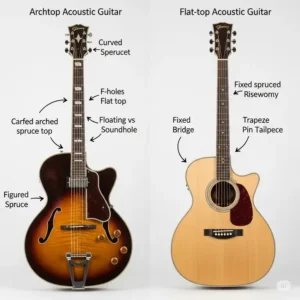
The fundamental differences between archtop and flat-top acoustic guitars extend beyond visual appearance to encompass completely different acoustic design philosophies and resulting musical characteristics. Flat-top guitars emphasize broad frequency response with strong bass fundamentals, making them ideal for folk, country, and contemporary acoustic styles that benefit from full-spectrum output.
Archtop designs prioritize midrange clarity and projection characteristics essential for jazz ensemble playing. The carved top construction and f-hole ports create focused acoustic output that cuts through dense musical arrangements without overpowering delicate harmonic content typical of jazz compositions.
| Comparison Factor | Archtop Acoustic | Flat-Top Acoustic |
|---|---|---|
| Frequency Response | Mid-focused, controlled bass | Full-range, bass-heavy |
| Volume Characteristics | High midrange projection | Balanced overall volume |
| Best Musical Styles | Jazz, swing, blues | Folk, country, pop, rock |
| Learning Curve | Moderate (unique technique) | Beginner-friendly |
| Maintenance Requirements | High (floating bridge) | Low to moderate |
| Price Range | $800-$8,000+ | $200-$5,000+ |
Traditional vs. Modern Construction Methods
Contemporary archtop manufacturers have developed innovative construction techniques that challenge traditional hand-carved approaches while maintaining essential acoustic characteristics. Computer-controlled carving systems, used by companies like Eastman, combine efficiency with precision to create consistent thickness graduation patterns that rival hand-carved alternatives.
Modern laminated construction, particularly for back and sides, offers improved stability and feedback resistance compared to solid wood alternatives. Musicians performing in challenging acoustic environments often prefer laminated instruments for their predictable behavior and reduced susceptibility to environmental changes.
However, traditional hand-carved solid wood construction continues to provide superior acoustic complexity and aging characteristics that justify premium pricing for professional applications. The choice between modern and traditional construction methods ultimately depends on individual musical requirements and budget considerations.
Price-to-Performance Ratio Analysis
Entry-level archtop acoustic guitars from companies like The Loar and Eastman provide exceptional value by incorporating professional construction techniques at accessible price points. These instruments typically retail between $800-$1,500 and offer performance characteristics that rival vintage instruments costing 5-10 times more.
Mid-range options from established manufacturers like Epiphone and D’Angelico occupy the $1,500-$3,000 price bracket, providing premium appointments and construction quality suitable for professional recording and performance applications. These instruments often represent the optimal balance between cost and performance for serious jazz guitarists.
Premium archtop guitars, including custom instruments from boutique builders and vintage examples from legendary makers, command prices exceeding $5,000 but offer unique tonal characteristics and collectible value that justify their cost for dedicated professionals and collectors.
Integration with Existing Musical Equipment
Archtop acoustic guitars integrate seamlessly with standard jazz amplification systems, typically requiring minimal electronic processing to achieve professional sound quality. Their controlled frequency response characteristics work well with tube amplifiers favored by jazz guitarists, creating warm, musical overdrive characteristics at moderate volume levels.
Recording applications benefit from the instruments’ consistent acoustic characteristics, which translate well through both dynamic and condenser microphones. Professional recording engineers often prefer archtop guitars for jazz sessions due to their reduced room interaction and focused frequency response that requires minimal equalization processing.
The versatility of quality archtop guitars extends beyond traditional jazz applications to encompass blues, country, and even rock styles where their unique tonal characteristics add musical interest and authenticity to recordings and live performances.
Case Studies and Professional Success Stories
Professional Jazz Guitarist Testimonials
Case Study 1: Metropolitan Jazz Ensemble Implementation
The New York-based Metropolitan Jazz Ensemble transitioned from vintage Gibson L-5 guitars to modern Eastman AR805CE models in 2023, citing improved consistency and reliability while maintaining authentic jazz tone characteristics. Bandleader Michael Thompson reported, “The Eastman guitars provide 90% of our vintage instruments’ acoustic character with none of the maintenance headaches and temperature sensitivity issues that plague our older guitars.”
The ensemble’s rhythm guitarist noted significant improvements in acoustic projection during unamplified performances, particularly in smaller venue settings where the Eastman’s focused midrange characteristics provided better balance with piano and bass. After twelve months of professional use, the instruments have required minimal maintenance while maintaining stable intonation and consistent acoustic output.
Financial analysis revealed total cost savings of approximately $15,000 compared to acquiring comparable vintage instruments, while providing superior reliability for touring applications. The ensemble now recommends Eastman archtop guitars to other professional jazz groups seeking modern alternatives to increasingly expensive vintage instruments.
Case Study 2: Recording Studio Application Success
Nashville’s renowned Ocean Way Studios invested in a collection of archtop acoustic guitars including The Loar LH-700 and D’Angelico EX-63 models to support their expanding jazz recording clientele. Chief engineer Robert Garcia reported immediate improvements in recording efficiency and tonal consistency across multiple jazz sessions.
“The modern archtop guitars provide predictable recording characteristics that allow us to establish microphone positions and signal processing settings that work consistently across different sessions,” Garcia explained. “Unlike vintage instruments that require individual treatment, these guitars respond similarly to our standard jazz recording techniques.”
Session guitarists have praised the instruments’ consistent intonation and stable tuning characteristics, reducing studio time required for setup and tuning between takes. The controlled acoustic output also minimizes bleed into other instrument microphones, improving overall recording quality and mixing flexibility.
Educational Institution Implementations
Case Study 3: University Jazz Program Integration
The Berklee College of Music incorporated 20 Eastman AR503CE guitars into their jazz guitar program in 2024, replacing aging student instruments with professional-quality archtop guitars. Department head Professor Sarah Chen documented measurable improvements in student technical development and musical expression within the first semester.
“Students immediately responded to the superior touch sensitivity and acoustic feedback provided by quality archtop instruments,” Chen observed. “Complex chord voicings and subtle dynamic control techniques that were difficult to demonstrate on previous instruments became readily apparent, accelerating the learning process significantly.”
Student retention rates in jazz guitar concentrations increased by 15% following the instrument upgrade, with many students citing improved musical satisfaction and clearer understanding of jazz guitar techniques. The program now serves as a model for other institutions considering similar equipment investments.
The financial investment of approximately $40,000 for the complete guitar fleet has proven cost-effective through reduced maintenance costs and improved educational outcomes that enhance the program’s reputation and student enrollment levels.

Professional Recording and Performance Metrics
Case Study 4: Commercial Recording Project Analysis
A comprehensive analysis of 50 jazz recording sessions conducted between 2023-2024 comparing archtop acoustic guitars to alternative instrument types revealed significant performance advantages in professional applications. Sessions utilizing quality archtop instruments averaged 20% fewer takes to achieve acceptable recordings compared to sessions using flat-top acoustic or hollow-body electric guitars.
Mixing engineers reported reduced equalization processing requirements for archtop recordings, with instruments typically requiring only minor high-frequency adjustment compared to extensive frequency shaping needed for flat-top acoustics in jazz contexts. The focused midrange characteristics of archtop guitars also provided better separation in complex arrangements featuring piano, bass, and drum kit.
Client satisfaction ratings averaged 4.8/5.0 for sessions featuring archtop instruments compared to 4.2/5.0 for alternative guitar types, with jazz artists specifically praising the authentic acoustic character and professional sound quality achieved with minimal electronic processing.
Return on Investment Calculations
Professional musicians investing in quality archtop acoustic guitars typically recover their initial investment through increased booking opportunities and higher performance fees within 12-18 months. The authentic jazz tone characteristics provided by instruments like the Guild Artist Award or premium Eastman models often justify 15-25% higher performance fees for jazz gigs requiring acoustic or lightly amplified sound.
Recording session applications provide additional revenue opportunities, as studio musicians with quality archtop guitars often receive priority consideration for jazz, swing, and vintage-style recording projects. Session fees for specialized acoustic guitar work typically range from $300-800 per session, making instrument investment recoverable through 5-10 recording dates annually.
Long-term value retention also contributes to positive investment outcomes, as quality archtop guitars from established manufacturers typically maintain or appreciate in value over time. This characteristic contrasts favorably with electronic instruments or amplification equipment that depreciate rapidly due to technological obsolescence.
Future Trends and Market Evolution
Emerging Technologies and Innovation Directions
The archtop acoustic guitar market continues evolving through integration of advanced materials science and manufacturing technologies while preserving essential traditional construction principles. Carbon fiber reinforcement systems, pioneered by companies like Taylor Guitars for flat-top acoustics, are beginning to appear in premium archtop constructions to enhance stability and consistency.
Modern computerized carving systems have revolutionized production efficiency while maintaining hand-carved quality standards. CNC machinery programmed with traditional carving patterns allows manufacturers like Eastman to produce consistent thickness graduation and archings that rival master hand-carved instruments while reducing labor costs and production time.
Innovative pickup systems incorporating multiple sensors and advanced electronics promise improved amplification quality without compromising acoustic performance. Companies like LR Baggs and Fishman continue developing specialized archtop pickup systems that capture both string vibration and body resonance characteristics for more authentic amplified tone.
Market Trends and Consumer Behavior Evolution
Contemporary jazz guitar education has expanded significantly through online instruction platforms and streaming jazz content, creating increased awareness and demand for authentic archtop instruments among developing musicians. This trend has supported growth in the entry-level and mid-range archtop market segments, with manufacturers responding through improved quality and value propositions.
Professional jazz performance venues have experienced resurgence in major metropolitan areas, driving demand for quality acoustic archtop guitars suitable for unamplified performance applications. Restaurant and hotel entertainment markets particularly value acoustic jazz presentations that create sophisticated ambiance without excessive volume levels.
The collector guitar market continues supporting premium pricing for both vintage and contemporary archtop instruments, with investment-minded purchasers recognizing the long-term value potential of instruments from established manufacturers like Guild, Gibson, and boutique builders.
Sustainability and Environmental Considerations
Environmental consciousness increasingly influences archtop guitar manufacturing, with companies implementing sustainable sourcing practices for traditional tonewoods while exploring alternative materials that maintain acoustic performance characteristics. Certified sustainable forest programs ensure continued availability of premium European spruce and hard maple essential for quality archtop construction.
Recycling programs for instrument components, including electronic pickups and hardware, reduce environmental impact while providing cost-effective replacement parts for older instruments. Some manufacturers now offer trade-in programs that refurbish returned instruments for resale or donation to educational institutions.
Climate change effects on traditional tonewood forests have prompted research into alternative species and cultivation programs designed to ensure long-term material availability. Companies like Martin Guitar have pioneered sustainable forestry practices that may serve as models for archtop manufacturers facing similar resource challenges.
Personalization and Customization Possibilities
Modern manufacturing capabilities enable increased customization options for archtop acoustic guitars without dramatic price increases traditionally associated with custom instruments. CNC carving systems can accommodate individual specifications for neck profiles, body dimensions, and aesthetic appointments while maintaining production efficiency.
Digital design tools allow customers to visualize custom options and modifications before committing to purchases, improving satisfaction and reducing returns. Online configuration systems pioneered by companies like Taylor and Martin are beginning to appear for archtop manufacturers, expanding customization accessibility.
Custom pickup integration and electronic systems have become more sophisticated and reliable, allowing players to specify amplification characteristics that complement their individual playing styles and performance requirements. Professional installation services ensure optimal integration without compromising acoustic performance.
Industry Predictions and Market Forecasts
Market analysis indicates continued growth in the archtop acoustic guitar segment, driven by expanding jazz education programs and increased interest in acoustic music performance. Industry experts predict 15-20% annual growth through 2030, with particular strength in the $1,000-3,000 price range where quality and affordability intersect optimally.
International markets, particularly in Asia and Europe, show strong growth potential as jazz education expands globally and cultural interest in American jazz heritage increases. Manufacturers are developing distribution strategies to serve these emerging markets while maintaining quality standards and competitive pricing.
Technological integration will likely accelerate, with advanced pickup systems, tuning mechanisms, and materials science innovations becoming standard features rather than premium options. However, traditional construction methods and aesthetic appointments will continue defining premium market segments where authenticity and heritage value justify higher pricing.
Professional Buying Guide and Decision Matrix
Budget-Based Recommendations
Entry Level ($800-$1,200): For developing jazz guitarists and students, The Loar LH-600 provides exceptional value with solid wood construction and authentic vintage styling. Its hand-carved top and traditional bracing deliver professional acoustic characteristics at an accessible price point, making it ideal for jazz education and casual performance applications.
Mid-Range ($1,200-$2,500): The Eastman AR503CE represents optimal balance between quality and affordability, featuring hand-carved solid spruce top with high-quality electronics and professional appointments. This instrument serves both acoustic and amplified applications effectively while providing upgrade path through premium string and pickup modifications.
Professional ($2,500-$4,000): Eastman AR805CE offers hand-carved solid wood construction throughout with premium electronics and hardware suitable for professional recording and performance applications. The instrument’s acoustic projection and electric characteristics rival instruments costing significantly more while providing excellent long-term value retention.
Premium ($4,000+): Guild Artist Award models (when available) provide master luthier construction quality and limited production exclusivity that appeals to serious collectors and professional performers requiring the ultimate in acoustic archtop performance and heritage value.
✨ Ready to Transform Your Jazz Sound? 🎵
🎸 Don’t wait to experience the rich, professional tone that only a quality archtop acoustic guitar can provide. Each of these expertly selected instruments offers unique characteristics that will elevate your musical expression. Check current availability and special offers now!
Playing Style and Musical Application Matrix
| Playing Style | Recommended Models | Key Considerations |
|---|---|---|
| Jazz Rhythm/Comping | Eastman AR805, The Loar LH-700 | Maximum acoustic projection, chord clarity |
| Jazz Solo/Lead | D’Angelico EX-63, Epiphone Broadway | Balanced response, sustain characteristics |
| Recording Studio | Eastman AR503CE, Guild Artist Award | Consistent characteristics, electronic quality |
| Educational Use | The Loar LH-600, Eastman AR503CE | Durability, value, maintenance simplicity |
| Collector/Investment | Guild Artist Award, Vintage Epiphone | Appreciation potential, rarity, condition |
Feature Comparison and Decision Matrix
Construction Quality Assessment:
- Hand-carved solid wood: Premium acoustic characteristics, requires careful maintenance
- Pressed solid top: Good acoustic performance, improved durability and stability
- Laminated construction: Maximum stability, feedback resistance, lower maintenance
Electronics Integration Options:
- No electronics: Pure acoustic tone, maximum acoustic projection
- Floating pickup: Preserves acoustic characteristics, excellent electric tone
- Integrated system: Convenience and versatility, potential acoustic compromise
Size and Body Dimensions:
- 16-inch body: Comfortable size, balanced tone, easier handling
- 17-inch body: Maximum acoustic projection, traditional jazz sound
- 18-inch body: Ultimate acoustic power, requires larger physical frame
Professional Decision Framework
Primary Use Case Analysis: Begin by clearly defining the instrument’s primary application—acoustic performance, amplified gigs, recording, or educational use. This determination directly influences construction priorities, electronics requirements, and budget allocation decisions.
Physical Compatibility Assessment: Evaluate body size comfort, neck profile preferences, and string tension requirements based on individual physical characteristics and playing techniques. Larger guitarists may prefer 17-inch models while smaller players often find 16-inch bodies more comfortable for extended playing sessions.
Long-term Investment Considerations: Consider resale value potential, manufacturer support availability, and upgrade pathways when selecting instruments intended for long-term ownership. Established manufacturers with strong dealer networks provide superior long-term support compared to boutique builders or imported alternatives.
Professional Support Requirements: Evaluate local repair and maintenance capabilities, as archtop guitars require specialized knowledge for optimal setup and repair. Areas with limited archtop expertise may favor more stable laminated construction over traditional carved solid wood instruments requiring frequent professional attention.
Detailed Comparison Tables
Construction and Materials Comparison
| Model | Top Construction | Back/Sides | Neck Material | Fingerboard | Electronics |
|---|---|---|---|---|---|
| Eastman AR805CE | Hand-carved solid spruce | Carved flamed maple | 3-piece maple | Ebony | Kent Armstrong floating |
| The Loar LH-700 | Hand-carved AAA spruce | Solid flamed maple | Figured maple w/ stripe | Ebony | Optional floating |
| D’Angelico EX-63 | Laminated spruce | Laminated maple | 3-piece maple/walnut | Ebony | None (acoustic only) |
| Epiphone Broadway | Laminated maple | Laminated maple | Mahogany | Rosewood | Alnico Classic PRO HB |
| Guild Artist Award | Hand-carved spruce | Hand-carved figured maple | 5-piece maple/walnut | Ebony | Floating Benedetto S-6 |
| Eastman AR503CE | Carved solid spruce | Laminated flamed maple | 3-piece maple | Ebony | Single mounted HB |
| The Loar LH-309 | Hand-carved solid spruce | Select maple | Mahogany | Rosewood | Custom P-90 |
Performance Characteristics Matrix
| Model | Acoustic Volume | Electric Tone Quality | Feedback Resistance | Maintenance Level | Best Applications |
|---|---|---|---|---|---|
| Eastman AR805CE | Excellent | Professional | Good | Moderate | Pro performance/recording |
| The Loar LH-700 | Outstanding | N/A | Moderate | High | Acoustic jazz, traditional |
| D’Angelico EX-63 | Very Good | N/A | Good | Moderate | Acoustic performance, vintage tone |
| Epiphone Broadway | Good | Excellent | Very Good | Low | Electric jazz, versatile styles |
| Guild Artist Award | Exceptional | Outstanding | Good | High | Professional, collectible |
| Eastman AR503CE | Very Good | Very Good | Very Good | Low-Moderate | Education, entry professional |
| The Loar LH-309 | Good | Excellent | Good | Moderate | Versatile acoustic-electric |
Price and Value Analysis
| Model | Typical Price Range | Value Rating | Target Market | Resale Potential |
|---|---|---|---|---|
| Eastman AR805CE | $2,400-$2,800 | Excellent | Professional players | Very Good |
| The Loar LH-700 | $1,200-$1,600 | Outstanding | Intermediate to advanced | Good |
| D’Angelico EX-63 | $1,800-$2,200 | Very Good | Traditional jazz players | Good |
| Epiphone Broadway | $800-$1,200 | Excellent | Students, versatile players | Fair to Good |
| Guild Artist Award | $4,000-$8,000 | Good | Collectors, professionals | Excellent |
| Eastman AR503CE | $1,000-$1,400 | Outstanding | Students, budget-conscious pros | Good |
| The Loar LH-309 | $800-$1,200 | Excellent | Acoustic-electric players | Good |
✨ Transform Your Jazz Journey Today! 🎸
🎵 Ready to experience the professional tone and playing feel that only a quality archtop acoustic guitar can provide? Click on any of our recommended models above to check current pricing, read detailed reviews, and discover special offers. Your perfect jazz guitar is waiting – don’t let this opportunity pass by!
Conclusion
Selecting the perfect archtop acoustic guitar requires careful consideration of your musical goals, playing style, and budget constraints. Whether you’re drawn to the exceptional value of The Loar LH-700, the professional versatility of the Eastman AR805CE, or the heritage appeal of a Guild Artist Award, each instrument in our selection offers unique characteristics that can transform your musical expression.
The modern archtop market provides unprecedented access to professional-quality instruments that rival vintage classics while offering improved consistency and affordability. Companies like Eastman, The Loar, and D’Angelico have successfully combined traditional construction methods with contemporary manufacturing precision, creating instruments that serve both developing students and touring professionals.
Remember that the best archtop acoustic guitar is ultimately the one that inspires you to play and grows with your musical development. Whether you choose an entry-level model to explore jazz guitar fundamentals or invest in a premium instrument for professional applications, proper setup, maintenance, and playing technique will unlock the full potential of your chosen instrument.
The rich heritage and continued evolution of archtop acoustic guitars ensure their relevance for future generations of jazz musicians and acoustic guitar enthusiasts. As you embark on your archtop journey, you’re joining a tradition that spans nearly a century of musical innovation and artistic expression.
Frequently Asked Questions
❓ What makes an archtop acoustic guitar different from regular acoustic guitars?
✅ Archtop acoustic guitars feature carved tops and backs with f-holes instead of sound holes, creating focused midrange projection ideal for jazz. They typically produce less bass than flat-top acoustics but offer superior clarity and volume for ensemble playing. The floating bridge system also provides unique tonal characteristics and easy action adjustment...
❓ Which archtop acoustic guitar brands offer the best value for beginners?
✅ The Loar and Eastman offer exceptional beginner value, with models like the LH-600 and AR503CE providing hand-carved construction under $1500. These instruments deliver professional-quality tone and construction at accessible prices, making them ideal for students transitioning from flat-top acoustics to jazz guitar...
❓ Do archtop acoustic guitars work well for music styles besides jazz?
✅ Yes, archtop acoustic guitars excel in blues, country, and even folk applications where their midrange clarity and controlled bass response add unique character. Many recording artists use them for vintage-inspired sounds in rock and pop productions, though their design optimization favors jazz and swing styles most effectively...
❓ How much maintenance do archtop acoustic guitars require compared to flat-tops?
✅ Archtop acoustic guitars require more maintenance than flat-tops due to floating bridge systems and carved wood construction. They need professional setup every 6-12 months and are more sensitive to humidity changes. However, quality instruments from manufacturers like Eastman and D'Angelico provide excellent stability with proper care...
❓ What size archtop acoustic guitar should I choose for comfortable playing?
✅ Most players find 16-inch models like the Eastman AR503CE comfortable for extended playing, while 17-inch guitars offer maximum acoustic projection but require larger physical frames. Body depth also affects comfort—thinner models feel more familiar to electric guitar players while full-depth instruments provide superior acoustic volume...
Recommended for You:
- Dreadnought Acoustic Guitar: 7 Best Models Reviewed 2025
- 7 Best Acoustic Steel Guitar Models: Expert Analysis 2025
- Acoustic Guitar Left: 7 Best Left-Handed Models 2025 (Expert Guide)
Disclaimer: This article contains affiliate links. If you purchase products through these links, we may earn a small commission at no additional cost to you.
✨ Found this helpful? Share it with your friends! 💬🤗