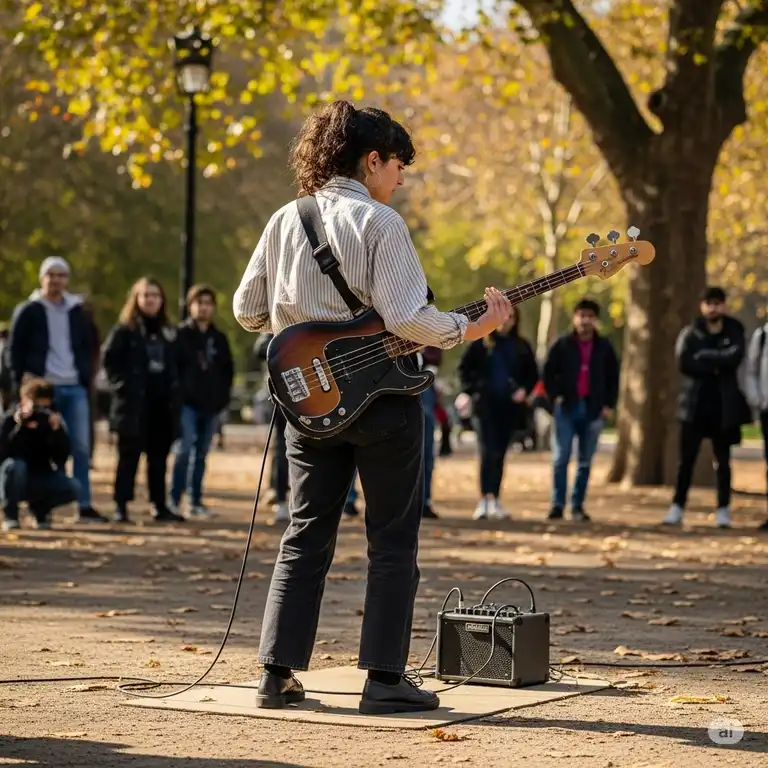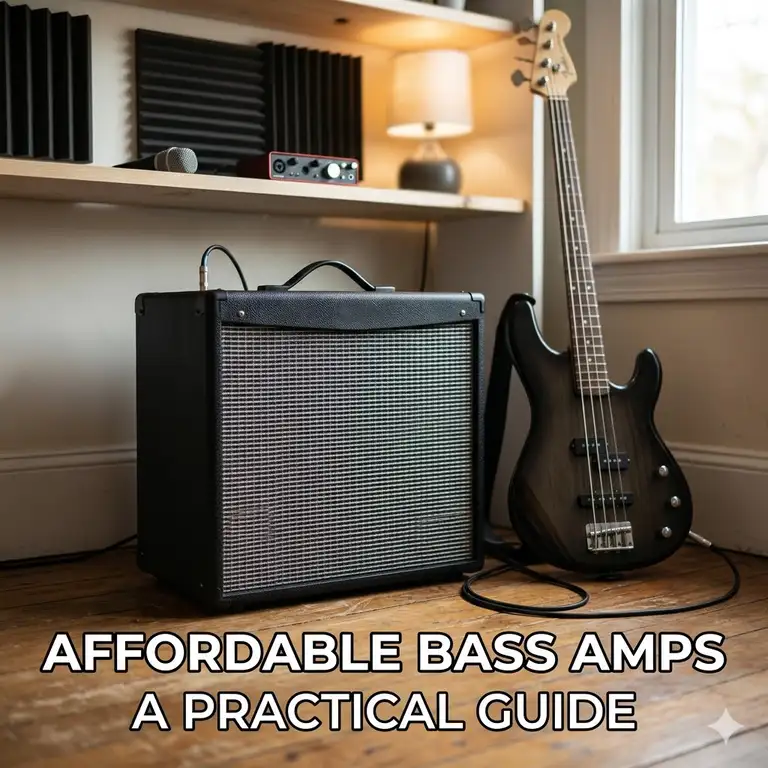
If you have ever tried to plug a bass into a standard guitar amp, you probably remember the disappointing, fartsy distortion—or worse, the smell of a blowing speaker. A bass guitar practice amplifier is a specialized piece of gear engineered specifically to handle the massive excursions and low-frequency energy that a four-string (or five-string) monster produces. In 2026, the market has shifted dramatically from “heavy boxes that hum” to sophisticated, high-fidelity units that fit on a bookshelf.
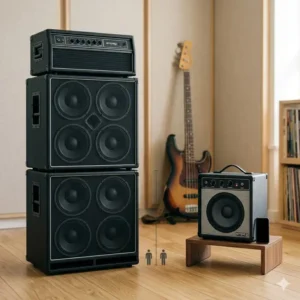
A bass guitar practice amplifier is a low-wattage (typically 15W to 60W) combo unit designed to reproduce low frequencies accurately at bedroom volumes while providing essential learning tools like headphone outputs and auxiliary inputs. Unlike the massive stacks you see on concert stages, these compact units prioritize tonal honesty and portability. The modern compact bass amp landscape is now dominated by Class D amplification and digital signal processing (DSP), allowing a 10-pound box to sound like a vintage 8×10 cabinet.
Choosing the right amp today isn’t just about finding the loudest one for the money; it is about finding a tool that inspires you to pick up the instrument. Whether you are a bedroom hobbyist or a professional needing a “coffee table” rig for late-night chart writing, the current crop of amplifiers offers unprecedented clarity. According to music theory standards from institutions like Berklee College of Music, having a clear, undistorted low-end is crucial for developing proper fingerstyle technique and ear training.
Quick Comparison: Top Bass Practice Solutions
| Model | Power | Speaker Size | Best For | Price Range |
| Fender Rumble 25 | 25W | 8″ | Beginners | $120 – $140 |
| Ampeg RB-108 | 30W | 8″ | Vintage Enthusiasts | $150 – $180 |
| Blackstar Fly 3 Bass | 3W | 3″ | Ultra-Portability | $70 – $90 |
| Boss Dual Cube Bass LX | 10W | 2 x 5″ | Desktop / Recording | $280 – $320 |
| Phil Jones Nanobass X4 | 35W | 4″ | Hi-Fi / Boutique | $330 – $360 |
Analysis of the Comparison Data
As the table illustrates, there is a significant divide between traditional “box” amps like the Fender and Ampeg models and modern “micro” designs like the Phil Jones or Boss units. While the Fender Rumble 25 offers the most “air movement” for the lowest investment, users looking for high-fidelity recording capabilities will find the Boss Dual Cube’s higher price point justified by its integrated USB audio interface and stereo spatial imaging. For those living in tight urban quarters, the 3W Blackstar proves that wattage is less important than a well-designed headphone circuit when the goal is silent practice.
💬 Just one click — help others make better buying decisions too! 😊
Top 5 Bass Guitar Practice Amplifier Models: Expert Analysis
1. Fender Rumble 25 v3: The Industry Standard
The Fender Rumble 25 v3 remains the most recommended entry-point for a reason: it’s lightweight, incredibly loud for its rating, and features the classic “Overdrive” circuit that gives your tone a bit of grit without needing a pedal.
-
Key Specs: 25 Watts of power paired with an 8-inch Fender Special Design speaker.
-
Practical Meaning: The 25-watt output provides enough headroom to keep your low E-string clear without clipping, while the 8-inch speaker is tuned to accentuate the mid-range “punch” that helps beginners hear their note definition clearly.
-
Expert Opinion: This is the “Goldilocks” amp. In my experience, most 15-watt amps feel thin, but the Rumble 25 has just enough cabinet volume to feel like a “real” amp. It’s the perfect choice for a student who needs a reliable, no-nonsense box that can survive being tossed in a car trunk.
-
Customer Feedback: Users consistently praise the “Contour” switch, which scoops the mids for a modern slap sound, though some note the 8-inch speaker can struggle with high-output active basses.
-
Pros:
-
Extremely lightweight at only 11 lbs
-
Natural-sounding overdrive circuit
-
Classic vintage aesthetic
-
-
Cons:
-
No XLR output for recording
-
Small speaker lacks deep sub-bass
-
-
Value Verdict: Around $130, this is the safest bet for any beginner.
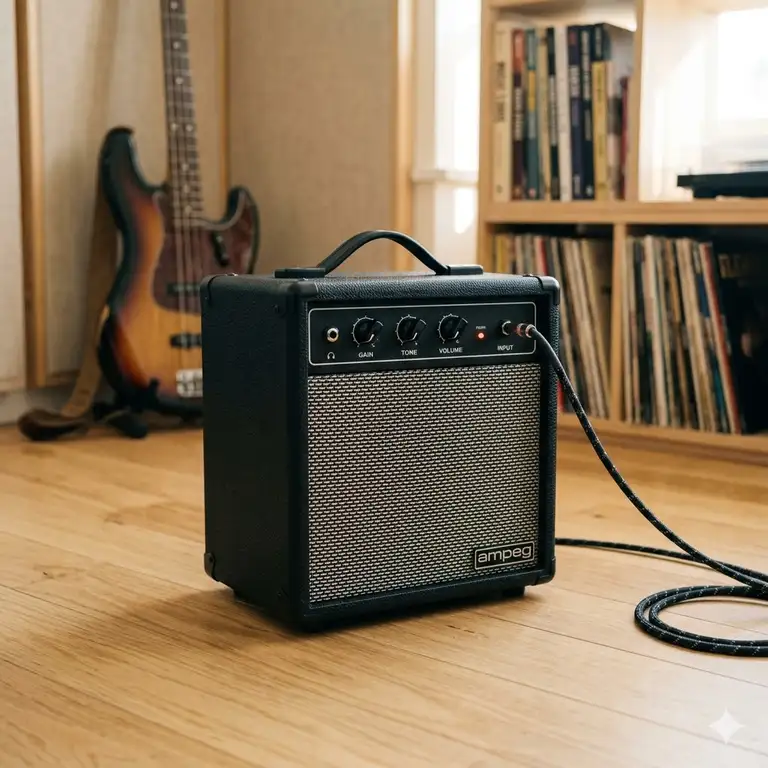
2. Ampeg Rocket Bass RB-108: Classic Grunt
The Ampeg Rocket Bass RB-108 brings the legendary “SVT” sound into a format that won’t break your floorboards or your bank account.
-
Key Specs: 30 Watts into an 8-inch speaker with a top-mounted legacy preamp.
-
Practical Meaning: The extra 5 watts over the Fender may seem negligible, but the RB-108 utilizes a more robust transformer that provides a “heavier” feel to the notes, mimicking the sag of a larger tube amp.
-
Expert Opinion: What most buyers overlook is the 60-degree tilt-back design. By angling the speaker toward your ears rather than your ankles, you can hear your tone much better at lower volumes. This is the amp for the player who loves 70s rock and wants that specific Ampeg “growl.”
-
Customer Feedback: Most owners love the Super Grit Technology (SGT) overdrive circuit, which provides a more “organic” distortion than digital modeling competitors.
-
Pros:
-
Professional aesthetics with “Checkered” Tolex
-
Superior tilt-back monitoring position
-
Very low floor noise through headphones
-
-
Cons:
-
Slightly heavier than the Rumble series
-
Simple 3-band EQ lacks versatility
-
-
Value Verdict: In the $160-$180 range, it offers the best “vintage” vibe on the market.
3. Blackstar Fly 3 Bass: The Ultimate Travel Companion
The Blackstar Fly 3 Bass is a tiny marvel that redefined what a compact bass amp could actually do when powered by just six AA batteries.
-
Key Specs: 3 Watts, 3-inch full-range speaker, and a built-in compressor.
-
Practical Meaning: While 3 watts sounds tiny, this amp uses a high-excursion speaker that moves more air than its size suggests. The built-in compressor is vital here; it prevents the tiny speaker from bottoming out on heavy thumb-slaps.
-
Expert Opinion: I often use this on my desk for transcribing songs. The spec sheet won’t tell you this, but the “Sub” control is actually a harmonic enhancer that adds psychoacoustic low-end—making your ears believe they are hearing frequencies the speaker can’t actually produce.
-
Customer Feedback: Travelers love the battery life, which can reach 50+ hours on a single set of alkalines, though some complain about the proprietary power supply (sold separately).
-
Pros:
-
Fits in a backpack or gig bag pocket
-
Includes a “Sub” control for faux-low-end
-
Excellent for use as a desktop computer speaker
-
-
Cons:
-
Physics limit the “thump” you can feel
-
Power adapter often costs extra
-
-
Value Verdict: Around $80, it is the king of portability.
4. Boss Dual Cube Bass LX: The High-Tech Workhorse
The Boss Dual Cube Bass LX is a stereo powerhouse designed for the modern bassist who wants a compact bass amp that handles everything from practice to live streaming.
-
Key Specs: 10 Watts (stereo 5W+5W), two 5-inch speakers, and 5 different amp types.
-
Practical Meaning: The stereo speakers allow for lush chorus and delay effects that “spin” around you. The five amp models range from “Super Flat” for upright bass to “Rock” for distorted tones, providing a massive palette of sounds.
-
Expert Opinion: The inclusion of a rhythm guide (drum machine) makes this a superior practice tool compared to a “dumb” amp. Practicing with the built-in beats is 10x more effective for your timing than playing to a boring metronome. It also functions as a USB audio interface, making it a “one-stop-shop” for home recording.
-
Customer Feedback: Pros love the “Dual” speakers for the way they handle stereo effects, but some find the deep-editing software required for some features a bit tedious.
-
Pros:
-
Integrated drum machine with multiple styles
-
USB output for direct recording to PC/Mac
-
Stereo XLR outputs for PA connection
-
-
Cons:
-
Higher price point than basic combos
-
Controls can be overwhelming for beginners
-
-
Value Verdict: In the $300 range, it’s a professional-grade studio tool.
5. Phil Jones Bass Nanobass X4: The Hi-Fi Specialist
The Phil Jones Bass Nanobass X4 is a boutique entry that proves size is no indicator of quality. It looks more like a high-end bookshelf speaker than a piece of guitar gear.
-
Key Specs: 35 Watts, 4-inch “NeoPower” speaker, and Bluetooth 5.0.
-
Practical Meaning: Phil Jones is a pioneer in “small speaker” technology. This 4-inch driver is engineered with a massive magnet and long-throw voice coil, allowing it to produce a flat, hi-fi response from 72Hz up to 15kHz.
-
Expert Opinion: This is for the “Tone Purist.” If you have a $2,000 Custom Shop bass, you don’t want a cheap amp coloring the sound. The X4 is the only amp in this size category that truly lets the character of your instrument shine through without artificial “bass boosting.”
-
Customer Feedback: Audiophiles rave about the Bluetooth audio quality, often using it as their primary home speaker when not playing bass.
-
Pros:
-
Studio-quality transparency
-
Beautiful aesthetic (Red, Black, or White)
-
Highest build quality in its class
-
-
Cons:
-
Lack of “grit” or “color” might feel clinical to some
-
Premium price tag
-
-
Value Verdict: Around $350, it is the choice for the discerning professional.
✨ Don’t Miss These Exclusive Deals!
🔍 Take your bass playing to the next level with these carefully selected products. Click on any highlighted item to check current pricing and availability. These tools will help you create authentic tones your family will love!
Buyer’s Decision Framework: Which Amp Fits Your Life?
Choosing a bass guitar practice amplifier requires an honest assessment of your living situation and your goals. If you pick the wrong tool, you’ll either end up with an amp you never turn on (because it sounds bad) or one that gets you an eviction notice.
Scenario A: The Apartment Dweller
If you have thin walls, your priority should be headphone quality and low-volume responsiveness.
-
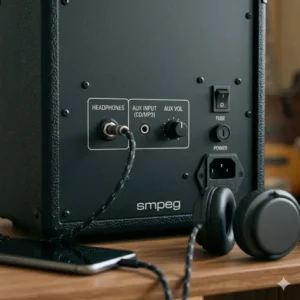
Look for: Amps with a dedicated “Aux-in” so you can play along to YouTube tracks silently.
-
Top Choice: The Boss Dual Cube Bass LX. Its stereo headphone processing creates a “room feel” in your ears so it doesn’t feel like the sound is stuck in the middle of your head.
Scenario B: The Student on a Budget
If you are just starting out, you need a compact bass amp that covers the basics without distracting you with too many knobs.
-
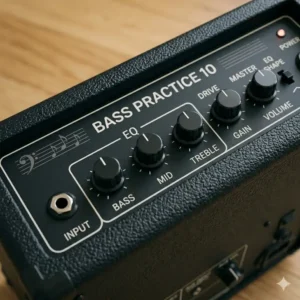
Look for: A simple 3-band EQ (Bass, Middle, Treble).
-
Top Choice: The Fender Rumble 25. It’s intuitive, affordable, and provides a “real amp” experience that builds good habits for when you eventually move to a larger stage rig.
Scenario C: The Desktop Producer
If your bass is usually plugged into a computer for recording or content creation, you need a hybrid device.
-
Look for: USB connectivity and a flat frequency response.
-
Top Choice: The Phil Jones Nanobass X4. It doubles as a high-end studio monitor, giving you two pieces of gear in one footprint.
Practical Usage Guide: Optimizing Your Practice Session
Buying the amp is only half the battle; knowing how to set it up will determine if you sound like a pro or a muddy mess. Low frequencies are notoriously difficult to manage in small rooms because of “standing waves.”
1. Placement is Everything
Never place your compact bass amp directly in a corner. While this increases the bass volume (a phenomenon known as “corner loading”), it also makes the sound boomy and indistinct. According to Wikipedia’s entry on Room Acoustics, placing a sound source near boundaries can cause significant peaks in the low-frequency response. Instead, keep the amp at least 6-12 inches away from walls.
2. The “Less is More” EQ Rule
A common mistake is cranking the “Bass” knob to 10. This usually just muddies the sound and makes the speaker work too hard.
-
Pro Tip: Try cutting the “Treble” slightly to remove finger clank and boosting the “Mids” to around 2 o’clock. This “mid-forward” sound is what actually helps you hear your pitch and rhythm accurately.
3. Mastering the Headphones
When using headphones, ensure you aren’t cranking the volume to dangerous levels. The Centers for Disease Control (CDC) warns that prolonged exposure to loud noise can cause permanent damage. Since bass frequencies aren’t as “sharp” to our ears, we often turn them up higher than we should. If you find your ears “ringing” after a practice session, turn the master volume down and use the amp’s Gain control to get the feel you want.
How to Choose a Bass Guitar Practice Amplifier
When shopping for a bass guitar practice amplifier, don’t just look at the wattage. Wattage in the bass world is deceptive. A 50-watt bass amp is roughly equivalent in perceived volume to a 15-watt tube guitar amp because low frequencies require significantly more energy to move a speaker cone.
1. Speaker Surface Area
Physics doesn’t lie. An 8-inch speaker is generally the minimum size for a “convincing” bass tone. While modern technology allows 4-inch and 5-inch speakers (like those in the Phil Jones or Boss models) to perform miracles, they require high-quality (and expensive) engineering to do so. If you are on a budget, stick to at least an 8-inch driver.
2. Connectivity Options
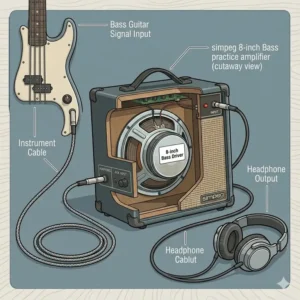
In 2026, an amp without an “Aux In” and a “Headphone Out” is practically obsolete for home use. However, look for “hidden” value features:
-
Bluetooth: Allows you to stream backing tracks wirelessly from your phone.
-
XLR Direct Out: Essential if you ever want to plug your amp into a PA system for a small gig or a high-end recording interface.
3. Analog vs. Digital Modeling
Analog amps (like the Fender or Ampeg) offer a “plug and play” simplicity. Digital modeling amps (like the Positive Grid Spark or Boss Cube) offer hundreds of effects and amp models. If you are a beginner, the simplicity of analog is often better to avoid “option paralysis.”
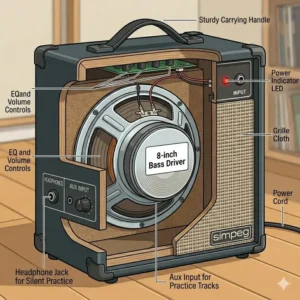
Common Mistakes When Buying a Compact Bass Amp
The most frequent error is buying a guitar amp for a bass. Guitar speakers are designed with thin paper cones and limited “throw.” A bass guitar will literally tear the speaker apart at high volumes. Always ensure the unit is explicitly labeled as a bass guitar practice amplifier.
Another mistake is overestimating your power needs. A 100-watt amp is great for a loud garage band, but in a small apartment, you will likely never turn the volume past “1.” High-wattage amps often don’t sound their best until they are pushed slightly. For home practice, a 25W to 50W range is the “sweet spot” for tone and neighborhood relations.
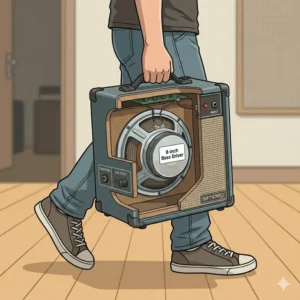
Finally, don’t ignore portability. A “practice” amp that weighs 40 lbs will eventually just sit in a corner and collect dust. The modern trend toward sub-15-lb amps means you can easily move your practice space from the bedroom to the living room or take it to a friend’s house for a quiet jam session.
Features That Actually Matter (And Those That Don’t)
Marketing departments love to throw “bells and whistles” at you, but for a bass guitar practice amplifier, only a few features truly impact your progress.
The “Must-Haves”
-
Onboard Compression: Bass guitars have a massive dynamic range. A built-in compressor helps level out your volume, making your playing sound more professional and protecting the speaker from spikes.
-
Quality Headphone Preamp: If you spend 90% of your time in headphones, the quality of the headphone jack is more important than the speaker itself.
The “Nice-to-Haves”
-
Onboard Tuner: Convenient, but most players already have a pedal or clip-on tuner.
-
App Integration: Great for tweaking deep settings, but can be a distraction when you just want to play.
The Marketing Hype
-
“Peak” Power Ratings: Manufacturers often list “Peak” wattage (e.g., 100W) when the actual “RMS” (continuous) power is only 25W. Always look for the RMS rating for a true indication of the amp’s capabilities.
Long-Term Cost & Maintenance
The good news is that a solid-state bass guitar practice amplifier is incredibly durable. Unlike tube amps, there are no expensive glass valves to replace every year. However, you should factor in the cost of high-quality cables. A cheap, unshielded cable will introduce “hum” into your practice rig, which is especially noticeable through headphones.
To extend the life of your compact bass amp:
-
Avoid extreme temperatures: Don’t leave your amp in a hot car or a damp basement, as this can cause the capacitors to degrade or the wood cabinet to warp.
-
Power down properly: Always turn the volume to zero before switching the unit off to prevent “thump” damage to the speaker.
-
Dust management: Use a simple microfiber cloth to keep the vents clear. Overheating is the number one killer of small Class D amplifiers.
Bass Amp vs. Guitar Amp: The Deep Dive
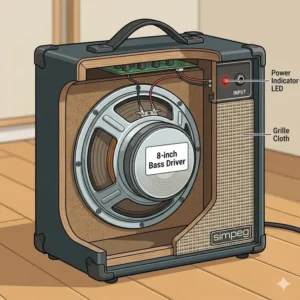
While they look similar, the internal architecture of a bass guitar practice amplifier is vastly different. Guitar amps are designed to distort in a “pleasing” way, emphasizing the high-mids and treble. A bass amp, however, needs a massive power supply to move the heavier speaker cone required for low frequencies.
If you look at the cabinet design, bass amps are often “sealed” or “ported” to control the air pressure behind the speaker. This prevents the “floppiness” associated with playing bass through an open-back guitar cabinet. In terms of frequency response, a bass amp focuses on 40Hz to 5kHz, whereas a guitar amp focuses on 80Hz to 10kHz. This is why a bass sounds “dull” through a guitar amp and a guitar sounds “dark” through a bass amp.
Safety and Sound Management in Apartments
Low-frequency sound waves are “omnidirectional,” meaning they travel through walls and floors much more easily than high-pitched sounds. Even a small compact bass amp can cause your neighbor’s floor to vibrate.
To maintain peace:
-
Decouple the amp: Place your amp on a dedicated “isolation pad” or even a thick foam yoga mat. This stops the vibrations from transferring directly into the floor.
-
Use the “Headphone Only” rule: After 9 PM, switch to headphones. The modern amps mentioned above all have “speaker-emulated” headphone outputs, meaning it will still sound like a big cabinet in your ears even if the room is silent.
✨ Don’t Miss These Exclusive Deals!
🔍 Take your bass playing to the next level with these carefully selected products. Click on any highlighted item to check current pricing and availability. These tools will help you create authentic tones your family will love!
Conclusion
Choosing the perfect bass guitar practice amplifier in 2026 is about balancing your tonal desires with your practical needs. Whether you choose the classic reliability of the Fender Rumble 25, the vintage soul of the Ampeg RB-108, or the high-tech versatility of the Boss Dual Cube Bass LX, the goal remains the same: to have a tool that makes you want to practice. The technology has finally reached a point where “small” no longer means “bad,” and “affordable” no longer means “cheap.” Invest in a quality compact bass amp, and your ears—and your neighbors—will thank you.
FAQs
❓ How many watts do I need for a bass guitar practice amplifier?
✅ For home practice, 15 to 50 watts is ideal. This provides enough headroom for a clean tone without being so loud that it becomes uncontrollable in a small room. If you plan to jam with a drummer, you will need at least 100-200 watts…
❓ Can I use my bass guitar practice amplifier for electric guitar?
✅ Yes, it is perfectly safe to plug a guitar into a bass amp. It will sound very clean and “dark,” which can be great for jazz, but you won’t get the natural grit of a guitar amp…
❓ Is an 8-inch speaker big enough for bass?
✅ For practice, yes. An 8-inch speaker in a well-designed cabinet can reproduce a low E-string accurately. However, for a 5-string bass with a low B, a 10-inch speaker or high-end 5-inch stereo setup is usually preferred…
❓ Do I need an XLR out on my practice amp?
✅ Only if you plan to record into a professional audio interface or play live. For 90% of home users, a standard 1/4-inch or USB output is more than sufficient for their needs…
❓ Why is my bass amp buzzing?
✅ This is usually caused by “dirty” power in your home or interference from fluorescent lights and computer monitors. Using a high-quality shielded cable and a power conditioner can often solve the problem…
Recommended for You
- 7 Best Acoustic Guitar Preamp Pedal Options for 2026: Pro Tone Guide
- 7 Best Bass Guitar Preamp Pedals for Pro Tone in 2026: Expert Guide
- 7 Best Acoustic Bass Strings 2026: Expert Guide and Review!
Disclaimer: This article contains affiliate links. As an Amazon Associate, I earn from qualifying purchases. If you purchase products through these links, we may earn a small commission at no additional cost to you.
✨ Found this helpful? Share it with your friends! 💬🤗