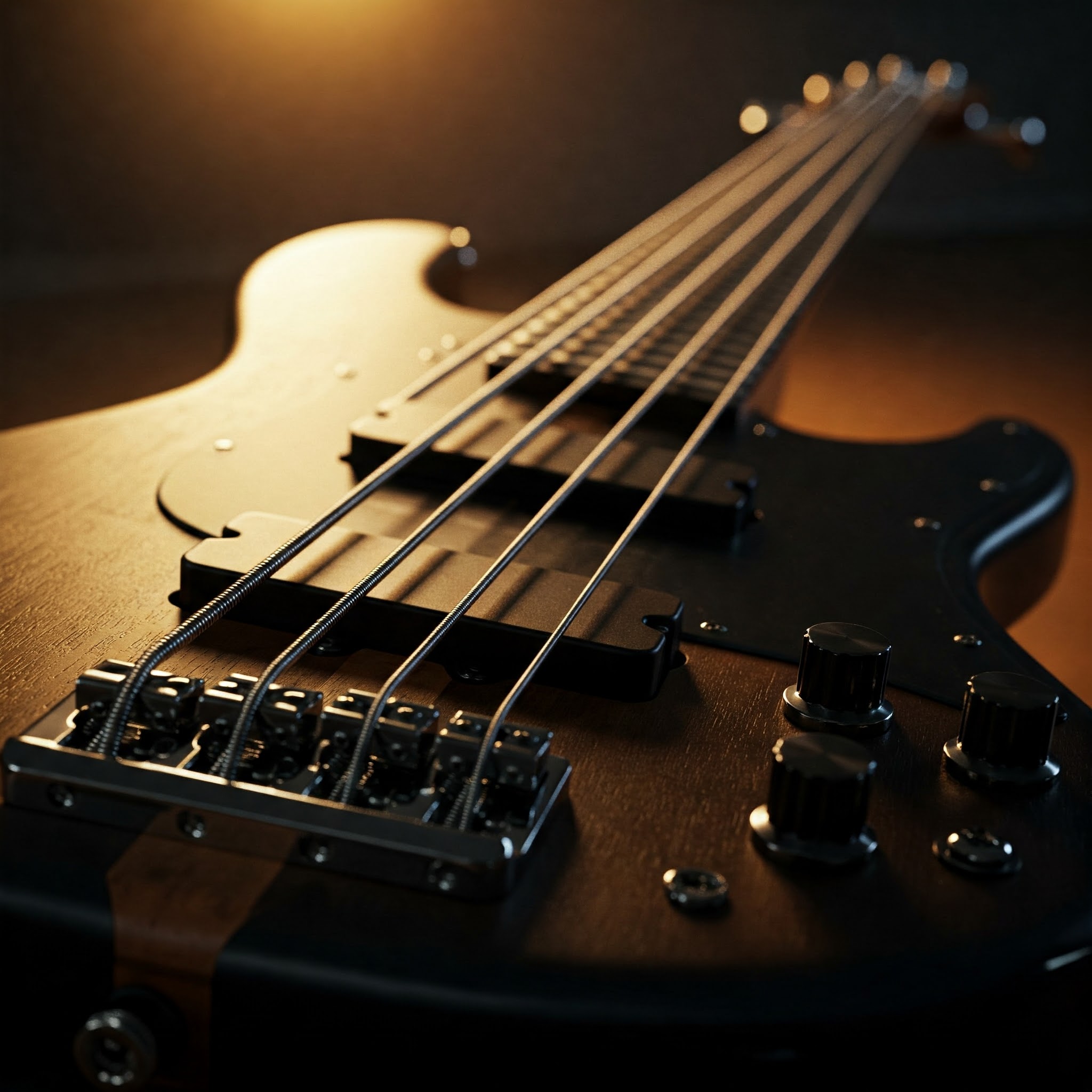
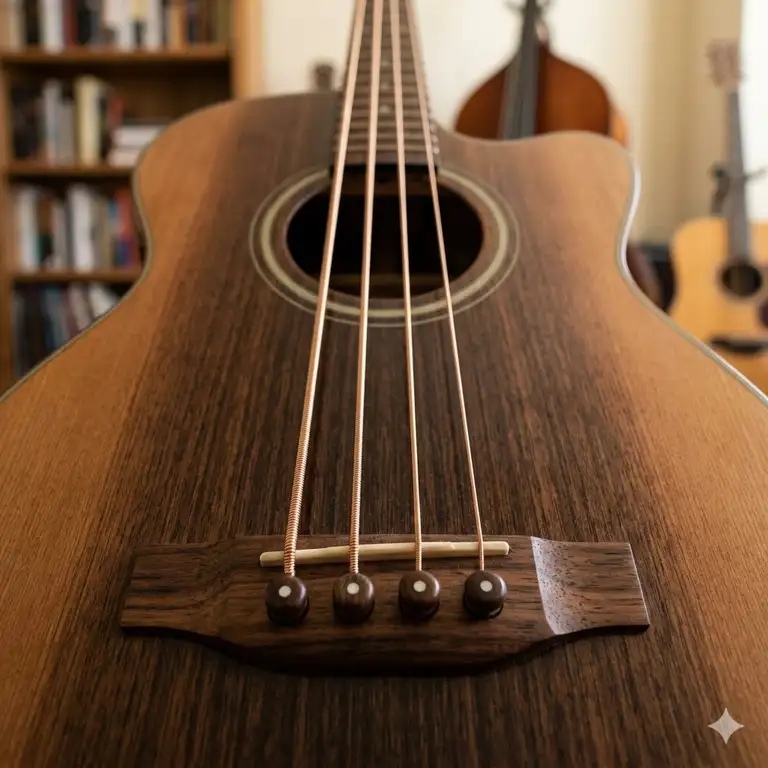
I have spent many years lugging around huge instruments and trying to find that perfect “thump” that sounds good even when you are just sitting on a porch. If you own an acoustic bass, you know the struggle. You want it to be loud, but you also want it to be smooth. Most people think all strings are the same, but let me tell you, that is simply not true. Picking the right acoustic bass strings can be the difference between a bass that sings and one that sounds like a wet cardboard box.
✨Was this helpful? Spread the word! 🚀
In this guide, I am going to walk you through everything I have learned about acoustic bass strings over the last decade. Whether you are playing a campfire set or plugging into a huge rig, the strings you choose change everything. We are going to look at materials, gauges, and even some fancy coatings that make your strings last longer than a typical New Year’s resolution.
Before we dive into the deep technical stuff, let’s look at how acoustic bass guitar strings differ from the regular electric ones you might be used to.
Acoustic vs. Standard Electric Strings Comparison
| Feature | Acoustic Bass Strings | Electric Bass Strings |
| Primary Material | Phosphor Bronze or 80/20 Bronze | Nickel-Plated Steel or Stainless Steel |
| Tone Profile | Warm, earthy, and naturally resonant | Bright, punchy, and metallic |
| Volume (Unplugged) | High resonance for acoustic projection | Low; requires an amplifier |
| Texture | Often rougher due to bronze wrap | Smoother (especially nickel) |
| Lifespan | Can oxidize faster without coating | Generally more resistant to sweat |
Quick Comparison: Top Acoustic Bass Strings at a Glance
| Rank | Product Name | Material | Gauge | Best For |
| 1 | D’Addario EPBB170 | Phosphor Bronze | .045-.100 | All-around balance |
| 2 | Ernie Ball Earthwood | 80/20 Bronze | .045-.095 | Brightness and snap |
| 3 | Elixir Strings 14077 | Coated 80/20 | .045-.100 | Maximum longevity |
| 4 | GHS Strings 3000 | Phosphor Bronze | .045-.105 | Deep, rich lows |
| 5 | DR Strings RARE | Phosphor Bronze | .045-.105 | Hand-wound quality |
| 6 | Fender 8060 | 80/20 Bronze | .045-.100 | Budget-friendly |
| 7 | La Bella 760N | Black Nylon Tape | .050-.105 | Upright-like tone |
Top 7 Acoustic Bass Strings: Expert Analysis
1. D’Addario EPBB170 Phosphor Bronze Acoustic Bass Strings
D’Addario is a name I trust because they have been making strings since before I was even a thought. The D’Addario EPBB170 set is essentially the industry standard for acoustic bass strings. These are made with a phosphor bronze wrap wire around a high-carbon steel hex core. This combination gives a very balanced tone. It isn’t too bright, but it definitely isn’t muddy either.
Technical Specifications:
-
Model: EPBB170
-
Gauges: .045, .065, .080, .100
-
Core: Hex-shaped High Carbon Steel
-
Wrap Material: Phosphor Bronze (92% Copper, 8% Tin, Phosphorus)
-
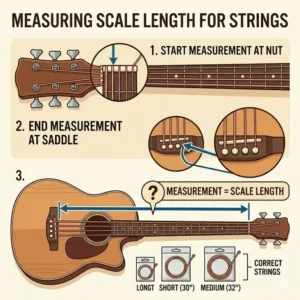
Scale Length: Long Scale (up to 36.25 inches)
Customer Review Analysis:
Most players on Amazon rave about how these strings “wake up” a dead-sounding bass. Many users mention that the initial “zing” fades into a nice, warm thud after about a week of playing. Some professional players note that the tension is perfect for standard tuning without being too stiff on the fingers.
Pros:
-
Excellent projection for unplugged sessions.
-
Corrosion-resistant packaging keeps them fresh in the box.
-
Reliable tuning stability.
Cons:
-
Phosphor bronze can be a bit rough on soft fingertips.
-
The high end can be a bit shrill for the first few hours of play.
2. Ernie Ball P02070 Earthwood Phosphor Bronze Acoustic Bass Strings
If you have ever been into a music store, you have seen the bright yellow packaging. The Ernie Ball P02070 Earthwood Phosphor Bronze Acoustic Bass Strings are famous for a reason. They use a specific blend of 92% copper, 7.7% tin, and 0.3% phosphorus. I find that these have a bit more “character” than the D’Addarios. They feel a bit more organic under the fingers.
Technical Specifications:
-
Model: P02070
-
Gauges: .045, .055, .080, .095
-
Core: Tin-plated Steel Hex Core
-
Wrap Material: Phosphor Bronze
-
Manufacturing: Precision made in Coachella, California
Customer Review Analysis:
Fans of these strings often highlight the “earthy” tone. A common piece of feedback is that these acoustic bass guitar strings feel lighter than other brands even at similar gauges. However, a few reviews mention that they might not last as long as coated alternatives if you have very sweaty hands.
Pros:
-
Very affordable and widely available.
-
Bright, crisp sound that cuts through a mix.
-
Iconic brand with high quality control.
Cons:
-
Slightly shorter lifespan than coated strings.
-
The .095 E-string might feel a bit thin for heavy hitters.
3. Elixir Strings 14077 Nanoweb Coated 80/20 Bronze Acoustic Bass Strings
Now, let’s talk about longevity. I hate changing strings. It’s a chore. That is why the Elixir Strings 14077 Nanoweb Coated 80/20 Bronze Acoustic Bass Strings are such a game changer. They have a microscopic coating that keeps skin oils and dirt out of the windings. This means they sound “new” for months rather than weeks.
Technical Specifications:
-
Model: 14077
-
Gauges: .045, .065, .080, .100
-
Coating: Nanoweb (Ultra-thin)
-
Material: 80/20 Bronze
-
Feel: Smooth and reduced finger squeak
Customer Review Analysis:
The consensus on Amazon is that these are worth every penny of the premium price. Players who use acoustic electric bass strings often prefer these because the coating reduces that annoying “chirp” sound when your fingers slide across the frets. Some old-school players find the coating feels a bit “plastic-y,” but most agree the tone lasts forever.
Pros:
-
Lasts 3-5 times longer than uncoated strings.
-
Smooth feel reduces finger fatigue.
-
Consistent tone throughout the life of the string.
Cons:
-
More expensive upfront cost.
-
Slightly less “raw” resonance compared to uncoated bronze.
4. GHS Strings 3000 Phosphor Bronze Acoustic Bass Strings
The GHS Strings 3000 Phosphor Bronze Acoustic Bass Strings are for the player who wants a deep, fundamental tone. GHS uses a slightly different winding technique that results in a very “solid” feeling string. I like these for acoustic electric bass guitar strings because they interact very well with piezo pickups, which can sometimes be too bright.
Technical Specifications:
-
Model: 3000 (Contact Core)
-
Gauges: .045, .063, .079, .105
-
Core: Round Core (on some variations) or Hex Core
-
Material: Phosphor Bronze
-
Packaging: Nitrogen-sealed for freshness
Customer Review Analysis:
Users appreciate the heavy E-string (.105), which provides a more satisfying low end. Reviewers often mention that these strings have a “stiff” feel, which is great for players who have a heavy right-hand technique. They are frequently cited as the best choice for large-bodied acoustic basses.
Pros:
-
Strong low-frequency response.
-
Very durable and resistant to breaking.
-
Great for aggressive playing styles.
Cons:
-
Can feel very stiff if you are used to light gauges.
-
The “Contact Core” design can be tricky for some bridge types.
5. DR Strings RARE Phosphor Bronze Acoustic Bass Strings
DR Strings claims that these are “low tension” strings. The DR Strings RARE Phosphor Bronze Acoustic Bass Strings are hand-wound, which is rare in this price bracket. Because they are wound on a hex core but with a specific tension profile, they are easier to press down. If you find your acoustic bass hard to play, these might be the answer.
Technical Specifications:
-
Model: RPLB-45
-
Gauges: .045, .065, .085, .105
-
Construction: Hand-wound
-
Material: Phosphor Bronze
-
Tone: Deep, loud, and warm
Customer Review Analysis:
Many players who have older instruments or hands that tire easily recommend these. The feedback usually centers on the “loudness” of the strings relative to how little effort it takes to play them. Some users have reported minor inconsistencies due to the hand-wound nature, but DR’s customer service is usually excellent.
Pros:
-
Easier on the fingers (lower perceived tension).
-
Hand-wound quality provides a unique harmonic richness.
-
Noticeably louder than many machine-wound sets.
Cons:
-
Can be harder to find in local shops.
-
Slightly higher price than standard Ernie Balls.
6. Fender 8060 Phosphor Bronze Acoustic Bass Strings
You can’t have a list without the big F. The Fender 8060 Phosphor Bronze Acoustic Bass Strings are straightforward and reliable. These are 80/20 bronze, which means they are 80% copper and 20% zinc. This usually results in a brighter, more “shimmering” sound than phosphor bronze.
Technical Specifications:
-
Model: 0738060405
-
Gauges: .045, .065, .080, .100
-
Core: Hex Core
-
Material: 80/20 Bronze
-
Ball Ends: Standard Fender quality
Customer Review Analysis:
These are often the “go-to” for people who just bought their first acoustic bass. They are cheap and they work. Reviewers say they have a very bright “piano-like” tone when they are fresh. The main complaint is that the brightness dies off fairly quickly compared to phosphor bronze.
Pros:
-
Very budget-friendly.
-
Great for recording when you need maximum brightness.
-
Trusted brand compatibility.
Cons:
-
Tone loses its “sparkle” faster than other materials.
-
Prone to faster oxidation if not wiped down after play.
7. La Bella 760N Black Nylon Tapewound Bass Strings
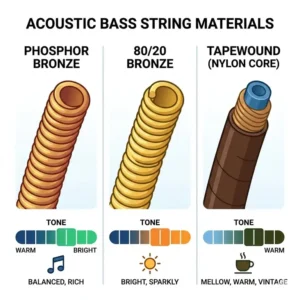
Okay, this is my “secret weapon.” While these aren’t bronze, the La Bella 760N Black Nylon Tapewound Bass Strings are often used on acoustic electric bass guitar strings to mimic the sound of an upright bass. They are metal strings wrapped in black nylon tape. They are incredibly smooth and have a very warm, dark tone.
Technical Specifications:
-
Model: 760N
-
Gauges: .050, .065, .085, .105
-
Wrap: Black Nylon Tape
-
Core: Stainless Steel
-
Feel: Perfectly smooth (no finger noise)
Customer Review Analysis:
Jazz and folk players love these. They are praised for their “thumpy” and “woody” sound. Many users mention that these strings basically last forever because the nylon protects the metal core from everything. However, they are much quieter unplugged than bronze strings, so they are really best for acoustic electric bass strings users.
Pros:
-
Zero finger noise/squeak.
-
Incredible lifespan (can last for years).
-
Beautiful, vintage “upright” sound.
Cons:
-
Very low acoustic volume (needs an amp).
-
The thicker gauge might require slight nut adjustments.
✨ Don’t Miss These Exclusive Deals!
🔍 Take your acoustic performances to the next level with these carefully selected acoustic bass strings. Click on any highlighted item to check current pricing and availability. These strings will help you find that perfect tone your music deserves! 🎸
💬 Just one click – help others make better buying decisions too!😊
Deep Dive: The Science of Acoustic Bass Strings
When you are looking for the best acoustic bass strings, you aren’t just buying wire. You are buying a physical component that dictates how your instrument vibrates. If you use the wrong set, you can actually damage your bass or just end up with a sound that makes you want to quit playing.
The Role of Materials
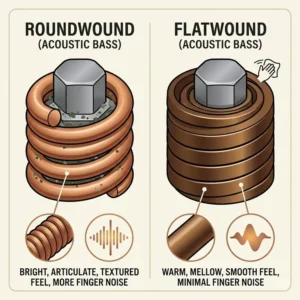
The most common material for acoustic bass guitar strings is Phosphor Bronze. Why? Because it’s a great balance. It has enough copper to be warm and enough tin to be durable. Phosphorus is added to the mix to act as a deoxidizer during the smelting process, which makes the alloy more resistant to corrosion.
Then you have 80/20 Bronze. This is the “classic” acoustic sound. It’s brighter and punchier. However, the zinc in 80/20 tends to react with the air faster. Furthermore, the sweat from your hands can turn these strings dull in just a few heavy practice sessions.
Coating vs. Uncoated: The Great Debate
I get asked all the time: “Are coated strings worth the extra ten dollars?” The answer depends on your body chemistry. Some people have “acidic” sweat that can kill a set of strings in one night. If that’s you, then yes, something like the Elixir Strings 14077 is a lifesaver.
On the other hand, if you love that raw, metallic grit under your fingers, you might find coated strings a bit too slippery. Similarly, some purists argue that the coating dampens the vibration of the string, leading to less volume. While this was true in 2005, by 2026, the technology has improved so much that most people can’t hear the difference.
Technical Specification Matrix (Spec Matrix)
| Product | Core Shape | Wrap Ratio | Finish | Tension (lbs) |
| D’Addario EPBB170 | Hex | 92/8 | Natural | High |
| Ernie Ball Earthwood | Hex | 92/8 | Natural | Medium-High |
| Elixir Nanoweb | Hex | 80/20 | Coated | Medium |
| GHS 3000 | Hex/Round | 92/8 | Natural | High |
| DR Rare | Hex | 92/8 | Hand-Wound | Low |
| Fender 8060 | Hex | 80/20 | Natural | Medium |
| La Bella 760N | Round | Nylon | Taped | Low-Medium |
How to Choose the Best Strings for Your Style
Choosing acoustic electric bass strings requires a different mindset than choosing strings for a purely acoustic instrument. When you are plugged in, your pickup (usually a piezo under the saddle) is going to hear everything.
For the Soloist
If you are playing solo and want every nuance to be heard, go for a lighter gauge. Something like a .040 or .045 set will allow you to do vibrato and bends much easier. I personally recommend the DR Strings RARE for this because the lower tension makes the bass feel more like a guitar and less like a piece of construction equipment.
For the Heavy-Handed Rocker
If you are playing in a band with acoustic guitars and a Cajon, you need to be loud. You need the mass of the string to move the top of the bass. Go for a .105 E-string. The GHS Strings 3000 set is a monster for this. It has the weight to actually move some air.
Budget vs. Premium: Is it worth it?
| Category | Typical Lifespan | Tone Quality | Price Point | Recommended For |
| Budget (Fender/Generic) | 2-4 Weeks | Bright then Dull | $15-$20 | Beginners, Quick Recording |
| Mid-Range (D’Addario/EB) | 4-6 Weeks | Consistent Balance | $20-$30 | Regular Giggers |
| Premium (Elixir/DR) | 3-6 Months | Refined/Lasting | $35-$50 | Professionals, Lazy String-Changers |
Understanding Gauges and Tension
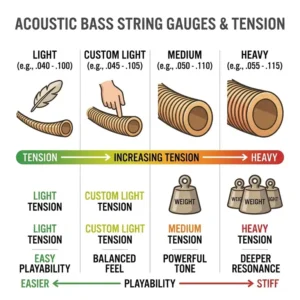
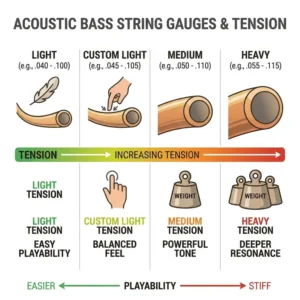
The “gauge” of the string refers to its diameter in inches. For example, a .100 string is 0.1 inches thick. You might think, “Hey, it’s just a few hundredths of an inch, what’s the big deal?” Well, in the world of acoustic bass strings, that small difference changes the tension by several pounds.
If you put strings that are too heavy on a bass that isn’t built for them, you can actually warp the neck or pull the bridge right off the body. Most acoustic basses come from the factory with “Light” or “Medium-Light” strings. Always check your manufacturer’s website before jumping up to a heavy gauge.
Common Gauge Ranges for 4 String Acoustic Bass Strings:
-
Extra Light: .040 – .095
-
Light: .045 – .100 (The Sweet Spot)
-
Medium: .050 – .105
-
Heavy: .055 – .110
Feature & Benefit Matrix
| Feature | Benefit | Who Needs It? |
| Phosphor Bronze | Warmth and corrosion resistance | Folk and Country players |
| 80/20 Bronze | High-end clarity and “zing” | Percussive players and Slappers |
| Hex Core | Better “grip” for the wrap wire | Modern players needing stability |
| Round Core | More flexibility and vintage vibe | Blues and Jazz players |
| Nylon Tape | Soft feel and dark tone | Upright bass enthusiasts |
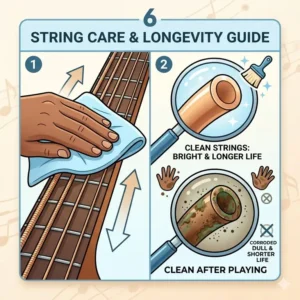
Maintenance: Making Your Acoustic Bass Strings Last
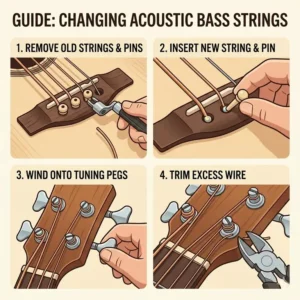
I see so many people change their strings, play for an hour, and then leave the bass on a stand. Two weeks later, the strings are brown and sound like mud. Acoustic bass guitar strings are sensitive. Because bronze is highly reactive to the moisture in your breath and the oils on your fingers, you have to be proactive.
-
Wash your hands: It sounds simple, but it’s the #1 way to keep your strings alive.
-
Wipe them down: Use a lint-free microfiber cloth after every session. Run it under the string as well as over it.
-
Use a humidifier: Acoustic instruments are made of wood. If the wood dries out, the bridge can lift, which puts weird tension on your strings.
-
String Lubricant: Products like Fast-Fret can add a tiny layer of protection, though I find they can sometimes gunk up acoustic electric bass strings if you use too much.
Longevity and Performance Metrics
| String Type | Initial Brightness | Sustain | Feel (Smoothness) | 3nd Month Performance |
| Phosphor Bronze | 8/10 | 9/10 | 6/10 | 4/10 |
| 80/20 Bronze | 10/10 | 8/10 | 5/10 | 2/10 |
| Coated (Elixir) | 7/10 | 8/10 | 9/10 | 8/10 |
| Nylon Tapewound | 3/10 | 6/10 | 10/10 | 9/10 |
Why Specific Strings Matter for Acoustic Electric Basses
When you have an acoustic electric bass, you are dealing with two different sound sources. There is the “acoustic” sound coming out of the hole, and the “electric” sound coming out of your speakers.
Often, what sounds good to your ears in a quiet room sounds terrible when amplified. For example, 80/20 bronze strings can be very “clanky” when plugged in. This is why many people who use acoustic electric bass guitar strings prefer Phosphor Bronze. The phosphorus takes the edge off those harsh high frequencies, making the amplified sound much more natural.
Furthermore, if you are using a bass with a magnetic pickup (rare but they exist), you cannot use bronze strings. Magnetic pickups need iron or nickel to work. However, 99% of acoustic-electric basses use piezo pickups, which work based on pressure, so bronze works perfectly fine.
The Mystery of the “Dead” E-String
A common complaint with acoustic bass strings is that the E-string sounds “dead” compared to the others. I have found that this is often a physical issue with the bridge. Because the E-string is so thick, it doesn’t always sit perfectly in the saddle.
If you experience this, try the GHS Strings 3000. Their “Contact Core” design thins out the string right where it passes over the bridge, which can help it vibrate more freely. Consequently, you get a much clearer and louder low end.
✨ Don’t Miss These Exclusive Deals!
🔍 Take your acoustic performances to the next level with these carefully selected products. Click on any highlighted item to check current pricing and availability. These strings will help you create the deep, rich tones you’ve been searching for! 🎸
Final Thoughts on Finding Your Sound
At the end of the day, your choice of acoustic bass strings is a personal journey. I have gone through dozens of sets to find what works for my specific bass and my specific playing style. If you are just starting out, grab a set of D’Addario EPBB170. They are the safest bet and they sound great.
If you are a seasoned pro looking for a specific vibe, maybe try those La Bella 760N tapewounds. They will completely change how you think about your instrument.
Remember, the strings are the only part of the bass you actually touch. If they feel bad, you won’t want to play. If they sound bad, no one will want to listen. Invest a little bit of time and money into finding the right match, and your acoustic bass will reward you with years of beautiful music.
FAQs
✅ For regular players, changing acoustic bass strings every 1-3 months is standard. Phosphor bronze strings lose their brilliance faster than nickel-plated ones. If the strings look dark, feel crusty, or can't stay in tune, it is time for a fresh set...
✅ You can, but it is not recommended. Electric bass strings lack the bronze winding necessary for acoustic projection. Without an amp, your bass will be very quiet. Additionally, the tension might be different, potentially affecting your instrument's neck and bridge...
✅ Not necessarily, but they are different. Coated strings like Elixir offer a slightly mellower top-end straight out of the box. While they lack the initial 'bite' of raw bronze, they maintain their 'medium-bright' tone for many months longer than uncoated sets...
✅ Phosphor bronze is the go-to for warmth. However, for a truly vintage, 'upright' vibe, many players prefer nylon tapewound strings. These provide a deep, thumpy fundamental with almost no overtones, perfect for jazz, folk, and acoustic blues styles...
✅ The cost is higher due to the materials and manufacturing complexity. Bronze alloys are more expensive than steel, and the strings are physically much larger than guitar strings. Additionally, the specialized winding required for acoustic resonance adds to the production costs... ❓ How often should I change my acoustic bass strings?
❓ Can I use regular electric bass strings on my acoustic bass?
❓ Do coated strings actually sound worse than uncoated strings?
❓ What is the best material for a warm, vintage bass tone?
❓ Why are acoustic bass guitar strings so much more expensive?
Recommended for You:
- Best Pickups for Acoustic Guitars: 7 Top Picks for Studio Sound (2026)
- 7 Best Acoustic Bass Pickup Systems for Thumping Tone in 2026
- Bone bridge pins: 7 Best Upgrades for 2026 Acoustic Tone
Disclaimer: This article contains affiliate links. If you purchase products through these links, we may earn a small commission at no additional cost to you.
✨ Found this helpful? Share it with your friends! 💬🤗