Have you ever plugged your bass directly into a PA system and felt like your sound was as thin as a piece of paper? I have been there, and let me tell you, it is a soul-crushing experience for any musician. Whether you are playing a local dive bar or a massive stadium, the secret to a thick, punchy, and professional sound often lies in a single box: the bass guitar preamp.
✨Was this helpful? Spread the word! 🚀
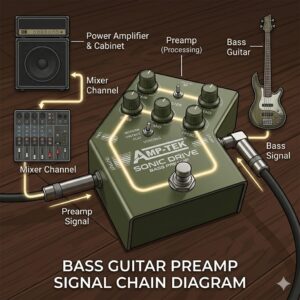
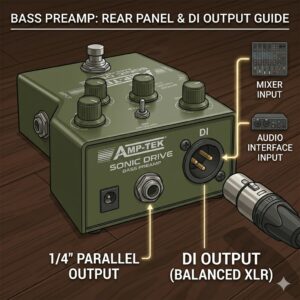
Essentially, a preamp takes the weak signal from your instrument and boosts it to a level where it can be manipulated and sent to a power amp or a mixing board. But it does so much more than just “making it louder.” It is the heart of your tone, allowing you to sculpt your frequencies, add some grit, and ensure you cut through the mix. Furthermore, modern units often serve as a DI (Direct Injection) box, which is a lifesaver for recording and live gigs.
Before we dive into the deep end, let’s look at how a dedicated preamp stacks up against other common signal chain options.
Comparison: Preamp Pedal vs. Standard DI vs. Onboard EQ
| Feature | Bass Guitar Preamp Pedal | Standard DI Box | Onboard Active Preamp |
| Tone Shaping | Extensive (EQ, Drive, Gain) | Minimal to None | 2-3 Band EQ Only |
| Portability | Very High (Fits in gig bag) | Very High | Internal to Bass |
| Output Options | XLR, 1/4″, Parallel | XLR Only | 1/4″ Only |
| Sound Character | Adds Color/Character | Transparent/Clean | Instrument Dependent |
| Power Needs | 9V-18V DC or Phantom | Passive or Phantom | 9V Battery |
Quick Comparison: Top Picks at a Glance
If you are in a rush and need a solid electric bass preamp right now, here are my top three recommendations based on versatility, build quality, and sheer “thump” factor.
| Model | Best For | Key Vibe | Signal Path |
| Tech 21 SansAmp BDDI V2 | Versatility | Classic Tube Warmth | Analog |
| Darkglass B7K Ultra V2 | Modern Metal | Aggressive & Clear | Analog w/ Digital Cab Sim |
| MXR M81 | Pure Transparency | Studio Clean | Analog |
Top 7 Bass Guitar Preamp Pedals: Expert Analysis
I have spent years cycling through gear, and these seven units represent the absolute gold standard for 2026. These are real products used by professionals worldwide, chosen for their reliability and sonic excellence.
1. Tech 21 SansAmp Bass Driver DI V2
The Tech 21 SansAmp Bass Driver DI V2 is arguably the most famous bass guitar preamp in history. It is a staple on pedalboards because it can emulate the warmth of a vintage tube amp with incredible accuracy. Specifically, the V2 update added a mid-range control and a shift switch, addressing the only complaint players had for twenty years.
-
Technical Specifications:
-
Controls: Drive, Level, Blend, Treble, Presence, Mid, Bass.
-
I/O: 1/4″ Input, XLR Out, 1/4″ Out, Parallel Out.
-
Power: 9V Battery, DC Power, or Phantom Power via XLR.
-
Features: Ground lift, -20dB pad for XLR, 10dB boost for 1/4″.
-
-
Customer Review Analysis: Users consistently praise its “bulletproof” construction. One common sentiment is that it makes even a cheap bass sound like a high-end boutique instrument. However, some jazz purists feel the “SansAmp” color is too distinct and hard to turn off completely.
-
Warranty: 1-year limited warranty.
-
Professional Applications: Ideal for rock, punk, and blues players who need a reliable “amp-in-a-box” solution.
-
Pros: Iconic “growl,” phantom power capability, incredibly durable.
-
Cons: Can be a bit “colored” for players seeking total transparency.
2. Darkglass Microtubes B7K Ultra V2
If you are looking for an active bass preamp that can handle high-gain distortion without losing low-end clarity, the Darkglass Microtubes B7K Ultra V2 is your best friend. Darkglass has revolutionized the modern metal scene with their unique approach to saturation.
-
Technical Specifications:
-
Controls: Master, Drive, Level, Blend, 4-band EQ with switchable mid-frequencies.
-
Special Features: Built-in impulse response (IR) cabinet simulation, Micro-USB port for loading custom IRs.
-
I/O: 1/4″ Input/Output, Balanced XLR Out, 3.5mm Headphone Out.
-
-
Customer Review Analysis: Modern players love the “clank” and definition it provides. Reviewers often mention that the headphone jack makes it the perfect practice tool. On the downside, the price point is steep for beginners.
-
Warranty: 2-year limited warranty.
-
Professional Applications: The gold standard for progressive metal, djent, and hard rock.
-
Pros: Incredible EQ precision, high-quality cab sims, dedicated distortion footswitch.
-
Cons: Expensive; can be overly aggressive for “vintage” styles.
3. MXR M81 Bass Preamp
Sometimes, you just want your bass to sound like… your bass, but better. The MXR M81 Bass Preamp is a compact, no-nonsense electric bass preamp that focuses on transparency and clean headroom.
-
Technical Specifications:
-
Controls: Input, Output, Bass, Mid (with frequency sweep), Treble.
-
I/O: 1/4″ In/Out, Balanced XLR Out.
-
Power: 9V or Phantom Power.
-
-
Customer Review Analysis: Most users appreciate the small footprint. “It fits on any board,” is a common remark. The sweepable mids are highly praised for fixing “room boom” during live shows.
-
Warranty: 1-year limited warranty.
-
Professional Applications: Session players and pit musicians who need a clean, dependable DI signal.
-
Pros: Extremely transparent, sweepable mid-frequency, tiny form factor.
-
Cons: No drive or distortion circuit included.
4. Ampeg SGT-DI Bass Preamp and DI
For those who crave the “Ampeg growl,” the Ampeg SGT-DI Bass Preamp and DI is a dream come true. It features a “Super Grit Technology” circuit that mimics the SVT and B15 circuits, which are the most recorded bass sounds in history.
-
Technical Specifications:
-
Controls: SGT Circuit (Grit/Level), 3-band EQ with sweepable mids, Ultra Hi/Lo switches.
-
Features: Built-in compressor, Cab Sim (SVT-810, V-4B, etc.).
-
I/O: 1/4″ In/Out, XLR Out, Aux In, Headphone Out.
-
-
Customer Review Analysis: Users are blown away by the Cab Sim accuracy. Many report they no longer bring an amp to gigs. Some users find the interface slightly crowded with all the switches.
-
Warranty: 2-year limited warranty.
-
Professional Applications: Classic rock, motown, and any setting requiring heritage Ampeg tones.
-
Pros: Best-in-class cab simulation, dual-voiced drive circuit, classic aesthetics.
-
Cons: Larger footprint than standard pedals.
5. Aguilar Tone Hammer Preamp/DI
The Aguilar Tone Hammer Preamp/DI is based on the famous OBP-3 onboard preamp circuit. It provides a warm, musical, and “organic” sound that many bassists describe as feeling like a high-end studio console.
-
Technical Specifications:
-
Controls: Gain, Treble, Mid (Freq/Level), Bass, Master.
-
Special Feature: AGS (Adaptive Gain Shaping) circuit.
-
Power: Two 9V batteries or 18V DC for maximum headroom.
-
-
Customer Review Analysis: Fans of the “Aguilar sound” love the musicality of the EQ. However, the AGS circuit can be tricky; it often requires a significant volume jump, which some users find frustrating.
-
Warranty: 3-year limited warranty (with registration).
-
Professional Applications: Jazz, gospel, and R&B players who want a “smooth” character.
-
Pros: Exceptional build quality, very musical EQ, operates at 18V for huge headroom.
-
Cons: AGS circuit isn’t independently foot-switchable for volume-matched drive.
6. Fishman Platinum Pro EQ
While many think of Fishman for acoustic guitars, the Fishman Platinum Pro EQ is a secret weapon as a bass guitar active preamp. It is specifically designed to handle the high impedance of piezo pickups (like on an upright bass) while sounding amazing with magnetic electric pickups.
-
Technical Specifications:
-
Controls: 5-band EQ, Low-cut filter, Compression, Volume boost.
-
Special Features: Built-in chromatic tuner, phase control for feedback suppression.
-
I/O: 1/4″ In/Out, XLR DI with Pre/Post switch.
-
-
Customer Review Analysis: Multi-instrumentalists love this pedal. One user mentioned it is the only pedal they need for both their electric and upright bass. Some find the plastic casing of older models a concern, but the “Pro” version is rugged metal.
-
Warranty: 1-year limited warranty.
-
Professional Applications: Folk, bluegrass, and acoustic-electric fusion.
-
Pros: Integrated tuner and compressor, great for upright bass, very versatile EQ.
-
Cons: A bit “utilitarian” in appearance; no “rock” drive.
7. EBS MicroBass 3
The EBS MicroBass 3 is a Swiss Army Knife. It is a 2-channel bass preamp for sale that allows you to blend two different signals or switch between two basses with different EQ settings.
-
Technical Specifications:
-
Controls: Dual channels (Clean/Drive), 3-band EQ on each, Compressor.
-
Features: Effects loop, built-in tuner, cabinet simulation.
-
I/O: Dual 1/4″ inputs, Stereo XLR Out, 1/4″ Out, Headphone Out.
-
-
Customer Review Analysis: Users call this the “ultimate fly-rig.” The ability to mix a clean low-end with a distorted high-end is a major selling point. The only complaint is the learning curve due to the sheer number of knobs.
-
Warranty: 2-year limited warranty.
-
Professional Applications: High-end touring professionals who need total control over every aspect of their signal.
-
Pros: Two-channel flexibility, professional-grade signal-to-noise ratio, stereo outputs.
-
Cons: Most expensive on this list; complex for beginners.
✨ Don’t Miss These Exclusive Deals!
Take your bass tone to the next level with these carefully selected products. Click on any highlighted item to check current pricing and availability. These preamps will help you create a studio-quality sound that your bandmates will love! 🎸✨
💬 Just one click – help others make better buying decisions too!😊
Detailed Spec Matrix: Comparing the Top 7
| Product Name | Technology | Channels | Drive/Grit | Cab Sim | Power |
| SansAmp BDDI V2 | Analog | 1 | Yes | Analog Filter | 9V/Phantom |
| Darkglass B7K Ultra | Analog/Digital | 1 (Dual Switch) | Yes | Digital (IR) | 9V DC |
| MXR M81 | Analog | 1 | No | No | 9V/Phantom |
| Ampeg SGT-DI | Analog/Digital | 1 | Yes | Digital (IR) | 9V DC |
| Aguilar Tone Hammer | Analog | 1 | Yes (AGS) | No | 18V DC |
| Fishman Platinum Pro | Analog | 1 | No | No | 9V DC |
| EBS MicroBass 3 | Analog | 2 | Yes | Analog | 9V DC |
Understanding the Electric Bass Preamp
When we talk about an electric bass preamp, we are discussing the primary stage of amplification. Its job is to prepare your signal for the rest of its journey. Think of it like a translator. Your bass speaks a very quiet, high-impedance language that power amps and mixing boards don’t quite understand. The preamp translates that into a loud, low-impedance “line level” language.
Additionally, most preamps include a DI output. This is crucial because it allows you to send a signal directly to the front-of-house (FOH) mixer. This means the sound guy gets a clean, strong version of your tone without having to mic a heavy cabinet. In 2026, many touring bassists are actually ditching amps entirely and just using their preamp pedal on stage!
Performance Metrics: How They Compare
| Model | Low-End Retainment | High-End Clarity | Build Quality | Noise Floor |
| SansAmp V2 | 9/10 | 7/10 | 10/10 | Very Low |
| Darkglass B7K | 8/10 | 10/10 | 9/10 | Low |
| MXR M81 | 10/10 | 9/10 | 9/10 | Near Zero |
| Ampeg SGT-DI | 9/10 | 8/10 | 8/10 | Low |
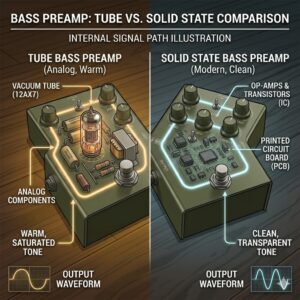
The World of Bass Guitar Active Preamp Systems
You might have heard the term active bass preamp thrown around in guitar shops. This can refer to two different things, and it is important to know the difference!
-
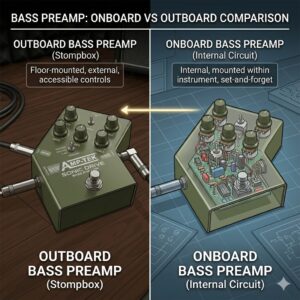
Outboard Preamp Pedals: These are the boxes I listed above. You plug your bass into them via a standard cable.
-
Onboard Active Preamps: These are electronics built directly into your bass guitar. If your bass has a battery compartment, it likely has an active preamp inside.
An active bass preamp inside your instrument allows for “boost and cut” EQ. A passive bass (like a standard Fender Precision) can only cut frequencies. With an active system, you can actually pump more bass or treble directly from your guitar’s knobs.
Why go Active?
-
Low Signal Loss: Active signals can travel through long cables without losing high-end “sparkle.”
-
Tone Versatility: You can change your sound on the fly between songs without walking back to your amp.
-
Consistency: Active basses tend to sound more consistent across different amplifiers.
Feature Comparison: Onboard vs. Outboard
| Benefit | Onboard Active System | Outboard Preamp Pedal |
| Ease of Use | Knobs are right on the bass | Requires a pedalboard/cables |
| Tone Power | Moderate EQ control | High EQ + Drive + DI |
| Reliability | Depends on battery life | Professional Power Supply |
| Cost | Usually cheaper to install | Can be an investment |
Looking for a Bass Preamp for Sale? A Buying Guide
If you are scouring the internet for a bass preamp for sale, it is easy to get overwhelmed by the options. I suggest you ask yourself three questions before hitting the “buy” button.
1. What is your primary genre?
If you play jazz or wedding gigs, you probably don’t need the aggressive distortion of a Darkglass. You would be much better off with an MXR M81 or a Fishman Platinum Pro. However, if you are in a metal band, a drive circuit is almost mandatory.
2. Do you need a DI output?
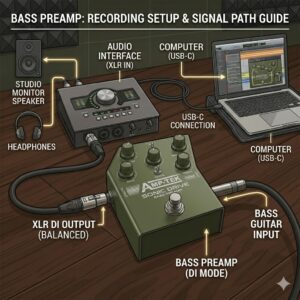
Most modern preamp pedals have an XLR DI out, but some smaller “mini” preamps don’t. If you plan on recording at home or playing live without an amp, the XLR output is non-negotiable.
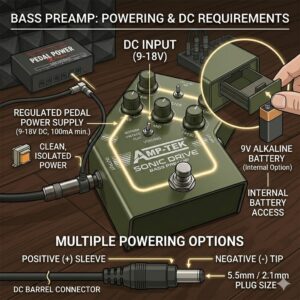
3. What is your power situation?
Some preamps, like the Aguilar Tone Hammer, run on 18V for better headroom. This means you need two 9V batteries or a specific power supply. Make sure your current pedalboard power brick can handle the requirements of the pedal you choose.
Budget vs. Premium: What do you get for your money?
| Price Tier | Features | Expectation |
| Budget ($50 – $120) | Basic EQ, Plastic/Light Metal | Decent for practice, might be noisy |
| Mid-Range ($130 – $250) | Pro DI, Solid EQ, Drive | Industry standard, tour-ready |
| Premium ($300 – $600+) | IR Cab Sims, Multiple Channels | Studio-grade components, maximum control |
Technical Deep Dive: EQ and Frequencies
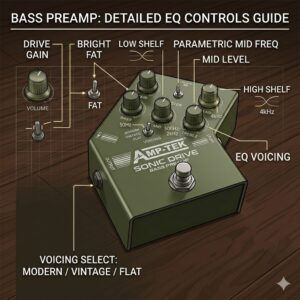
To truly master your bass guitar preamp, you need to understand the frequencies you are moving. Most preamps focus on three or four bands:
-
Bass (40Hz – 80Hz): This is the “feel” in your chest. Too much makes the sound “muddy”; too little makes it “thin.”
-
Low-Mids (250Hz – 500Hz): This is where the “body” of the bass lives. This helps you be heard in a dense mix.
-
High-Mids (800Hz – 2kHz): This is where finger noise and “attack” live. Boosting this helps with clarity.
-
Treble (3kHz – 8kHz): This provides the “snap” and “sizzle.” Great for slap bass, but too much can sound harsh.
Benefit Quantification: Adding a Preamp to Your Rig
| Metric | Without Preamp | With High-Quality Preamp |
| Signal Strength | Variable/Weak | Consistent/Strong |
| Mix Presence | Often buried | Easily Adjustable |
| Recording Quality | Requires post-processing | “Radio Ready” out of the box |
| Gig Setup Time | 15-20 mins (Miking Amp) | 2 mins (XLR to Board) |
✨ Step Up Your Sound Today!
Ready to transform your live and studio tone? Check out these top-rated bass preamps and find the one that fits your style. Click any of the product links above to see the latest deals and customer reviews on Amazon. Your perfect tone is just one click away! 🎸🔥
Conclusion: Final Thoughts on Your Bass Tone
Finding the perfect bass guitar preamp is a journey, not a destination. I have spent years swapping pedals, and I can tell you that the right one will not only make you sound better but will also make you want to play more. Whether you want the vintage grit of the SansAmp, the modern precision of Darkglass, or the pure transparency of the MXR, there is a tool out there that matches your musical voice.
Specifically, remember that the preamp is the bridge between your fingers and the audience’s ears. Investing in a high-quality unit is the single best thing you can do to professionalize your setup in 2026. Don’t be afraid to experiment with different settings, sweep those mid-frequencies, and find the “sweet spot” that makes your bass sing!
Frequently Asked Questions
✅ While your amp has a built-in preamp, a dedicated pedal offers a consistent DI signal for the sound engineer. This ensures your front-of-house tone remains identical even if you use different backline amps at various venues...
✅ Absolutely. Most modern preamps act as a high-quality analog front-end. By plugging the XLR or 1/4 inch output into your audio interface, you get a much warmer and more professional sound than plugging into the interface directly...
✅ An active preamp uses a power source (battery or DC) to boost signals and provide more EQ control. Passive systems can only cut frequencies and generally have a weaker output, making them more susceptible to signal loss over long cables...
✅ For beginners or home practice, budget preamps are fine. However, professional units offer better shielding, lower noise floors, and more reliable XLR outputs. If you plan on gigging regularly, investing in a mid-range unit is highly recommended...
✅ A cabinet simulator mimics the frequency response of a real speaker cabinet. Without it, a distorted bass signal can sound harsh and 'fizzy' when sent directly to a PA system. Cab sims add warmth and realistic air... ❓ Do I really need a bass guitar preamp if I already have a good amplifier?
❓ Can I use an electric bass preamp for recording directly into my computer?
❓ What is the difference between a bass guitar active preamp and a passive one?
❓ Is it worth buying a cheap bass preamp for sale under $100?
❓ How does a cab sim feature on a preamp pedal affect my sound?
Recommended for You:
- Best Pickups for Acoustic Guitars: 7 Top Picks for Studio Sound (2026)
- 7 Best Soundhole Pickup Options for 2026: Expert Guitarist Review
- 7 Best Acoustic Bass Pickup Systems for Thumping Tone in 2026
Disclaimer: This article contains affiliate links. If you purchase products through these links, we may earn a small commission at no additional cost to you.
✨ Found this helpful? Share it with your friends! 💬🤗