
If you have ever spent two hours hugging a massive dreadnought guitar during a live set, you know the struggle. Your shoulder aches, your ribs feel bruised, and you probably look like you are wrestling a small piece of furniture. That is where the thinline acoustic guitar steps in to save the day. I have spent years playing different styles, and I can tell you that switching to a slimmer body is a game-changer for stage comfort.
✨Was this helpful? Spread the word! 🚀
These instruments offer the look and feel of an electric guitar but keep that woody, organic soul we love about acoustics. Whether you are a small-framed player, a gigging professional, or someone who just hates bulky gear, the thinline acoustic guitar is likely the answer to your prayers. In this guide, I will break down why these slim beauties are taking over the market in 2026.
Quick Comparison: Thinline vs. Traditional Acoustic
Before we dive into the nitty-gritty, let’s look at how a thinline acoustic guitar stacks up against a standard acoustic.
| Feature | Thinline Acoustic Guitar | Traditional Acoustic (Dreadnought) |
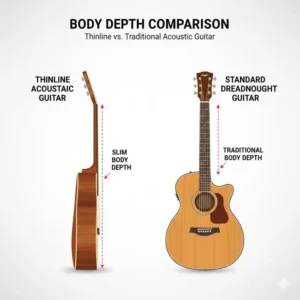
| Body Depth | 2.5–3 inches | 4.5–5 inches |
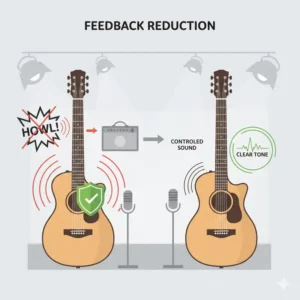
| Feedback Resistance | High (Great for loud stages) | Low (Prone to howling) |
| Acoustic Volume | Moderate (Quiet unplugged) | High (Loud and boisterous) |
| Playability | Easy (Feels like an electric) | Demanding (Bulky) |
| Best For | Stage, Recording, Small Players | Bluegrass, Campfires, Unplugged |
Top 7 Thinline Acoustic Guitar Models: Expert Analysis
I have scoured the market to find the best options available right now. These are not just random picks; these are real, high-performance instruments used by professionals.
1. Yamaha APX600 Thinline Acoustic-Electric Guitar
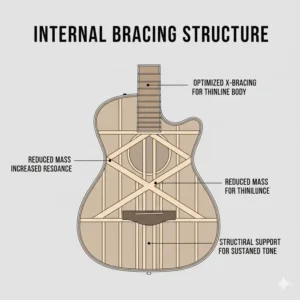
The Yamaha APX600 is essentially the poster child for the thin line acoustic guitar category. It features a spruce top and a unique non-scalloped X-type bracing that maximizes body resonance.
-
Technical Specifications:
-
Body Depth: 80–90mm (approx. 3.15–3.5 inches).
-
Scale Length: 25 inches.
-
Top Material: Spruce.
-
Electronics: System 65A Preamp with Piezo Pickup and Built-in Tuner.
-
Nut Width: 43mm.
-
-
Customer Review Analysis: Users consistently praise the Yamaha APX600 for its “slender neck” and “unbeatable price-to-performance ratio.” Some note that the unplugged sound is a bit thin, but plugged in, it sounds like a much larger guitar.
-
Warranty Information: Yamaha typically offers a limited lifetime warranty on the top, neck, back, and sides, with one year for electronics.
-
Professional Applications: Ideal for rhythm guitarists in a pop or country band who need to move around on stage.
-
Pros:
-
Extremely comfortable for long sets.
-
Great feedback rejection.
-
Very affordable.
-
-
Cons:
-
Lacks deep bass when not plugged in.
-
Plastic nut and saddle.
-
2. Fender Highway Series Parlor Thinline Acoustic
Fender took a bold step with the Fender Highway Series Parlor. This is a shallow body acoustic guitar that looks more like a Telecaster’s cousin than a traditional parlor guitar.
-
Technical Specifications:
-
Body Depth: 2.25 inches.
-
Top Material: Solid Sitka Spruce.
-
Body Material: Chambered Mahogany.
-
Electronics: Fishman Fluence Acoustic Pickup.
-
Scale Length: 24.75 inches.
-
-
Customer Review Analysis: Reviewers love the “organic feel” of the Fishman Fluence pickup. One player mentioned, “It doesn’t sound like a piezo; it sounds like a mic’d guitar.”
-
Warranty Information: Fender provides a 2-year limited warranty for the original purchaser.
-
Professional Applications: Perfect for singer-songwriters who want a modern, sleek aesthetic on stage.
-
Pros:
-
Solid wood construction.
-
Revolutionary pickup system.
-
Includes a high-quality gig bag.
-
-
Cons:
-
Expensive compared to entry-level models.
-
Requires a battery for the active electronics.
-
3. Ibanez GA35TCE Thinline Nylon String
If you want the “classical” vibe without the “classical” bulk, the Ibanez GA35TCE is a fantastic acoustic guitar thinline option with nylon strings.
-
Technical Specifications:
-
Body Style: Thinline Cutaway Classical.
-
Top: Spruce.
-
Electronics: Ibanez AEQ210T preamp with onboard tuner.
-
Output: Balanced XLR and 1/4-inch jacks.
-
Neck: 14th fret joint (unusual for classical guitars).
-
-
Customer Review Analysis: Many players appreciate the narrow nut width, which makes it easier for steel-string players to transition to nylon. Some users noted they had to adjust the truss rod out of the box.
-
Warranty Information: Ibanez offers a 1-year limited warranty.
-
Professional Applications: Great for wedding gigs or Latin jazz where a “plug and play” nylon sound is needed.
-
Pros:
-
Dual outputs (XLR and 1/4-inch).
-
Beautiful mosaic rosette.
-
Very slim neck.
-
-
Cons:
-
String tension can feel high for beginners.
-
Acoustically quiet.
-
4. Cordoba Stage Guitar
The Cordoba Stage Guitar is a premium thinline electro acoustic guitar designed specifically for—you guessed it—the stage. It is a chambered-body masterpiece.
-
Technical Specifications:
-
Body Depth: 1.5 inches (ultra-thin).
-
Top Material: Solid Spruce with Flame Maple Veneer.
-
Electronics: Fishman Stage Pickup System.
-
Nut Width: 48mm.
-
Finish: Gloss Polyurethane.
-
-
Customer Review Analysis: Pro players call this the “best-looking stage guitar on the market.” The lack of a soundhole almost entirely eliminates feedback.
-
Warranty Information: Cordoba offers a 3-year limited warranty if registered.
-
Professional Applications: Touring musicians playing in high-volume environments.
-
Pros:
-
Stunning flame maple top.
-
Virtually feedback-proof.
-
High-end Fishman electronics.
-
-
Cons:
-
Zero acoustic projection (requires an amp).
-
Wider nut might be tough for small hands.
-
5. Godin Multiac Nylon Encore
Godin is famous for their hybrid designs. The Godin Multiac Nylon Encore is a top-tier thinline acoustic guitar that bridges the gap between electric playability and classical tone.
-
Technical Specifications:
-
Body: Two-chambered Silver Leaf Maple.
-
Top: Solid Cedar.
-
Electronics: Custom EPM Dual Source System (under-saddle piezo and acoustic soundboard transducers).
-
Scale: 25.5 inches.
-
-
Customer Review Analysis: Enthusiasts love the “infinite tonal possibilities” provided by the dual-source electronics. It is often cited as the gold standard for stage nylon guitars.
-
Warranty Information: Godin offers a 1-year warranty on electronics and a limited lifetime warranty on the woodwork.
-
Professional Applications: Jazz fusion, world music, and professional studio recording.
-
Pros:
-
Exceptional build quality (Made in Canada).
-
Detailed EQ sliders.
-
Extremely comfortable neck.
-
-
Cons:
-
High price point.
-
Unique look isn’t for everyone.
-
6. Taylor T5z Classic
The Taylor T5z Classic isn’t just a slim body acoustic guitar; it’s a hybrid monster. It can go from a shimmering acoustic tone to a screaming electric lead with the flick of a switch.
-
Technical Specifications:
-
Body: Sapele.
-
Top: Tropical Mahogany.
-
Electronics: Five-way switching with an acoustic body sensor and two humbuckers.
-
Fretboard: Ebony.
-
Nut Width: 1.68 inches.
-
-
Customer Review Analysis: Users are blown away by the versatility. One reviewer said, “I can leave my Strat and my Martin at home; the T5z does it all.”
-
Warranty Information: Taylor provides a standard 2-year warranty, extendable to 12 years upon registration.
-
Professional Applications: Function band guitarists who need to cover many genres in one night.
-
Pros:
-
Ultimate versatility.
-
Taylor’s legendary playability.
-
Exquisite mahogany finish.
-
-
Cons:
-
Very expensive.
-
Acoustic tone is “processed” compared to a real hollow body.
-
7. Epiphone SST Coupe
For those looking for a budget-friendly chambered nylon string, the Epiphone SST Coupe is a solid entry-level thinline acoustic guitar choice.
-
Technical Specifications:
-
Body: Chambered Mahogany.
-
Top: Laminated Spruce.
-
Electronics: Shadow Panorama System with headphone out.
-
Scale: 25.5 inches.
-
Neck Shape: 1960s SlimTaper D.
-
-
Customer Review Analysis: Beginners find the headphone output incredibly useful for silent practice. Experienced players use it as a “travel couch guitar.”
-
Warranty Information: Epiphone Limited Lifetime Warranty.
-
Professional Applications: Practicing on the road or low-budget stage performances.
-
Pros:
-
Unique headphone jack feature.
-
Very lightweight.
-
Attractive price.
-
-
Cons:
-
Laminated top lacks richness.
-
Tuners feel a bit cheap.
-
🔍 Find Your Perfect Match!
✨ Don’t Miss These Exclusive Deals! 🔍 Are you tired of your guitar feeling like a bulky suitcase? It’s time to upgrade. Check out the NAMM Foundation for more information on the benefits of music education and choosing the right gear. Then, click on our recommended products to see the latest prices on Amazon. Your back will thank you! 🎸✨
💬 Just one click – help others make better buying decisions too!😊
🔍 Technical Specifications Matrix
| Model | Top Wood | Electronics | Best Use |
| Yamaha APX600 | Spruce | System 65A | General Stage |
| Fender Highway | Solid Spruce | Fishman Fluence | Modern Folk |
| Ibanez GA35TCE | Spruce | AEQ210T | Entry Nylon |
| Cordoba Stage | Solid Spruce | Fishman Stage | Pro Nylon |
| Godin Multiac | Solid Cedar | Dual Source | Jazz Fusion |
| Taylor T5z | Mahogany | 5-way Hybrid | Everything |
| Epiphone SST | Laminated Spruce | Shadow | Practice/Travel |
💰 Budget vs. Premium Comparison
| Category | Typical Models | Price Range | Target Audience |
| Budget | Yamaha APX, Ibanez GA | Under $400 | Beginners/Casuals |
| Mid-Range | Fender Highway, Epiphone SST | $600–$1,000 | Serious Hobbyists |
| Premium | Taylor T5z, Godin Multiac | Over $1,500 | Professional Touring |
Why Choose a Thinline Acoustic Guitar?
You might be wondering, “Why would I want a guitar that is less loud?” It is a fair question. Traditionally, acoustic guitars were designed to be loud enough to compete with banjos and fiddles in a room. But we live in 2026. We have microphones. We have PA systems.
The thinline acoustic guitar solves several modern problems:
1. Ergonomics and Comfort 🧘♂️
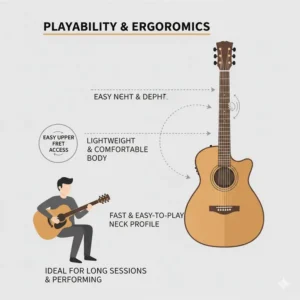
A standard dreadnought is about 5 inches deep. For many people, especially those with shorter arms or back issues, reaching over that “box” is uncomfortable. A thinline acoustic guitar usually cuts that depth in half. This allows your picking arm to sit in a more natural position, similar to how you would hold a Fender Stratocaster.
2. Feedback Reduction 🔇
Have you ever heard that terrible screeching sound when an acoustic guitar gets too close to a speaker? That is feedback. It happens because the large, hollow body of a standard acoustic acts like a giant microphone, catching the sound from the speakers and vibrating the top. Because a thin line acoustic guitar has less internal air space and a stiffer body, it is much less likely to howl at high volumes.
3. Portability ✈️
Let’s be honest: lugging a full-sized hard case through an airport is a nightmare. A slim body acoustic guitar often fits into “electric guitar” sized gig bags, making it much easier to fit in overhead bins or the trunk of a small car.
4. Playability for Electric Players 🎸
If you are used to the fast, low action of an electric guitar, a chunky acoustic can feel like playing a piece of 2×4 lumber. Most thinline acoustic guitar models feature slimmer necks and lower string tension, making it easy to pull off blues bends or fast lead lines that would be impossible on a traditional guitar.
Features and Benefits Matrix
| Feature | Benefit | Who Needs It? |
| Slim Body | Reduced fatigue and pain | Small players & long giggers |
| Cutaway Design | Access to high frets | Lead guitarists |
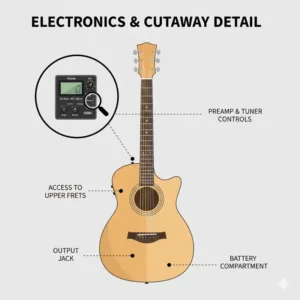
| Built-in EQ | Total control over your tone | Stage performers |
| X-Bracing | Structural strength + resonance | Everyone |
| Balanced Outputs | Professional noise-free signal | Studio musicians |
The Evolution of the Shallow Body Acoustic Guitar
The history of the thinline acoustic guitar is actually quite fascinating. It started in the late 1960s and early 70s when brands like Ovation introduced the “roundback” design. They realized that if people were going to play through an amp anyway, the acoustic volume didn’t matter as much as the comfort.
In the 1980s, Yamaha launched the APX series, which really defined the modern thin line acoustic guitar. It wasn’t just a “thin acoustic”; it was an instrument designed from the ground up to be plugged in. They changed the soundhole shape and the bracing to make sure it sounded great through a PA system.
Today, in 2026, we see even more innovation. Brands are using carbon fiber, chambered solid woods, and sophisticated digital modeling to make a thinline electro acoustic guitar sound like a vintage 1940s Martin. It is a great time to be a guitar player!
How to Choose the Right Thinline Acoustic Guitar for You
Buying a guitar is a personal journey. You shouldn’t just buy the most expensive one; you should buy the one that fits your needs. Here is a breakdown of what to look for.
Consider Your Style
-
Strummers: Look for a thinline acoustic guitar with a spruce top like the Yamaha APX600. Spruce provides the “snap” and clarity needed for chords.
-
Fingerstyle Players: You might prefer a cedar top or a mahogany top. The Taylor T5z Classic with its mahogany top offers a warmer, more intimate sound.
-
Classical/Flamenco: You definitely want a thinline nylon string like the Cordoba Stage Guitar.
Tone Wood Comparison
| Wood Type | Tone Profile | Best For |
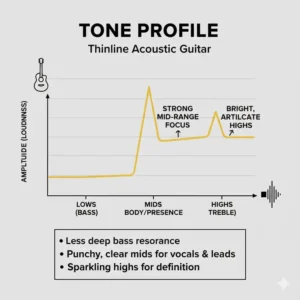
| Spruce | Bright, Punchy, Versatile | Everything |
| Mahogany | Warm, Mid-range focused | Blues/Folk |
| Cedar | Dark, Lush, Responsive | Classical |
| Maple | Very bright, Clear | High-volume bands |
Scale Length and Nut Width
Don’t overlook the technical bits! A shorter scale length (around 24 inches) means the strings are under less tension and are easier to press down. A wider nut width (like on the Godin Multiac) is better for fingerpicking because it gives your fingers more room, but a narrower nut (like on the Fender Highway) feels more like an electric guitar.

Common Misconceptions About Thinline Acoustic Guitars
I hear a lot of “old school” players talk down about the thin line acoustic guitar. Let’s clear up some of the myths.
Myth #1: They sound “thin” and “tinny.”
-
The Reality: Unplugged? Yes, they aren’t as loud. But through a high-quality preamp or a dedicated acoustic amp, a thinline acoustic guitar can sound massive. It’s all about the electronics.
Myth #2: They are only for beginners.
-
The Reality: Tell that to professional touring musicians! Many pros prefer a shallow body acoustic guitar because it is reliable and consistent night after night.
Myth #3: You can’t play them unplugged.
-
The Reality: You can! They are perfect for “couch practice.” You can hear yourself clearly without bothering the neighbors or the person in the next room.
User Compatibility Matrix
| Player Type | Recommended Thinline Acoustic Guitar | Why? |
| The Student | Ibanez GA35TCE | Affordable and easy on the fingers. |
| The Weekend Warrior | Yamaha APX600 | Reliable, great tuner, looks cool. |
| The Pro Performer | Cordoba Stage | High-end sound and no feedback. |
| The Gear Junkie | Taylor T5z Classic | So many knobs and switches! |
| The Traveler | Epiphone SST Coupe | Small, light, and headphone-ready. |
Maintenance Tips for Your Thinline Acoustic Guitar
Just because it is thinner doesn’t mean it doesn’t need love. In fact, thinline guitars can be more sensitive to humidity because they often use thinner pieces of wood to maximize resonance in a small space.
-
Keep it Humidified: Use a guitar humidifier in the case, especially during winter. You want to keep it between 45% and 55% humidity.
-
Wipe the Strings: After a sweaty gig, wipe down your thinline acoustic guitar strings. This prevents corrosion and keeps your tone bright.
-
Check the Battery: Most thinline electro acoustic guitar models use a 9V battery. Always keep a spare in your gig bag. Nothing kills a vibe like your guitar dying mid-solo.
-
Lube the Nut: If you are having tuning issues, a little bit of graphite in the nut slots goes a long way.
🎸 Ready to make the switch?
✨ Don’t Miss These Exclusive Deals! 🔍 Ready to find your soulmate in a guitar? Click on any of the highlighted products above to check current pricing on Amazon. Whether you want the budget-friendly Yamaha APX600 or the pro-level Taylor T5z, these links will take you straight to the best deals. These instruments will help you create a sound you love without the physical strain. Shop now and start playing in comfort! 🎸✨
Conclusion: Is the Thinline Acoustic Guitar Right for You?
At the end of the day, the thinline acoustic guitar is all about balance. It balances acoustic tone with electric comfort. It balances stage volume with feedback control. If you are a bedroom player who only cares about the deepest, woodiest unplugged sound, you might want to stick to a jumbo or a dreadnought.
However, if you are a modern musician who values comfort, versatility, and stage-ready performance, the thin line acoustic guitar is an incredible tool. From the budget-friendly Yamaha APX600 to the engineering marvel that is the Taylor T5z, there is a slim guitar out there for everyone.
I have found that since switching to a shallow body acoustic guitar, I practice more often because it is so easy to just grab off the stand. It feels less like a chore and more like an extension of my body. If you are on the fence, I highly encourage you to try one out. Your shoulders, your sound guy, and your music will thank you.
FAQs
✅ Yes, most thinline acoustic guitar models are perfectly loud enough for solo practice in a living room. While they lack the booming projection of a dreadnought, they provide a clear, balanced tone that allows you to hear your technique clearly without annoying neighbors...
✅ You can, but it is not recommended for most models. A thinline acoustic guitar is still designed for the tension of bronze strings. Using electric strings may result in a very weak output from the piezo pickup and might require a significant truss rod adjustment...
✅ These terms are often used interchangeably. However, a shallow body acoustic guitar usually refers to a traditional acoustic with a reduced depth, while a thinline often implies a more specialized design, like the Yamaha APX series, with modern electronics and cutaways...
✅ No, quite the opposite. The primary benefit of a thinline acoustic guitar is its resistance to feedback. Because the body has less internal volume, it doesn't vibrate as much in response to loud stage monitors, making it ideal for high-volume performances...
✅ Absolutely. Many beginners find the slim body of a thinline acoustic guitar much easier to hold. The smaller dimensions allow the player to see the fretboard better and prevent the arm fatigue that often discourages new players from practicing consistently... ❓ Is a thinline acoustic guitar loud enough for home practice?
❓ Can I use electric guitar strings on a thinline acoustic?
❓ What is the main difference between a shallow body acoustic and a thinline?
❓ Do thinline acoustic guitars feedback easily?
❓ Is a thinline acoustic guitar good for beginners?
Recommended for You
- Thin Body Acoustic Guitar – 7 Best Models Reviewed 2025
- Best Yamaha Acoustic Guitar: 7 Top Picks You’ll Love
- Taylor Electric Guitar: 7 Best Hybrid Models 2025 Guide
Disclaimer: This article contains affiliate links. If you purchase products through these links, we may earn a small commission at no additional cost to you.
✨ Found this helpful? Share it with your friends! 💬🤗