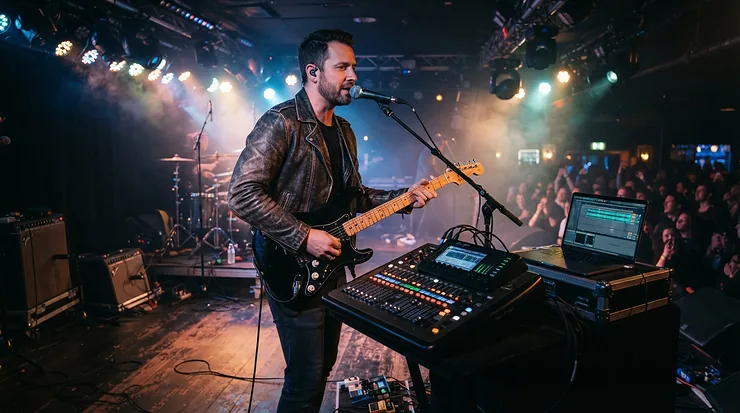
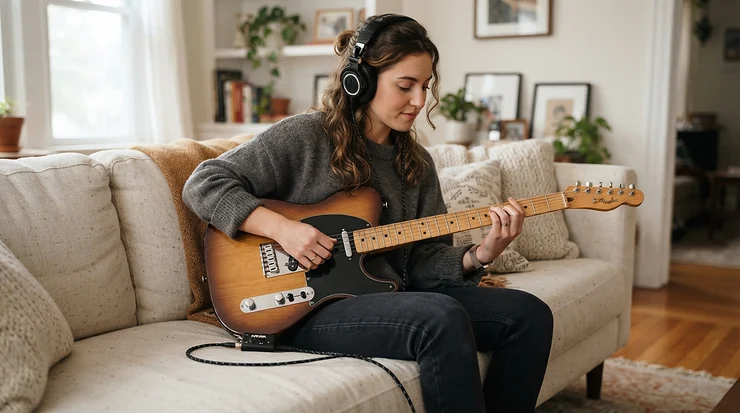
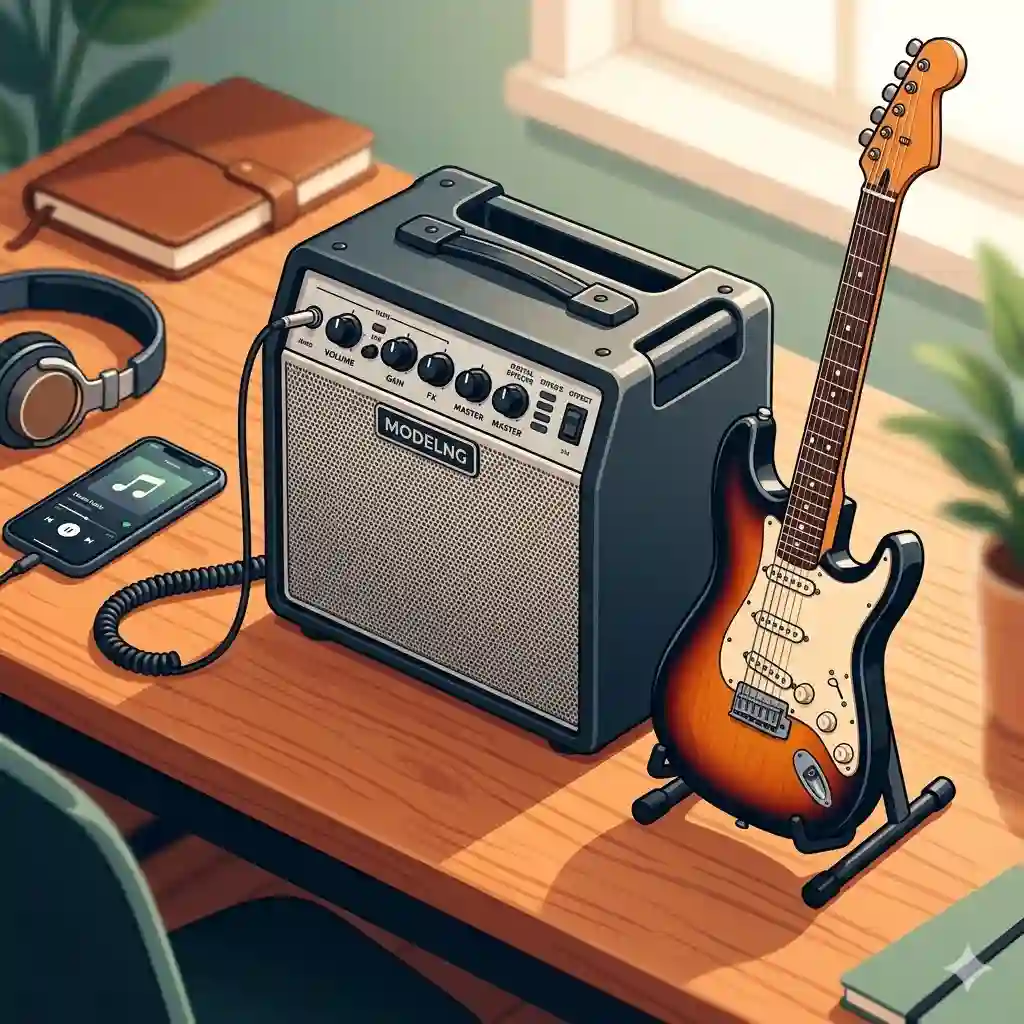
A player in an apartment with thin walls, a guitar on a stand and an hour free after dinner needs three things from modeling guitar amps: a quiet mode that still sounds like an amp, a headphone jack that works, and a USB port for recording. Six combos cover that ground in 2027, from the Fender Mustang LT25 at between $150 and $180 to the battery-powered Yamaha THR30II Wireless at between $540 and $600.
Guitar World’s 2026 roundup of the best guitar amps gives its budget slot to the Boss Katana-50 Gen 3, its practice slot to the Positive Grid Spark 2 and its beginner slot to the Fender Mustang LT25. This guide adds the Line 6 Catalyst CX 60, the Yamaha THR30II Wireless and the Blackstar ID:Core V4 Stereo 40, then sorts all six by what they do when the room is small, the budget is fixed and the phone app is optional.
The comparisons rest on published reviews from Guitar World, MusicRadar, Sound On Sound, Premier Guitar and SoundGuys, on owner ratings at Sweetwater and Thomann, and on one Line 6 forum thread; no unit was played for this guide.
What makes the best guitar modeling amp for home use
Three practical questions separate these amps long before tone enters the argument: how low the volume can go while the amp still behaves like an amp, how the speaker handles low notes, and which features arrive only after another purchase.
Quiet modes that keep the amp working
Volume is where a bedroom amp earns its keep. The Boss Katana-50 Gen 3 has a Power Control switch with standby, 0.5 watt, half and max positions. The Line 6 Catalyst CX 60 has a rear attenuator that steps from full to half, 1 watt and mute, and the Blackstar ID:Core V4 Stereo 40 drops to about 1 watt from a front-panel button, all per Guitar World. The reviews opened for the Fender Mustang LT25 and the Positive Grid Spark 2 mention no attenuator, so those two rely on the master volume and the headphone jack.
SoundGuys calls the LT25’s 25 watts plenty for a practice amp, which puts the wattage race in perspective. A bedroom rarely needs more than a few watts, and the attenuator matters more than the number printed on the grille.
Speaker size and the low-note problem
Driver size sets how much air an amp can move. The Boss Katana-50 Gen 3 and the Line 6 Catalyst CX 60 each carry one 12-inch speaker, the Fender Mustang LT25 has one 8-inch, the Blackstar ID:Core V4 Stereo 40 two 6.5-inch drivers, the Positive Grid Spark 2 two 4-inch drivers and the Yamaha THR30II Wireless two 3.5-inch drivers. Reviewers keep returning to the small end of that list: Guitar World says the small speakers on the Blackstar ID:Core V4 Stereo 40 limit its bass, and a Thomann reviewer calls the speaker on the Fender Mustang LT25 bassy and weak.
Apps, Bluetooth and extras sold apart
USB audio is present on all six. Bluetooth is built into the Positive Grid Spark 2 and the Yamaha THR30II Wireless, is an optional adapter on the Boss Katana-50 Gen 3, and is not mentioned in the reviews opened for the Line 6 Catalyst CX 60 and the Blackstar ID:Core V4 Stereo 40; the Fender Mustang LT25 has none, according to SoundGuys. Footswitches, transmitters, batteries and adapters each sit outside the price range quoted for the amp, a point the entries below return to.
Modeling guitar amps compared at a glance
Model
Output and speakers
Quiet-practice route
USB audio
Bluetooth
Dealer price range
Boss Katana-50 Gen 3
50 W, one 12 in
Power Control down to 0.5 W; stereo headphone jack
USB-C
Optional adapter
$300 to $350
Positive Grid Spark 2
50 W, two 4 in
Headphone output
USB-C, works as an interface
Built in
Just under $300
Line 6 Catalyst CX 60
60 W, one 12 in
Attenuator down to 1 W; 1/4 in headphone out
Yes
Not mentioned
$250 to $330
Yamaha THR30II Wireless
30 W (about 15 W on battery), two 3.5 in
Compact small-room amp
Yes
Built in
$540 to $600
Blackstar ID:Core V4 Stereo 40
2 x 20 W, two 6.5 in
1 W button; headphone and CabRig output
USB-C, four-channel
Not mentioned
$230 to $260
Fender Mustang LT25
25 W, one 8 in
Headphone jack mutes the speaker
Micro-USB
None
$150 to $180
Weight and price split the group more than wattage does. The Boss Katana-50 Gen 3 weighs 11.6 kg, roughly double the 5.5 kg of the Positive Grid Spark 2 (my arithmetic), and the Yamaha THR30II Wireless costs about three to four times as much as the Fender Mustang LT25 at the ends of their dealer ranges (my arithmetic). Guitar World lists the Line 6 Catalyst CX 60 at 18.9 kg, which conflicts with the 11.8 kg that Sound On Sound gives for the original Catalyst 60, so the Catalyst line is left out of the weight comparison.
Best modeling guitar amps 2027: six combos for six rooms
Each entry starts from a situation and works toward the amp. Prices are dealer ranges from the pages cited, so check the current price on Amazon.com before deciding.
Late-evening practice is where this amp has built its reputation. Guitar World’s review describes the Power Control switch, and Sweetwater reviewers say it delivers big tone at low volume, which suits bedrooms and small spaces. The rest of the layout is familiar from earlier Katanas: one 12-inch speaker, 50 watts, six voices (acoustic, clean, pushed, crunch, lead and brown), five effect sections, a stereo headphone jack and USB-C.
MusicRadar’s reviewer singled out the new Pushed voice, an edge-of-breakup clean that works especially well with single-coil guitars, and found the overall tone clearer and more detailed than the previous generation. Deeper edits go through the Tone Studio software, and Bluetooth needs an optional adapter that both MusicRadar and Guitar World criticize as an extra cost; their UK reviews price it between £45 and £49.
Owner ratings are good but not spotless. Sweetwater shows 4.4 out of 5 across 31 reviews, with 65 percent at five stars. One buyer there returned the amp after a month over crackles and weak handling of gain and low notes, while another reports hiss and hum at higher gain that the Tone Studio noise suppressor reduced. Expect between $300 and $350 for the amp alone, based on the retailers Guitar World lists.
Boss Katana-50 Gen 3See current price, sizes and reviews on Amazon.
Nearly every setting beyond volume lives in a phone app, which is both the appeal and the risk of this amp. Guitar World lists a 50-watt Class D design with two angled 4-inch drivers, 33 amp models, 43 effects, a 60-second looper and Bluetooth for streaming backing tracks. Premier Guitar adds that it doubles as a USB audio interface, that an optional rechargeable battery is rated at about 12 hours at half volume, and that the price sits under $300. The amp weighs 5.5 kg.
Owners are enthusiastic. Thomann shows 4.7 out of 5 from 375 ratings, and its reviewers describe the app as stable and the build as premium. One reviewer there says the amp held its own against a 16-piece Latin jazz orchestra, a single account but a useful hint about volume, and another says its bass tones are clear and powerful. The sources disagree on the speakers: Premier Guitar calls them full-range and flat-response, while a Thomann reviewer says the amp can’t stand in as a flat-response speaker for non-guitar sources.
Pros:
Built-in looper and Bluetooth, per Guitar World
Works as a USB audio interface, per Premier Guitar
Optional battery for playing away from an outlet
Cons:
Guitar World found the AI tone generator inconsistent and freeform looping awkward without a footswitch
A Thomann reviewer says the wireless footswitch needs a button press on the amp to reconnect each time
Patch changes from that footswitch take about half a second, one Thomann reviewer reports
Positive Grid Spark 2See current price, sizes and reviews on Amazon.
The front panel reads like a traditional combo, with one knob per job, but the 24 effects behind it come from Line 6’s Helix technology. Guitar World lists 60 watts through one 12-inch speaker, twelve amp voicings in six categories with a boost for each, and the four-position attenuator. Connections include a 1/4-inch headphone output, USB audio, an XLR line out with ground lift, MIDI and an effects loop. The reviewer praised the sounds enthusiastically and flagged two weak spots: no display screen, which makes deep edits harder, and a footswitch that costs extra.
Sound On Sound’s review covers the original Catalyst 60 with six amp designs rather than the CX’s twelve, and zZounds now lists that version as no longer available, so check that a listing says CX 60. The review still explains the family’s strengths: simple controls, a touch-sensitive response and effects modeled on classics such as the Echoplex, Uni-Vibe and Leslie.
Owner reports add caution. Sweetwater shows 4.6 from only 14 reviews for this amp, and one reviewer there says the corner protectors came off easily while another needed MIDI to switch banks from a footswitch. A thread on Line 6’s forum describes a used original Catalyst 60 whose USB and headphone sound turned over-saturated, and the thread shows no confirmed cause. Dealers list this amp between $250 and $330.
Line 6 Catalyst CX 60See current price, sizes and reviews on Amazon.
At between $540 and $600 this is the priciest amp in the group, and the smallest. Guitar World’s review lists 30 watts (2 x 15 watts) through two 3.5-inch drivers, about 15 watts on battery, and 4.3 kg in a 420 x 195 x 155 mm case that sits on a bookshelf or desk. It carries 15 guitar amp models on a top-panel switch, plus acoustic, bass and flat voicings, and a rechargeable battery rated at about five hours at medium volume.
The “wireless” name needs a footnote. The built-in receiver pairs with a Line 6 transmitter that Guitar World says costs about $100 and is sold separately. Bluetooth handles backing tracks and the THR Remote app, and two 1/4-inch line outs help with recording.
Thomann shows 4.7 out of 5 from 172 ratings for the wireless model, yet the main complaint there is reliability. One reviewer found streaming and the guitar link inconsistent, sold the amp and bought a Positive Grid Spark 2; another could rarely connect the THR Remote app on two phones. Praise is aimed at low-volume sound, with one reviewer saying it works without disturbing housemates. One buyer returned it over underwhelming speakers, and another says low notes suffer on bass or baritone guitar.
Pros:
Rechargeable battery rated about five hours, per Guitar World
All 15 guitar amp models reachable from a top-panel switch
At 4.3 kg, the lightest amp in this group
Cons:
Transmitter sold separately, at around $100 per Guitar World
No effects loop, and not loud enough for gigging, per Guitar World
Thomann reviewers report unreliable Bluetooth and app connections
Yamaha THR30II WirelessSee current price, sizes and reviews on Amazon.
Two 20-watt channels feed two 6.5-inch speakers in this combo, which Guitar World lists at 6.2 kg with six programmable voices. A button drops the output to about 1 watt, a headphone and CabRig Lite speaker-simulated output serves quiet sessions, USB-C carries four channels for recording and the free Architect app handles deeper edits. The review also lists live-streaming support and an optional battery pack that gives roughly nine hours away from a wall socket.
Guitar World found limits in the details. Each patch must match its voice switch position, so storage is restrictive, the DC power cable has no retaining clip, and the small speakers restrain the bass. The reviewer also calls this amp’s output gain over the smaller models modest and says the V4 is an incremental update on the V3. Bluetooth is not mentioned for this model, and the footswitch is sold separately.
Street pricing runs between $230 and $260 in the Guitar World review. The reviewer sees the extra output as most useful for band practice and small, quiet gigs.
Blackstar ID:Core V4 Stereo 40See current price, sizes and reviews on Amazon.
Fender’s smallest modeling combo packs 25 watts, one 8-inch speaker, 20 amp models, 25 effects and 30 presets into a cabinet that SoundGuys weighs at 5.8 kg. Guitar World likes the large encoder for scrolling presets without menus, finds the delays and reverbs surprisingly good and hears tones ranging from Fender-style cleans and crunch to higher gain. A headphone jack mutes the speaker, there is an aux input and footswitch jack, and micro-USB handles recording and editing; the Fender Tone app connects only through a computer.
SoundGuys, whose reviewer bought the unit and tested it for eight days, adds practical complaints: 25 of the 30 presets come with reverb or delay switched on, the effects are weaker than standalone pedals, and no micro-USB cable is included. Thomann shows 4.6 out of 5 from 293 ratings, but three reviewers there call the micro-USB port outdated, one finds the speaker bassy and weak, another misses a dedicated mid knob, and one advises against recording with it, suggesting DAW plugins instead.
Pros:
Simple controls and a large preset encoder, per Guitar World
Headphone jack mutes the speaker, per SoundGuys
Lowest price in this group, between $150 and $180
Cons:
Micro-USB with no cable in the box
No Bluetooth
A Thomann reviewer found no way to download shared Fender Tone sounds for this model
Fender Mustang LT25See current price, sizes and reviews on Amazon.
Where these amps frustrate owners, and the cheap fixes
Extras add up. Bluetooth on the Boss Katana-50 Gen 3 needs an adapter that two UK reviews price at £45 to £49, the Yamaha THR30II Wireless needs a transmitter that Guitar World puts around $100, and the battery and wireless footswitch for the Positive Grid Spark 2 are separate purchases. Either the Katana with its adapter or the Yamaha with its transmitter lands well above the headline range, so total the cost before comparing.
Small speakers shape the low end. Two 3.5-inch drivers or one 8-inch driver move less air than a 12-inch, which fits what Thomann reviewers say about the Yamaha THR30II Wireless and the Fender Mustang LT25, although one Sweetwater reviewer still returned a Boss Katana-50 Gen 3 over weak low-end handling. The cheap fix is to use the headphone or speaker-simulated outputs for sound-critical sessions, which is what the CabRig Lite output on the Blackstar ID:Core V4 Stereo 40 and the cab-simulated USB out on the Boss Katana-50 Gen 3 are for.
Apps and connections generate the most friction. A Thomann reviewer of the Positive Grid Spark 2 dislikes the connection screen that appears at every launch, Thomann reviewers of the Yamaha THR30II Wireless describe app and Bluetooth drop-outs, and a Sweetwater reviewer of the Boss Katana-50 Gen 3 needed Sweetwater’s tech support to get the software working. Test the app on your own phone or computer inside the return window rather than after it.
One more caution comes from a single Sweetwater report. That reviewer damaged two units of the Katana line when a PC with a faulty power supply was connected over USB and recommends a ground loop isolator. It is one account, but an isolator is a low-cost precaution for any amp that shares a USB connection with a computer.
How to read modeling guitar amps reviews without being fooled
Star ratings on these amps come from stores with different audiences and very different sample sizes. The Positive Grid Spark 2 shows 4.7 from 375 ratings on Thomann, the Yamaha THR30II Wireless 4.7 from 172, the Fender Mustang LT25 4.6 from 293, the Boss Katana-50 Gen 3 4.4 from 31 on Sweetwater and the Line 6 Catalyst CX 60 4.6 from 14 on Sweetwater. A single return moves the small samples noticeably, so the 14-review score says less than the 375-rating score.
Version names matter more than they should. The Catalyst exists as an original 60 and a CX 60, the Spark line has a Spark 40 and a Spark 2, and the Katana has several generations. Sound On Sound reviewed the original Catalyst 60 and the first Spark, and its notes on a muffled stock speaker in the Spark 40 do not automatically carry over to the Positive Grid Spark 2, whose angled-horn drivers Guitar World describes separately.
Three habits help. Search the owner reviews for the words app, Bluetooth, crackle and bass, because those are where the complaints cluster. Weigh a return story above a five-star line that never mentions volume. And read expert reviews for what they flag as missing, since Guitar World and MusicRadar both criticized the paid Bluetooth on the Boss Katana-50 Gen 3 even while praising its sound.
Watts, headphones, apps and tubes: the straight answers
What is a modeling guitar amp?
A modeling amp uses digital processing to imitate several amplifier voices and effects inside one cabinet, usually with presets, a headphone jack and USB recording. A traditional tube amp is built around one analog circuit, so a modeler trades that simplicity for variety and low-volume options.
How many watts does the best guitar modeling amp for home use need?
Fewer than the label suggests. SoundGuys calls 25 watts plenty for practice, and several amps here step down to 0.5 or 1 watt. A 50-watt combo with a power-reduction switch covers bedrooms and small jams, while a 30-watt desktop amp suits small rooms.
Can modeling amps for guitar be used with headphones and for recording?
Yes. All six amps in this guide offer USB recording, and most add a headphone output or a speaker-simulated output. The cheapest model uses older micro-USB and ships without a cable, so check the port and the cable before buying.
Do modeling amps need a phone app to work?
Not to make sound, but deeper editing depends on software. Premier Guitar calls the app essential for one smart amp here, other makers use desktop editors, and one Fender model connects to its app only through a computer.
Is a modeling amp or a tube amp better for a beginner?
Guitar World names a modeling combo its best beginner pick and calls Blackstar's V4 range ideal first amps. Tube amps offer a different feel, but presets, headphone jacks and low-volume modes are the reasons reviewers recommend these combos to first-time players.
Which of the six to buy
Pick the room before the amp. A shared-wall apartment points to the Boss Katana-50 Gen 3 or the Line 6 Catalyst CX 60, since each pairs a 12-inch speaker with a power mode down to 0.5 or 1 watt. A player who wants a looper, backing tracks and an app should start with the Positive Grid Spark 2, the amp Guitar World names best for practice.
Streamers and desk players get stereo width and a 1-watt button from the Blackstar ID:Core V4 Stereo 40, and anyone on a tight budget can start with the Fender Mustang LT25. The Yamaha THR30II Wireless costs the most and asks for a separate transmitter to go cable-free, so it suits the player who values a battery and a tiny cabinet above the price. Among modeling guitar amps, the best match is the one whose quiet mode fits your walls. If one of these fits your room, take a closer look at its current Amazon.com listing and note the return window.
Disclaimer: This post contains affiliate links. As an Amazon Associate, I earn from qualifying purchases made through these links, at no additional cost to you.
Found a combo that suits your walls? Compare its current listing and keep an eye on the return window.