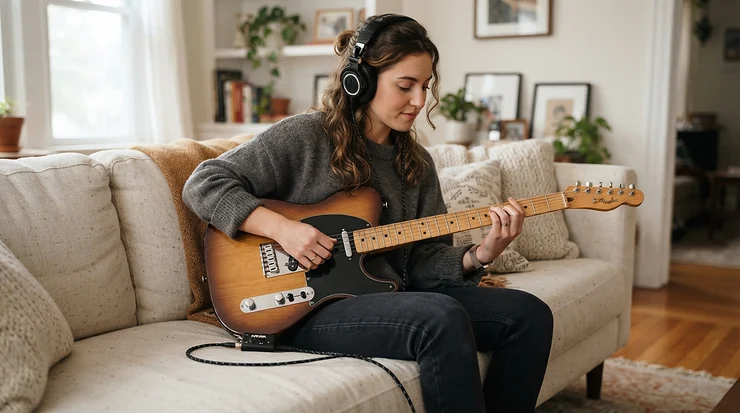
A pocket-sized unit that plugs into your guitar and drives a pair of headphones is not a shrunken combo amp, and it does not replace an audio interface either. Headphone guitar amps divide into two camps: analog plugs that only make sound for your ears, and rechargeable modelers that add Bluetooth, presets and sometimes a USB recording path. Which camp you shop in matters more than any single tone. For 2027, the five headphone guitar amps below are matched to five practice situations, from a tight budget to a cable-free headset.
This guitar headphone amp 2027 guide leans on Guitar World’s roundup and reviews, Sound On Sound’s review of the Boss Katana:GO, guitar.com’s review of the Boss Waza-Air, Thomann buyer ratings and an owner thread at TDPRI. No unit was plugged in for this guide, so every comment on feel and sound belongs to a named reviewer, and prices appear as ranges to compare with the current listing on Amazon.com.
Power, input, recording and backing tracks: what separates these amps
Tone gets the attention, yet four hardware details decide whether one of these amps stays in your gig bag or ends up in a drawer. Guitar World’s headphone amp roundup touches all four, and reviewers and owners fill in the rest.
Power source. The Vox amPlug 3 AC30 runs on two AAA cells, which Vox rates at roughly 10 to 16 hours on alkaline, according to Guitar World’s review. The rechargeable modelers run shorter: the roundup puts the Fender Mustang Micro Plus at about four hours minimum, and the maker’s page for the Valeton Rushead Max promises up to five.
Input fit. Guitar World’s spec lists mark a flexible, rotating input on the Vox and the Fender, while the Earthquaker Devices Easy Listening has none. Two Thomann buyers say the Valeton’s bottom-mounted jack puts its knobs out of reach on some guitars, and the Vox reviewer warns that plug can sit awkwardly on certain bodies.
Backing tracks and recording. The Vox needs an aux cable and has no Bluetooth; the Valeton also uses an aux jack. The Fender Mustang Micro Plus and the Boss Katana:GO stream backing tracks over Bluetooth, and both can send audio over USB.
Headphone pairing. Guitar World’s roundup advises wired headphones, because Bluetooth headsets are more likely to add noticeable latency. Impedance matters too: Adorama’s spec list for the Boss amp recommends a load of 16 ohms or greater, and one TDPRI owner reported weak drive for Sennheiser HD 6xx-series headphones from the Fender.
Guitar headphone amp vs audio interface: what each one asks of you
An interface records your guitar and leaves the amp to software; a plug-in amp is the amp. Guitar World’s guide to playing without an amp describes the interface route as building tone “completely in the box,” which needs a DAW and a computer, and it says a more involved rig may add a DI box. Its budget example, an interface plus free AmpliTube 5CS software and a cable, comes to roughly $170 (my arithmetic from its parts list). The plug-in amps in the same guide run from about $50 to $130, need no software for basic use, and are pitched at beginners who feel self-conscious playing through a practice amp.
Recording blurs the line. Guitar World’s roundup says USB-equipped models such as the Fender Mustang Micro Plus can feed a computer or phone directly, while the traditional bug-style plugs are headphone-only and don’t sound great sent into an interface. One limit applies to the Boss Katana:GO: Sound On Sound’s reviewer notes that its USB audio always carries the processed sound, with no clean DI option, so the amp tone is baked into the take.
An interface keeps the dry guitar, which is why anyone planning to mix music will likely want one eventually (my reasoning from that DI limit). For playing at 11 p.m. without a laptop, a plug-in amp is the shorter path.
Headphone guitar amps reviews, compared on battery, input and recording
Model
Tone engine
Power
Backing tracks
Recording
Price range
Vox amPlug 3 AC30
Analog, two channels, four effects
Two AAA cells, 10 to 16 hours claimed
Aux cable, no Bluetooth
None
About $50 to $72
Fender Mustang Micro Plus
25 amps, 25 effects, 100 presets
Rechargeable, about 4 hours minimum
Bluetooth
USB audio to phone or computer
About $110 to $140
Boss Katana:GO
10 guitar amp types, 60+ effects, 30 memories
Rechargeable, about 5 hours
Bluetooth
USB, processed sound only
About $110 to $130
Valeton Rushead Max
3 amp models, mod and ambient effects
Rechargeable, up to 5 hours
Aux input
Not listed
Around $40
Boss Waza-Air
Amp built into wireless over-ear headset
Headphones about 5 hours
Bluetooth
Not listed
About $315 to $400
The price spread runs roughly tenfold (my arithmetic), but the feature split is cleaner than the price one: only the Fender and Boss plug-ins record over USB, only the Vox is battery-swappable, and only the Boss Waza-Air removes the cable between guitar and ears. Compare current availability on Amazon.com before you settle on a tier.
Best headphone guitar amps for five practice situations
Each entry starts from a situation and works back to the amp, so read the headings as a filter and not as a ranking.
Plug in, turn a few knobs, play: that sums up the Vox amPlug 3 AC30, which Guitar World’s reviewer calls one of the best headphone amps available. It uses analog circuitry with two channels, a clean Normal channel and a Top Boost channel that, the reviewer says, delivers more overdrive than expected and became their favorite. Reverb, tremolo, chorus and delay are on board, with a side-mounted tap tempo for the delay and a limited set of rhythm patterns.
The trade-offs are modern ones. There is no Bluetooth, so backing tracks need an aux cable, which the reviewer found awkward, and power comes from two AAA cells instead of a USB pack, though the reviewer judged the battery life good. The dials are small and hard to read at some angles, and nothing shows which effect is active.
Vox sells other versions too. Guitar World’s roundup lists a High Gain model and a Bass model, the latter described as sounding poor with guitar, so only the AC30 version is covered here. Dealers and the reviewer put the AC30 between about $50 and $72, and Guitar World gives its weight as 40 grams.
Vox amPlug 3 AC30See current price, sizes and reviews on Amazon.
A headphone amp that also works as a phone or laptop audio interface saves a purchase, and that is the pitch of the Fender Mustang Micro Plus. Guitar World’s roundup counts 25 amp models, 25 effects and a USB-C rechargeable battery, and its review adds 100 preset slots, a small screen with a tuner and the Fender Tone app for deeper editing. Those additions answered the main complaints about the original Fender Mustang Micro, and the reviewer found the distorted tones deeper than on that model.
Pros:
25 amp models and 25 effects with 100 preset slots, per Guitar World
USB-C audio to a phone or computer, with the app setting the USB level
Cons:
No quick way to switch presets, which hinders playing along with songs
Bass can overload at higher volumes, especially with a Telecaster neck pickup or a baritone guitar
Owner reports are mixed rather than negative. In a TDPRI thread, one owner called it a worthy successor to the original and liked the global EQ, but reported flaky Bluetooth with the Tone app on older Bluetooth 4.x phones, which a later app update improved. Another owner, who sold theirs, reported a low-end noise they could not dial out, weak drive for Sennheiser HD 6xx headphones and an iPad that needed external power over USB. Those are single-owner accounts, not a pattern. Retailer links in Guitar World’s review run from about $110 to $140.
Fender Mustang Micro PlusSee current price, sizes and reviews on Amazon.
3. Boss Katana:GO — Katana tones for long couch sessions
Guitar World’s writer meant only to get the Boss Katana:GO working on its first evening, then looked up two hours later with a new song idea, after a Blackstar Fly 3 had sat unused and other practice setups fell short. That is one writer’s account, though it points at why a simple interface matters: the unit has a bright OLED screen, a built-in tuner and physical dials.
Adorama’s spec list gives ten guitar amp types, over 60 effects, 30 memories in guitar mode and 30 more in bass mode, and about five hours of battery. Bluetooth connects the Boss Tone Studio app and streams backing tracks, and Sound On Sound’s reviewer perceived no latency over headphones. The headphone jack is a stereo mini jack, and Adorama recommends a load of 16 ohms or greater.
Stage Feel, the spatial mode that places the amp and backing track around you, splits opinion. Guitar World’s writer says it makes long headphone sessions more comfortable, while Sound On Sound’s reviewer usually left it off, finding the guitar sounded better that way and some presets “mushy” with it on. The same reviewer also notes the noise gate can truncate quiet note tails with no onboard threshold control. Guitar World’s writer adds that the casing may not survive being stepped on.
Sound On Sound reviewed the more compact redesign, and a Boss product page says the latest model has the same sounds and features as the earlier one. Prices across Guitar World and Sound On Sound run from about $110 to $130. Check current availability below.
Boss Katana:GOSee current price, sizes and reviews on Amazon.
Among the five, the guitar headphone amp best matched to a tight budget is the Valeton Rushead Max, which the maker’s own store lists at around $40 but showed as sold out when opened, so check the current price on Amazon.com. That page lists a built-in lithium battery rated up to five hours on USB charging, three amp models (clean, overdrive and distortion), a mod module with chorus, tremolo and flanger, an ambient module with reverb and delay, and an aux input.
American Songwriter calls it very versatile for the price. Thomann’s buyers give it 4.4 out of 5 across 54 ratings, and their written reviews are specific. One reports about five days of practice, over an hour a day, without recharging, and another calls the sound clear on a Squier Telecaster. The complaints cluster around ergonomics: one buyer with a Yamaha guitar found the controls badly placed because the input jack sits at the bottom, another found that jack awkward on an LP-style guitar but easier on a Strat, and a third mentions some hiss at high volume when not playing.
The maker’s page lists no Bluetooth and no USB audio.
Valeton Rushead MaxSee current price, sizes and reviews on Amazon.
5. Boss Waza-Air — wireless over-ear for moving around
Cable-free practice is the whole point of the Boss Waza-Air, which puts the amp inside an over-ear headset, with a transmitter plugged into the guitar. Guitar World’s roundup counts five amp models and 50 effects, Bluetooth streaming for backing tracks and gyro-based 3D sound, and prices it between about $315 and $400. Guitar.com’s reviewer gave it 8 out of 10, found the headset comfortable enough for commuting and heard no audible latency, which that review calls crucial for playing along.
Pros:
Amp built into the headphones, so nothing runs between guitar and ears
Crisp, full, hi-fi amp tones, per guitar.com
Cons:
About five hours of battery, which the reviewer considers short for a 320 g headset
Six memory slots with none empty, so saving a new sound overwrites one
The spatial effect is the divisive part. Guitar.com’s reviewer says it may add only subtle depth, that the review team disagreed on its value, and that sound shifting toward one ear when you turn your head can distract more than help. Sources also describe the onboard sounds differently: Guitar World lists five amp models, while guitar.com describes six built-in sounds that boil down to a clean and a dirty tone, each in three spatial modes. That review dates from the product’s early days, when the Android app was unfinished, so check the app’s current state before relying on it.
Boss Waza-AirSee current price, sizes and reviews on Amazon.
Three more models appeared in the sources and deserve a look if none of the five fits. The IK Multimedia Tonex Plug offers a huge tone library and low-latency Bluetooth, though Guitar World notes slow preset loading, a fiddly desktop app and a higher cost than its main rivals. The Positive Grid Spark Neo includes a wireless transmitter that fits inside the guitar for cable-free practice. American Songwriter lists the NUX Mighty Plug MP-2 with 13 amp models, 19 effects, impulse-response cabinets, Bluetooth audio and an app mode.
Jack fit, wireless headphones and bass: where plug-in amps disappoint
Fit comes first. A plug-in amp hangs off the output jack, so body shape matters: the Thomann buyers and Guitar World’s Vox reviewer each describe awkward fits on some guitars, and a rotating or folding plug eases that.
Headphone choice comes next. Latency is the risk with wireless headsets, which is why Guitar World’s roundup recommends wired ones. The Boss Katana:GO avoids the question, since Sound On Sound explains its Bluetooth carries app control, MIDI and backing tracks and not headphone audio.
Low frequencies are the third trap. The Fender Mustang Micro Plus can overload in the low end with bass or low-tuned guitars at higher volumes, per Guitar World, and the Vox amPlug 3 Bass sounds poor with guitar. Finally, expectations: American Songwriter treats these units as a separate tool for different needs, not a replacement for guitar amps with speakers.
Headphone amp questions on batteries, Bluetooth, bass and interfaces
Can I send a headphone amp's output into an audio interface?
Guitar World's roundup says traditional plug-in units are built for headphones only and don't sound great when sent into an interface. Models with USB output record directly to a phone or computer, and a guitar plugged straight into an interface keeps the dry signal for amp-sim software.
How long do headphone guitar amps run on a charge?
Analog plug-ins on two AAA cells are quoted at roughly 10 to 16 hours by Vox, per Guitar World. Rechargeable modelers run shorter, with sources citing about four to five hours per charge, so keep a USB cable handy for long sessions.
Can I use Bluetooth headphones with a headphone amp?
Guitar World advises against it because Bluetooth headphones are more likely to add noticeable latency, while wired headphones play back instantly. Bluetooth on the Boss amp Sound On Sound reviewed carries app control, MIDI and backing tracks rather than headphone audio.
Do headphone guitar amps work for bass or acoustic guitar?
Some do, but check the version. Guitar World says the Vox bass model sounds poor with guitar, and Sound On Sound describes a bass mode on one Boss amp. American Songwriter notes one folding-plug modeler suits acoustics and ukuleles, so confirm compatibility on the maker's page.
Do I need a headphone amp if my combo amp already has a headphone jack?
Not necessarily. American Songwriter points out that many standard amps include a headphone output, and it treats plug-in units as a separate tool, not a replacement. A plug-in unit wins on portability and needs no speaker amp or setup space.
Match the amp to how you hear and record your playing
Among headphone guitar amps, the right one is the one that fits how you will hear and capture your playing. The Vox amPlug 3 AC30 covers quiet practice for the least money and effort, if you can live with an aux cable and two AAA cells. The Fender Mustang Micro Plus adds USB recording, and the Boss Katana:GO adds a deeper tone library and Bluetooth backing tracks, with the caveat that it records only the processed sound. The Valeton Rushead Max is the low-cost rechargeable route, and the Boss Waza-Air is the only cable-free system here, priced accordingly. If you plan to record seriously, budget for an interface and amp-sim software too, and treat a plug-in amp as the late-night practice tool. Check the current price on Amazon.com for each model before you decide.
Disclaimer: This post contains affiliate links. As an Amazon Associate, I earn from qualifying purchases made through these links, at no additional cost to you.
Before you order, compare the exact model name and version on each listing, because the Vox and Boss lines come in several variants.