As an Amazon Associate I earn from qualifying purchases. Links in this article may be affiliate links. How we choose gear
Pick a stand that cradles the neck if your guitar is expensive, oddly shaped or lives where kids and pets walk by, and save the plain A-frame for a standard body in a quiet room. That is the verdict of this 2027 look at guitar stands, and the reasons come from one controlled test, spec sheets and named owner threads. A stand that fails costs far more than the stand: a Long & McQuade buyer watched a Martin hit the floor, and a forum poster describes a broken neck on an Ibanez after a cradle stand tipped forward.
Load and height figures below come from maker and dealer pages, the only side-by-side test is GearLab’s comparison of 11 stands, and each owner story is a forum post or review-site comment that speaks for one person.
Where the stand sits matters as much as which one you buy. Gibson’s storage guide calls floor stands convenient and less permanent than wall hangers, and warns against putting a guitar near an open fireplace or in an attic or basement without climate control. Pick the room first, then the stand.
Neck grip, footprint, padding and body shape: what separates one stand from another
GearLab’s testers bought 11 stands, logged roughly 25 hours on each and scored setup, sturdiness, padding, ease of use and multi-instrument ability. The sturdiness test hung a 30-pound dumbbell on every stand, a deliberate overshoot because most guitars weigh around 10 pounds. Read the full GearLab guitar stand test if you want the scoring detail; the findings that shape this guide are short.
Neck grip comes first. A tubular or hanging stand has a cradle that touches the neck, usually with a strap or auto-closing arms. An A-frame leans on gravity alone. Guitar Lobby’s reviewer says A-frames have no neck cradle or latch and advises against them in homes with pets or young children.
Body shape comes second. GearLab found that the Amazon Basics Folding A-Frame and a ChromaCast A-frame struggled to balance oddly shaped guitars, and that the ChromaCast could not hold a Jazzmaster at all. Hangers and tripods with a neck cradle handled the odd shapes. The pattern is simple: if the body has to balance the guitar, odd bodies lose.
Footprint is third. Tripod legs stick out where people walk, and Guitar Lobby warns that they can be tripped over. Multi-guitar stands save floor space per guitar but get awkward in corners.
Padding and finish close the list. Guitar Lobby tells buyers to check whether a stand is safe for nitrocellulose finishes, and the evidence on that is genuinely split, as the review section further down shows.
| Model | Type | Guitars | Listed height / load | Finish note | Price tier |
|---|---|---|---|---|---|
| Hercules GS414B PLUS | Hanging tripod, auto-grip yoke | 1 | 37.4 to 45.2 in; 33 lb | Maker says foam suits most finishes; owners disagree | Around $60 to $70 |
| On-Stage XCG4 | Tubular tripod with strap | 1 | 19.25 to 24 in; load not listed | EVA rubber; no nitro statement found | Around $18 to $20 |
| Amazon Basics Folding A-Frame | A-frame, 3 widths | 1 | About 3.5 lb; 10 kg (about 22 lb) load on a reseller page | Gearank: nitro safety not specified | Around $15 to $20 |
| Hercules GS432B PLUS | Triple hanging stand | 3 | 35.6 to 44.5 in; 66 lb | Equipboard says not for nitro | Check the current price on Amazon.com |
| String Swing CC01KOAK | Wall hanger | 1 | 15 lb rating; GearLab’s test held at least double | Not addressed in the sources read | Around $20 in GearLab’s review |
Only one stand in the table carries a written finish warning, and it is a no. The other four say nothing definitive, which leaves nitro owners with a cloth-barrier decision rather than a spec to rely on. Capacity numbers rarely decide anything here, since a 10-pound guitar sits far under every rating.
Best guitar stands 2027: one pick per situation
Each stand below is matched to a situation instead of ranked on a single score, because a stand that suits a Telecaster in a bedroom is the wrong tool for a three-guitar gig bag.
1. Hercules GS414B PLUS — neck-hanging grip for awkward bodies
Hanging a guitar by its neck takes the body shape out of the equation, and that is why owners with unusual guitars keep landing on the Hercules GS414B PLUS. A Sweetwater reviewer says it works extremely well for a Firebird and would suit other non-traditional shapes such as Explorers and Flying Vs. A Thomann reviewer calls it brilliant for an ESP George Lynch arrow guitar. Both are single owners, though they point the same way.
The hardware explains the hold. The auto-grip yoke closes under the guitar’s weight, an instant-height clutch with a locking pin adjusts it, and foam covers every contact point including the legs, according to retailer pages. Adorama lists a height range of 37.4 to 45.2 inches, a 33-pound capacity and a lifetime limited warranty, and two narrow-neck adapters in the box for banjos and mandolins. Retailer listings disagree on the smallest neck it accepts, giving 28 mm on one and 40 mm on another, with 52 mm (about 2.05 inches) as the upper limit, so measure your neck before ordering.
Pros:
- Grips the neck, so body shape barely matters
- Folds for travel and adjusts height without tools
- Thomann shows 4.9 out of 5 from 691 ratings
Cons:
- Guitar Lobby’s reviewer calls it expensive
- A Long & McQuade buyer reports the height trigger going gooey and then breaking, dropping a Martin
Another buyer on the same page says the maker replaced a faulty stand at no cost after a few emails, which suggests support is responsive even when the part fails. Dealers put it around $60 to $70.
Check the current price on Amazon.com.
2. On-Stage XCG4 — the cheap tripod that still has a strap
Around $18 to $20 buys the On-Stage XCG4, which GearLab named its best budget traditional-style stand. In their test it fit every guitar style they tried securely and was easy to use, but it tilted backward under the 30-pound load and the padding ran a little thin.
A security strap on the upper yoke is the feature that separates it from an A-frame. The lower stepped yoke is removable, height adjusts from 19.25 to 24 inches, and the padding is EVA rubber over sheet-metal leg housings, per Adorama and Frontend Audio. A reseller page that mirrors the Amazon listing shows 4.7 out of 5 from about 19,900 reviews.
Equipboard’s summary of owner chatter adds a warning that a strap-and-latch design may not be ideal around kids, pets or earthquake-prone areas. One owner with an 8-pound Stratocaster on a reseller page was initially worried about the short rear leg, found it fine, and suggested that guitars with heavy headstocks might fare worse. That is one buyer’s guess, but GearLab’s backward tilt points the same direction. Adorama also sells it in multi-packs, which suits a spare room with several guitars.
3. Amazon Basics Folding A-Frame — no cradle, no latch, no fuss
Safety on this stand depends entirely on placement, because the Amazon Basics Folding A-Frame has nothing gripping the neck. GearLab still rated it Best Overall and an Editors’ Choice at about $19, praising its strong build, adjustability and quick setup, and noting the oddly shaped guitar struggles described earlier.
The model number is GFS70. It weighs 3.53 pounds, offers three width settings and uses neoprene foam on the arms with a rubber cap at the apex, according to reseller pages that mirror the Amazon listing, which show 4.8 out of 5 from more than 60,000 reviews. Guitar Lobby’s reviewer notes a 5-degree backrest incline and, as with any A-frame, advises against it around pets and small children. Dealers sit around $15 to $20.
Owners on that mirror page raise two practical points. One buyer says guitars with smaller bodies, including most electrics, are not tall enough to reach the apex pad, so the pad ends up supporting the neck joint or the neck itself. Another warns that you must center the guitar or it will topple, since nothing secures the neck. Acoustics with big, tall bodies fit best.
Folded flat, it makes a sensible second stand for a rehearsal bag.
See the current listing on Amazon.com.
4. Hercules GS432B PLUS — three guitars, one footprint
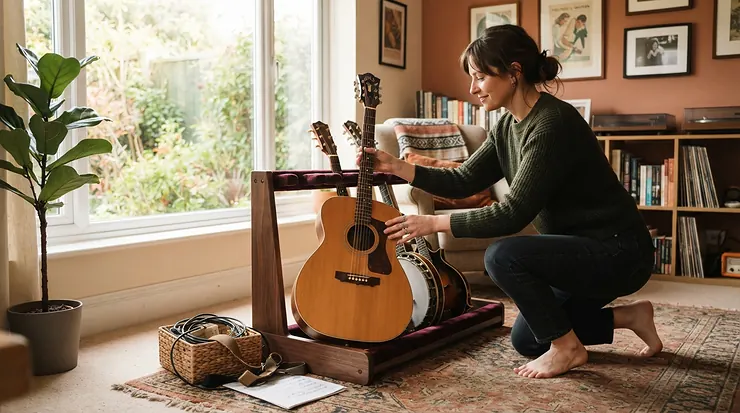
Gig bands and collectors who rotate instruments are the reason the Hercules GS432B PLUS exists. It holds three guitars, basses or mandolins on foldable auto-grip yokes with adjustable backrests, supports 66 pounds, and stands 35.6 to 44.5 inches tall according to GuitarGuitar’s listing, which also gives a 16.9-inch base radius, a 29.9 by 5.3 by 5.3 inch folded size and about 6.4 pounds. Zzounds and Adorama show slightly different height figures for what appear to be earlier or alternate listings, so confirm the version.
Thomann buyers report that the lower support fits a 34-inch-scale bass and a 24.75-inch guitar at the same height, and another buyer who hangs a guitar, baritone and bass says the length mismatch means not every instrument touches the bottom support. A reseller buyer says it holds an Explorer and a Jazz Bass confidently, while Equipboard’s summary flags possible compatibility trouble with Flying V shapes. A shape that overhangs the lower support is the likely cause, in my reading.
Finish is the larger question. Equipboard’s FAQ says the stand is not recommended for nitrocellulose finishes. Durability needs a look too: two Long & McQuade buyers of the earlier Hercules GS432B report the spring-loaded height lever snapping with three guitars on it, one spontaneously and one while a guitar was being lifted off. One Thomann reviewer also says the tubing seems thinner than a year or so earlier. Those are a handful of reports against roughly 1,200 mirrored Amazon ratings averaging 4.6 to 4.8, but the failure mode is a three-guitar crash.
Check the current price on Amazon.com.
5. String Swing CC01KOAK — wall hanger when the floor is full
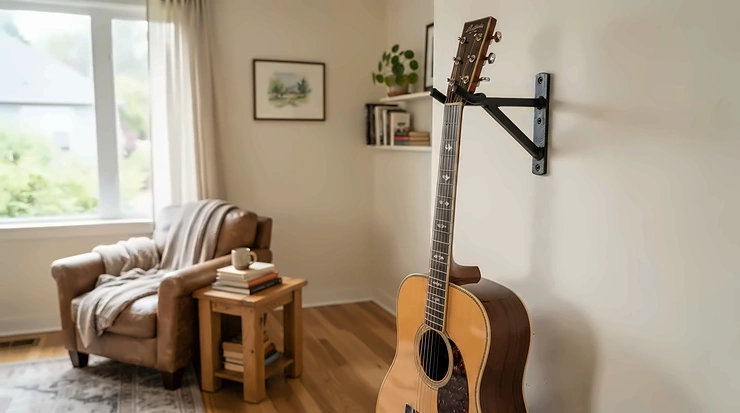
Dropping the floor footprint altogether is the argument for the String Swing CC01KOAK. GearLab named it its best wall-hanging stand and Top Pick at about $21, after it held at least twice its suggested 15-pound limit and every guitar shape the testers tried. Popular Science’s roundup also lists a String Swing at the top of its guitar stand picks.
GearLab flagged the trade-offs: setup took tools and the placement is permanent. That makes it a poor fit for renters whose landlords object, a point Gibson raises as well, though Gibson also notes that wall hangers keep guitars off the floor and reduce accidents with young children or pets. GearLab tested the hanger’s strength, not your wall’s, so fasten it into a stud; that advice is my own reasoning, not a test result.
Guitar stand for Gene Simmons axe shape base and other odd bodies
Axe-shaped bodies are the hardest case. Gene Simmons is credited with the axe bass design, and it has since appeared in Kramer and Cort versions with an axe-shaped body and no obvious base to balance on. No stand maker lists the shape as a supported fit in the pages reviewed, so the advice below is an inference from how similar shapes behave.
Owners of other awkward bodies agree on one thing: grip the headstock. A Gibson forum poster says a Rockstand did not suit a Flying V while a stand with its neck support in the middle let the V stand upright on its legs. An Unofficial Warmoth poster calls Flying V, Explorer-style and Warlock shapes not stand-friendly. A zZounds reviewer with a BC Rich Ironbird says its base ruled out normal stands but the Ultimate Support GS-100 worked well. That stand is now listed as unavailable at zZounds, yet the design lesson holds. Bax’s buyer guide gives the same rule for pointy shapes: look for a floor stand that grips at the base of the headstock, or one made for your model.
My read is that an axe-shaped body should behave like a V or an Explorer, so a neck-hanging stand such as the Hercules GS414B PLUS is the safer starting point, and an A-frame is the likeliest to tip. Check the headstock width against the yoke range and test the guitar low to the floor before trusting it.
One clarification for shoppers: officially licensed 10-inch Axe Heaven mini replicas of the Gene Simmons Axe bass ship with their own miniature A-frame stand, per Veeps and Goldmine listings, so a collectible needs no separate purchase.
A black and white electric guitar with wires, an amp and a stand: setting up the corner
A guitar parked beside an amp is the classic spot for a stand, and cables are where it goes wrong. Gibson’s guide treats clip-on amp holders as a temporary lean, “not as stable, generally, as a real stand.” A proper stand beside the amp keeps the guitar upright while the cord trails across the floor.
The cord matters for the finish too. A Seymour Duncan poster says the rubber boot on a cable’s jack end, resting against the body, began reacting with the finish. Keep jack boots off the guitar when it rests on a stand, and lay the cable behind the legs so nobody trips over a tripod leg and the cord at once.
Light finishes show reaction marks clearly. A Gibson forum poster with a white Les Paul Raw Power found a stain on the back where it sat on foam, and a replying poster said that looked like a chemical reaction with the nitro lacquer. A black-and-white guitar on foam-padded arms gets the same advice as any other: a thin cotton cloth over the contact points, especially with a new guitar and a new stand.
Guitar stand how to use: a routine that keeps the guitar upright
- Open the legs fully on firm, level flooring and set the height so the neck cradle meets the neck just below the headstock. On the XCG4 that is a 19.25 to 24 inch range; the Hercules GS414B PLUS goes up to 45.2 inches.
- Lower the guitar neck-first into the cradle, then let the body rest against the lower pads. On a hanging stand with auto-grip arms, the arms close as the weight settles.
- Fasten the strap or latch if there is one, which matters most around kids and pets.
- Unplug the cable, or move the jack boot clear of the body, before you step away.
- Put a cloth over the foam if the guitar has a nitrocellulose finish, and take the guitar off the stand if it will sit for months.
- For an A-frame, center the guitar over both legs. A buyer on the Amazon Basics mirror says an off-center guitar simply topples.
When lifting the guitar off, raise it straight up, not forward. Guitar Lobby’s reviewer recommends examining a stand in person where possible, and Guitar Lobby’s stand roundup explains the four stand families if you are still deciding.
Guitar stands reviews: what owners report after the first year
Finish damage is the most argued topic in owner threads. Hercules says through a statement relayed in a Gibson forum thread that its foam does not react with most finishes, nitro included. Another poster in an older thread recalls that the company’s 2007 ad copy promised nitro safety and later dropped it. A poster in a Seymour Duncan thread says thick black foam side stands are fine and only stands with rubber surgical tubing melted a nitro finish. Another believes off-gassing from foam is the cause and that a cloth barrier may not stop it. One Gibson forum member has used a folding stand with foam for years on five guitars with no damage; another thinks damage is worse with a new stand and a new guitar. The honest summary is split: some owners see marks, others none, and cloth is cheap.
Falls are the second theme. A Heritage Owners Club poster says he has seen ten guitars damaged falling from stands at gigs, including four-point stands, which is a single account but an argument for latches near crowds. A musicplayer.com poster says cradle stands tip forward and cost him a neck on an Ibanez.
Mechanisms fail in a third pattern. Several Long & McQuade buyers report height-adjust levers going gooey or snapping on Hercules stands, across the Hercules GS414B PLUS and the earlier Hercules GS432B, while Thomann’s 691 ratings average 4.9 out of 5 for the single stand. Failures on one retailer’s page and praise on another do not cancel out; they suggest the lever is the part to inspect on a stand that has been adjusted often.
Buying moves that end with a guitar on the floor
Choosing an A-frame for a house with toddlers or pets is the most common mistake, since nothing locks the neck. Putting a heavy-headed electric on any A-frame is the second, and buying a multi-guitar stand for instruments of very different lengths is the third, because the reviewer who hangs a guitar, baritone and bass says they do not all rest on the support. Using a new stand on a new nitro guitar without a cloth completes the list.
Quick answers on nitro, pets, odd shapes and humidity
Are guitar stands safe for nitrocellulose finishes?
Is an A-frame stand safe around kids and pets?
What stand holds a Flying V or an axe-shaped guitar?
Can an acoustic guitar stay on a stand all day?
Is a guitar stand better than a wall hanger?
The guitar stand to buy, matched to your guitar
Start with the neck. For an expensive, odd-shaped or heavy-headed guitar, the Hercules GS414B PLUS is the most secure single stand in this group, and its reported weak point is the height lever, so check it after heavy use. The On-Stage XCG4 is the sensible value pick for a standard electric when you want a strap for under $20. The Amazon Basics Folding A-Frame works for a big acoustic in a calm room and as a rehearsal spare, never as the only stand in a busy house.
Three guitars on one footprint belong on the Hercules GS432B PLUS, with the nitro caveat. If the floor is already crowded, the String Swing CC01KOAK goes on the wall.
Whatever you choose among these guitar stands, put a cloth on the foam if the finish is lacquer and the cable behind the legs.
See the current listings on Amazon.com.
Recommended for You
- Burswood guitar: Which One Fits Your Budget?
- Orangewood guitars: Which One Fits Your Playing?
- Bass amp cables — Which One Fits Which Rig
Disclaimer: This post contains affiliate links. As an Amazon Associate, I earn from qualifying purchases made through these links, at no additional cost to you.
Match the stand to the neck first and the body shape stops being a problem.