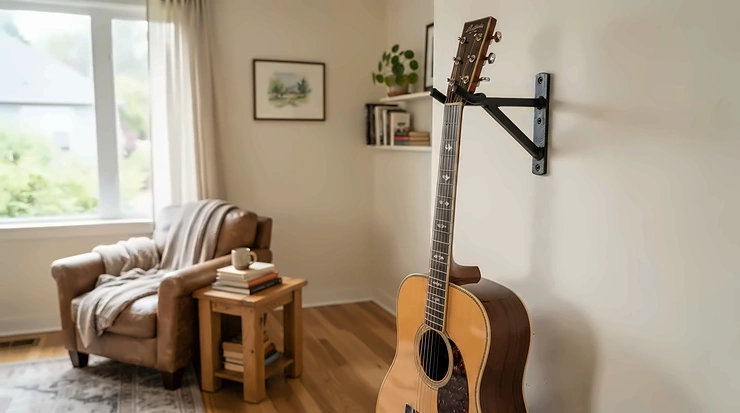
Five of the six hangers below are listed at roughly 15 to 16.5 pounds of load, a number that sounds generous until you read what owners report. In several forum threads the hanger holds and the wall does not: screws and drywall anchors pull out together. This 2027 look at guitar wall mounts sorts the options by what each one asks of your wall, your finish and your headstock, not by looks alone.
No hanger was bolted to a wall for this piece. Load figures and dimensions are the makers’ and dealers’ own, and the owner findings come from named forum threads and buyer reviews, each of which speaks for only a handful of people.
Hangers appeal for plain reasons. Gibson’s storage guide calls them a good way to free floor space and keep guitars within reach, says they lower the odds of accidents with young children or pets, and notes that renters may run into landlord rules. The same guide warns against storing guitars near fireplaces or in attics and basements without climate control.
That sets the audience. The picks below suit a player who has a stud to screw into, plays the guitar often enough to justify hanging it, and has a room where temperature and humidity stay steady. A rare or fragile instrument in a drafty room is better off in its case.
Finish, yoke and fastening: what separates a safe hanger from a risky one
Foam and rubber are where a hanger touches the guitar, and owners disagree about whether that contact is harmless on nitrocellulose lacquer. Hercules says, in a statement carried on Andertons’ product page, that its special foam does not react with the large majority of popular finishes, nitrocellulose included, but adds that every builder’s nitro formula differs and tells owners to check their guitar’s manual. Thomann’s page for the Hercules GSP39WB PLUS leans the other way and lists it as not suitable for permanent use with nitro lacquer. Both statements are claims, not test results.
The owner reports split as well. A member of the JustinGuitar community says two nitro Gibsons have hung on Hercules hangers or stands for 12 years without marks. On the Gibson forum, an owner who found a damaged patch on a new Les Paul Standard suspected the stand or hanger, while the distributor insisted its stands were safe, so that case stayed open. A buyer of a budget auto-lock hanger, the Sondery, wrote that its foam ate through the finish on a 30-year-old Martin D-18 headstock after a few weeks on the wall.
The usual workaround is a barrier. One Gibson forum poster covers the rubber with a polish cloth, a jazz forum member slips cut-off glove fingers over the foam, and a poster on the Rickenbacker Resource forum argues that plasticizers in vinyl and many foams are what attack lacquer, so any sleeve has to block them.
Yokes matter too. Guitar display stand wall mount options fall into three families: fixed or pivoting cradles that rely on the neck’s weight, auto-grip arms that close around the neck, and horizontal plates that skip the headstock altogether. Fastening, the third factor, gets its own section further down because the reported failures cluster there.
Where the hangers differ: load, fit, finish and fixings
Model
Base and mounting
How it holds
Listed load
Finish note
Dealer price range
String Swing CC01K
Hardwood plate
Pivoting deep cradle
15 lb (roundup); 50 lb (one retailer)
Dealer copy says the tubing will not mark finishes
$13 to $19
Hercules GSP38WB PLUS
Wood base
Auto-grip arms, swivel yoke
16.5 lb (roundup)
Maker says foam is safe for most finishes; check manual
$22 to $28
Hercules GSP39WB PLUS
Steel base
Auto-grip arms, swivel yoke
15.4 lb
Same maker claim; Thomann advises against permanent use on nitro
$25 to $30
Fender Level-Up Tele Wall Hanger
Wood base
Fixed offset dowels
Not listed
Tested safe for standard polyurethane
$25 to $35
String Swing CC151LP
Steel flat plate
Horizontal cradles
15 lb
Not addressed
$40 to $55
Gator Frameworks GFW-GTR-HNGRBLK
Steel plate with foam wall pad
Rubberized swivel yoke
15 lb
Not addressed
$15 to $25
Load ratings sit so close together, per American Songwriter’s hanger roundup and the maker pages, that capacity will not choose for you. The two outliers are the String Swing CC01K, where one retailer says 50 pounds against 15 in the roundup (trust the lower number and the box), and the Fender Level-Up Tele Wall Hanger, which gives no rating at all.
Finish statements are the real spread. Hercules and Fender publish written claims, a dealer’s copy makes one for String Swing, and the Gator page makes none. Prices are dealer ranges and shift from one retailer to the next.
Best guitar wall mounts, matched to a wall and a guitar
Fit and install complaints in buyer reviews are the most useful evidence, so the entries below lean on them for headstock and fastening problems. Each hanger is placed by the situation it suits rather than ranked on a single score.
Guitars with uneven heels or lopsided headstocks are what the String Swing CC01K was reworked for. Dealers describe the Keeper cradle as deep enough that the instrument cannot be seated badly, and the yoke pivots so a non-symmetrical headstock still hangs straight. To take the guitar down you lift it about two inches and bring it forward.
The body is hardwood, made in the USA, with mounting hardware in the box and a lifetime structural warranty, according to Chicago Music Exchange. The cradle opening is listed at 1.75 inches, and dealers warn that it may be too narrow for some classical and bass guitars, steering those buyers to the original CC01.
Load ratings disagree here: American Songwriter lists 15 pounds, while a retailer listing for the walnut version says 50. Plan around the lower figure.
One long-term report comes from a Gibson forum member who screwed several String Swings into wall studs, put a polish cloth over the rubber, and says a Les Paul has hung on one since 2002 with no finish damage. A TDPRI member who hangs Telecasters says these yokes rotate to fit and hold Tele necks securely. Both are single-owner accounts, and the first credits the studs as much as the hanger. Dealers list the walnut and oak versions between roughly $13 and $19.
Check the current price on Amazon.com.
String Swing CC01KSee current price, sizes and reviews on Amazon.
Dealers list the Hercules GSP38WB PLUS between roughly $22 and $28, and the money buys a wood base plus arms that close on their own. The Auto Grip System works by weight: the arms turn in and up as the neck settles into the yoke, then open when you lift the guitar out. The short arm measures 4.1 inches on Adorama’s listing for the brown version, which also notes a limited lifetime warranty.
Guitar Lobby’s reviewer named it the best overall pick, calling the auto-lock responsive and the yoke grip strong, and listed no drawbacks. The finish caveat from the earlier section applies in full.
Pros:
Arms close under the guitar’s weight and release when it is lifted
Wood base that dealers pitch as a decor piece
Limited lifetime warranty on dealer pages
Cons:
Nitro owners are told to check the foam against their guitar’s manual
A PRS forum member reports a Hercules hanger pulling itself out of his wall and dropping a guitar, though he does not blame the hanger
One poster in a Seymour Duncan thread screws his into studs with long drywall screws instead of the ones that ship in the box.
Hercules GSP38WB PLUSSee current price, sizes and reviews on Amazon.
Thomann’s page for the Hercules GSP39WB PLUS shows 4.8 out of 5 from 414 ratings, 362 of them five-star and three one-star, a sizable pool for a wall hanger. The base is steel, the arm is 105 millimeters (4.1 inches) long, and the load limit is 7 kilograms (15.4 pounds). A pair of narrow-instrument adapters in the box lowers the minimum arm spacing from 1.57 inches to 1.1, so slim necks seat properly.
Telecaster fit is where its reviewers say the most. One Thomann reviewer feared the thin Tele headstock would slip through and found the arms stop it and hold it well; another uses it on both a Strat and a Tele and reports no stability worries. Two reviewers is a small sample, though both point the same way.
The finish note from Thomann, no permanent use on nitro, sits against Hercules’ own statement that the foam is safe for most finishes. Read your guitar’s manual before choosing between them. The base plate shows three drill holes on Thomann’s page while the maker’s listing mentions two screws in the box, so a third screw is worth buying. Adorama lists it around $25 to $30.
Hercules GSP39WB PLUSSee current price, sizes and reviews on Amazon.
A narrow, offset headstock is the problem this hanger was drawn around. Fender’s product page describes maple wood in a mahogany finish, fixed EVA-padded dowels offset so the guitar hangs straight, a body that sits closer to the wall than yoke hangers, and a slit on top for picks. All mounting hardware is included, and every piece is one of a kind, so grain varies.
Fender says it was tested and found safe for standard polyurethane finishes. It names no other finish, so a lacquer-finished Telecaster owner should look elsewhere or add a barrier. The dowels are fixed, with no arms to close, so the hold comes from geometry and gravity, which is my reading of the design rather than anything Fender states.
The page lists no dimensions and no load rating, a gap worth closing before it goes on the wall. Fender’s own page puts it in the neighborhood of $25 to $35.
Look up the current listing on Amazon.com.
Fender Level-Up Tele Wall HangerSee current price, sizes and reviews on Amazon.
Players who dislike hanging a guitar by its headstock have this option. The String Swing CC151LP lays the instrument flat against the wall on adjustable cradles, with a neck cradle plus two body cradles, according to Guitarist Next Door. That site recommends it for Telecasters for exactly that reason: the headstock is never the support.
String Swing sells narrow and wide versions. The narrow low-profile model is listed for electrics up to 2.25 inches deep, so thick hollow-bodies and acoustics call for the wide version or the maker’s acoustic holder. American Songwriter gives the dimensions as 4.5 by 19.5 by 3.75 inches with a 15-pound rating and says it mounts on drywall, plaster, concrete or wood. That 19.5-inch plate eats wall space, but it may also reach two studs, which a vertical hanger cannot; that is my inference, since stud spacing varies.
A Seymour Duncan forum member keeps a headless Strandberg on the horizontal mount and calls it fine with a couple of caveats. A buyer on a Desertcart listing says it fits a semi-hollow guitar easily and that String Swing replaced parts damaged in shipping. Dealer pages put the wide version between roughly $40 and $55.
String Swing CC151LPSee current price, sizes and reviews on Amazon.
Among the cheapest here, the Gator Frameworks GFW-GTR-HNGRBLK runs roughly $15 to $25 across dealers. It is black-finished steel with a 1.5-inch cradle and a 15-pound rating in American Songwriter’s roundup. A rubberized swivel yoke sits on a standoff that Reverb’s listing says clears both straight and angled headstocks, and a decorative plate hides the screws while a foam pad protects the wall.
Pros:
Plate hides the hardware and a foam pad shields the wall
Standoff clearance for straight and angled headstocks
Low price tier
Cons:
The drywall anchors in the box are the weak link in a zZounds buyer’s account
Adorama lists a three-year warranty, shorter than the lifetime terms on the String Swing and Hercules pages
Among guitar wall mounts reviews on zZounds, one buyer says the whole hanger fell within two months, anchors snapping inside the wall, and the guitar landed on a pedalboard. It is a single account, but it matches the pattern in the threads below.
Gator Frameworks GFW-GTR-HNGRBLKSee current price, sizes and reviews on Amazon.
Guitar wall mount for Telecaster owners: the headstock problem
The Telecaster’s narrow headstock is the usual stress test. Guitarist Next Door counts it among the trickier shapes to match with a hanger, and owner reports are mixed. A TDPRI poster says older flap-style Hercules hangers let a Stratocaster headstock cam out of the rubber and that he knows the same issue affects Telecasters, so he uses String Swings, which he says rotate to fit and grip Tele necks. Against that, two Thomann reviewers report a Tele sitting securely on the Hercules GSP39WB PLUS. The conflict probably tracks hanger generation and wall quality, though that is my reading, not a finding.
That leaves four routes: a pivoting yoke like the String Swing CC01K, auto-grip arms with adapters on the Hercules GSP39WB PLUS, Fender’s dowel design, or the horizontal String Swing CC151LP. Check which finish your guitar has, because Fender’s tested-safe claim covers standard polyurethane only. For one Tele in my own house, I would start with the String Swing CC01K, add a cloth over the rubber if the finish is lacquer, and put the screws into a stud.
Are guitar wall hooks ideal for an acoustic?
Acoustic guitar wall mounts add two problems electrics rarely have: humidity and the contact surface of the back and sides. Gibson’s guide says seasonal humidity shifts can move a neck enough to need a truss rod adjustment, and that humidity control helps prevent splits in flat-tops, mandolins and ukuleles. A jazz forum member keeps only his Epiphones on hangers because he cannot hold his living-room humidity steady, and a hanger seller’s own blog lists drier climates as a drawback for acoustics.
Physical contact matters as well. A zZounds expert note on the String Swing says owners have complained about marring the backs of acoustics or the wall, and suggests mounting a wooden spacer block behind the hanger to add standoff. The Gator Frameworks GFW-GTR-HNGRBLK ships with a foam wall pad for the wall side of that problem.
Opinions on neck stress also differ. A Thomann reviewer argues that suspending a guitar by the headstock puts less strain on the neck, and a Gibson forum poster relays that some techs recommend resting guitars on wall hangers, though he has also heard the opposite advice. For a daily player in a room with steady humidity, a padded cradle is a reasonable answer to “are guitar wall hooks ideal.” A costly acoustic in a dry or drafty room is safer in a case.
Screws, studs and the day a hanger lets go
The most useful evidence in the owner threads is about walls, not hangers. In a Seymour Duncan thread, a member’s new Les Paul fell when the hanger, screws and self-threading drywall anchors tore out together. Replies pointed to toggle bolts or a horizontal board screwed into studs, and one noted that metal studs hold screws worse than wood. A TalkBass poster says an acoustic fell off a wall and split its top, and concludes that anything short of a stud or solid wood is asking for trouble. Those accounts agree with each other, though each is a single owner.
Not everyone sees failures. A poster on an Ernie Ball forum says the newer screw-in plastic anchors are rated for 40 pounds each (check the packaging), and a Seymour Duncan member keeps only lightweight acoustics on the anchors that came with the hanger. A Gibson forum poster suggests a stud finder, or a decorative 1x board spanning two studs where one stud will not line up.
Guitar Lobby’s advice on mounting is a good place to start: tap the wall and listen for the dull note of a stud, drill into the center of it, use expansion bolts in concrete, and hire help if you are unsure. BestReviews adds a placement note, avoiding tight hallways and busy spots where the guitar can be knocked loose.
A short routine covers most of it:
Find the stud and mark its center.
Use long wood screws or toggle bolts, not the thin anchors in the box.
Set the height so the guitar clears the floor and any door swing.
Lower the guitar into the cradle and give it a gentle tug before you walk away.
Hanging a guitar on the wall: finish, studs and neck stress answered
Are wall hangers bad for guitars?
Not inherently. Sources describe hangers as safe when the guitar is seated carefully and the fastening is solid. The risks come from weak anchoring, foam that reacts with a finish, or unstable humidity. A case remains the cautious choice for rare instruments.
Do guitar wall mounts have to go into a stud?
Owner threads strongly favor it. Several posters report hangers pulling out of drywall, anchors included, while those who screw into studs or a board spanning studs report no trouble. Without a stud, toggle or molly bolts rated well above the guitar's weight are the usual fallback.
Will a guitar hanger damage a nitro finish?
It can, and the evidence is mixed. Hercules says its foam does not react with most finishes but tells nitro owners to consult the manual, and one dealer page advises against permanent use. A cloth barrier over the foam is the common precaution among owners.
What is the best guitar wall mount for a Telecaster?
Telecaster headstocks are narrow, so pivoting or auto-grip yokes tend to work better than flap-style paddles. Owners report good results with both, and Fender sells a Tele-shaped hanger tested on polyurethane finishes. A horizontal mount avoids the headstock entirely.
Can an acoustic guitar stay on a wall mount all the time?
Only in a room with steady humidity and temperature. Gibson cautions against storing guitars near fireplaces or in unconditioned attics and basements, and seasonal humidity swings can shift a neck. Rotate it into a case if the room is dry or drafty.
The wall mount to buy, by wall type
Stud first, hanger second. With solid wood behind the plaster, the String Swing CC01K is the safest all-round start among these guitar wall mounts: a pivoting yoke, hardware in the box and a low price. The Hercules GSP39WB PLUS earns its place when you want arms that close on the neck, provided you read its nitro caveat first, and the Hercules GSP38WB PLUS offers the same grip system on a wood base.
A polyurethane-finished Telecaster belongs on the Fender Level-Up Tele Wall Hanger, while the String Swing CC151LP suits a player who would rather not hang a guitar by its headstock. The Gator Frameworks GFW-GTR-HNGRBLK works if you replace its anchors with screws into a stud.
Whatever you buy, tap the wall, find the stud, and keep a cloth between foam and lacquer. See the current prices on Amazon.com.
Disclaimer: This post contains affiliate links. As an Amazon Associate, I earn from qualifying purchases made through these links, at no additional cost to you.