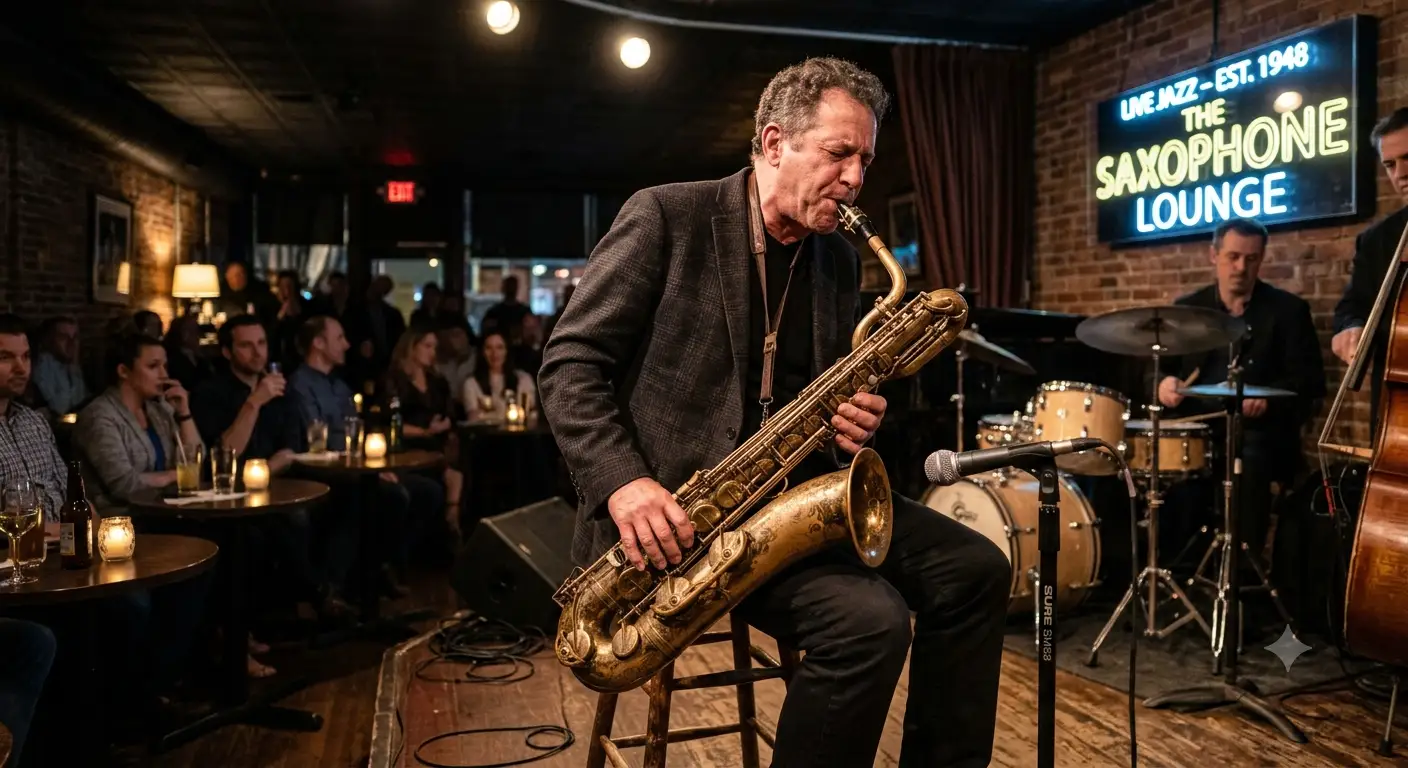
If you’ve ever stood in front of a saxophone section and wondered what that towering, curled-up horn in the back corner actually is, you’ve met the bass saxophone. It’s the instrument most band directors never mention, the one jazz history books treat as a footnote, and the one that makes an entire room turn around when someone finally gets a clean low Bb out of it. A bass saxophone isn’t a bigger baritone with a marketing upgrade — it’s a genuinely different instrument, with its own quirks, its own repertoire, and its own very specific shopping problems.
This guide exists because most bass saxophone content online is either a decade-old forum thread or a single product listing dressed up as a review. Here, you’ll get real model names, real specs pulled from manufacturers and dealers, and honest analysis of what the aggregated reviews actually say — good and bad. In line with FTC guidance on affiliate advertising disclosures, every price you see below is a range rather than a fixed number, because dealer pricing on an instrument this niche shifts constantly depending on stock, freight costs, and exchange rates.
Whether you’re a college saxophone studio filling out a low-reed section, a woodwind doubler chasing a specific sound for a session, or a curious multi-instrumentalist who just wants to feel a floor peg under a saxophone for the first time, this article walks through seven real bass saxophones on the market today, what actually separates them, and how to avoid an expensive mistake.
Quick Comparison: Bass Saxophones at a Glance
Before diving into the full lineup, here’s a fast snapshot of where each tier of bass saxophone sits. This isn’t the full breakdown — that’s coming up next — but it’s a useful gut check if you already know roughly what budget and use case you’re working with.
| Tier | Example Model | Typical Price Range | Best For |
|---|---|---|---|
| Entry-level | Levante LV-SB5105 | Around $2,000–$3,500 | First-time buyers, curious doublers |
| Budget-pro | IW 661 Professional Bass Saxophone | Roughly $2,500–$4,000 | Gigging players on a tight budget |
| Mid-range value | Jinbao Sakkusu Bass Saxophone | Between $3,000 and $6,000 | Serious hobbyists, saxophone choirs |
| Modern flagship | Selmer Paris Series II Bass Saxophone | Typically $28,000–$35,000 | Touring professionals, orchestras |
Looking at this table, the spread between the cheapest and most expensive bass saxophones on the market is enormous — over $30,000 in some cases — which is unusual even by saxophone standards. That gap exists because you’re paying less for “more features” and more for consistency, tuning stability, and how many years the instrument will hold up under regular gigging. We’ll unpack exactly what that money buys in the full comparison below.
💬 One click helps other bass saxophone shoppers make an informed choice too! 😊
Top 7 Bass Saxophones: Expert Analysis
A quick note before you scroll: bass saxophones are a genuinely small market compared to alto or tenor. Most of these instruments come from a handful of factories in China and Taiwan, get rebranded under different dealer names, or trace back to French and American designs from a century ago. Knowing that helps you read spec sheets and reviews with the right amount of skepticism — and that honesty is exactly the point of this section.
1. Levante LV-SB5105 — most accessible entry point
The Levante LV-SB5105 is the bass saxophone most beginners will actually stumble across first, since it’s stocked directly through major retailers rather than special-ordered from a specialty sax shop. It’s built in the key of Bb with an auxiliary A key and a high F key, giving it the same functional range most players expect from a modern low saxophone. That auxiliary A key matters more than it sounds: on a horn this size, awkward key placement turns basic scale work into a hand-cramping exercise, so having ergonomic thought put into the layout is a genuine plus at this price point.
Who is this for? Honestly, it’s built for the player who wants to try a bass saxophone without committing five figures to the experiment — a school program testing the waters, a doubler curious about the low end, or a home studio owner who wants the sound for recording rather than heavy touring. Verified customer review data specific to this model is thin online, which is worth stating plainly rather than inventing sentiment that doesn’t exist; what’s consistent across similar entry-level Jinbao-family basses is that setup quality varies more than build quality, so a proper technician adjustment after purchase is close to mandatory.
Pros:
- ✅ Included light case makes shipping and storage more manageable
- ✅ High F key and auxiliary A key cover standard playable range
- ✅ Lower price makes bass saxophone ownership realistic for more players
Cons:
- ❌ Factory setup often needs a technician pass before it plays its best
- ❌ Limited independently verified long-term reliability data available
At around $2,000 to $3,500 depending on the retailer and current stock, the Levante LV-SB5105 represents reasonable value for a true entry point into an instrument that otherwise starts in the thousands — just budget for a setup appointment on top of the sticker price.
2. IW 661 Professional Bass Saxophone — short-wrap design at a fair price
The IW 661 from International Woodwind is marketed by its maker as one of the horns credited with reviving interest in affordable bass saxophones, and regardless of how much credit it deserves for that, the design choice behind it is genuinely worth understanding. It uses a shorter wrap and a redesigned bore compared to older vintage-style long-wrap basses, which in practice means the tubing folds more compactly. What that means for you: a more manageable overall footprint and, according to the manufacturer, more even intonation across registers than older long-wrap designs typically deliver.
It’s keyed from low Bb to high F#, matching the professional range expectation for modern bass saxophones. Because of its size and weight, it ships via freight trucking rather than standard parcel post — something to factor into your total cost and timeline before ordering, since freight-shipped instruments can take considerably longer to arrive than a next-day Amazon package. Aggregated player discussion around this style of shorter-wrap, budget professional bass saxophone tends to be split: some players appreciate the improved intonation and lower cost of entry, while others who grew up on vintage long-wrap Conns and Bueschers find the tonal character noticeably different and less “vintage-warm.”
Pros:
- ✅ Shorter wrap design improves intonation consistency across registers
- ✅ Full professional range from low Bb to high F#
- ✅ More affordable than premium modern or vintage alternatives
Cons:
- ❌ Freight shipping adds time and logistics compared to standard delivery
- ❌ Tone character differs from vintage long-wrap basses some players prefer
Priced generally in the $2,500 to $4,000 range once freight is factored in, the IW 661 Professional Bass Saxophone is a strong value pick if intonation stability matters more to you than vintage tonal nostalgia.
3. Jinbao Sakkusu Bass Saxophone — the value pick worth a second look
The Jinbao Sakkusu occupies an interesting spot in the market: it’s a factory-made, short-wrap bass saxophone that dealers openly market as a far more attainable alternative to five-figure European horns, while still targeting a step up from bare-bones entry models. Reviewers who cover this specific segment closely have noted that pricing across Jinbao-made bass saxophone stencils, sold under a wide variety of brand names, has ranged from roughly $2,000 on the low end to north of $10,000 depending on the importer and level of quality control applied before resale — which tells you the factory itself isn’t the only variable that determines what you’re actually getting.
What most buyers overlook with Jinbao-sourced basses specifically is that the underlying manufacturing has genuinely improved compared to the rougher Chinese-made basses that circulated a decade or more ago, even as skepticism from longtime players persists. Based on comparing player commentary across multiple sources, the mechanism on well-set-up Jinbao-family horns is described as noticeably tighter and more refined than older-generation Asian-made basses, even by reviewers who remain cautious about recommending them without reservation.
Pros:
- ✅ Significantly lower price than European or flagship alternatives
- ✅ Mechanism quality has improved meaningfully over older Asian-made basses
- ✅ Wide dealer network makes sourcing parts and support easier
Cons:
- ❌ Quality control varies noticeably between importers and resellers
- ❌ Some experienced players remain skeptical of long-term durability
Given the documented $2,000–$10,000 spread across Jinbao-made stencils, a well-vetted Jinbao Sakkusu typically lands in the $3,000 to $6,000 range — solid value if you buy from a dealer who actually inspects and adjusts the horn before shipping it.
4. The Wilmington Bb Bass Saxophone — factory horn, professional setup
The Wilmington is a different kind of proposition entirely: it starts life as a factory-produced bass saxophone but gets a full professional setup pass from the MusicMedic Sax ProShop before it ships, addressing the exact ergonomics and intonation issues that have historically given bass saxophones a rough reputation. According to the shop’s own description, the setup process includes adjusting key heights, pad heights, timing, tuning and toning, and reducing key noise — the kind of granular technical work that a factory assembly line typically skips.
Here’s what the spec sheet doesn’t say outright but the description implies: buying this model is really buying labor and expertise as much as hardware. The result, per the manufacturer, is keywork that lays under the hands almost like a baritone saxophone — a meaningful claim, since awkward key spacing is one of the most common complaints about bass saxophones generally. It’s also described as highly adjustable and repairable, which matters enormously on an instrument this large, since dents and mechanical wear are basically inevitable over a working life.
Pros:
- ✅ Professional setup addresses common bass saxophone ergonomic complaints
- ✅ Even tone and strong intonation reported across all registers
- ✅ Built to be highly adjustable and repairable over its lifespan
Cons:
- ❌ Setup-focused pricing means less room to negotiate than a bare factory horn
- ❌ Independent, third-party customer reviews are limited outside the seller’s own materials
Expect to pay in the neighborhood of $4,000 to $6,500 for the Wilmington Bb Bass Saxophone, which represents genuinely good value if a properly set-up instrument matters more to you than owning a name-brand badge.
5. P. Mauriat PM-350GL — modern engineering, serious sound
The P. Mauriat PM-350GL is the product of roughly three years of dedicated design work by a manufacturer that already built a strong reputation on its alto and tenor lines before tackling a bass saxophone. It’s keyed from low Bb to high F#, built with mother-of-pearl key touches, a triple neckstrap ring, and a floor peg that pivots and swivels — small ergonomic details that add up on an instrument you’re often playing while standing.
What sets it apart in practice: reviewers who’ve directly compared it to Jinbao-family basses describe the keywork as noticeably more fluid and comfortable, and the design is widely understood to closely follow the architecture of the current Selmer Paris Series II bass — putting it in an interesting middle ground of “premium modern engineering at a meaningful discount to the flagship it resembles.” That said, based on comparing published dealer pricing across multiple countries, this is not a budget instrument by any stretch; it’s aimed at university programs, military bands, and professional woodwind doublers who need a dependable modern bass without paying flagship European prices.
Pros:
- ✅ Ergonomic keywork feels notably more comfortable than budget alternatives
- ✅ Full professional range with mother-of-pearl key touches and hand engraving
- ✅ Backed by a manufacturer with an established professional saxophone reputation
Cons:
- ❌ Price puts it out of reach for casual or first-time buyers
- ❌ Manufacturer specifications have historically been less transparent than competitors
Dealer pricing found during research for the P. Mauriat PM-350GL ranges roughly from $18,000 to $28,000 depending on region and currency — a serious investment, but one that undercuts the Selmer it’s often compared to by a meaningful margin.
5.5 A Quick Word on Variants and Alternatives
Before moving to the last two picks, it’s worth noting that bass saxophones don’t really come in “sizes” or “colors” the way altos and tenors do — variation mostly shows up in finish (gold lacquer, silver plate, or unlacquered) and in wrap style (short wrap versus long wrap). If a dealer offers the same model in multiple finishes, the tonal difference is generally considered minor compared to setup quality and player technique.
6. Vintage Conn or Buescher Bass Saxophone — the collector’s alternative
Vintage American bass saxophones from Conn and Buescher, built primarily in the 1920s through the 1940s, remain the reference point that every modern reissue is implicitly compared against. These horns represent a completely different manufacturing philosophy — hand-finished, long-wrap construction with the dense, dark tonal character that defined 1920s dance bands and early jazz recordings. Specialist vintage dealers currently list playable examples of vintage Conn bass saxophones at prices around $6,500, with condition, originality of finish, and completeness of keywork driving significant swings above or below that figure.
The honest trade-off here is real: vintage basses typically demand pads, corks, and sometimes full mechanical overhauls before they’re gig-ready, and replacement parts for a 90-to-100-year-old instrument aren’t sitting on a shelf at your local repair shop. What most buyers overlook is that the total cost of a vintage bass saxophone isn’t the purchase price — it’s the purchase price plus a near-certain restoration bill. Reviews consistently report that once properly restored, these horns deliver a tonal depth and character that modern factory basses struggle to replicate, which is exactly why serious collectors keep chasing them despite the hassle.
Pros:
- ✅ Distinctive vintage tone many players consider unmatched by modern horns
- ✅ Historical and collector value that can appreciate over time
- ✅ Long wrap design often favored by traditional jazz and vintage-style players
Cons:
- ❌ Near-certain need for pad, cork, or full mechanical restoration
- ❌ Parts scarcity can turn simple repairs into lengthy, costly projects
Budget roughly $6,000 to $9,000 all-in for a Vintage Conn or Buescher Bass Saxophone once you include a proper overhaul — a fair price for genuine period character, provided you go in with realistic restoration expectations.
7. Selmer Paris Series II Bass Saxophone — the modern flagship
The Selmer Paris Series II bass saxophone is the horn every other modern bass saxophone in this list is, directly or indirectly, positioned against. Hand-made in France, it’s built with a full-ribbed yellow brass construction, mother-of-pearl key touches, hand engraving across the bell and bow, and a range extending to high F#. It ships with a purpose-built Selmer bass case and an S80 C* mouthpiece, and it carries the same Series II bore architecture that’s made Selmer’s alto and tenor lines the professional standard for a generation.
Published dealer pricing found during research places this instrument consistently between roughly $28,000 and $35,000 depending on region, currency, and current exchange rates — making it, by a wide margin, the most expensive instrument on this list. Reviews from dealers who’ve play-tested the Series II bass describe it as light and compact for its size, with a warm, expressive tone across all registers and genuinely versatile response. What that means in practice: you’re paying flagship pricing for an instrument that professional-level players and serious institutions treat as a long-term investment rather than a stepping-stone horn, and that reputation is a major part of what justifies the price gap over the PM-350GL.
Pros:
- ✅ Full-ribbed French construction with a proven professional bore design
- ✅ Warm, versatile tone reported across the entire playing range
- ✅ Comes complete with purpose-built case and professional mouthpiece
Cons:
- ❌ Price puts it firmly out of reach for all but institutions and top professionals
- ❌ Special-order lead times are common given how few units are produced
At $28,000 to $35,000, the Selmer Paris Series II Bass Saxophone isn’t a value pick by any definition — it’s the ceiling of the market, and it’s priced exactly like one.
Top 7 Bass Saxophones — Full Comparison Table
| Model | Tier | Key Range | Price Range | Best For |
|---|---|---|---|---|
| Levante LV-SB5105 | Entry | Low Bb – High F | $2,000–$3,500 | First-time buyers |
| IW 661 Professional Bass Saxophone | Budget-pro | Low Bb – High F# | $2,500–$4,000 | Value-focused gigging players |
| Jinbao Sakkusu Bass Saxophone | Mid-range | Low Bb – High F# | $3,000–$6,000 | Hobbyists, saxophone choirs |
| The Wilmington Bb Bass Saxophone | Mid-upper | Low Bb – High F# | $4,000–$6,500 | Players who value pro setup |
| P. Mauriat PM-350GL | High-end | Low Bb – High F# | $18,000–$28,000 | Doublers, institutional buyers |
| Vintage Conn/Buescher Bass Saxophone | Collector | Low Bb – High F (varies) | $6,000–$9,000 restored | Traditional jazz tone chasers |
| Selmer Paris Series II Bass Saxophone | Flagship | Low Bb – High F# | $28,000–$35,000 | Touring professionals |
Looking at the full picture, the Jinbao Sakkusu Bass Saxophone stands out as the most balanced value between the entry tier and the true professional tier, while the P. Mauriat PM-350GL offers the clearest “professional performance without flagship pricing” argument on this list. If budget isn’t a constraint and long-term reliability matters most, the Selmer Paris Series II Bass Saxophone remains the safest institutional purchase, even at more than four times the cost of the PM-350GL.
What Is a Bass Saxophone?
A bass saxophone is a large, low-pitched member of the saxophone family, pitched in Bb and sounding two octaves and a major second below written pitch. It sits below the baritone saxophone and above the rarely-seen contrabass, and most modern models include a high F# key for extended range.
The instrument dates back further than most players expect. According to Wikipedia’s entry on the bass saxophone, it was likely the very first type of saxophone Adolphe Sax built, observed in use as early as 1842. Despite that historical head start, it never became a standard orchestral or concert band fixture; instead, it found its niche in 1920s jazz recordings, free jazz, saxophone choirs, and the occasional rock or concert band arrangement that calls for serious low-end presence.
How to Choose a Bass Saxophone
Shopping for the best bass saxophone for your situation comes down to a handful of practical criteria, not marketing copy. Here’s how experienced buyers actually narrow the field:
- Define your use case first. A saxophone choir, a jazz combo, and a home recording setup all put wildly different demands on a bass saxophone, and that should drive your budget before anything else.
- Decide between short-wrap and long-wrap designs. Short-wrap horns (like the IW 661 and Sakkusu) tend to be more compact and often more evenly in tune; long-wrap vintage designs deliver a different, arguably warmer tonal character.
- Budget for setup, not just purchase price. As the product breakdown above shows, a technician adjustment can make or break a factory-built bass saxophone regardless of price tier.
- Check the key range you actually need. Most modern basses reach high F#; if a used or vintage horn doesn’t, confirm that’s acceptable for your repertoire before buying.
- Factor in case, shipping, and freight costs. Because of the instrument’s size, freight shipping is often separate from — and significant relative to — the sticker price.
- Ask about parts availability if buying vintage. A gorgeous vintage Conn or Buescher is only as good as your ability to actually get it repaired when something breaks.
- Try before you buy whenever possible. Bass saxophones vary more instrument-to-instrument than altos or tenors, so a specific serial number can play meaningfully better or worse than its spec sheet suggests.
Bass Saxophone vs Baritone Saxophone
The most common point of confusion for shoppers new to this instrument is how a bass saxophone actually differs from a baritone saxophone, since the two are often displayed side by side and can look deceptively similar in photos.
The baritone saxophone is pitched in Eb, sits comfortably in most saxophone sections and jazz big bands, and is genuinely portable — most players can carry one in a single hand via its strap. The bass saxophone, tuned in Bb a fourth lower, is dramatically larger, heavier, and requires significantly more air to play a full phrase without running out of breath mid-line. Where a baritone is a standard voicing in nearly every saxophone ensemble arrangement, a bass saxophone is closer to a specialty or novelty voice — powerful and distinctive, but rarely written into standard charts.
For a working saxophonist, the baritone is close to mandatory; the bass saxophone is closer to a serious hobby or a specific professional niche (saxophone choirs, certain jazz repertoire, vintage-style ensembles). Buyers frequently assume a bass saxophone is simply “a bigger baritone” and are surprised by both the price jump and the physical demands — which is exactly why this comparison deserves space here rather than a single throwaway sentence.
Getting Started With Your New Bass Saxophone
Bringing home your first bass saxophone comes with a learning curve most beginner guides don’t mention, mostly because most beginner guides are written for alto and tenor players.
In your first 30 days, prioritize breath support drills over technical exercises — long tones at a comfortable dynamic will teach your body how much air this instrument actually demands, and skipping that step is the single most common early mistake. Get the horn to a technician for a full adjustment check before your first serious practice session, even if it arrived “playable,” since bass saxophone pads and springs are more prone to shipping-related shifts given the instrument’s size. Invest in a proper floor peg or stand early rather than trying to hold the full weight in a neck strap for extended sessions — most players who skip this step develop shoulder or neck fatigue within the first few weeks. Finally, budget time to simply get used to the stretch between keys; hand position that feels natural on a baritone will feel cramped or overextended on a bass saxophone until your muscle memory adjusts, typically over four to six weeks of regular practice.
Real-World Scenarios: Which Bass Saxophone Fits You?
The college saxophone studio director building out a saxophone choir for a spring recital typically needs reliable intonation across four or five horns rather than one showpiece instrument, which points toward the Jinbao Sakkusu Bass Saxophone or a small fleet of Levante LV-SB5105 units — affordable enough to buy multiples, consistent enough to blend in an ensemble setting.
The touring woodwind doubler who needs a bass saxophone for a handful of specific charts a few times a year, but needs it to be absolutely dependable when called upon, is the classic buyer for the P. Mauriat PM-350GL — professional-grade reliability without paying full flagship pricing for an instrument used a fraction as often as a primary horn.
The vintage jazz enthusiast chasing the specific dark, breathy tone heard on 1920s recordings is generally better served by a properly restored Vintage Conn or Buescher Bass Saxophone than any modern reissue, budget permitting, since that tonal signature is genuinely difficult to replicate with modern factory tooling.
✨ Don’t miss these exclusive deals!
🔍 Take your bass saxophone search to the next level with this carefully curated lineup. Click a highlighted model above to check current pricing and availability. These picks will help you find a low-reed voice serious saxophonists and curious hobbyists alike will genuinely enjoy playing.
Common Bass Saxophone Problems (and Solutions)
Problem: The horn feels physically exhausting to play for more than a few minutes. This is almost always a breath-support and embouchure adaptation issue rather than a defective instrument — build up stamina gradually with long tones rather than trying to power through full pieces immediately.
Problem: Intonation drifts noticeably between low and high registers. On factory-built basses, this is frequently a setup issue rather than a design flaw; a technician adjustment of pad heights and spring tension, as described in the Wilmington’s build process above, often resolves it entirely.
Problem: Keys feel sticky or slow to respond after a few weeks of regular play. Bass saxophone pads are large and can be slower to seat properly than smaller saxophone pads; a break-in period of regular playing combined with routine pad seating checks typically solves this.
Problem: Shipping damage on arrival. Given the freight shipping methods common for this instrument, inspect the case and horn immediately upon arrival and document any damage before signing for delivery — this protects you under most dealer and carrier claims processes.
Common Mistakes to Avoid When Buying a Bass Saxophone
The single biggest mistake first-time buyers make is assuming any bass saxophone for sale online is comparable to any other simply because the specs look similar on paper — as this guide has shown, the same “low Bb to high F#” range shows up on a $2,000 horn and a $30,000 horn, and the difference lives almost entirely in build consistency and setup quality, not the spec sheet.
A close second mistake is underestimating shipping and setup costs, both of which can add hundreds of dollars to an already significant purchase. Buyers also frequently skip verifying seller legitimacy on unfamiliar marketplaces; if a deal seems dramatically cheaper than everything else in this guide, treat that as a signal to research the seller thoroughly rather than a stroke of luck. Reputable dealers disclose their return policies and warranty terms clearly, in the same spirit that responsible affiliate content clearly discloses its own commercial relationships — transparency in either direction is a good sign, and its absence is a red flag worth taking seriously.
What to Expect: Everyday Performance
Technical specs only tell part of the story of what it’s actually like to play a bass saxophone day to day. The instrument’s sheer bore size means it responds to air differently than anything else in the saxophone family — research on saxophone acoustics from the University of New South Wales explains how the reed and the bore’s air column interact to produce sound, and on an instrument this large, that interaction simply requires a larger, steadier air supply than a tenor or baritone demands.
In practice, that translates to noticeably faster fatigue during long practice sessions, a genuinely huge dynamic range when you do have the air to spare, and a low end that fills a room in a way smaller saxophones simply can’t replicate. Everyday intonation tends to be most stable in the middle register, with the extreme low and high ends of the range requiring more deliberate embouchure control — a pattern reviewers note consistently across both budget and premium models, though premium models tend to narrow that gap significantly.
Long-Term Cost and Maintenance
The purchase price of a bass saxophone is genuinely just the entry fee. Reed costs run comparable to baritone saxophone reeds but from a smaller pool of manufacturers, so expect slightly less selection and, at times, higher per-reed pricing than mainstream saxophone sizes. Case and stand accessories tend to be more expensive across the board simply because the instrument’s dimensions push everything into custom or semi-custom territory rather than mass-produced options.
Repair costs scale with the instrument’s size and complexity — a full pad replacement job on a bass saxophone typically costs more than the equivalent job on an alto or tenor, purely due to the larger pad sizes and more extensive keywork involved. For a rough sense of total cost of ownership: budget-tier basses often see their first major service bill within the first year or two of regular use, while professionally set-up instruments like the Wilmington or premium modern horns like the PM-350GL and Selmer Series II tend to go considerably longer between major service intervals, which is a meaningful part of what that higher purchase price is actually buying.
Features That Actually Matter (and Ones That Don’t)
Cutting through the marketing language on bass saxophone spec sheets, a few features genuinely move the needle. High F# key range matters if you’re covering modern repertoire or saxophone choir arrangements that call for it. A well-designed floor peg that pivots and swivels, like the one on the PM-350GL, matters enormously for comfort during long standing performances. Ergonomic key placement, particularly around the left-hand pinky table, matters because awkward spacing on a bass saxophone causes real hand strain in a way it simply doesn’t on smaller horns.
What matters less than marketing suggests: elaborate engraving, which affects appearance and resale sentiment but has no measurable effect on tone or playability, and exotic finish options beyond standard lacquer or silver plate, which are largely aesthetic preferences rather than functional upgrades.
| Modern Factory Basses | Vintage American Basses |
|---|---|
| Consistent factory intonation out of the box | Tonal character many consider warmer and more distinctive |
| Parts and service readily available | Parts scarcity can complicate repairs significantly |
| Lower upfront cost across most tiers | Purchase price often just the starting cost before restoration |
| Modern ergonomic key layouts | Historic key layouts some players find charmingly, or frustratingly, different |
Looking at this comparison, modern factory basses generally win on practicality and predictability, while vintage originals win on character and collector appeal — which is exactly why both categories earned a spot in the product lineup above rather than one simply replacing the other.
Safety, Regulations, and Standards
Bass saxophones don’t carry the same regulatory attention as, say, children’s toys or electronics, but a few practical safety considerations still apply. Because of the instrument’s substantial weight, proper ergonomics matter more here than with any other saxophone. Research published via the National Library of Medicine on playing-related musculoskeletal disorders found a high prevalence of these disorders even among amateur musicians, underscoring why a well-fitted harness, a stable floor peg, and reasonable practice-session lengths aren’t optional extras — they’re genuine injury prevention for an instrument this heavy.
On the consumer-protection side, buyers purchasing internationally or through smaller import dealers should confirm return policies, warranty terms, and freight insurance coverage before finalizing a purchase, since a damaged bass saxophone is an expensive and logistically painful thing to return. There’s no federal certification specific to bass saxophones the way there is for, say, children’s products, so due diligence on the dealer’s reputation functionally substitutes for regulatory oversight in this niche corner of the musical instrument market.
Frequently Asked Questions
❓ Is a bass saxophone a good first saxophone for a beginner?
✅ Generally, no — most teachers recommend starting on alto or tenor saxophone first. The bass saxophone's size, air demands, and cost make it a better second or third instrument once fundamental technique and breath support are already established…
❓ What's the difference between a bass saxophone and a contrabass saxophone?
✅ A bass saxophone is pitched in Bb, one octave below tenor; a contrabass saxophone sits a full octave below that, making it dramatically larger, rarer, and considerably more expensive, with only a handful of specialist manufacturers producing them at all…
❓ How much do bass saxophone reeds cost?
✅ Bass saxophone reeds are generally priced similarly to baritone saxophone reeds but come from fewer manufacturers, so expect a narrower selection and occasionally higher per-box pricing. Check current listings for exact reed pricing, as it varies by brand and strength…
❓ Do bass saxophones hold their value for resale?
✅ Well-maintained vintage Conn and Buescher models tend to hold or even appreciate in collector value over time. Modern factory basses depreciate more like typical musical instruments, though well-known brands like Selmer and P. Mauriat tend to retain value better than unbranded imports…
❓ How do you transport and store a bass saxophone safely?
✅ Always use a properly fitted hard case for transport, and store the instrument upright with the neck removed when possible to reduce pressure on delicate keywork. Climate-controlled storage away from direct sunlight helps protect both lacquer and pads long-term…
Conclusion
The bass saxophone isn’t an instrument most players need, but for the ones who do, nothing else quite substitutes for it. Across the seven models covered here, the honest takeaway is that price correlates far more closely with consistency and setup quality than with any dramatic difference in core design — a Levante LV-SB5105 and a Selmer Paris Series II Bass Saxophone are both, fundamentally, Bb saxophones reaching down to a low Bb and up to a high F#. What separates them is manufacturing precision, ergonomic refinement, and how many years of reliable service you’re paying for.
If you’re testing the waters, start with the Jinbao Sakkusu Bass Saxophone or the IW 661 Professional Bass Saxophone and budget for a proper technician setup. If you’re a serious doubler or institution that needs an instrument you can depend on without flagship pricing, the P. Mauriat PM-350GL is the strongest argument on this list. And if budget genuinely isn’t the constraint, the Selmer Paris Series II Bass Saxophone remains the instrument every other option on this page is quietly trying to compete with.
Whichever direction you go, verify current pricing and availability before purchasing, since as covered throughout this guide, bass saxophone pricing shifts more than almost any other instrument category due to its small, specialty market.
✨ Ready to add serious low-end presence to your saxophone lineup? Check today’s pricing and availability on the models above before they’re gone!
Recommended for You
- 7 Best Bass Saxophone for Sale Options to Transform Your Sound in 2025
- 7 Best Low C Bass Clarinet Options: Expert Analysis for Professional Musicians 2025
- The Ultimate Guide to Bass Saxophone Saxophones 2025: Unleash the Powerful Low End Sound 🎷
Disclaimer: This post contains affiliate links. As an Amazon Associate, I earn from qualifying purchases made through these links, at no additional cost to you.
✨ Found this article helpful? Share it with someone who needs it! 💬🤗