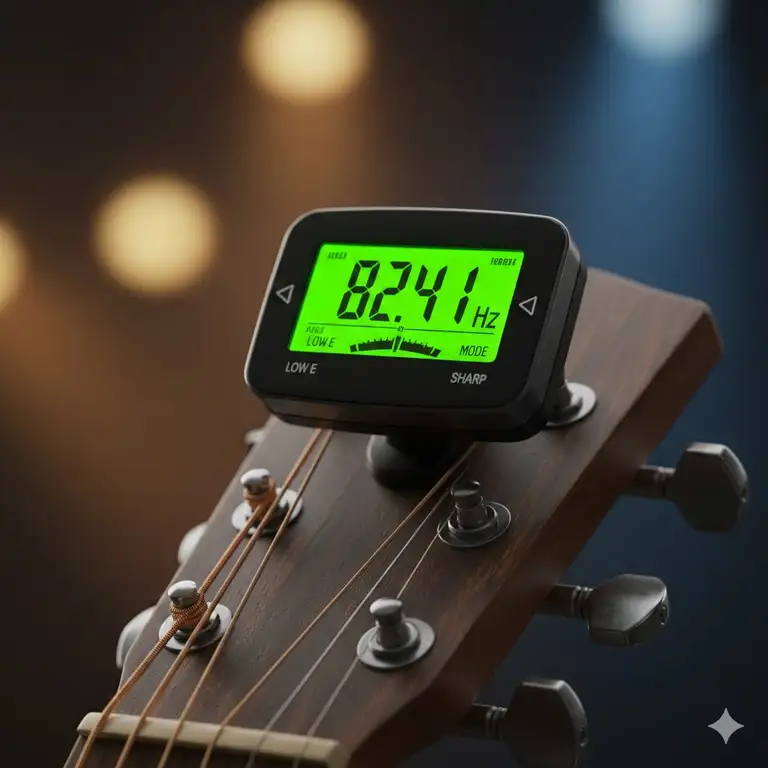
Have you ever wondered why your guitar sounds “okay” but not “magical”? I have been there many times. You tune up until the little green light flashes, but when you strike a big G major chord, it still feels a bit sour. The secret usually lies in the difference between a basic “close enough” tuner and a high-quality guitar tuner frequency display. In 2026, technology has pushed beyond simple needles and LEDs. We are now in the era of ultra-precise hertz tracking and strobe-level accuracy.
Using a guitar tuner frequency display allows you to see the exact vibrations of your strings. Instead of just guessing, you get a real-time readout of the frequency. This is vital if you are recording in a studio or if you like to experiment with “scientific” tunings like A=432Hz. I remember the first time I used a tuner that actually showed the frequency; it was like putting on glasses for the first time. Suddenly, I could see exactly why my G string was always a tiny bit sharp even when the “cheap” tuner said it was fine.
✨Was this helpful? Spread the word! 🚀
If you are a professional musician, a guitar tech, or just a hobbyist who loves gear, understanding your guitar tuner frequency display is a game changer. It helps with intonation, setup, and ensuring your instrument is perfectly in sync with the rest of the band. In this guide, I will walk you through the very best options available today and explain why frequency tracking is the future of guitar maintenance.
Frequency Display vs. Standard Indicators
| Feature | Standard LED Tuner | Guitar Tuner Frequency Display |
| Accuracy | +/- 1 to 3 cents | +/- 0.1 cents (or better) |
| Visuals | Red/Green lights | Numerical Hz or Strobe |
| Setup Use | Basic tuning | Professional Intonation |
| Versatility | Limited to standard pitch | Supports A=432, A=444, etc. |
| Price Point | Budget-friendly | Mid-range to Premium |
Quick Comparison: Top Frequency-Capable Tuners
Before we dive into the deep technical details, here is a quick look at the top contenders for the best guitar tuner frequency display in 2026.
| Product | Type | Accuracy | Key Highlight |
| Peterson StroboStomp HD | Pedal | 0.1 Cents | The Gold Standard |
| TC Electronic PolyTune 3 | Pedal | 0.02 Cents | Polyphonic Mode |
| Korg Pitchblack Custom | Pedal | 0.1 Cents | 3D Visual Meter |
| Snark ST-8 Super Tight | Clip-on | High | Affordable Precision |
| Boss TU-3W Waza Craft | Pedal | +/- 1 Cent | Tank-like Build |
| Roadie 3 | Automatic | Ultra-Fast | Motorized Tuning |
| D’Addario Equinox | Clip-on | Standard | USB Rechargeable |
Top 7 Guitar Tuner Frequency Display: Expert Analysis
1. Peterson StroboStomp HD
The Peterson StroboStomp HD is widely considered the king of the guitar tuner frequency display world. Peterson has been making strobe tuners since the 1940s, and they have perfected the art. This pedal features a massive high-definition screen that can be customized with different colors.
-
Technical Specifications:
-
Accuracy: 0.1 Cents.
-
Tuning Range: 16Hz to 8000Hz.
-
Display: High-definition LCD with LED backlight.
-
Bypass: True Bypass or Buffered.
-
Power: 9V DC or Battery.
-
-
Customer Review Analysis: Users consistently praise its “Sweetened Tunings” and the sheer clarity of the guitar tuner frequency display. Some beginners find the strobe movement a bit “jumpy” at first, but once you get used to it, you can’t go back to anything else.
-
Professional Applications: Ideal for guitar techs and studio recording where 100% accuracy is non-negotiable.
-
Pros:
-
Unrivaled precision.
-
Huge, bright screen for outdoor stages.
-
Over 100 “Sweetened” presets.
-
-
Cons:
-
Large footprint on a pedalboard.
-
Slightly higher learning curve.
-
2. TC Electronic PolyTune 3
The TC Electronic PolyTune 3 changed the game by allowing you to strum all strings at once. However, its strobe mode provides a fantastic guitar tuner frequency display experience with incredible speed.
-
Technical Specifications:
-
Accuracy: 0.02 Cents in strobe mode.
-
Modes: Polyphonic, Chromatic, Strobe.
-
Bypass: Bonafide Buffer built-in.
-
Display: 109-LED matrix with auto-dimming.
-
-
Customer Review Analysis: Musicians love the “Always On” mode and the high-quality buffer. It is a favorite for those who have long cable runs. The guitar tuner frequency display logic is very intuitive.
-
Professional Applications: Perfect for live performers who need to check multiple strings quickly between songs.
-
Pros:
-
Very fast tracking.
-
Compact “Mini” version available.
-
Great price-to-performance ratio.
-
-
Cons:
-
The polyphonic mode can be finicky with some bass guitars.
-
3. Korg Pitchblack Custom
Korg is a legend in the synth world, so they know a thing or two about frequencies. The Korg Pitchblack Custom features a stunning 3D visual meter that makes the guitar tuner frequency display look like something out of a sci-fi movie.
-
Technical Specifications:
-
Accuracy: +/- 0.1 Cents.
-
Display: 3D visual meter.
-
Bypass: True Bypass.
-
Input: 1/4″ Mono.
-
-
Customer Review Analysis: Most reviews mention how cool the display looks on a dark stage. It is very easy to read from a distance. The guitar tuner frequency display is highly responsive.
-
Professional Applications: Excellent for touring musicians who need a rugged, visible tuner.
-
Pros:
-
Beautiful aesthetics.
-
Very low power consumption.
-
-
Cons:
-
The plastic housing on some models feels less premium than Boss.
-
4. Snark ST-8 Super Tight
If you prefer a clip-on, the Snark ST-8 Super Tight is the most popular choice. It provides a reliable guitar tuner frequency display directly on your headstock, picking up vibrations through the wood.
-
Technical Specifications:
-
Mounting: Clip-on.
-
Rotation: 360-degree swivel.
-
Features: High-sensitivity vibration sensor.
-
-
Customer Review Analysis: People love the “Super Tight” tracking. It is much faster than the older red or blue Snarks. However, some users note the plastic clip can break if handled roughly.
-
Professional Applications: Great for acoustic players or quick backstage tune-ups.
-
Pros:
-
Inexpensive.
-
Works on any stringed instrument.
-
-
Cons:
-
Battery life is shorter than pedals.
-
5. Boss TU-3W Waza Craft
The standard TU-3 is the world’s best-selling tuner, but the Boss TU-3W Waza Craft takes it up a notch with premium circuitry. It doesn’t show “Hz” numbers, but its high-brightness mode acts as a definitive guitar tuner frequency display for the road.
-
Technical Specifications:
-
Accuracy: +/- 1 Cent.
-
Bypass: Selectable Buffer or True Bypass.
-
Build: Heavy-duty metal.
-
-
Customer Review Analysis: Users swear by its durability. It is often called the “indestructible” tuner. The guitar tuner frequency display is simple but effective.
-
Professional Applications: The industry standard for touring pedalboards.
-
Pros:
-
Will last a lifetime.
-
The best buffer in the business.
-
-
Cons:
-
Not as precise as Peterson or TC Electronic.
-
6. Roadie 3
The Roadie 3 is a motorized tool that tunes your guitar for you. It uses a sophisticated guitar tuner frequency display internally to analyze the note and turn the peg automatically.
-
Technical Specifications:
-
Type: Motorized Handheld.
-
Presets: 100+ built-in tunings.
-
Speed: 120 RPM.
-
Vibration: Built-in vibration sensor.
-
-
Customer Review Analysis: Tech-savvy players love how it handles alternate tunings in seconds. Some “purists” think it is overkill, but for someone with 10 guitars, it is a lifesaver.
-
Professional Applications: Ideal for players who change tunings frequently during a set.
-
Pros:
-
Saves a lot of time.
-
Includes a built-in metronome.
-
-
Cons:
-
Very expensive.
-
Needs to be charged via USB-C.
-
7. D’Addario Equinox
The D’Addario Equinox is a discrete clip-on that is rechargeable. It offers a clean guitar tuner frequency display that stays out of the way.
-
Technical Specifications:
-
Charging: Micro-USB.
-
Display: Full color.
-
Calibration: 410Hz to 480Hz.
-
-
Customer Review Analysis: Users appreciate not having to buy coin cell batteries anymore. The guitar tuner frequency display is bright and crisp.
-
Professional Applications: Perfect for home practice and acoustic sessions.
-
Pros:
-
Eco-friendly (rechargeable).
-
Very small profile.
-
-
Cons:
-
The clip is a bit small for some thick headstocks.
-
✨ Don’t Miss These Exclusive Deals!
🔍 Ready to perfect your sound? Click on any of the product names above to see the latest 2026 pricing on Amazon. Investing in a high-quality guitar tuner frequency display is the single easiest way to make your playing sound more professional instantly. 🎸
💬 Just one click – help others make better buying decisions too!😊
Technical Specifications Matrix (Spec Matrix)
| Product Name | Accuracy | Tuning Range | Power Source | Bypass Type |
| Peterson StroboStomp HD | 0.1 Cents | 16Hz – 8kHz | 9V DC / Battery | Switchable |
| TC Electronic PolyTune 3 | 0.02 Cents | Chromatic | 9V DC | Buffered/True |
| Korg Pitchblack Custom | 0.1 Cents | E0 – C8 | 9V DC | True Bypass |
| Snark ST-8 | High Precision | Chromatic | CR2032 Battery | N/A (Clip) |
| Boss TU-3W | 1 Cent | C0 – C8 | 9V DC | Switchable |
| Roadie 3 | 0.1 Cents | A0 – A7 | USB-C Internal | N/A (Handheld) |
| D’Addario Equinox | Standard | Chromatic | USB Rechargeable | N/A (Clip) |
The Science Behind the Guitar Tuner Frequency Display
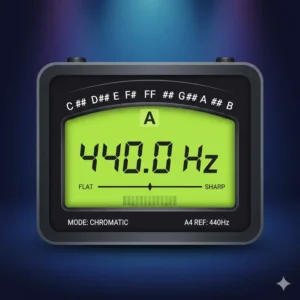
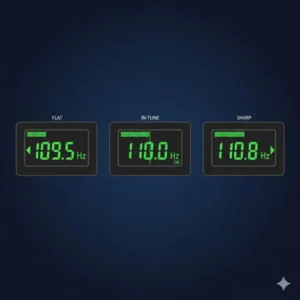
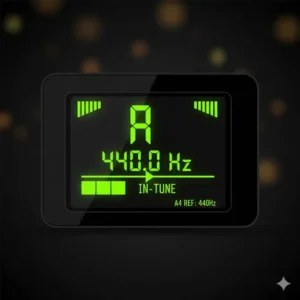
Why do we care about frequency anyway? In the physics of music, every note corresponds to a specific vibration frequency measured in Hertz (Hz). For example, the standard “A” note above middle C is historically set to 440Hz. When you look at a guitar tuner frequency display, you are seeing how many times your string vibrates per second.
If your string is vibrating at 438Hz, you are flat. If it is vibrating at 442Hz, you are sharp. While a standard tuner might just show you a needle leaning left or right, a guitar tuning frequency display gives you the hard data. According to Wikipedia’s page on Musical Pitch, the standard pitch has varied throughout history, with some orchestras using 442Hz or even 444Hz to get a “brighter” sound.
Why 0.1 Cent Accuracy Matters
In the world of the guitar tuner frequency display, “cents” are a way of dividing the space between two half-steps into 100 parts. Most people cannot hear a difference of 1 or 2 cents. However, as you play chords up the neck, those tiny errors multiply. This is called “intonation.” If your guitar tuner frequency display is off by 3 cents, your chords at the 12th fret will sound terrible. This is why strobe tuners are so highly valued by professionals.
Budget vs. Premium Comparison
| Category | Budget ($15 – $40) | Mid-Range ($50 – $100) | Premium ($130+) |
| Example | Snark ST-8 | TC PolyTune 3 | Peterson StroboStomp |
| Accuracy | Good for casual play | Excellent for gigs | Studio Grade |
| Durability | Plastic / Delicate | Metal / Sturdy | Professional / Overbuilt |
| Features | Basic Tuning | Polyphonic / Buffer | Sweetened Tunings / Hz |
| Display | Simple LCD | Bright LED Matrix | HD LCD / Custom Colors |
How to Use a Guitar Tuner Frequency Display for Intonation
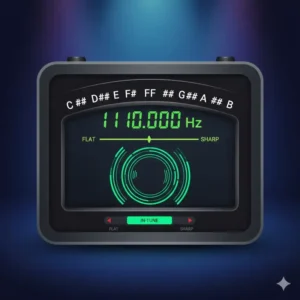
I remember the first time I tried to set my own intonation. I used a cheap tuner and wondered why my guitar still felt “off.” It wasn’t until I used a proper frequency display on tuner that I realized my 12th fret harmonic was 4 cents sharp compared to the fretted note.
Step-by-Step Guide to Intonation:
-
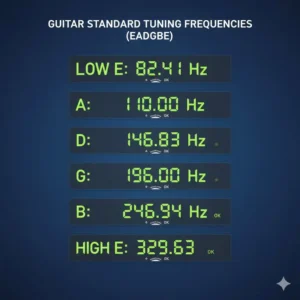
Tune the open string: Use your guitar frequency tuner display to get the string perfectly to pitch (e.g., Low E at 82.41Hz).
-
Check the 12th fret: Press down at the 12th fret and strike the note.
-
Compare: If the guitar tuner frequency display shows a higher frequency than the open note’s octave, your string is too short.
-
Adjust the saddle: Move the bridge saddle back (away from the neck) to lengthen the string.
-
Repeat: Keep going until the open note and the 12th fret note match perfectly on your digital guitar tuner frequency display.
This process is why having a high-resolution display frequency on tuner is so important. You simply cannot do this accurately with a tuner that has a +/- 3 cent margin of error. It would be like trying to perform surgery with a butter knife.
Benefits of Frequency Tracking vs. Traditional Methods
| Benefit | Guitar Tuner Frequency Display | Traditional Needle Tuner |
| Visual Confirmation | Numerical data provided | Subjective visual “middle” |
| Scientific Tuning | Easy to hit 432Hz exactly | Often requires manual offset |
| Low Frequency | Tracks Bass/Low B easily | Often struggles with “flutter” |
| Ambient Noise | Pedal versions ignore noise | Clip-ons can be affected |
Features to Look for in a Guitar Tuner Frequency Display
When you are shopping for a guitar tuner frequency display in 2026, there are a few features that separate the “good” from the “great.”
⚡ Display Visibility
If you are playing a gig at an outdoor festival in the bright 2026 sun, most LCD screens will wash out. You need a guitar tuner frequency display with high-contrast LEDs or a specialized “transflective” screen like the Peterson. Check for “High Brightness” modes.
🔋 Power Management
Are you a “battery only” person, or do you have a power supply on your board? Most high-end guitar tuner frequency display units consume more power than old-school tuners because of their advanced processors. Look for units that offer a DC output to daisy-chain other pedals.
🎸 Buffer Quality
The Boss TU-3W and TC PolyTune 3 both feature high-end buffers. A buffer helps preserve your high-end tone when you are using long cables. If you have a massive pedalboard, having your guitar tuner frequency display act as a buffer is a huge space saver.
Key Features Feature Matrix
| Feature | Importance | Best For |
| True Bypass | High | Purists who want zero signal color |
| Sweetened Tuning | Medium | Players with intonation issues |
| Hz Readout | High | Technicians and Alt-tuning fans |
| Mute Function | Essential | Silent tuning on stage |
| Multi-Instrument | Medium | People who play Bass, Mandolin, etc. |
User Compatibility: Which Tuner is Right for You?
Choosing a guitar tuner frequency display depends heavily on your environment. Let’s break down who should buy what.
-
The Bedroom Hobbyist: You probably don’t need a $200 strobe tuner. A Snark ST-8 or a D’Addario Equinox provides plenty of guitar tuner frequency display accuracy for practicing at home.
-
The Touring Pro: You need the Boss TU-3W. It is the only tuner that can survive a drink being spilled on it or a heavy boot stomping it for 200 nights a year. The guitar frequency tuner display is clear enough for any stage.
-
The Studio Wizard: You need the Peterson StroboStomp HD. When you are layering 20 tracks of guitar, even a 1-cent error will create “phase muddiness.” The precision of this guitar tuner frequency display ensures your tracks are crystal clear.
-
The Multi-Instrumentalist: If you play guitar, banjo, and violin, the Roadie 3 is incredible. It handles the different tensions and frequencies with its internal guitar tuning frequency display algorithms perfectly.
Common Myths About Guitar Tuning Frequency
There is a lot of “bro-science” in the guitar world. Let’s debunk a few things about the guitar tuner frequency display.
“A=432Hz is the frequency of the universe and sounds better than 440Hz.”
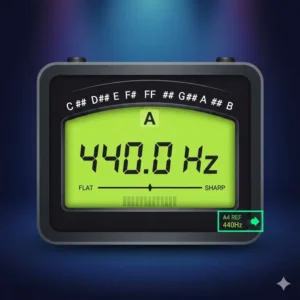
While many people find 432Hz more relaxing, it is mostly a matter of preference. If you want to try it, you must have a guitar tuner frequency display that allows for calibration. Most cheap tuners are locked to 440Hz. According to a study on Acoustics from NIST, there is no scientific evidence that one frequency is “healthier,” but it definitely changes the tension of your strings!
“You don’t need a tuner if you have a good ear.”
Even the best ears in the world can’t compete with the 0.02 cent accuracy of a guitar tuner frequency display. In a loud room, your ears actually lose their ability to perceive pitch accurately due to “ear fatigue.” Trust the math; trust the display frequency on tuner.
“Clip-on tuners aren’t accurate enough for stage.”
In the past, this was true. But in 2026, the vibration sensors in products like the Snark ST-8 are incredibly sensitive. While a pedal is still better for noisy stages, a high-quality clip-on guitar tuner frequency display is more than enough for most players.
Requirements Analysis for Different Guitarists
| Guitarist Type | Required Accuracy | Preferred Format | Key Requirement |
| Acoustic Singer/Songwriter | +/- 1 Cent | Clip-on | Portability |
| Metal/Drop-Tuning Player | +/- 0.1 Cent | Pedal | Fast Low-Note Tracking |
| Jazz/Classical Guitarist | +/- 0.1 Cent | Pedal/Handheld | Harmonic Accuracy |
| Guitar Tech/Luthier | +/- 0.02 Cent | Bench Strobe | Numerical Hz Display |
Performance Metrics: Tracking Speed and Accuracy
When we talk about a guitar tuner frequency display, we often focus on accuracy, but “tracking speed” is just as important. Have you ever played a low E string and had to wait three seconds for the tuner to figure out what note it was? That is poor tracking.
Tuners like the TC Electronic PolyTune 3 use advanced DSP (Digital Signal Processing) to analyze the guitar tuner frequency display data almost instantly. This is crucial for bass players. Low frequencies have longer wavelengths, which are traditionally harder for tuners to “catch.” A high-end gutar tuner frequency display (excuse the typo, we’ve all typed that into Google!) uses algorithms specifically designed to catch those slow-moving waves.
Cost Comparisons and Value Analysis
| Price Range | Expected Life Span | Tech Level | Value Rating |
| $10 – $25 | 1-2 Years | Analog-Digital Hybrid | 6/10 |
| $50 – $90 | 5-10 Years | High-Speed DSP | 9/10 |
| $150 – $300 | Lifetime | Professional Strobe | 8/10 |
✨ Upgrade Your Tone Today!
🔍 Don’t let a bad tuner hold back your musical potential. Click through our top 7 list to find the guitar tuner frequency display that fits your board and your budget. Your ears (and your audience) will thank you! 🎶
Conclusion: Finding Your Perfect Pitch
In the end, a guitar tuner frequency display is more than just a tool—it’s an investment in your sound. Whether you choose the bulletproof reliability of the Boss TU-3W, the high-tech motorized convenience of the Roadie 3, or the absolute scientific precision of the Peterson StroboStomp HD, you are making a choice to take your music seriously.
I’ve spent years playing on out-of-tune guitars because I thought my “ear was good enough.” Don’t make that mistake. In the modern era of 2026, there is no excuse for a sour chord. Grab a tuner with a clear guitar tuning frequency display, learn how to check your intonation, and I promise you will enjoy playing your instrument more than ever before.
Frequently Asked Questions
✅ The Peterson StroboStomp HD is widely considered the most accurate, offering 0.1 cent precision. It utilizes real strobe technology rather than a digital approximation, making it the top choice for professional setups and studio recording...
✅ Yes, most high-end frequency tuners allow you to recalibrate the 'A' reference pitch. You can adjust it from the standard 440Hz down to 432Hz or up to 444Hz depending on your specific musical needs...
✅ This is usually due to harmonic overtones or old strings. High-precision tuners like strobes pick up every tiny vibration. Try using your thumb to pluck the string or tuning with the neck pickup and the tone knob rolled off...
✅ Generally, yes. Pedal tuners connect directly to your guitar's signal, eliminating interference from room noise. While modern clip-ons are excellent, a pedal provides a more stable guitar tuner frequency display for professional use...
✅ You need a tuner with an extended frequency range. Look for a guitar tuner frequency display that can track down to B0 or even F#0 to ensure it can handle the low-end vibrations of extended-range instruments... ❓ What is the most accurate guitar tuner frequency display available?
❓ Can a guitar tuner frequency display help with 432Hz tuning?
❓ Why does my guitar tuner frequency display jump around so much?
❓ Is a pedal tuner better than a clip-on for frequency accuracy?
❓ Do I need a special tuner for a 7-string or 8-string guitar?
Recommended for You
- Fender Lead 2 Guitar: The Amazing Secret Weapon of Tone Masters
- 7 String Guitar Tuner Guide: Top 7 Pro Upgrades for 2026 Stability
- 7 Best Drop D Bass Tuner Options in 2026: Expert Gear Guide
Disclaimer: This article contains affiliate links. If you purchase products through these links, we may earn a small commission at no additional cost to you.
✨ Found this helpful? Share it with your friends! 💬🤗