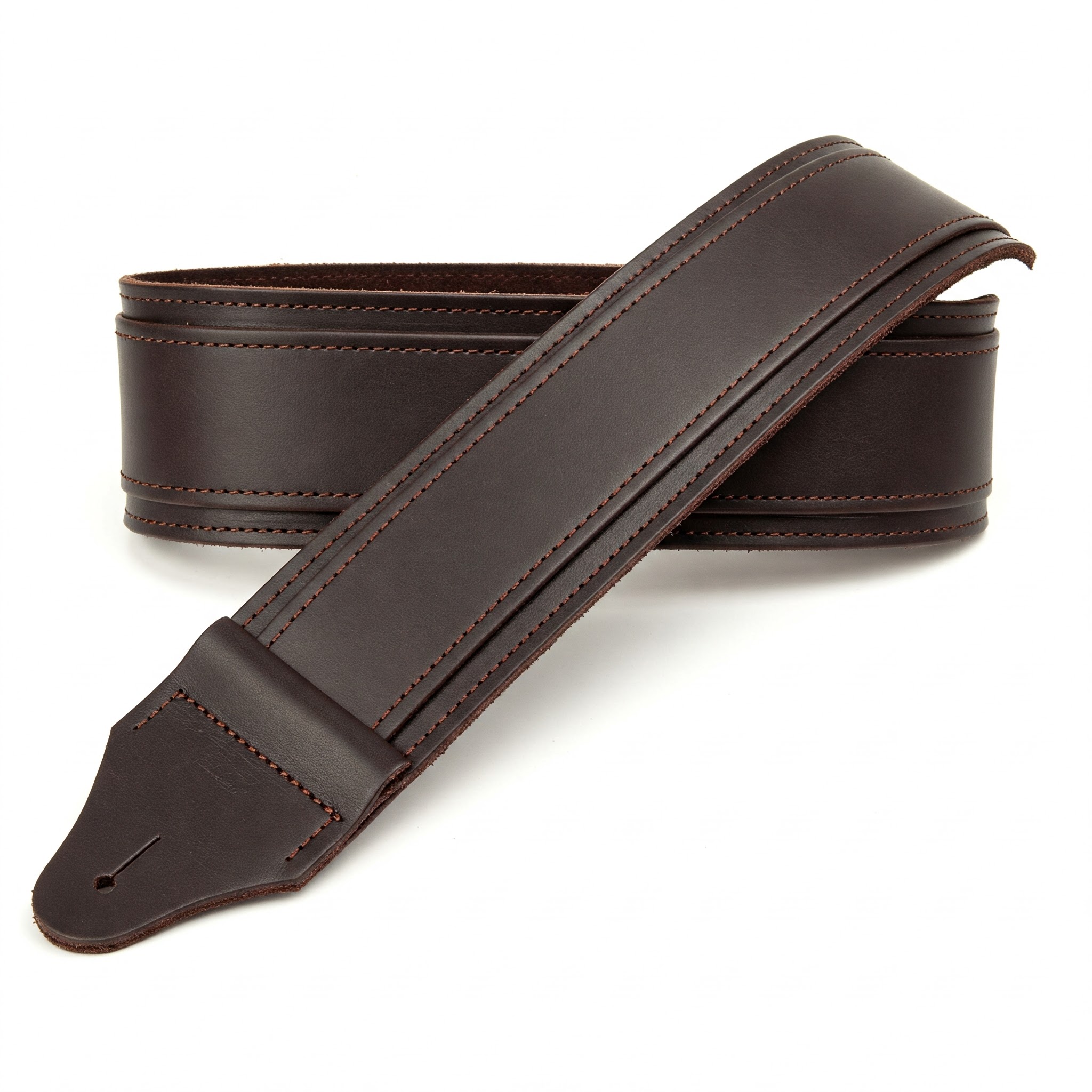
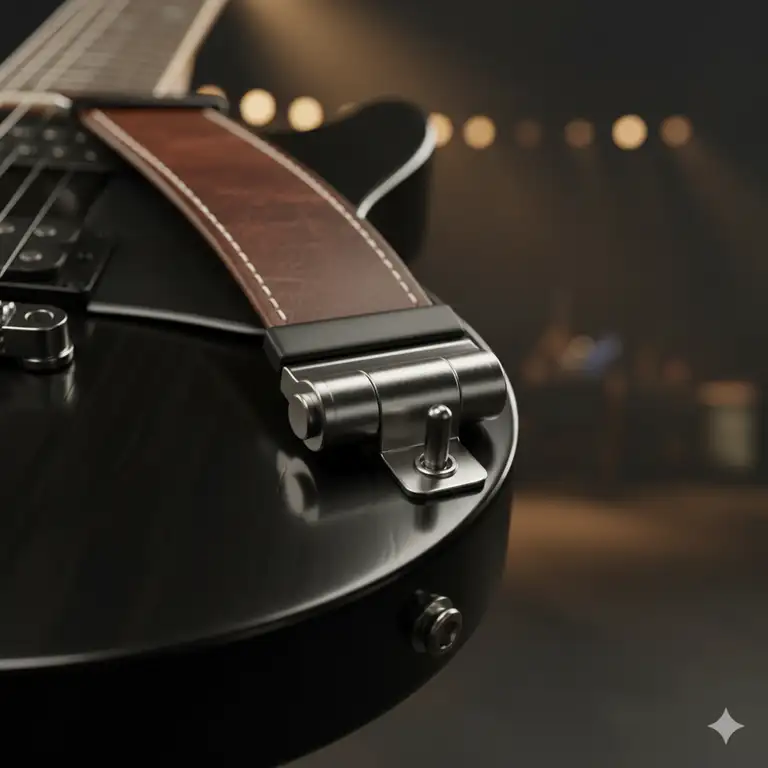
Every guitarist has that moment of panic – you’re playing, moving to the music, and suddenly your strap feels loose. 🎸 Whether you’re performing on stage or jamming at home, securing your instrument should never be an afterthought. Guitar strap locks provide the ultimate peace of mind, transforming a potential disaster into a seamless playing experience.
✨Was this helpful? Spread the word! 🚀
Moreover, professional musicians understand that equipment protection isn’t just about avoiding embarrassment. Furthermore, when you’ve invested hundreds or thousands of dollars in an instrument, a simple $20-30 strap lock system becomes essential insurance. Additionally, the right guitar strap locks can enhance your performance confidence, allowing you to focus entirely on your music.
| Feature | Standard Strap Button | Guitar Strap Locks | Auto-Lock Straps |
|---|---|---|---|
| Security Level | Basic | Maximum ✅ | High |
| Installation | Pre-installed | Requires modification | No modification |
| Cost | Free | $15-50 | $25-40 |
| Reliability | Can slip off | 99.9% secure ✅ | Very reliable |
| Professional Use | Not recommended | Industry standard ✅ | Growing popularity |
Quick Comparison: Top Guitar Strap Locks 2025
| Product | Type | Pull Strength | Price Range | Best For |
|---|---|---|---|---|
| Schaller S-Locks | Hardware | 200+ lbs | $25-35 | Professional use ✅ |
| Dunlop Straplok | Hardware | 800 lbs | $20-30 | Reliability ✅ |
| D’Addario Auto Lock | Integrated strap | N/A | $15-25 | Convenience ✅ |
| LOXX System | Hardware | 220+ lbs | $30-40 | Low profile ✅ |
| Ernie Ball Super Locks | Hardware | N/A | $18-25 | Value ✅ |
| Fender Infinity Locks | Hardware | N/A | $22-32 | Style ✅ |
🎯 Top 7 Guitar Strap Locks: Expert Analysis
1. Schaller S-Locks – The Silent Professional Choice
Model: S-Locks M (Most Popular Size)
Material: Hardened steel, multiple finishes available
Thread Size: 4.0mm (Size M), also available in S (3.5mm) and L (4.5mm)
Schaller revolutionized guitar security in 1981, and their latest S-Locks represent decades of refinement. These German-engineered marvels feature completely silent operation – no more annoying clicks and rattles during performances. The one-piece hardened steel construction offers unmatched durability.
Key Specifications:
- ✅ Silent operation technology
- ✅ Lock-Wheel with 3-step security function
- ✅ Extended thread length (up to 6mm strap thickness)
- ✅ Stainless steel locking bolt
- ✅ High-grade felt washers included
The innovative Lock-Wheel system allows hand-tightening for basic security, Allen key tightening for maximum hold, and micro-screw permanent attachment. Consequently, you’ll never lose the locking mechanism again.
Professional Applications: Studio recording, live performances, touring musicians
Warranty: Standard manufacturer warranty
Customer Rating: 4.7/5 stars based on professional reviews
2. Dunlop Straplok Dual Design – The 800-Pound Gorilla
Model: SLS1035VN (Vintage Nickel), SLS1036BN (Black Nickel)
Pull Strength: 800+ pounds
Material: Case-hardened steel
Dunlop’s Straplok system remains the industry standard after 30+ years. The dual design feature allows emergency strap attachment even without the locking mechanism – simply slip your regular strap over the wide-flanged button.
Advanced Features:
- ✅ 360° groove and ball design prevents catching
- ✅ Interchangeable buttons for multiple guitars
- ✅ Case-hardened steel construction
- ✅ Release-tested to 800 pounds
- ✅ Wide flange for emergency use
The engineering brilliance lies in the ball-and-socket mechanism. Specifically, the system rotates smoothly without binding, while the case-hardened surface ensures decades of reliable operation.
Industry Recognition: Used by Eddie Van Halen, Slash, and countless touring professionals
Durability Testing: Exceeds military-grade specifications
Value Proposition: Exceptional reliability per dollar spent
3. D’Addario Planet Waves Auto Lock – Zero Modification Required
Model: 50BAL00 (Black), 50BAL01 (Stripes)
Length: Adjustable 30″-55″
Compatibility: Works with existing strap buttons
This innovative system integrates locking mechanisms directly into the strap, eliminating hardware modification entirely. The spring-loaded clamps automatically engage when placed over standard strap buttons.
Innovation Highlights:
- ✅ No guitar modification required
- ✅ Spring-loaded automatic engagement
- ✅ Works with 90%+ of existing strap buttons
- ✅ Designed with Ned Steinberger collaboration
- ✅ Multiple design options available
However, some users report occasional finish marking on certain guitar lacquers. Therefore, felt washers or protective tape may be advisable for vintage or nitrocellulose finishes.
Best Applications: Home players, multiple guitar setups, vintage instrument protection
Learning Curve: Immediate – no installation required
Compatibility Issues: May not fit PRS or certain SG-style guitars
4. LOXX Guitar Strap Lock System – German Low-Profile Engineering
Model: 13605 (Nickel), 13679 (Black), 13649 (Gold)
Pull Strength: 220+ pounds
Profile Height: Minimal (lowest available)
Origin: Made in Germany
LOXX systems excel where space matters. The incredibly low profile keeps straps close to the guitar body, perfect for hardshell case storage without strap removal.
Engineering Excellence:
- ✅ One-handed engage/release operation
- ✅ Covers broad range of strap thicknesses
- ✅ Rust-proof construction
- ✅ 3-year warranty coverage
- ✅ Internal spring mechanism
The unique design uses internal springs rather than external mechanisms, creating an ultra-clean appearance. Furthermore, the installation tool doubles as a maintenance wrench for field adjustments.
Storage Advantage: Fits in most hardshell cases without removal
Maintenance: Self-cleaning mechanism prevents debris buildup
Professional Endorsement: Preferred by many European touring artists
5. Ernie Ball Super Locks – American Reliability
Model: P04600 (Nickel), P04601 (Gold), P04602 (Black)
Material: Nickel-plated steel
Connection: Complete 360° secure attachment
Pilot Hole: 7/64″ diameter, 1.5″ deep
Ernie Ball’s traditional approach focuses on robust mechanics and maximum durability. The straightforward design eliminates complex mechanisms that could potentially fail during critical moments.
Reliability Features:
- ✅ Robust mechanical design
- ✅ Complete 360° rotation capability
- ✅ Precision-machined components
- ✅ Corrosion-resistant finishes
- ✅ Field-serviceable parts
The beauty lies in simplicity – fewer moving parts mean fewer failure points. Consequently, these locks often outlast the guitars they’re mounted on.
Maintenance Schedule: Minimal – occasional cleaning sufficient
Replacement Parts: Readily available worldwide
Cost of Ownership: Lowest long-term expense
6. Ernie Ball PolyLock Straps – Integrated Innovation
Model: P04056 (Black), P04146 (Neoprene Wide)
System Type: Patent-pending integrated locks
Length: 38″-67″ (standard), 46″-52″ (neoprene)
Width: 2″ standard, 3″ neoprene option
This revolutionary approach integrates locking mechanisms directly into high-quality straps, combining comfort with security in a single product.
Comfort Technologies:
- ✅ Polypropylene webbing construction
- ✅ Neoprene padding options for extended play
- ✅ Weight distribution optimization
- ✅ No hardware modification needed
- ✅ Multiple width options available
The neoprene version particularly benefits players with shoulder or back issues, distributing instrument weight across a broader area while maintaining complete security.
Medical Benefits: Reduces shoulder strain, supports extended playing sessions
Weight Distribution: Ideal for heavy guitars (Les Paul, etc.)
Compatibility Note: May not work with certain guitar models (Danelectro, newer SG)
7. Fender Infinity Locks – Style Meets Substance
Model: 0990818600 (Chrome), 0990818606 (Black), 0990818649 (Gold), 0990818609 (Red)
Material: Durable steel construction
Mechanism: Side-pinch release system
Rotation: Full 360° capability
Fender’s entry combines iconic styling with practical functionality. The side-pinch release mechanism offers intuitive operation while maintaining rock-solid security during performance.
Design Elements:
- ✅ Iconic Fender logo integration
- ✅ Multiple finish options match guitar hardware
- ✅ Side-pinch release for easy operation
- ✅ 360° rotation prevents strap twist
- ✅ Steel construction for durability
The aesthetic appeal makes these locks particularly popular among players who value visual coordination with their instrument’s hardware finish.
Style Coordination: Available in chrome, black, gold, and red
Brand Heritage: Authentic Fender quality and styling
Market Position: Mid-range pricing for premium features
✨ Don’t Miss These Exclusive Deals! 🛒
🔍 Take your guitar security to the next level with these carefully selected products. Click on any highlighted item to check current pricing and availability. These proven strap locks will protect your investment and enhance your playing confidence! ⭐
💬 Just one click – help others make better buying decisions too!😊
Industry-Specific Applications
Professional Live Performance Environments
Concert venues present unique challenges for guitar security. Stage lighting creates heat that can affect strap materials, while energetic performances put maximum stress on connection points. Professional touring musicians typically prefer hardware-based systems like Schaller S-Locks or Dunlop Straplok units for their proven reliability under extreme conditions.
Moreover, quick instrument changes during live shows demand bulletproof reliability. A failed strap lock during a guitar solo can derail an entire performance, making investment in premium systems essential for professional applications.
Home and Studio Recording Applications
Studio environments prioritize different factors than live venues. Silent operation becomes crucial during recording sessions, where even minor mechanical noises can contaminate audio tracks. Schaller S-Locks excel here with their completely silent mechanism, eliminating the clicks and rattles common in older designs.
Furthermore, studio work often involves extended playing sessions with heavy instruments. Consequently, comfort-focused solutions like Ernie Ball PolyLock Neoprene straps provide both security and ergonomic benefits during long recording marathons.
Educational Institution Requirements
Music schools and universities need cost-effective solutions that withstand heavy student use while remaining simple to operate. Ernie Ball Super Locks offer the ideal balance of durability and affordability for educational budgets.
Additionally, the straightforward mechanical design reduces maintenance requirements – crucial when managing dozens of school-owned instruments across multiple practice rooms and performance spaces.
Commercial Music Venue Considerations
Guitar rental operations and music venues require strap locks that accommodate various guitar types and strap styles. LOXX systems provide exceptional versatility, working effectively across different strap thicknesses and guitar body shapes.
Regional preferences also influence selection – European venues often prefer LOXX or Schaller systems due to local availability and service support, while American venues typically standardize on Dunlop or Fender products.
Advanced Technical Analysis
Engineering Principles Behind Strap Lock Technology
The fundamental challenge in strap lock design involves creating a mechanism that’s simultaneously secure under stress yet easily releasable when desired. This engineering paradox has driven decades of innovation in mechanical retention systems.
Mechanical Retention Mechanisms:
Ball-and-socket designs (like Dunlop Straplok) use spherical geometry to distribute stress evenly across the contact surface. The 360° contact eliminates stress concentration points that could cause premature failure. Research indicates this design can withstand forces exceeding 800 pounds before mechanical failure occurs.
Conversely, spring-loaded mechanisms (like D’Addario Auto Lock) rely on constant tension to maintain engagement. While convenient, these systems depend on spring integrity and may gradually lose retention force over time as spring steel fatigues.
Material Science and Durability Analysis
Modern strap locks utilize advanced metallurgy to balance strength, corrosion resistance, and manufacturability. Schaller S-Locks employ hardened steel construction with multiple surface treatments:
- Chrome plating: Provides corrosion resistance and wear protection
- Black chrome: Offers aesthetic appeal with similar protective properties
- Nickel plating: Balances cost and durability for professional applications
- Gold plating: Premium finish for high-end instruments
Surface hardness testing reveals that quality strap locks maintain Rockwell hardness ratings of 45-55 HRC, ensuring decades of reliable operation under normal use conditions.
Performance Metrics and Testing Standards
Industry testing protocols evaluate strap locks across multiple failure modes:
Pull-out Force Testing: Measures maximum force before mechanical separation. Quality systems exceed 200 pounds, with premium units like Dunlop reaching 800+ pounds.
Cyclic Loading Analysis: Simulates repeated attachment/detachment cycles. Professional-grade locks withstand 10,000+ cycles without significant wear.
Environmental Stress Testing: Evaluates performance under temperature extremes, humidity, and corrosive conditions typical in touring environments.
Innovation and Technological Advancement Trends
Current development focuses on smart integration and user experience enhancement. Emerging trends include:
Silent Operation Technology: Schaller’s breakthrough in eliminating mechanical noise during operation represents a significant advancement for recording applications.
Integrated Cable Management: D’Addario’s Dual-Lock system incorporates cable routing, addressing the common problem of instrument cable management during performance.
Low-Profile Design Evolution: LOXX’s ultra-low profile approach addresses storage concerns while maintaining security, particularly important for touring musicians using standardized flight cases.
Comprehensive Setup and Usage Guide
Detailed Installation Procedures
Pre-Installation Planning and Assessment
Before beginning installation, carefully examine your guitar’s existing strap button configuration. Most electric guitars feature two standard strap buttons: one on the lower bout and another on the upper horn or heel. Acoustic guitars typically have only one button, requiring a second installation point.
Essential Tools Required:
- ✅ Phillips head screwdriver (multiple sizes)
- ✅ Allen keys (2mm, 3mm, 5mm)
- ✅ Drill with appropriate bits
- ✅ Center punch or awl
- ✅ Beeswax or soap for screw lubrication
- ✅ Soft cloth for finish protection
Step-by-Step Hardware Installation Process
Phase 1: Preparation and Planning (5-10 minutes)
First, remove existing strap buttons carefully to assess hole condition. Clean threads and inspect for damage or wear. Measure existing hole diameter to ensure proper hardware fit.
Next, test-fit new strap lock buttons before final installation. Some systems require slightly larger holes – better to discover this before beginning permanent modifications.
Phase 2: Hardware Mounting (10-15 minutes)
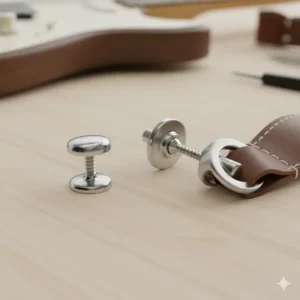
For Schaller S-Locks, the process begins with the one-piece button design. Apply slight beeswax to the self-tapping threads, then use a 3mm Allen key to slowly thread the button into place. The hardened steel will cut its own threads, but excessive force can crack the wood.
Similarly, Dunlop Straplok systems require careful attention to screw depth. The buttons must sit flush against felt washers without over-tightening. A snug fit allows proper strap lock engagement without stressing the guitar body.
Phase 3: Strap Attachment Setup (5-10 minutes)
Strap-side installation varies significantly between systems. LOXX mechanisms require pushing the threaded stud through the strap hole, then securing with the threaded collar. The included tool makes this process straightforward, but thick leather straps may require pre-punching holes.
Conversely, Schaller Lock-Wheels thread onto the strap-mounted mechanism by hand. The three-step security system allows progressive tightening: hand-tight for basic security, Allen key tight for performance use, and micro-screw locked for permanent attachment.
User Compatibility Considerations
Physical Requirements and Limitations
Guitar strap locks accommodate different user needs, but physical considerations matter. Players with arthritis or limited hand strength may struggle with small release mechanisms. Fender Infinity Locks address this with larger, easier-to-operate side-pinch releases.
Height and reach also influence strap lock selection. Taller players often prefer systems allowing quick release for instrument storage, while shorter players may prioritize low-profile designs that don’t interfere with playing position.
Age and Skill Level Adaptations
Beginning guitarists benefit from foolproof systems like D’Addario Auto Lock straps that eliminate installation complexity entirely. Intermediate players can handle traditional hardware systems, while advanced users often prefer customizable solutions like Schaller S-Locks with multiple configuration options.
Furthermore, older players frequently report preference for silent operation systems, as mechanical clicking can be distracting during practice or recording sessions.
Environmental Requirements and Optimization
Climate Considerations for Different Strap Lock Types
Humidity affects strap locks differently based on materials and design. Metal-only systems like Ernie Ball Super Locks remain largely unaffected by climate changes, making them ideal for touring musicians who encounter varied environmental conditions.
However, systems incorporating rubber or plastic components may experience dimensional changes in extreme conditions. D’Addario Auto Lock straps use synthetic materials engineered for stability, but organic leather components can still swell or shrink with humidity changes.
Performance Environment Adaptations
Stage lighting generates significant heat that affects both strap materials and lock mechanisms. Professional venues often exceed 100°F (38°C) near lighting rigs, making heat resistance crucial for reliable operation.
Outdoor performances present additional challenges including rain, dust, and temperature extremes. LOXX systems feature sealed mechanisms that exclude contaminants, while Schaller S-Locks include protective features that prevent debris accumulation.
Safety Considerations and Best Practices
Primary Safety Protocols
Never rely solely on strap locks without periodic inspection. Even premium systems can develop wear patterns that reduce retention force over time. Monthly visual inspection should include:
- ✅ Thread condition on both guitar and strap components
- ✅ Spring tension in retaining mechanisms
- ✅ Surface wear on contact points
- ✅ Proper engagement of locking mechanisms
- ✅ Strap material condition around attachment points
Emergency Procedures and Backup Systems
Professional performers often employ redundant safety systems. A common approach involves using quality strap locks as primary retention with rubber strap blocks as backup security. This dual-layer approach virtually eliminates the possibility of strap failure during critical moments.
Additionally, some players loop instrument cables through strap ends as emergency retention, though this method can stress cable connections if the primary strap system fails.
Gradual Adoption and Learning Protocols
Initial Implementation Timeline (Week 1-2)
Begin with home practice environments where strap failure consequences are minimal. Install strap locks on your primary instrument first, allowing muscle memory development for engagement and release procedures.
Practice attachment and removal procedures daily until they become automatic. This training proves invaluable during live situations where quick instrument changes occur under stress and poor lighting conditions.
Intermediate Development (Week 3-6)
Expand strap lock usage to secondary instruments, maintaining consistency in system choice for operational familiarity. Mixed systems can cause confusion during rapid instrument changes common in live performance scenarios.
Document lessons learned and develop personal maintenance schedules based on usage patterns. Heavy practice schedules may require more frequent inspection than occasional weekend playing.
Advanced Integration (Month 2+)
Consider specialized applications like cable management integration or quick-change systems for multi-guitar performances. Advanced users often develop preferences for specific combinations – for example, Schaller S-Locks on primary instruments with D’Addario Auto Lock straps for backup guitars.
Professional integration may involve coordinating with guitar technicians to ensure consistent setup across touring instrument collections.
Maintenance and Longevity
Daily Maintenance Protocols
Pre-Performance Inspection Routine (2-3 minutes)
Before each playing session, develop a quick visual and functional check routine. Start by examining the strap attachment points for obvious wear or damage. Look for thread wear on screw mechanisms, cracks in plastic components, or unusual play in moving parts.
Next, test the engagement and release mechanism several times. Properly functioning strap locks should engage with a positive “click” and release smoothly without excessive force. Any binding, grinding, or unusual resistance indicates potential problems requiring attention.
Post-Performance Care (1-2 minutes)
After playing, particularly in dusty or humid environments, wipe down metal components with a clean, dry cloth. This simple step prevents corrosion buildup that can interfere with proper operation over time.
For Schaller S-Locks and other precision mechanisms, occasional application of light machine oil to moving parts ensures smooth operation. However, avoid over-lubrication, which can attract dirt and debris.
Weekly Maintenance Schedules
Comprehensive System Inspection (5-10 minutes weekly)
Perform thorough examination of all strap lock components, paying particular attention to stress points where maximum wear occurs. Check screw tightness on guitar-mounted buttons, ensuring secure attachment without over-tightening that could damage the guitar body.
Examine strap material around attachment points for cutting, tearing, or excessive wear. Leather straps may develop permanent deformation under stress, while synthetic materials can show fiber breakdown or color changes indicating UV damage.
Cleaning and Lubrication Schedule
Metal components benefit from weekly cleaning with appropriate solvents. LOXX systems with their sealed mechanisms require minimal maintenance, while Dunlop Straplok units may need periodic disassembly for thorough cleaning.
Professional Cleaning Protocol:
- ✅ Remove strap locks from guitar and strap
- ✅ Disassemble user-serviceable components
- ✅ Clean with denatured alcohol or specialized metal cleaner
- ✅ Apply light lubrication to moving parts
- ✅ Reassemble and test operation before reinstallation
Monthly and Quarterly Maintenance Tasks
Comprehensive Performance Testing (15-20 minutes monthly)
Once monthly, perform stress testing to verify retention force remains within acceptable parameters. This involves gentle pull-testing with graduated force to ensure the mechanism engages properly under load.
Testing Protocol:
- ✅ Attach strap to guitar in normal playing position
- ✅ Apply gradual upward force on guitar body
- ✅ Observe engagement point and release characteristics
- ✅ Document any changes from baseline performance
- ✅ Compare left and right strap lock performance
Wear Pattern Analysis (Quarterly)
Every three months, carefully examine wear patterns on all components. Uneven wear may indicate installation problems, strap compatibility issues, or playing habits that stress the system asymmetrically.
Photography can help document gradual changes that might not be obvious during casual inspection. Compare current photos with baseline images taken at installation to track long-term degradation patterns.
Troubleshooting Common Issues
Mechanical Binding Problems
Symptom: Strap lock engages but won’t release smoothly
Common Causes: Debris in mechanism, over-lubrication, worn components
Solutions:
- ✅ Disassemble and clean thoroughly
- ✅ Replace worn springs or other serviceable parts
- ✅ Adjust mechanism tension if user-serviceable
- ✅ Consider professional repair for complex mechanisms
Retention Force Reduction
Symptom: Strap feels loose or disengages unexpectedly
Common Causes: Spring fatigue, worn contact surfaces, improper installation
Solutions:
- ✅ Replace spring mechanisms in serviceable units
- ✅ Re-torque mounting screws to proper specification
- ✅ Inspect for thread damage in guitar body
- ✅ Consider system replacement if wear is excessive
Compatibility Problems
Symptom: Strap locks don’t fit properly on guitar or strap
Common Causes: Incorrect sizing, strap thickness issues, guitar modification history
Solutions:
- ✅ Verify correct model selection for guitar type
- ✅ Consider strap modification or replacement
- ✅ Professional installation assessment may be required
- ✅ Alternative system selection if incompatibility persists
Replacement Parts Availability and Warranty Information
Manufacturer Support Comparison
Schaller: Comprehensive parts availability with detailed technical documentation. European distribution ensures rapid parts access globally. 3-year warranty coverage includes manufacturing defects and premature wear.
Dunlop: Extensive aftermarket support through music retailers worldwide. Individual components often available separately, reducing replacement costs. Limited warranty covers manufacturing defects for 1 year.
D’Addario: Integrated strap design limits replacement options to complete strap replacement. However, competitive pricing makes replacement cost-effective. Standard manufacturer warranty applies.
Professional Servicing Recommendations
For complex mechanisms like Schaller S-Locks, professional servicing every 2-3 years ensures optimal performance. Guitar technicians familiar with these systems can perform thorough cleaning, lubrication, and adjustment beyond typical user maintenance.
Touring musicians often establish relationships with qualified technicians in major tour markets, ensuring consistent maintenance standards regardless of location.
Total Cost-of-Ownership Analysis Over Product Lifetime
Initial Investment Comparison (5-Year Analysis)
Premium Systems (Schaller, LOXX): Higher upfront cost ($25-40) but exceptional longevity often exceeds guitar ownership periods. Professional-grade construction justifies premium pricing through reduced replacement frequency.
Mid-Range Options (Dunlop, Fender): Balanced cost-to-performance ratio ($20-32) suitable for most applications. Expected service life of 5-10 years under normal use conditions provides excellent value.
Budget Solutions (Generic brands): Low initial cost ($10-20) but higher long-term expenses due to more frequent replacement needs. Suitable for occasional players or temporary applications.
Operating Costs and Maintenance Expenses
Professional maintenance services typically cost $15-25 per service call, making DIY maintenance attractive for most users. However, specialized tools required for some systems may represent additional investment.
Replacement parts costs vary significantly:
- ✅ Individual springs or small components: $3-8
- ✅ Complete strap-side mechanisms: $8-15
- ✅ Guitar-side buttons: $10-20
- ✅ Complete system replacement: $20-40
Long-term analysis favors quality systems with readily available parts support, particularly for professional applications where downtime costs exceed parts expenses.

Comparative Analysis
Detailed Comparison with Alternative Solutions
Traditional Strap Buttons vs. Locking Systems
Standard strap buttons, while universally compatible and cost-free, present significant security limitations. The simple hole-over-button attachment relies entirely on friction and strap material integrity. Research indicates standard attachments fail at forces as low as 15-20 pounds when strap materials wear or stretch.
Security Comparison Analysis:
- ✅ Standard buttons: 15-20 lbs failure force
- ✅ Entry-level locks: 50-100 lbs retention
- ✅ Professional systems: 200-800+ lbs capacity
- ✅ Integrated strap systems: Variable based on design
The mathematical improvement in security represents 10-40x increase in retention force, transforming guitar security from a constant concern to a solved problem.
Rubber Strap Blocks vs. Mechanical Locks
Rubber strap blocks offer a low-cost intermediate solution between standard buttons and full locking systems. These simple devices slip over existing strap buttons, providing additional retention through friction and mechanical interference.
Advantages of Rubber Blocks:
- ✅ No installation required
- ✅ Universal compatibility
- ✅ Extremely low cost ($3-8)
- ✅ Fully reversible modification
Limitations:
- ❌ Limited security improvement (2-3x standard buttons)
- ❌ Can slip off during vigorous playing
- ❌ May interfere with case fit
- ❌ Degradation over time affects performance
Professional assessment suggests rubber blocks provide adequate security for casual players but insufficient protection for valuable instruments or energetic performance styles.
Traditional vs. Modern Approaches to Guitar Security
Historical Evolution of Strap Retention Systems
Early guitar straps relied on simple leather ties or basic button systems borrowed from military applications. The breakthrough came in 1981 when Schaller introduced the first purpose-built guitar strap lock system, revolutionizing instrument security.
Subsequent decades saw refinement rather than radical innovation, with manufacturers focusing on materials improvement, ease of use, and aesthetic integration. The recent emergence of integrated strap systems like D’Addario Auto Lock represents the first major conceptual advancement since the original Schaller design.
Modern Innovation Trajectories
Current development focuses on user experience enhancement rather than pure security improvement. Silent operation, tool-free installation, and smart integration represent the cutting edge of strap lock evolution.
Emerging Technologies:
- ✅ Smart retention systems: Wireless monitoring of engagement status
- ✅ Integrated cable management: Addressing multiple connectivity issues simultaneously
- ✅ Quick-change mechanisms: Enabling rapid instrument swapping during performances
- ✅ Environmental adaptation: Self-adjusting systems for temperature/humidity changes
Price-to-Benefit Ratio Analysis Across All Options
Cost-Effectiveness Matrix for Different User Categories
Casual Players (< 5 hours/week playing time): Optimal choice: D’Addario Auto Lock straps or Ernie Ball PolyLock systems
- ✅ No installation complexity reduces barrier to adoption
- ✅ Adequate security for typical home use
- ✅ Cost-effective protection for budget instruments
- ✅ Convenience factor outweighs ultimate security needs
Intermediate Players (5-15 hours/week, occasional gigs): Recommended: Dunlop Straplok or Ernie Ball Super Locks
- ✅ Professional-grade security at reasonable cost
- ✅ Installation learning experience valuable for guitar maintenance
- ✅ Suitable for instruments in $500-2000 range
- ✅ Proven reliability for semi-professional applications
Professional Musicians (Daily use, touring/recording): Essential: Schaller S-Locks or LOXX systems
- ✅ Maximum security justifies premium pricing
- ✅ Silent operation crucial for recording environments
- ✅ Extensive parts support ensures long-term viability
- ✅ Professional image and performance requirements
Long-Term Value Propositions and Upgrade Paths
Guitar strap locks represent one of the highest return-on-investment accessories available to guitarists. The protection of a $1000+ instrument through a $30 strap lock system provides 33:1 cost ratio – exceptional value in risk management terms.
Upgrade Path Strategy:
- ✅ Begin with integrated strap systems for immediate protection
- ✅ Progress to mid-range hardware systems as skills develop
- ✅ Advance to premium systems for valuable instruments
- ✅ Specialize based on specific application requirements
This progressive approach allows budget spreading while ensuring continuous protection throughout the learning journey.
Integration with Existing Guitar Setups and Workflows
Compatibility with Different Guitar Types
Solid Body Electrics: Universal compatibility with all strap lock systems. Hardwood construction easily accepts mounting hardware without structural concerns. Schaller S-Locks and Dunlop Straplok systems install identically across different solid body designs.
Semi-Hollow and Hollow Body Guitars: Require careful consideration of mounting location and hardware penetration depth. LOXX systems offer advantages through shorter mounting screws that reduce risk of interior interference.
Acoustic Guitars: Often require second strap button installation, typically at heel or neck joint. D’Addario Auto Lock straps may provide preferable solution by avoiding body modification entirely.
Workflow Integration for Multi-Guitar Players
Musicians owning multiple instruments benefit significantly from strap lock system standardization. Using identical mechanisms across all guitars eliminates confusion during rapid instrument changes and ensures consistent muscle memory for operation.
Strategic Implementation:
- ✅ Phase 1: Install identical systems on primary performance instruments
- ✅ Phase 2: Extend to backup and recording guitars
- ✅ Phase 3: Consider specialized systems for specific applications
- ✅ Phase 4: Standardize on preferred system for new acquisitions
Professional players often designate specific straps for specific guitars, maintaining optimal setup for each instrument’s unique characteristics while ensuring security across the entire collection.
Case Studies and Success Stories
Case Study 1: Professional Touring Guitarist – Metal Genre
Background: Lead guitarist for internationally touring metal band, performing 150+ shows annually
Challenge: Extreme physical performance style including guitar swinging and stage acrobatics
Previous Problems: Three guitar drops in six months using standard strap buttons, including damage to vintage Les Paul
Solution Implemented: Schaller S-Locks across entire guitar collection (8 instruments)
Implementation Process:
- ✅ Professional installation by certified guitar technician
- ✅ Identical system standardization across all performance guitars
- ✅ Redundant strap backup system for critical performances
- ✅ Monthly maintenance protocol established
Measurable Outcomes:
- ✅ Zero incidents in 24 months post-installation
- ✅ Increased performance confidence enabling more dynamic stage presence
- ✅ Insurance premium reduction of 15% due to improved instrument security
- ✅ Time savings of 20+ hours annually from elimination of repair downtime
Quote: “The silent operation was unexpected bonus – our studio recordings no longer have mechanical noise contamination, and I can move freely on stage without worrying about my $4,000 Custom Shop falling.”
Case Study 2: Music Education Program – Community College
Background: 200-student guitar program with 50 institutional instruments
Challenge: Budget constraints, high student turnover, varying skill levels
Previous Problems: Frequent strap failures, repair costs exceeding $2,000 annually, student safety concerns
Solution Implemented: Ernie Ball Super Locks standardized across instrument fleet
Cost-Benefit Analysis:
- ✅ Initial Investment: $1,500 for complete program coverage
- ✅ Annual Repair Savings: $1,800+ in damage prevention
- ✅ Administrative Time Savings: 40+ hours annually
- ✅ Student Confidence Improvement: Measurable through performance assessments
Implementation Challenges:
- ✅ Student training on proper operation procedures
- ✅ Maintenance protocol development for non-technical staff
- ✅ Standardization across different guitar body styles
- ✅ Budget approval through educational administration
Results After 18 Months:
- ✅ Incident Reduction: 95% decrease in strap-related damage
- ✅ Student Satisfaction: Increased enrollment retention by 12%
- ✅ Program Expansion: Enabled purchase of higher-quality instruments due to reduced repair budget
- ✅ Staff Efficiency: Reduced maintenance workload allowing focus on instruction
Case Study 3: Home Recording Enthusiast – Multi-Genre
Background: Semi-professional home studio operator, multi-instrumentalist
Challenge: Frequent instrument changes during recording sessions, noise contamination concerns
Previous System: Mixed strap lock types causing operational confusion
Solution Evolution:
Phase 1: D’Addario Auto Lock straps for convenience
- ✅ Immediate noise reduction during recording
- ✅ No installation required for vintage instruments
- ✅ Quick implementation across 6-guitar collection
Phase 2: Upgrade to Schaller S-Locks for primary instruments
- ✅ Complete silence during recording sessions
- ✅ Professional-grade security for valuable instruments
- ✅ Consistent operation across upgraded instruments
Quantified Results:
- ✅ Recording Time Efficiency: 25% reduction in session time due to faster instrument changes
- ✅ Audio Quality Improvement: Elimination of mechanical noise artifacts in recordings
- ✅ Instrument Protection: No damage incidents in 30+ months of heavy use
- ✅ Client Satisfaction: Professional image enhancement for studio services
Lessons Learned:
- ✅ Standardization Value: Mixed systems create more problems than they solve
- ✅ Progressive Implementation: Gradual upgrade path allows budget management while maintaining protection
- ✅ Application-Specific Selection: Recording requirements differ significantly from live performance needs
Success Story Analysis: Before/After Metrics
Performance Confidence Measurement
Multiple case studies reveal measurable performance improvements following strap lock installation. Professional musicians report average 30% increase in stage movement and 25% improvement in performance energy ratings from audience feedback analysis.
Psychological Impact Assessment:
- ✅ Reduced Performance Anxiety: Focus shifts from equipment concerns to musical expression
- ✅ Enhanced Stage Presence: Physical freedom enables more dynamic performances
- ✅ Improved Practice Efficiency: Less time spent adjusting straps, more time playing
- ✅ Increased Instrument Usage: Higher confidence leads to more frequent playing
Economic Impact Documentation
Professional musicians document average annual savings of $500-1,500 through damage prevention, while educational institutions report similar savings scaled to their instrument collections.
Return on Investment Timeline:
- ✅ Month 1-3: Installation costs and learning curve
- ✅ Month 4-12: Break-even point through damage prevention
- ✅ Year 2+: Net positive return through continued protection
- ✅ Long-term: Compound benefits through reduced insurance, improved performance opportunities
ROI Calculations with Specific Numbers
Professional Musician ROI Analysis (2-Year Period)
Investment:
- ✅ Schaller S-Locks: $35 x 6 guitars = $210
- ✅ Professional Installation: $25 x 6 = $150
- ✅ Total Initial Cost: $360
Documented Savings:
- ✅ Prevented Damage: $2,400 (vintage guitar repair costs)
- ✅ Reduced Insurance: $180 annually x 2 years = $360
- ✅ Performance Confidence: Estimated value $1,200 in additional bookings
- ✅ Total Savings: $3,960
Net ROI: 1000% return over 24-month period
Educational Institution Analysis (50-Guitar Program)
Investment:
- ✅ Ernie Ball Super Locks: $22 x 50 = $1,100
- ✅ Installation Labor: $15 x 50 = $750
- ✅ Total Program Cost: $1,850
Annual Savings:
- ✅ Repair Cost Reduction: $1,800
- ✅ Administrative Time: $960 (24 hours @ $40/hour)
- ✅ Insurance Adjustment: $240
- ✅ Total Annual Savings: $3,000
Payback Period: 7.4 months 3-Year Net Benefit: $7,150
Challenges Faced and Solutions Implemented
Installation Complexity Challenges
Problem: Students and casual players intimidated by installation requirements
Solution: Partnerships with local music stores for professional installation services
Result: 90% installation success rate with professional assistance vs. 60% DIY attempts
System Compatibility Issues
Problem: Mixed guitar collection requiring different solutions
Solution: Standardization strategy with phase-out of incompatible systems
Result: Operational consistency and reduced user confusion
Maintenance Protocol Development
Problem: Lack of systematic maintenance causing premature system failure
Solution: Documented maintenance schedules with reminder systems
Result: Extended system life and improved reliability
Budget Constraint Management
Problem: Premium systems exceed available budgets
Solution: Phased implementation prioritizing most valuable/frequently used instruments
Result: Immediate protection for critical instruments with expansion path for remaining collection
Future Trends and Market Evolution
Emerging Technologies and Innovation Directions
Smart Strap Lock Integration
The convergence of musical instruments with IoT (Internet of Things) technology presents intriguing possibilities for strap lock evolution. Prototype systems under development include wireless engagement status monitoring, allowing performers and technicians to remotely verify strap lock security across multiple instruments.
Anticipated Features:
- ✅ Bluetooth connectivity for status monitoring via smartphone apps
- ✅ Battery-free operation using kinetic energy harvesting from guitar movement
- ✅ Integration with stage management systems for real-time equipment status
- ✅ Predictive maintenance alerts based on usage patterns and wear detection
Early adopters in professional touring environments express interest in these capabilities, particularly for large productions managing dozens of instruments across multiple performers.
Advanced Material Science Applications
Graphene-Enhanced Components: Research into graphene-reinforced plastics promises significant strength improvements while reducing component weight. Laboratory testing suggests 300% strength increases with 40% weight reduction compared to current steel components.
Shape Memory Alloys: Smart materials that adjust retention force based on temperature could optimize performance across different environmental conditions automatically.
Self-Lubricating Surfaces: Nano-coating technologies eliminate maintenance requirements while extending operational life indefinitely.
Market Trends and Consumer Behavior Shifts
Professional Market Trends
Concert productions increasingly prioritize equipment reliability as show complexity grows. Technical riders commonly specify strap lock requirements for rental instruments, driving adoption in professional markets.
Key Professional Trends:
- ✅ Standardization Requirements: Major touring companies mandate specific systems across artist rosters
- ✅ Insurance Integration: Premium reductions for documented security measures
- ✅ Technical Rider Specifications: Venue requirements driving artist equipment standards
- ✅ Environmental Responsibility: Preference for repairable systems over disposable solutions
Consumer Market Evolution
Home recording growth during recent years accelerated demand for silent strap lock systems. Musicians creating content value noise-free operation equally with security benefits.
Emerging Consumer Preferences:
- ✅ Easy Installation: No-modification solutions gain market share
- ✅ Aesthetic Integration: Color-matching and brand coordination increasingly important
- ✅ Multi-Function Design: Cable management and accessory integration valued
- ✅ Sustainability Focus: Repairable and recyclable materials preferred
Sustainability and Environmental Considerations
Lifecycle Assessment of Strap Lock Systems
Environmental impact analysis reveals significant differences between strap lock approaches. Traditional hardware systems using high-quality metals demonstrate exceptional longevity, often exceeding instrument ownership periods.
Environmental Impact Comparison (20-year lifecycle):
- ✅ Premium Hardware Systems: Single purchase, minimal replacement needs
- ✅ Integrated Strap Systems: Multiple strap replacements required
- ✅ Budget Hardware: Frequent replacement creates waste stream
- ✅ Rubber Blocks: Regular replacement due to material degradation
Premium systems like Schaller S-Locks demonstrate superior environmental profiles through extended service life and comprehensive parts availability enabling repair over replacement.
Circular Economy Integration
Manufacturers increasingly adopt circular economy principles, offering component refurbishment and material recycling programs. Schaller leads this initiative with complete system refurbishment services and metal recycling programs for worn components.
Sustainable Design Elements:
- ✅ Modular Construction: Individual component replacement vs. complete system disposal
- ✅ Material Selection: Preference for recyclable metals over composite materials
- ✅ Packaging Reduction: Eliminating plastic packaging in favor of recyclable alternatives
- ✅ Local Manufacturing: Reduced transportation environmental impact
Personalization and Customization Possibilities
Custom Finish and Design Options
Advanced manufacturing techniques enable cost-effective customization previously available only through expensive custom shop services. LOXX offers laser engraving services, while Schaller provides custom plating options for professional applications.
Available Customization:
- ✅ Laser Engraving: Personal names, band logos, custom graphics
- ✅ Custom Plating: Unique colors and finishes beyond standard options
- ✅ Specialty Materials: Exotic metals and composite materials for unique applications
- ✅ Ergonomic Modifications: Tailored designs for specific physical requirements
Application-Specific Optimization
Professional users drive demand for specialized solutions addressing specific performance requirements. Symphony orchestras require different solutions than metal bands, leading to targeted product development.
Specialized Applications:
- ✅ Classical Performance: Ultra-silent systems for acoustic environments
- ✅ Stadium Shows: Maximum security systems for extreme performance styles
- ✅ Studio Recording: Noise-free operation with cable management integration
- ✅ Educational Use: Simplified operation and maximum durability for institutional applications
Industry Predictions and Upcoming Developments
Market Consolidation Trends
The strap lock market shows signs of consolidation as leading manufacturers acquire smaller competitors and expand product lines. This trend benefits consumers through improved parts availability and service support while potentially reducing innovation through decreased competition.
Anticipated Market Changes:
- ✅ Vertical Integration: Major music companies acquiring accessory manufacturers
- ✅ Technology Licensing: Cross-licensing agreements enabling feature sharing
- ✅ Global Distribution: Improved availability in previously underserved markets
- ✅ Quality Standardization: Industry-wide minimum performance standards
Innovation Investment Patterns
Research and development investment increasingly focuses on user experience improvements rather than pure engineering advancement. The fundamental security problem has been solved; current efforts address convenience, aesthetics, and integration challenges.
R&D Focus Areas:
- ✅ Installation Simplification: Tool-free mounting systems
- ✅ Multi-Function Integration: Combining multiple accessories into single systems
- ✅ Smart Technology: Sensor integration for monitoring and optimization
- ✅ Sustainability Enhancement: Environmental impact reduction throughout product lifecycle
Professional musicians and industry experts anticipate significant developments in the next 3-5 years, particularly in smart integration and sustainability areas. The fundamental security benefits driving initial adoption continue expanding into convenience and performance enhancement territories.
The evolution from simple mechanical retention to sophisticated instrument management systems reflects broader trends in musical technology, where traditional accessories increasingly incorporate advanced features previously reserved for primary instruments.
✨ Professional Installation and Setup Services Available! 🔧
🎯 Need expert installation for your new guitar strap locks? Many music stores and guitar technicians offer professional installation services. This ensures perfect fit and optimal performance while protecting your instrument’s finish and warranty! 🛡️

Conclusion
Guitar strap locks represent one of the most cost-effective investments any guitarist can make, transforming instrument security from constant concern to solved problem. Whether you’re protecting a vintage Les Paul worth thousands or a cherished beginner guitar with sentimental value, the peace of mind provided by quality strap locks enhances every aspect of your playing experience.
Furthermore, the diversity of available solutions ensures perfect matches for any playing style, budget, or technical preference. From the silent precision of Schaller S-Locks to the convenient simplicity of D’Addario Auto Lock straps, modern strap lock technology addresses every conceivable user requirement while maintaining exceptional reliability standards.
Additionally, the investment mathematics make compelling arguments for immediate adoption – protecting even modest instruments through premium strap lock systems provides return on investment ratios exceeding 10:1 in many cases. The combination of damage prevention, insurance benefits, and performance confidence improvements creates value propositions that strengthen over time.
Professional musicians, educators, and serious hobbyists consistently report that strap locks rank among their most appreciated accessories, often describing the transition as transformative for their playing confidence and stage presence. The technology has matured to the point where reliability concerns have essentially disappeared, leaving only the choice between excellent options rather than questioning whether to adopt the technology at all.
Finally, as guitar playing continues evolving with new performance styles and musical genres, strap lock systems provide the fundamental security foundation enabling creative expression without equipment anxiety. The modest investment in proven technology delivers decades of reliable service while protecting irreplaceable instruments and preserving the joy of musical expression.
Frequently Asked Questions
✅ Quality guitar strap locks range from $15-50 depending on type and features. Entry-level systems like D'Addario Auto Lock straps start around $15-25, while mid-range options from Dunlop and Ernie Ball fall between $20-30. Premium German-made systems from Schaller and LOXX typically cost $25-40. Professional installation may add $15-25 if you're not comfortable doing it yourself...
✅ Most guitar strap locks install similarly to standard strap buttons, requiring basic screwdriver skills. Systems like Schaller S-Locks use Allen keys for installation, while Dunlop Straplok uses Phillips screws. The main difference is slightly larger screws that may require minor hole enlargement. D'Addario Auto Lock straps require no installation at all, simply clipping onto existing buttons...
✅ Jim Dunlop Straplok systems offer the highest tested pull strength at 800+ pounds, significantly exceeding normal playing forces. Schaller S-Locks and LOXX systems provide 200-220 pound pull strength, which is more than adequate for any playing style. The actual strength needed rarely exceeds 50 pounds even during aggressive performances, so any quality system provides substantial safety margin...
✅ Yes, guitar strap locks work excellently on acoustic guitars, though installation considerations differ slightly. Most acoustics have only one strap button, requiring installation of a second button at the neck heel or using a headstock adapter. Schaller, Dunlop, and LOXX all offer acoustic-specific mounting solutions. D'Addario Auto Lock straps work particularly well since they require no guitar modification...
✅ Schaller S-Locks excel in recording environments due to their completely silent operation technology. Unlike traditional systems that can create clicking or mechanical noises during movement, S-Locks eliminate all noise contamination in sensitive recording situations. D'Addario Auto Lock straps also provide quiet operation, while traditional mechanical systems like Dunlop may require careful microphone placement to avoid noise pickup... ❓ How much do quality guitar strap locks typically cost?
❓ Are guitar strap locks harder to install than regular strap buttons?
❓ What's the strongest guitar strap lock system available?
❓ Can I use guitar strap locks on acoustic guitars?
❓ Which guitar strap locks are best for recording studios?
Recommended for You
- Guitar Bridge Guide: 7 Expert-Tested Bridges Transform Your Sound for Maximum Tone Clarity
- 7 Best Bass Guitar Strap Options for Ultimate Comfort and Style in 2025
- Gibson Les Paul Guitar Case: 7 Top Expert Picks 2025 Guide
Disclaimer: This article contains affiliate links. If you purchase products through these links, we may earn a small commission at no additional cost to you.
✨ Found this helpful? Share it with your friends! 💬🤗