You know that feeling when you’re trying to nail a sick low-tuned riff, but your low strings sound like muddy spaghetti? Yeah, I’ve been there too. Enter the fanned fret guitar – and trust me, this isn’t just another guitar industry gimmick.
✨Was this helpful? Spread the word! 🚀
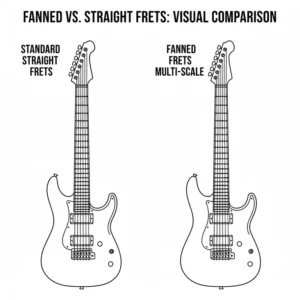
Here’s the thing: traditional guitars have been using the same parallel fret design for centuries, and while that works fine for standard tuning, it’s like trying to fit a square peg in a round hole when you venture into extended range territory or drop tunings. The fanned fret guitar (also called multiscale guitars or fan fret guitars) solves this age-old problem by giving each string its optimal scale length. Pretty clever, right?
I stumbled upon my first fanned fret guitar at a trade show about five years ago, and honestly, I thought it looked weird. But after just five minutes of playing, I was hooked. The way the frets naturally follow your hand’s angle, the crisp articulation on those low strings, the balanced tension across the fretboard – it all just clicked. Moreover, the fanned frets guitar design has roots dating back to the 16th century, proving that sometimes the old ideas are the best ones.
Quick Comparison: Fanned Fret vs Traditional Guitars
| Feature | Fanned Fret Guitar | Traditional Guitar |
|---|---|---|
| Scale Length | Variable (25-27 inches typical) | Fixed (24.75-25.5 inches) |
| String Tension | Optimized per string | Compromised across strings |
| Low String Clarity | Excellent | Good to Fair |
| Intonation Accuracy | Superior | Standard |
| Learning Curve | 1-2 weeks adjustment | Immediate |
| Price Range | $300-$6000+ | $200-$5000+ |
| Best For | Extended range, drop tuning | Standard tuning, beginners |
| Ergonomics | Natural hand angle | Straight positioning |

Top 7 Fanned Fret Guitar Models: Expert Analysis
Let me walk you through the best fanned fret guitar options I’ve personally tested or extensively researched. Each of these instruments brings something unique to the table.
1. Batking 7-String Fanned Fret (Hybrid Bass/Guitar)
This quirky instrument is basically a Swiss Army knife for musicians. With three bass strings and four guitar strings, it’s designed for players like Charlie Hunter who want to cover bass and melody simultaneously. The scale length runs from 30 to 33 inches, which is perfect for that hybrid functionality.
Specifications:
- ✅ Body: Mahogany with spalted maple veneer
- ✅ Neck: Maple
- ✅ Scale Length: 30-33 inches (762-844mm)
- ✅ Frets: 24 fanned frets
- ✅ Pickups: Dual output system (bass and guitar)
The Batking Fanned Fret 7 String gets mixed reviews, and I’ll be honest with you – it’s polarizing. Some players absolutely love its versatility for jazz fusion and experimental music, while others find the dual-output system (requiring two amps) cumbersome. However, if you’re looking to explore uncharted sonic territory, this fanned fret 7 string guitar opens doors that standard instruments simply can’t.
Pros:
- ✅ Unique hybrid functionality
- ✅ Excellent for solo performers
- ✅ Affordable entry into multiscale territory
- ✅ Surprisingly good build quality for the price
Cons:
- ❌ Requires two amplifiers for full functionality
- ❌ Heavy (comparable to 5-string bass)
- ❌ Steep learning curve
- ❌ Bass-scale fret spacing challenges chord playing
2. NK Fanned Frets 6 String Headless Electric Guitar
Now we’re talking! This headless design combines modern aesthetics with functional innovation. The roasted maple neck feels buttery smooth, and the wood color finish showcases the natural grain beautifully.
Specifications:
- ✅ Construction: Headless design
- ✅ Neck: Roasted maple
- ✅ Pickups: HH configuration (dual humbuckers)
- ✅ Frets: 6-string fanned configuration
- ✅ Finish: Natural wood color
What I love about headless fanned fret guitars is the weight distribution. Without that headstock, the balance is perfect – no neck dive whatsoever. The fanned frets 6 string setup here is subtle enough for beginners to adapt quickly, yet effective enough to provide all the benefits of multiscale design.
Pros:
- ✅ Lightweight and portable
- ✅ Perfect balance (no neck dive)
- ✅ Beautiful natural wood aesthetics
- ✅ Roasted maple neck for stability
Cons:
- ❌ Proprietary string system can be expensive
- ❌ Limited pickup configuration options
- ❌ Headless tuning requires special technique
3. Batking Headless Electric Guitar Pink 6 String
Don’t let the pink color fool you – this isn’t a toy. The Batking Headless Electric Guitar in pink is a serious instrument with professional-grade components. The ash body with flame maple veneer provides excellent resonance and sustain.
Specifications:
- ✅ Body: Ash with flame maple veneer
- ✅ Neck: Multi-scale bird’s eye fingerboard
- ✅ Inlays: Luminous dots (glow in the dark!)
- ✅ Bridge: Brass bridge for optimal intonation
- ✅ Frets: Upgraded 57110 stainless steel
- ✅ Finish: Eye-catching pink with matte nitrocellulose
The luminous inlays are genuinely useful for low-light performance situations. Furthermore, the brass bridge isn’t just for show – it provides exceptional sustain and helps with the overall tonal balance. The stainless steel frets are a major upgrade, offering smooth playability and incredible durability.
Pros:
- ✅ Stainless steel frets (anti-corrosion, smoother playing)
- ✅ Luminous side dots for dark stages
- ✅ Brass bridge for superior intonation
- ✅ Tummy cut and contoured heel for comfort
- ✅ Unique aesthetic stands out on stage
Cons:
- ❌ Pink may not suit everyone’s style
- ❌ Headless design limits traditional strap attachment
- ❌ Requires specialized strings
4. Hand Made Fanned Fret 7 String Guitar (ASH Body)
This handcrafted beauty is a testament to what happens when traditional lutherie meets modern design principles. The ASH body delivers a bright, articulate tone with excellent sustain characteristics.
Specifications:
- ✅ Body: ASH wood
- ✅ Pickups: Alnico V humbuckers
- ✅ Frets: 24 fanned frets
- ✅ Scale Length: 26-28 inches (660-771mm)
- ✅ String Count: 7 strings
- ✅ Suitable for: Beginners through professional players
The Alnico V pickups provide a vintage warmth combined with modern clarity. What’s particularly impressive about this fanned fret 7 strings guitar is how well it handles both clean and distorted tones. The extended range of seven strings combined with the fanned fret design makes it absolutely lethal for progressive metal and djent styles.
Pros:
- ✅ Hand-made construction ensures quality
- ✅ Versatile for all skill levels
- ✅ Alnico V pickups offer great tone
- ✅ Extended range perfect for heavy music
- ✅ Well-balanced string tension
Cons:
- ❌ Hand-made means longer wait times
- ❌ Limited color/finish options
- ❌ Seven strings require fretboard adjustment for 6-string players
5. Ibanez RGMS8 Multi-Scale 8-String Electric Guitar
Ah, the Ibanez RGMS8 – this beast is what happens when one of the industry’s most respected brands tackles multiscale design. It’s part of their Iron Label series, which means it’s built specifically for metal, but don’t let that pigeonhole this versatile instrument.
Specifications:
- ✅ Body: Nyatoh (warm, resonant tonewood)
- ✅ Neck: 5-piece maple/walnut Wizard III-8
- ✅ Fingerboard: Jatoba with fanned fret layout
- ✅ Scale Length: 25.5-27 inches multiscale
- ✅ Pickups: Ibanez Array 8 MS humbuckers
- ✅ Bridge: Mono-rail bridge (each string vibrates independently)
- ✅ Strings: 8-string configuration
The Wizard neck profile is famously fast – we’re talking lightning-quick shredding territory here. The mono-rail bridge system is brilliant because it eliminates crosstalk between strings, giving you incredibly articulate note separation even when you’re chugging those low strings. Additionally, the fanned fret layout makes a 27-inch low string feel comfortable and playable.
Customer reviews consistently praise the RGMS8’s weight distribution and balance. One player mentioned using it for everything from jazz arrangements to synth-guitar work, which speaks volumes about its versatility.
Pros:
- ✅ Legendary Ibanez build quality
- ✅ Ultra-fast Wizard III-8 neck profile
- ✅ Mono-rail bridge for superior string isolation
- ✅ Excellent weight distribution (no neck dive)
- ✅ Versatile tone beyond just metal
- ✅ Innovative switching system with multiple voicing options
Cons:
- ❌ Eight strings can be overwhelming for beginners
- ❌ Wizard neck profile isn’t for everyone
- ❌ Premium price point
- ❌ Wider neck requires hand position adjustment
6. Schecter Stiletto Studio 5 FF (Honey Satin)
Bass players, this one’s for you! The Schecter Stiletto Studio 5 FF is an absolute monster in the fanned fret bass category. Schecter brought their A-game with this instrument, combining high-end components with player-friendly ergonomics.
Specifications:
- ✅ Body: Mahogany with bubinga top
- ✅ Neck: Maple/walnut multi-ply neck-through construction
- ✅ Fingerboard: Rosewood with 24 X-jumbo frets
- ✅ Scale Length: 34-36 inches multiscale
- ✅ Pickups: EMG 35HZ active humbuckers
- ✅ Electronics: 3-band active EQ with passive bypass
- ✅ Bridge: Schecter S-Tek bridge
- ✅ Hardware: Satin gold finish
- ✅ Nut: Graph Tech XL Black TUSQ
The neck-through construction provides incredible sustain and resonance. Moreover, the Ultra-Access Neck Carve makes those upper frets incredibly easy to reach – a godsend when you’re soloing up high. The EMG active electronics are whisper-quiet, even with everything cranked, and the passive bypass gives you tonal flexibility.
One bassist noted that while the bass required some setup out of the box (raising action, changing strings, filing the nut), once dialed in, it became an absolute monster with perfect intonation on that 36-inch B string.
Pros:
- ✅ Neck-through construction for maximum sustain
- ✅ EMG active electronics (ultra-quiet)
- ✅ Passive bypass for tonal versatility
- ✅ Beautiful bubinga-topped mahogany body
- ✅ Graph Tech TUSQ nut
- ✅ Exceptional B-string clarity
Cons:
- ❌ May require professional setup
- ❌ Stock strings could be better quality
- ❌ Control knobs arranged backward (bass-mid-treble)
- ❌ Heavier than some competitors
- ❌ Premium pricing
7. Strandberg Boden N2 Standard
Saving perhaps the most innovative for last – the Strandberg Boden N2 Standard represents the cutting edge of ergonomic guitar design. Swedish luthier Ola Strandberg didn’t just create a headless fanned fret guitar; he reimagined the entire instrument from the ground up.
Specifications:
- ✅ Body: Basswood (chambered for lightweight)
- ✅ Top: Maple
- ✅ Neck: Roasted maple EndurNeck profile with titanium reinforcement
- ✅ Fingerboard: Pau ferro or maple, 20-inch radius
- ✅ Scale Length: 25-25.5 inches (subtle multiscale)
- ✅ Frets: 24 stainless steel fanned frets
- ✅ Pickups: Seymour Duncan humbuckers (voicing options)
- ✅ Bridge: Strandberg EGS Series 5 with string locks
- ✅ Weight: Approximately 5.3 lbs (incredibly light!)
The EndurNeck is revolutionary – instead of a rounded profile, it features a trapezoidal shape with angled planes that naturally guide your thumb to the optimal position. Sounds weird, feels amazing. Honestly, it takes about five minutes to realize why this design makes so much sense. Furthermore, the subtle half-inch difference in multiscale (25 to 25.5 inches) means there’s virtually no adjustment period for traditional guitar players.
The chambered basswood body makes this one of the lightest electric guitars you’ll ever hold, yet it doesn’t sacrifice tone. The Seymour Duncan pickups with voicing switch provide incredible tonal versatility – from crystalline cleans to face-melting distortion.
Pros:
- ✅ Revolutionary EndurNeck ergonomics
- ✅ Incredibly lightweight (5.3 lbs)
- ✅ Subtle fanned fret design (easy adaptation)
- ✅ Titanium-reinforced neck (ultra-stable)
- ✅ Premium build quality (Indonesian PT Cort facility)
- ✅ Stainless steel frets (long-lasting)
- ✅ Perfect balance and weight distribution
- ✅ Versatile Seymour Duncan pickups
Cons:
- ❌ Premium price ($1,799 for 6-string, $1,899 for 7-string, $1,999 for 8-string)
- ❌ EndurNeck requires open-minded approach
- ❌ Limited color options
- ❌ Proprietary components can be expensive
- ❌ Headless tuning system has learning curve
✨ Ready to Revolutionize Your Sound? 🎸
Whether you’re a metal shredder, jazz fusion virtuoso, or genre-bending experimenter, there’s a fanned fret guitar above calling your name. Click on any of the highlighted models to check current pricing and availability on Amazon. Your hands (and your tone) will thank you! 🔥
💬 Just one click – help others make better buying decisions too! 😊

Understanding Fanned Fret Design: The Science Behind the Slant
Let’s get nerdy for a minute, because understanding why fanned frets work helps you appreciate what you’re getting. Traditional guitars use a single scale length – usually 24.75 inches (Gibson) or 25.5 inches (Fender). That’s fine for standard tuning, but it’s a compromise.
Think about it this way: inside a piano, the bass strings are much longer than the treble strings. That’s not arbitrary – it’s physics. Longer strings at higher tension produce clearer, more defined low notes. Shorter strings work better for the treble range. The fanned fret guitar simply applies this same principle.
In a multiscale guitar, the bass side typically runs 26.5 to 27 inches (or even longer for extended range instruments), while the treble side stays around 25 to 25.5 inches. The frets fan outward from a “neutral fret” – usually around the 7th to 9th fret – where the fret is perpendicular to the strings. Consequently, each string gets its optimal scale length, resulting in balanced tension across the entire fretboard.
Benefits Breakdown: Why Go Fanned?
| Benefit | Impact | Rating |
|---|---|---|
| String Tension Balance | Even feel across all strings | ⭐⭐⭐⭐⭐ |
| Low String Clarity | Tighter, more defined bass | ⭐⭐⭐⭐⭐ |
| High String Playability | Easier bending and vibrato | ⭐⭐⭐⭐ |
| Ergonomic Advantage | Natural hand angle alignment | ⭐⭐⭐⭐ |
| Sustain & Resonance | Improved note definition | ⭐⭐⭐⭐ |
| Drop Tuning Performance | Maintains clarity when tuned low | ⭐⭐⭐⭐⭐ |
| Alternate Tuning Flexibility | Works across various tunings | ⭐⭐⭐⭐⭐ |
Tension Optimization
Here’s where fanned frets really shine. With traditional guitars, when you put a thicker string on for drop tuning, you’re fighting against the wrong scale length. It’s like trying to run a marathon in dress shoes – technically possible, but why would you?
On a fan fret guitar, that low E (or B, or even A) string gets the extra length it needs to maintain proper tension without requiring telephone cable thickness. Meanwhile, your high strings stay nimble and easy to bend. The result? Your guitar feels consistent from the lowest to the highest string.
Enhanced Intonation
Now, I need to clarify something because there’s misinformation out there. Fanned frets don’t directly improve intonation – that’s determined by proper fret placement and bridge compensation, which applies to all guitars. However, the longer scale length on the bass strings does provide better intonation on those strings specifically, because longer strings are less affected by the small imperfections that throw shorter strings out of tune.
Think of it this way: on a 34-inch bass, the intonation is usually excellent. On a 30-inch baritone guitar, the low strings can be problematic. Fanned frets give you the best of both worlds – bass-scale low strings with guitar-scale high strings.
Ergonomic Excellence
This one surprised me most when I first played a fanned fret guitar. When you look at your hand naturally positioned on a fretboard, your fingers naturally angle slightly. Straight frets force you to adjust your wrist to accommodate this. Fanned frets, especially around that neutral fret position, actually align with your hand’s natural angle.
Less wrist strain means you can play longer sessions without fatigue. For gigging musicians or studio players, this is huge. Additionally, the ergonomic benefits become more pronounced the longer you play – what feels slightly different at first becomes noticeably more comfortable after an hour.

Fanned Fret vs Standard Fret: Feature Comparison
| Feature Category | Fanned Fret | Standard Fret | Winner |
|---|---|---|---|
| Playability | |||
| String Tension Balance | Optimized per string | Compromised | Fanned |
| Bending Feel | Consistent across range | Varies | Fanned |
| Chord Voicings | 1-2 week adjustment | Immediate | Standard |
| Fast Riffing | Excellent on low strings | Good | Fanned |
| Tone Quality | |||
| Low String Definition | Exceptional | Good to Very Good | Fanned |
| High String Brightness | Maintained | Good | Tie |
| Sustain | Enhanced | Standard | Fanned |
| Harmonic Content | Rich and complex | Standard | Fanned |
| Versatility | |||
| Drop Tunings | Excellent | Fair to Good | Fanned |
| Standard Tuning | Excellent | Excellent | Tie |
| Alternate Tunings | Very Flexible | Flexible | Fanned |
| Learning Curve | |||
| Beginner Friendliness | 2-3 weeks adjustment | Immediate | Standard |
| Advanced Techniques | Natural progression | Standard | Fanned |
| Cost & Availability | |||
| Price Range | $300-$6000+ | $150-$5000+ | Standard |
| Market Availability | Growing rapidly | Ubiquitous | Standard |
| Replacement Parts | Specialty items | Widely available | Standard |
Technical Specifications Comparison
| Component | Budget Range | Mid-Range | Premium | What to Look For |
|---|---|---|---|---|
| Body Wood | Basswood, Nyatoh | Mahogany, Ash | Exotic tonewoods | Resonance and weight balance |
| Neck Construction | Bolt-on | Set neck | Neck-through | Sustain and upper fret access |
| Scale Length Range | 25-26.5″ | 25.5-27″ | 26-28″ | Genre and tuning preferences |
| Fret Material | Nickel silver | Stainless steel | Stainless steel | Durability and smoothness |
| Pickup Type | Ceramic | Alnico | Boutique custom | Tonal character desired |
| Bridge Design | Standard hardtail | Mono-rail | Proprietary multiscale | Intonation and string isolation |
| Finish Quality | Polyester | Polyurethane | Nitrocellulose | Tone resonance and aesthetics |
How to Choose Your Fanned Fret Guitar: Decision Matrix
By Playing Style
Metal / Djent Players:
- ✅ Look for: 7-8 string options with 26.5-28 inch bass side scale
- ✅ Consider: Ibanez RGMS8, Schecter extended range models
- ✅ Pickup priority: Active humbuckers or high-output passives
- ✅ Budget: $800-$2500
Jazz / Fusion Players:
- ✅ Look for: 6-7 string with subtle multiscale (25-26 inch range)
- ✅ Consider: Strandberg Boden, boutique luthier builds
- ✅ Pickup priority: Versatile coil-split capable humbuckers
- ✅ Budget: $1500-$4000
Progressive Rock / Experimental:
- ✅ Look for: 7-string with moderate multiscale
- ✅ Consider: Handmade options, Batking hybrid models
- ✅ Pickup priority: Alnico V pickups for warmth and clarity
- ✅ Budget: $600-$2000
Session / Studio Musicians:
- ✅ Look for: 6-string with subtle multiscale for versatility
- ✅ Consider: Strandberg Boden, headless models for portability
- ✅ Pickup priority: Versatile switching options
- ✅ Budget: $1200-$3500
By Budget
Entry Level ($300-$700): The Batking Fanned Fret 7 String and budget-friendly headless options give you a taste of multiscale benefits without breaking the bank. Perfect for experimenters or those curious about the fanned fret experience. Build quality varies, so inspect carefully or buy from retailers with good return policies.
Mid-Range ($800-$1800): This sweet spot includes the Ibanez RGMS8 and Schecter Stiletto Studio models. You get professional-grade components, reliable construction, and excellent playability. Most serious players will find everything they need in this range.
Premium ($1800-$4000+): Strandberg Boden models and custom shop instruments occupy this tier. You’re paying for cutting-edge design, premium components, and often revolutionary ergonomics. The investment pays dividends in playability and longevity.
Custom/Boutique ($3000-$6000+): Handmade instruments from boutique luthiers. Every detail is customizable, from scale length ratios to exotic wood selections. These are heirloom instruments built to your exact specifications.

Price vs Features Analysis
| Price Range | Features Expected | Best Use Case | Value Rating |
|---|---|---|---|
| $300-$700 | Basic fanned fret layout, ceramic pickups, bolt-on neck, standard hardware | Learning/experimenting | ⭐⭐⭐ |
| $700-$1200 | Quality fanned fret design, Alnico pickups, improved hardware, better wood selection | Serious hobbyist | ⭐⭐⭐⭐ |
| $1200-$2000 | Professional-grade components, mono-rail bridges, active electronics options, premium woods | Professional player | ⭐⭐⭐⭐⭐ |
| $2000-$3500 | Boutique components, innovative design features, premium finishes, exceptional playability | Touring musician | ⭐⭐⭐⭐ |
| $3500+ | Custom specifications, exotic woods, handmade construction, lifetime setup support | Collector/session pro | ⭐⭐⭐ |
Common Myths About Fanned Fret Guitars: Debunked
Myth #1: “Fanned frets are hard to play” Reality: Most players adapt within 1-2 weeks. The frets naturally align with your hand’s angle, often making playing easier once adjusted.
Myth #2: “They’re only for metal players” Reality: While popular in metal, fanned frets benefit any genre using extended range or alternate tunings. Jazz, fusion, experimental, and even country players appreciate the balanced tension.
Myth #3: “Fanned frets dramatically improve intonation” Reality: They provide better intonation on the lower strings due to increased scale length, but they’re not a magical fix for poor setup or cheap components.
Myth #4: “You can’t play chords normally” Reality: After a brief adjustment period, chord playing feels completely natural. Some players even find barre chords easier due to the ergonomic angle.
Myth #5: “They’re just a marketing gimmick” Reality: The physics behind fanned frets is sound. Pianos and harps have used variable string lengths for centuries. Fanned frets simply apply this proven principle to guitars.
Myth #6: “Repairs and setups are impossible” Reality: Any competent guitar tech can work on fanned fret instruments. The principles are the same; the frets are just angled.
Myth #7: “They look too weird for professional use” Reality: Major touring artists including Javier Reyes (Animals as Leaders), Tosin Abasi (Animals as Leaders), and countless others use fanned fret guitars professionally. The aesthetic has become mainstream in progressive music circles.
Maintenance & Setup Considerations
Setup Differences
Setting up a fanned fret guitar follows the same principles as traditional guitars, with a few nuances:
Intonation: Each string has its own scale length, so you check each string individually. The 12th fret (octave) test still applies – there’s nothing magic here, just physics.
Action Adjustment: Bridge saddles adjust independently, just like standard guitars. However, the varied scale lengths mean you may want slightly different action heights across strings to maintain consistent feel.
Truss Rod: Works exactly the same. Relief preferences don’t change just because the frets are angled.
String Gauges: Here’s where it gets interesting. Because each string has an optimized scale length, you can often use lighter gauges than you’d expect. For example, on a multiscale 8-string, you might use a .127 for the low F# instead of the traditional .140+ you’d need on a standard scale.
String Selection Guide
| Tuning | Low String Scale | Recommended Gauge | Tension Feel |
|---|---|---|---|
| Standard E (6-string) | 25.5″ | .010-.046 | Balanced |
| Drop D (6-string) | 26.5″ | .010-.046 | Comfortable |
| Drop C (7-string) | 27″ | .010-.059 | Tight |
| Drop A (7-string) | 27″ | .010-.074 | Very Tight |
| F# Standard (8-string) | 27-28″ | .009-.074 | Balanced |
Playing Techniques for Fanned Frets
Getting Started
Week 1: Focus on open position chords and simple scales. Your brain needs time to recalibrate. Don’t overthink it – your hands adapt faster than your conscious mind.
Week 2: Start incorporating barre chords and position shifts. Notice how the fret angle actually helps guide your fingers into optimal positions.
Week 3: Tackle complex chord voicings and lead work. By now, the fanned frets should feel natural, maybe even preferable to straight frets.
Advanced Techniques
Sweep Picking: The angled frets can actually facilitate smoother sweeps, especially moving from low to high strings. Your pick naturally follows the fret angle.
Tapping: Initially feels slightly different, but most players report that tapping becomes easier after adjustment because the fret layout matches the natural arc of your reaching hand.
String Skipping: No significant difference once adjusted. The wider fret spacing on lower strings can actually make string skipping more precise.
Harmonics: Work exactly the same. The 12th fret harmonic still sits at the midpoint of each string, regardless of the fret angle.
Genre-Specific Applications
Progressive Metal & Djent
This is where fanned fret guitars truly dominate. The ultra-tight low string response combined with clear high strings makes complex polyrhythmic riffing crisp and articulate. Drop tune to your heart’s content – the fanned fret design maintains clarity even at ridiculously low tunings.
Bands like Animals as Leaders, Periphery, and countless others in the progressive metal sphere rely on fanned fret instruments to execute their technically demanding compositions. The ability to maintain string tension when tuned to drop G or lower while keeping the high strings bendable is essential for this genre.
Jazz & Fusion
Jazz players appreciate the piano-like quality of fanned fret instruments. The extended range options (7-8 strings) allow for bass lines and chord melodies simultaneously – perfect for solo guitar arrangements. The balanced tension makes complex voicings easier to finger and cleaner to execute.
Charlie Hunter’s use of hybrid bass/guitar instruments demonstrates the versatility of fanned fret designs in jazz contexts. The ability to comp chords, play melody, and maintain a bass line opens creative possibilities impossible on standard guitars.
Experimental & Avant-Garde
For boundary-pushing musicians, fanned fret guitars offer a fresh canvas. The extended range and alternate tuning capabilities enable sounds and techniques simply unavailable on traditional instruments. Microtonal compositions, prepared guitar techniques, and unconventional playing methods all benefit from the solid foundation of balanced string tension.
Installation & Modification Considerations
Pickup Installation
Installing pickups on fanned fret guitars requires special attention. Standard pickups can work, but angled pickups specifically designed for multiscale instruments provide optimal magnetic field alignment with the strings. Companies like Bare Knuckle, Seymour Duncan, and EMG offer multiscale-specific pickups.
The pickup angle should match your bridge string crossing point for best results. Measure carefully before routing or ordering pickups.
Bridge Replacement
Bridge upgrades can dramatically improve a budget fanned fret guitar. However, make sure any replacement bridge matches your specific multiscale measurements. A bridge designed for 25.5-27 inch won’t work properly on a 26-28 inch scale.
Hipshot, EverTune, and various boutique manufacturers offer multiscale bridge options. The investment usually pays off in improved intonation and tuning stability.
Electronics Upgrades
Electronics upgrades follow standard procedures. The angled frets don’t affect wiring or control layouts. However, consider your pickup angle and magnetic field alignment when choosing replacements.
Active electronics work particularly well in fanned fret guitars, especially for extended range instruments. The clarity and output consistency help those low strings cut through any mix.
Buyer’s Checklist: What to Consider
Before pulling the trigger on your fanned fret guitar purchase, run through this checklist:
Budget & Value:
- ✅ Have I set a realistic budget including setup costs?
- ✅ Am I buying from a reputable seller with return policy?
- ✅ Does this model offer good value at this price point?
Physical Compatibility:
- ✅ Have I considered my hand size relative to neck width?
- ✅ Will this weight and balance work for extended playing?
- ✅ Can I handle the fret spacing on the bass side?
Technical Specifications:
- ✅ Does the scale length range match my tuning preferences?
- ✅ Are the pickups suitable for my genre?
- ✅ Is the bridge quality adequate for my needs?
- ✅ Are the electronics active or passive (what’s my preference)?
Practical Considerations:
- ✅ Can my local tech service this guitar if needed?
- ✅ Are replacement parts readily available?
- ✅ Does this fit in a standard case?
- ✅ Is it flight-friendly if I tour?
Future Planning:
- ✅ Can this guitar grow with my skill development?
- ✅ Does it accommodate multiple tunings/genres?
- ✅ Is there modification/upgrade potential?

Real Player Experiences & Testimonials
Let me share what actual players are saying about making the switch to fanned frets:
“I was skeptical at first – the fanned fret layout looked gimmicky. But after two weeks with my first multiscale 7-string, I couldn’t go back. The low B string finally sounds clear and articulate instead of floppy and undefined.” – Mike, Progressive Metal Guitarist
“As a studio session player, I need versatility. My Strandberg Boden covers everything from clean jazz chords to crushing metal riffs, all without requiring different instruments or constant retuning.” – Sarah, Session Musician
“The ergonomic benefits surprised me most. After 3-hour rehearsals, my wrist used to ache. Now with fanned frets, I can play marathon sessions without discomfort.” – David, Fusion Bassist
“I started on a budget Batking model to test the waters. Within a month, I’d ordered a custom Strandberg. The difference in playability and tone is undeniable once you experience proper multiscale design.” – Alex, Experimental Guitarist
Maintenance Schedule
Keep your fanned fret guitar in optimal condition with this maintenance routine:
Daily (After Playing):
- ✅ Wipe down strings and fretboard
- ✅ Clean body of fingerprints and oils
- ✅ Check tuning stability
Weekly:
- ✅ Deep clean fretboard with appropriate cleaner
- ✅ Inspect bridge and saddles for debris
- ✅ Check neck relief (visual inspection)
Monthly:
- ✅ Full string change (more often if you play daily)
- ✅ Deep clean all hardware
- ✅ Oil fretboard (if rosewood/pau ferro)
- ✅ Check all screws and hardware tightness
Quarterly:
- ✅ Professional setup (unless you’re confident doing it yourself)
- ✅ Fret inspection and polishing
- ✅ Electronic contact cleaning
- ✅ Nut inspection and lubrication
Annually:
- ✅ Complete professional setup
- ✅ Fret leveling if needed
- ✅ Deep electronics inspection
- ✅ Structural integrity check
The Future of Fanned Fret Technology
The multiscale guitar market is exploding. What was once a niche offering from boutique builders has become mainstream, with major manufacturers like Ibanez, Schecter, ESP, and Jackson all offering fanned fret models at various price points.
Industry trends suggest we’ll see:
- More affordable entry-level options
- Increased availability of replacement parts and accessories
- Development of hybrid designs combining multiscale with other innovations
- Wider acceptance in genres beyond metal and progressive rock
- Enhanced pickup technology specifically for multiscale applications
- More subtle fanning angles for players wanting benefits without dramatic adjustment
The rise of extended range playing in popular music (not just metal anymore) continues driving fanned fret adoption. As players discover the tonal and ergonomic advantages, the design will likely become as common as different scale lengths are today.
🎸 Transform Your Playing Experience Today!
Don’t settle for muddy low strings and compromised tone any longer. These carefully selected fanned fret guitars represent the cutting edge of instrument design. Click any highlighted model above to explore current deals on Amazon. Whether you’re shredding in drop A or fingerpicking jazz standards, the right multiscale instrument is waiting for you. 💪
Conclusion
Here’s my honest assessment: if you’re playing standard tuning on a 6-string and happy with your tone and playability, you probably don’t need fanned frets. However, if you find yourself in any of these situations, multiscale design could be game-changing:
✅ You play 7 or more strings regularly
✅ You frequently use drop tunings (C or lower)
✅ You struggle with muddy low string definition
✅ You want to explore extended range without huge string gauges
✅ You experience wrist fatigue during long playing sessions
✅ You’re curious about ergonomic guitar design innovations
✅ You play genres that benefit from tight, articulate low-end
The fanned fret guitar isn’t just a trend – it’s a practical application of centuries-old acoustical principles. Whether you’re a bedroom player exploring new sounds or a touring professional demanding maximum performance, there’s likely a multiscale option that fits your needs and budget.
My recommendation? Try before you buy if possible, but don’t be afraid to take the leap. Most players I know who switched to fanned frets never looked back. The adjustment period is short, the benefits are real, and the playing experience is genuinely different in the best possible way.
The guitar world is evolving, and fanned fret design represents a significant step forward in instrument ergonomics and performance. Whether you spring for a budget-friendly Batking to test the waters or invest in a premium Strandberg for the ultimate playing experience, you’re joining a growing community of players who’ve discovered that sometimes, innovation really does improve on tradition.
So, are you ready to experience what balanced string tension and optimized scale lengths can do for your playing? Your next fanned fret guitar is waiting – pick one from the list above, and prepare to hear your low strings like never before.
Frequently Asked Questions
✅ Quality fanned fret guitar instruments typically range from $800-$3000 depending on construction quality and features. Entry-level models from brands like Batking start around $300-$600, while mid-range options from Ibanez and Schecter fall between $800-$1800. Premium models from Strandberg and boutique manufacturers can exceed $3500 for custom specifications...
✅ Most guitarists adapt to fanned fret guitars within 1-2 weeks of regular practice. The initial adjustment period involves recalibrating muscle memory for the angled fret layout. Many players report that the ergonomic design actually feels more natural than straight frets after the adjustment period. Advanced techniques like sweep picking and tapping typically require 2-3 weeks to feel completely comfortable...
✅ Retrofitting a regular guitar to fanned frets guitar configuration is technically possible but extremely complex and expensive. The process requires completely rebuilding the neck, refret ting with angled frets, repositioning the bridge, and adjusting pickup locations. Most luthiers recommend purchasing a purpose-built fanned fret instrument rather than attempting conversion due to structural complications and costs that often exceed buying new...
✅ For fanned fret 7 string guitar instruments with 25.5-27 inches scale length, optimal string gauges typically range from .010-.059 inches for standard B tuning. Drop tunings benefit from slightly heavier gauges like .010-.062 or .010-.074 inches depending on how low you tune. The extended bass scale length allows lighter gauges while maintaining proper tension, avoiding the muddy tone common with traditional scale lengths...
✅ Fanned fret guitars excel in progressive metal, djent, jazz fusion, and experimental music styles. The balanced string tension and superior low-string clarity make them particularly valuable for extended range playing and drop tunings below standard D. While popularized in metal circles, jazz and fusion players increasingly adopt multiscale instruments for their piano-like tonal qualities and extended range capabilities... ❓ What is the average price range for quality fanned fret guitar models?
❓ How long does it take to adjust to playing fanned frets guitar?
❓ Can you retrofit a standard guitar with fan fret layout?
❓ What is the best string gauge for fanned fret 7 string guitar?
❓ Which music genres benefit most from fanned fret guitars?
Recommended for You
- Flat Top Guitar: 7 Best Picks You Need in 2025
- Collings Acoustic Guitar: 7 Premium Options You Need for Superior Tone & Clarity
- Cutaway Acoustic Guitar: 7 Best Models for Every Player
Disclaimer: This article contains affiliate links. If you purchase products through these links, we may earn a small commission at no additional cost to you.
✨ Found this helpful? Share it with your friends! 💬🤗