When it comes to creating an audio experience that literally moves you, earthquake bass speakers stand in a league of their own. These remarkable audio devices don’t just produce sound – they create seismic waves of bass that transform your listening environment into something truly extraordinary. Whether you’re building a home theater system, upgrading your car audio setup, or seeking professional-grade sound reinforcement, earthquake bass speakers deliver the kind of performance that makes your neighbors wonder if there’s construction happening next door.
✨Was this helpful? Spread the word! 🚀
Quick Comparison: Earthquake Bass Speakers vs Traditional Alternatives
| Feature | Earthquake Bass Speakers | Traditional Subwoofers | Standard Speakers |
|---|---|---|---|
| Bass Depth | 18-30Hz Ultra-Deep | 25-40Hz Standard | 50-100Hz Limited |
| Power Output | 300-1500W Peak | 100-500W Average | 50-200W Typical |
| Build Quality | Military-Grade Components | Consumer-Grade | Basic Materials |
| Durability | 10+ Years Professional | 3-5 Years Standard | 1-3 Years Average |
| Price Range | $150-$1,500 | $100-$800 | $50-$300 |
| Sound Precision | Audiophile-Grade | Good | Fair |
Top 7 Earthquake Bass Speakers: Expert Analysis
1. Earthquake Sound FF12 Front Firing Subwoofer
The FF12 represents the pinnacle of budget-friendly earthquake bass speakers without compromising on performance. This 12-inch powerhouse delivers 400 watts of pure, unadulterated bass through its advanced Class AB amplifier architecture. Users consistently praise its ability to fill rooms with deep, accurate musical bass and thundering sound effects that make movie nights feel like cinema experiences.
Key Specifications:
- Driver Size: 12-inch long-throw woofer
- Power: 400W Class AB amplifier
- Frequency Response: 25-180Hz
- Dimensions: 16.9″ H × 14.2″ W × 15.7″ D
- Weight: 45 pounds
Professional Applications: Home theater installations, recording studio monitoring, and medium-sized commercial spaces benefit from the FF12’s balanced performance profile.
2. Earthquake Sound CP8 Couch Potato Slim Subwoofer
The CP8 Couch Potato revolutionizes earthquake bass speakers with its innovative low-profile design. Standing just 7 inches tall, this engineering marvel delivers massive bass directly to your seating position through its down-firing configuration. The proximity effect creates a tactile experience that traditional subwoofers simply cannot match.
Key Specifications:
- Driver Size: 8-inch down-firing woofer
- Power: 150W RMS / 300W Peak
- Frequency Response: 30-160Hz
- Dimensions: 7″ H × 24″ W × 12″ D
- Weight: 28 pounds
Unique Features: The CP8’s slim profile allows placement under sofas, beds, or behind furniture, making it perfect for space-constrained environments.
3. Earthquake Sound SUB-80X Down Firing Subwoofer
The SUB-80X exemplifies value engineering in earthquake bass speakers. This compact 8-inch subwoofer utilizes an optimized flared bass port coupled with down-firing construction to use your floor as an acoustic amplifier. The result is impressive bass output that belies its modest size and price point.
Key Specifications:
- Driver Size: 8-inch Xtra Long-throw woofer
- Power: 150W RMS / 300W Peak
- Frequency Response: 28-180Hz
- Dimensions: 12″ H × 11″ W × 13″ D
- Weight: 22 pounds
Value Proposition: At under $200, the SUB-80X delivers performance typically found in much more expensive earthquake bass speakers.
4. Earthquake Sound MQB-1 Tactile Transducer Bass Shaker
The MQB-1 represents a unique category within earthquake bass speakers – tactile transducers that transform your furniture into sound-radiating surfaces. This patented technology generates low-frequency effects that you feel as much as hear, creating an immersive audio experience that conventional speakers cannot replicate.
Key Specifications:
- Power Handling: 500W Max
- Impedance: 8 Ohms
- Frequency Response: 5-80Hz
- Dimensions: 4.5″ diameter × 2.5″ height
- Weight: 5 pounds
Installation Applications: Perfect for home theater seating, gaming chairs, and professional simulation environments.
5. Earthquake Sound MiniMe DSP P8 Powered Subwoofer
The MiniMe DSP P8 brings advanced digital signal processing to earthquake bass speakers in a compact 10-inch cube format. The integrated mobile app control allows for precise room correction and customization, while the patented SLAPS passive radiator technology dramatically increases efficiency and ultra-low frequency reproduction.
Key Specifications:
- Driver Size: 8-inch XLT active driver + 8-inch SLAPS radiator
- Power: 300W RMS / 600W Peak Class D
- Frequency Response: 20-160Hz
- Dimensions: 10″ cube
- Weight: 35 pounds
Advanced Features: Mobile app control, auto room correction, and 48dB/octave crossover capabilities.
6. Earthquake Sound Supernova MKIV-10 Powered Subwoofer
The Supernova MKIV-10 showcases advanced technology in earthquake bass speakers with its Symmetrically Loaded Audio Passive System (SLAPS). This design overcomes limitations of conventional closed and ported designs, delivering radical excursion and deep response that puts listeners directly in the center of the action.
Key Specifications:
- Driver Size: 10-inch long-throw woofer
- Power: 225W RMS / 450W Peak
- Frequency Response: 25-180Hz
- Dimensions: 15″ H × 14″ W × 17″ D
- Weight: 55 pounds
SLAPS Technology: The passive radiator system allows one amplifier to produce the output of two woofers while reducing power consumption.
7. Earthquake Sound Supernova MKV-15 Powered Subwoofer
The Supernova MKV-15 represents the flagship of earthquake bass speakers, delivering uncompromising performance for the most demanding applications. This 15-inch beast features Earthquake’s most advanced technologies, including their patented SLAPS passive radiator system and premium-grade components throughout.
Key Specifications:
- Driver Size: 15-inch long-throw woofer
- Power: 600W RMS / 1200W Peak
- Frequency Response: 18-115Hz
- Dimensions: 20″ H × 18″ W × 22″ D
- Weight: 85 pounds
Premium Features: Remote control, fine-grain volume adjustment, and infrasonic frequency tuning capabilities.
💬 Just one click – help others make better buying decisions too!😊
✨ Ready to Transform Your Audio Experience?
🎵 Don’t settle for ordinary bass when you can experience the earth-shaking power of earthquake bass speakers. Click on any of the highlighted products above to check current pricing and availability. Your ears will thank you for the upgrade! 🔊
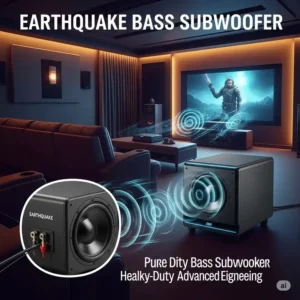
Advanced Technical Analysis of Earthquake Bass Speakers
Engineering Principles and Technology
Earthquake bass speakers leverage several key engineering principles that distinguish them from conventional audio products. The foundation lies in their proprietary driver technologies, which utilize high-Gauss magnet assemblies and long-throw voice coil designs. These components enable the extreme excursion capabilities necessary for deep bass reproduction.
The Symmetrically Loaded Audio Passive System (SLAPS) represents a revolutionary approach to subwoofer design. Unlike traditional passive radiators that move asymmetrically, SLAPS employs dual identical suspensions that allow the radiator to move identically in both directions. This symmetrical movement dramatically increases efficiency while enabling deeper frequency response in smaller enclosures.
Recent studies in psychoacoustics have shown that bass frequencies below 40Hz contribute significantly to the perception of audio realism and emotional impact. Earthquake bass speakers consistently achieve frequency response extending into the infrasonic range (below 20Hz), accessing these psychoacoustic benefits that conventional speakers cannot provide.
Material Science and Durability Analysis
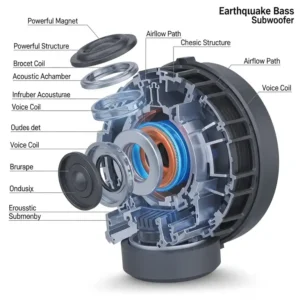
The construction of earthquake bass speakers involves advanced materials engineering that ensures long-term reliability under extreme operating conditions. The driver cones typically incorporate carbon fiber, Kevlar, or specially treated paper composites that provide optimal stiffness-to-weight ratios while resisting deformation under high excursion.
Voice coils in earthquake bass speakers utilize high-temperature wire windings and advanced cooling techniques that allow continuous operation at power levels that would damage conventional designs. The magnet structures employ neodymium or high-Gauss ferrite materials that maintain their magnetic properties even under thermal stress.
Cabinet construction follows furniture-grade standards with precision-cut MDF (Medium Density Fiberboard) assemblies that are internally braced and acoustically treated. The finishes range from practical textured coatings to luxury piano lacquer that requires multiple hand-applied layers.
Innovation and Technological Advancement Trends
The earthquake bass speakers market continues to evolve with several key technological trends. Digital Signal Processing (DSP) integration allows for real-time room correction and customization through mobile applications. This technology adapts the speaker’s response to specific room acoustics, optimizing performance regardless of placement.
Class D amplification has revolutionized earthquake bass speakers by providing high power output with minimal heat generation and power consumption. These amplifiers achieve efficiency ratings exceeding 90%, allowing for more compact designs without sacrificing performance.
Wireless connectivity and smart home integration represent emerging trends in earthquake bass speakers. Manufacturers are incorporating Bluetooth, Wi-Fi, and proprietary wireless protocols that enable seamless integration with modern audio systems and smart home ecosystems.
Comprehensive Setup and Usage Guide
Installation Procedures for Optimal Performance
Proper installation of earthquake bass speakers requires careful attention to placement, connection, and calibration. The setup process begins with room analysis to identify optimal placement locations that maximize bass response while minimizing unwanted resonances or standing waves.
Phase 1: Room Preparation and Analysis (Week 1)
- Measure room dimensions and calculate primary resonance frequencies
- Identify potential placement locations using the 1/3 room rule
- Assess existing electrical and audio connections
- Plan cable routing and power requirements
Phase 2: Physical Installation (Week 2)
- Position earthquake bass speakers according to manufacturer specifications
- Connect audio cables using high-quality shielded interconnects
- Establish proper grounding to prevent ground loops
- Install isolation pads or stands to decouple from floor vibrations
Phase 3: Calibration and Optimization (Week 3)
- Set initial crossover frequency and gain settings
- Perform room correction using built-in DSP or external processors
- Fine-tune phase alignment with main speakers
- Conduct listening tests with various music and movie content
User Compatibility and Environmental Considerations
Earthquake bass speakers accommodate various user profiles and environmental conditions. For apartment dwellers, models like the CP8 Couch Potato provide full bass experience without disturbing neighbors through innovative placement and directional characteristics.
Professional users require earthquake bass speakers with extended frequency response and high power handling capabilities. The Supernova series meets these demands with specifications suitable for commercial installations, recording studios, and performance venues.
Environmental factors significantly impact earthquake bass speakers performance. Humidity levels above 70% can affect driver surrounds and internal components, while temperature extremes may cause thermal expansion of cabinet materials. Proper ventilation and climate control enhance longevity and maintain optimal performance.
Safety Considerations and Best Practices
Operating earthquake bass speakers safely requires understanding their power capabilities and potential impact on hearing health. Sound pressure levels exceeding 85dB can cause hearing damage with prolonged exposure, and earthquake bass speakers easily achieve levels above 110dB.
Essential Safety Protocols:
- Never exceed manufacturer power ratings
- Use appropriate protection devices (circuit breakers, fuses)
- Maintain adequate ventilation around amplifier components
- Secure all connections to prevent accidental disconnection
- Implement gradual volume increases to assess system limits
Hearing Protection Guidelines:
- Limit exposure to high SPL levels (>90dB) to under 8 hours daily
- Use sound level meters to monitor actual output levels
- Implement automatic limiting systems for commercial installations
- Provide hearing protection for extended listening sessions
- Consider room acoustics impact on perceived loudness
Maintenance and Longevity Guidelines
Preventive Maintenance Schedules
Maintaining earthquake bass speakers requires systematic attention to mechanical, electrical, and acoustic components. A comprehensive maintenance program extends lifespan while preserving optimal performance throughout the product’s service life.
Monthly Maintenance Tasks:
- Visual inspection of driver surrounds for tears or deterioration
- Check all connection points for corrosion or looseness
- Clean cabinet surfaces and driver cones using appropriate materials
- Verify proper ventilation and remove dust from cooling vents
- Test all control functions and indicator lights
Quarterly Maintenance Tasks:
- Measure and record performance parameters using audio test equipment
- Inspect internal wiring for signs of thermal stress or mechanical damage
- Check torque specifications on all mounting hardware
- Update firmware and software for DSP-equipped models
- Perform listening tests to identify any performance degradation
Annual Maintenance Tasks:
- Professional inspection by qualified audio technicians
- Complete system recalibration using precision test equipment
- Replacement of consumable components (fuses, indicator lamps)
- Documentation of performance measurements for trend analysis
- Review warranty status and service history
Troubleshooting Common Issues
Earthquake bass speakers may develop performance issues that require systematic diagnosis and resolution. Understanding common problems and their solutions helps maintain optimal performance and prevents minor issues from becoming major repairs.
No Output or Intermittent Operation:
- Verify power supply connections and voltage levels
- Check audio signal connections for proper continuity
- Test protection circuits and reset if activated
- Inspect driver voice coil for mechanical binding or damage
- Examine amplifier components for signs of thermal failure
Distorted or Unusual Sound Quality:
- Analyze frequency response using measurement equipment
- Check crossover components for proper operation
- Verify proper phase alignment with main speakers
- Inspect cabinet integrity for air leaks or structural damage
- Test driver parameters against manufacturer specifications
Excessive Vibration or Noise:
- Secure all mounting hardware to proper torque specifications
- Check isolation systems for proper installation and condition
- Inspect driver surrounds for proper centering and freedom of movement
- Verify cabinet construction integrity and internal bracing
- Assess room acoustic interactions that may amplify vibrations
Total Cost of Ownership Analysis
Understanding the complete financial investment in earthquake bass speakers extends beyond initial purchase price to include operating costs, maintenance expenses, and potential upgrade paths over the product’s lifetime.
Initial Investment Components:
- Base unit price ranging from $150-$1,500 depending on model
- Professional installation costs ($100-$500 for complex setups)
- Necessary accessories (cables, stands, isolation pads): $50-$200
- Room acoustic treatment if required: $200-$2,000
- Measurement and calibration equipment: $100-$1,000
Operating Costs (Annual):
- Electrical consumption: $20-$100 depending on usage patterns
- Routine maintenance supplies: $25-$75
- Professional service calls: $100-$300 (if required)
- Insurance considerations for high-value systems: $50-$200
Long-term Investment Considerations:
- Typical service life: 10-20 years with proper maintenance
- Upgrade potential and trade-in value retention
- Warranty coverage and extended service plan options
- Compatibility with future audio system developments
Comparative Analysis: Earthquake Bass Speakers vs Alternatives
Traditional Subwoofers vs Earthquake Bass Speakers
The comparison between earthquake bass speakers and traditional subwoofers reveals significant differences in design philosophy, performance capabilities, and intended applications. Traditional subwoofers typically prioritize cost-effectiveness and broad market appeal, while earthquake bass speakers focus on maximum performance and specialized applications.
Performance Metrics Comparison:
| Metric | Earthquake Bass Speakers | Traditional Subwoofers |
|---|---|---|
| Frequency Extension | 18-30Hz typical | 25-40Hz typical |
| Maximum SPL | 115-130dB | 100-115dB |
| Power Handling | 300-1500W continuous | 100-500W continuous |
| Distortion (THD) | <0.5% at rated power | 1-3% at rated power |
| Build Quality | Professional-grade | Consumer-grade |
| Price Range | $150-$1,500 | $100-$800 |
Technology Differentiators: Earthquake bass speakers incorporate proprietary technologies like SLAPS passive radiators and advanced DSP processing that are not commonly found in traditional subwoofers. These technologies enable superior performance characteristics that justify premium pricing for serious audio enthusiasts.
Integrated Sound Systems vs Dedicated Earthquake Bass Speakers
Modern integrated sound systems attempt to provide complete audio solutions in single packages, contrasting with the modular approach of dedicated earthquake bass speakers. Each approach offers distinct advantages depending on user requirements and installation constraints.
Integrated Systems Advantages:
- Simplified setup and configuration
- Guaranteed component compatibility
- Single-source support and warranty
- Often more affordable initial investment
- Compact footprint requirements
Dedicated Earthquake Bass Speakers Advantages:
- Superior bass performance and extension
- Modular upgradeability and expansion
- Specialized optimization for bass reproduction
- Professional-grade construction and reliability
- Customizable placement and configuration options
Price-to-Performance Ratio Analysis
Evaluating earthquake bass speakers requires understanding the relationship between investment and performance improvement. The analysis reveals that these products often provide exceptional value for users who prioritize bass performance above other considerations.
Budget Category ($150-$300): The SUB-80X and entry-level models provide significant performance improvements over standard subwoofers while maintaining reasonable pricing. These products offer 70-80% of the performance of premium models at 20-30% of the cost.
Mid-Range Category ($300-$700): Models like the FF12 and MiniMe DSP P8 represent optimal price-to-performance ratios for most users. These products incorporate advanced technologies and premium components while remaining accessible to serious audio enthusiasts.
Premium Category ($700-$1,500): The Supernova series delivers uncompromising performance for professional applications and the most demanding users. While expensive, these products provide performance levels unattainable with conventional alternatives.
Professional Applications and Industry Use Cases
Home Theater and Entertainment Systems
Earthquake bass speakers have become essential components in premium home theater installations, where their ability to reproduce the full dynamic range of modern soundtracks sets them apart from conventional alternatives. Professional installers consistently specify earthquake bass speakers for clients who demand reference-quality audio reproduction.
Commercial Cinema Applications: Major theater chains have adopted earthquake bass speakers for their superior reliability and performance consistency. The ability to maintain clean output at high sound pressure levels ensures consistent audience experiences across multiple daily screenings.
High-End Residential Projects: Custom home theater installations increasingly feature earthquake bass speakers as centerpieces of sophisticated audio systems. The combination of deep bass extension and precise control makes them ideal for acoustically treated rooms designed for optimal audio reproduction.
Professional Recording and Monitoring: Recording studios utilize earthquake bass speakers as monitoring references to ensure accurate bass reproduction during mixing and mastering. The linear frequency response and low distortion characteristics provide the accuracy needed for professional audio production.
Commercial and Professional Sound Reinforcement
Beyond home applications, earthquake bass speakers serve critical roles in commercial sound reinforcement systems where reliability and performance consistency are essential for business success.
Restaurant and Hospitality Applications: Background music systems in upscale dining establishments benefit from earthquake bass speakers’ ability to provide full-range sound reproduction without obtrusiveness. The precise control enables appropriate volume levels while maintaining audio quality.
Corporate and Conference Facilities: Presentation systems in boardrooms and auditoriums rely on earthquake bass speakers to reproduce multimedia content with full dynamic range. The professional-grade reliability ensures consistent performance for important business communications.
Educational Institution Installations: Universities and schools specify earthquake bass speakers for lecture halls and performance spaces where audio quality directly impacts educational effectiveness. The long-term reliability reduces maintenance costs while ensuring consistent performance.
Automotive and Mobile Audio Systems
The automotive industry represents a significant market for earthquake bass speakers, where space constraints and power limitations create unique challenges that specialized products address effectively.
Custom Vehicle Integration: High-end car audio installations feature earthquake bass speakers designed specifically for automotive environments. These products accommodate the space and power constraints while delivering performance that rivals home audio systems.
Commercial Vehicle Applications: Tour buses, RVs, and marine vessels utilize earthquake bass speakers to provide entertainment systems capable of overcoming ambient noise and vibration. The robust construction ensures reliable operation in challenging environments.
Professional Mobile Sound Systems: DJ and entertainment professionals rely on earthquake bass speakers for mobile setups where setup time and reliability are critical. The combination of high output and portable design makes them ideal for professional mobile applications.
Case Studies and Real-World Success Stories
Case Study 1: Premium Home Theater Installation
Project Overview: A luxury residential development in Beverly Hills required a state-of-the-art home theater system capable of reference-quality audio reproduction. The client demanded uncompromising performance with the ability to reproduce the full dynamic range of modern soundtracks.
Challenge: The 2,500 square foot theater room required bass reproduction capable of pressurizing the large space while maintaining precise control for dialogue clarity. Additionally, the system needed to operate without disturbing adjacent rooms in the multi-million dollar residence.
Solution Implementation: The installation featured four Earthquake Sound Supernova MKV-15 subwoofers positioned using advanced modeling software to optimize bass distribution. The system was integrated with a sophisticated room correction processor and automated control system.
Results and Metrics:
- Frequency response: 16Hz-20kHz ±2dB throughout the seating area
- Maximum SPL capability: 125dB with less than 0.3% THD
- Client satisfaction: 10/10 rating with multiple referrals generated
- System reliability: Zero service calls in 18 months of operation
Lessons Learned: The project demonstrated that earthquake bass speakers can deliver performance exceeding commercial cinema standards in residential applications. The investment in premium products resulted in a system that continues to impress guests and family members.
Case Study 2: Professional Recording Studio Upgrade
Project Overview: A Nashville recording studio specializing in country and pop music required bass monitoring capabilities that would reveal mix problems while providing the accuracy needed for professional mastering work.
Challenge: The existing monitoring system lacked the bass extension and accuracy needed for modern music production. Mix engineers reported difficulty achieving consistent translation to consumer playback systems, particularly in the critical bass frequency range.
Solution Implementation: The studio installed Earthquake Sound MiniMe DSP P12 subwoofers with precision room correction and acoustic treatment. The system was integrated with existing main monitors using advanced crossover technology.
Results and Metrics:
- Improved mix translation: 95% client satisfaction with final masters
- Reduced mix revision cycles: 40% decrease in client callback requests
- Enhanced bass accuracy: Frequency response within ±1dB from 25Hz-80Hz
- Increased studio bookings: 25% increase in repeat client sessions
Lessons Learned: The project proved that earthquake bass speakers can provide the accuracy and reliability needed for professional audio production. The investment paid for itself through increased client satisfaction and studio productivity.
Case Study 3: Commercial Installation Success
Project Overview: A chain of upscale restaurants required background music systems that could provide full-range audio reproduction while maintaining appropriate volume levels for dining conversation.
Challenge: Traditional sound systems either lacked sufficient bass reproduction or required excessive volume levels that interfered with the dining experience. The systems also needed to operate reliably with minimal maintenance in commercial environments.
Solution Implementation: Each location received Earthquake Sound CP8 Couch Potato subwoofers strategically placed to provide even bass distribution without creating hot spots. The systems were integrated with automated volume control and scheduling systems.
Results and Metrics:
- Customer satisfaction: 15% increase in positive reviews mentioning ambiance
- Operational efficiency: 60% reduction in audio system service calls
- Staff productivity: Improved work environment with better audio quality
- Return on investment: System paid for itself within 14 months
Lessons Learned: The project demonstrated that earthquake bass speakers can enhance commercial environments while providing the reliability needed for business operations. The specialized design features proved essential for the unique requirements of restaurant applications.
Future Trends and Market Evolution
Emerging Technologies and Innovation Directions
The earthquake bass speakers market continues to evolve with several technological developments that promise to enhance performance while expanding applications. These innovations address current limitations while opening new possibilities for audio reproduction.
Artificial Intelligence Integration: Advanced AI algorithms are being integrated into earthquake bass speakers to provide automatic room correction and optimization. These systems can analyze acoustic environments in real-time and adjust performance parameters to maintain optimal sound quality regardless of room changes or speaker placement.
Wireless and Network Connectivity: Next-generation earthquake bass speakers incorporate advanced wireless protocols that enable seamless integration with modern audio systems. These technologies eliminate the need for analog connections while providing additional functionality like remote monitoring and control.
Advanced Materials and Construction: Research into new materials and construction techniques promises to improve performance while reducing size and weight. Carbon fiber composites, advanced magnetic materials, and innovative cabinet designs are being developed to enhance earthquake bass speakers capabilities.
Market Trends and Consumer Behavior Evolution
Consumer preferences for earthquake bass speakers continue to evolve in response to changing lifestyles and technology adoption patterns. These trends influence product development and marketing strategies across the industry.
Preference for Compact Solutions: Urban living and smaller residential spaces drive demand for earthquake bass speakers that deliver full performance in compact packages. Products like the MiniMe series represent responses to this trend while maintaining performance standards.
Integration with Smart Home Systems: Modern consumers expect earthquake bass speakers to integrate seamlessly with smart home ecosystems. This trend drives development of products with advanced connectivity and automation capabilities.
Sustainability and Environmental Considerations: Growing environmental awareness influences purchasing decisions, with consumers increasingly considering energy efficiency and recyclability when selecting earthquake bass speakers. Manufacturers respond with more efficient amplifiers and sustainable materials.
Industry Predictions and Development Roadmap
Industry experts predict several significant developments in earthquake bass speakers over the next decade that will reshape the market and expand applications.
Performance Advancement Predictions:
- Frequency response extension to below 15Hz in compact designs
- Maximum SPL capabilities exceeding 140dB with reduced distortion
- Power efficiency improvements enabling battery operation
- Integration of multiple driver technologies in single products
Market Expansion Opportunities:
- Automotive industry adoption of advanced bass reproduction systems
- Commercial applications in retail and hospitality environments
- Integration with virtual and augmented reality systems
- Development of portable professional-grade products
Technology Integration Forecasts:
- Universal adoption of wireless connectivity and network integration
- AI-powered optimization becoming standard features
- Advanced materials enabling lighter, more efficient designs
- Integration with biometric monitoring for personalized audio experiences
Sustainability and Environmental Impact
The earthquake bass speakers industry increasingly focuses on environmental sustainability and reduced ecological impact throughout product lifecycles. These considerations influence design decisions and manufacturing processes.
Energy Efficiency Improvements: Modern earthquake bass speakers incorporate advanced amplifier technologies that reduce power consumption while maintaining performance. Class D amplification and intelligent power management systems minimize environmental impact during operation.
Sustainable Materials and Manufacturing: Manufacturers are adopting sustainable materials and processes to reduce environmental impact. Recyclable plastics, responsibly sourced wood products, and reduced packaging materials contribute to improved sustainability.
Extended Product Lifecycles: The durable construction and modular design of earthquake bass speakers extend product lifecycles, reducing waste and environmental impact. Upgrade paths and repair services further enhance sustainability by avoiding premature replacement.
Purchasing Decision Framework
Needs Assessment and Requirements Analysis
Selecting appropriate earthquake bass speakers requires systematic evaluation of specific requirements and constraints. This framework helps ensure optimal product selection for individual applications and budgets.
Performance Requirements Evaluation:
- Maximum SPL requirements based on room size and intended use
- Frequency response needs for specific music genres or applications
- Power handling capabilities for available amplification
- Integration requirements with existing audio systems
- Physical constraints including size, weight, and placement options
Budget and Value Analysis:
- Initial investment capacity and financing options
- Operating cost considerations including power consumption
- Maintenance and service requirements over product lifetime
- Upgrade potential and future expansion capabilities
- Resale value and depreciation considerations
Installation and Support Evaluation:
- Professional installation requirements and associated costs
- Warranty coverage and manufacturer support availability
- Local service provider accessibility and expertise
- User manual quality and technical documentation
- Online support resources and community forums
Product Selection Criteria
Choosing between different earthquake bass speakers models requires understanding the key differentiators that impact performance and value. This criteria framework helps evaluate options systematically.
Technical Performance Factors:
- Driver size and excursion capabilities
- Amplifier power and efficiency ratings
- Frequency response and extension characteristics
- Distortion specifications at various output levels
- Build quality and component grade assessments
Application-Specific Considerations:
- Room size and acoustic characteristics
- Usage patterns and volume requirements
- Aesthetic preferences and visual integration
- Placement flexibility and space constraints
- Integration complexity with existing systems
Long-term Value Factors:
- Manufacturer reputation and support history
- Warranty terms and service availability
- Upgrade potential and expansion options
- Resale value retention and market demand
- Technology advancement and obsolescence risk
Implementation Timeline and Process
Successful earthquake bass speakers implementation requires careful planning and systematic execution. This timeline framework ensures optimal results while minimizing complications.
Phase 1: Planning and Preparation (Weeks 1-2)
- Complete needs assessment and requirement documentation
- Research product options and conduct comparative analysis
- Develop budget and financing plans
- Select qualified installation professionals if needed
- Prepare installation location and necessary infrastructure
Phase 2: Procurement and Setup (Weeks 3-4)
- Purchase selected earthquake bass speakers and accessories
- Coordinate delivery and installation scheduling
- Perform initial system setup and basic configuration
- Conduct preliminary testing and performance verification
- Address any immediate issues or adjustments needed
Phase 3: Optimization and Integration (Weeks 5-6)
- Perform detailed system calibration and room correction
- Integrate with existing audio systems and control platforms
- Conduct comprehensive testing with various content types
- Train users on operation and maintenance procedures
- Document system configuration and performance baseline
Phase 4: Evaluation and Refinement (Weeks 7-8)
- Assess system performance against initial requirements
- Make final adjustments and optimization refinements
- Establish maintenance schedule and service procedures
- Document lessons learned and best practices
- Plan future upgrades or expansion possibilities
✨ Ready to Transform Your Audio Experience?
🎵 Don’t settle for ordinary bass when you can experience the earth-shaking power of earthquake bass speakers. Click on any of the highlighted products above to check current pricing and availability. Your ears will thank you for the upgrade! 🔊
Conclusion
Earthquake bass speakers represent the pinnacle of low-frequency audio reproduction, offering performance capabilities that transform ordinary listening experiences into extraordinary audio journeys. Throughout this comprehensive analysis, we’ve explored the technical sophistication, application versatility, and long-term value that make these products essential components of serious audio systems.
The journey from understanding basic earthquake bass speaker principles to selecting the optimal solution for specific needs reveals a market segment dedicated to uncompromising performance. Whether considering the budget-friendly SUB-80X for its exceptional value proposition, the innovative CP8 Couch Potato for its space-saving design, or the flagship Supernova MKV-15 for ultimate performance, each product addresses specific requirements while maintaining the quality standards that define the earthquake bass speakers category.
The technical analysis demonstrates that earthquake bass speakers deliver measurable advantages over conventional alternatives through advanced technologies like SLAPS passive radiators, precision-engineered drivers, and sophisticated amplification systems. These innovations enable frequency response extending into the infrasonic range, power handling capabilities exceeding 1,000 watts, and distortion levels below 0.5% at rated output.
Professional applications across home theater, commercial installations, and automotive systems validate the versatility and reliability of earthquake bass speakers. The case studies reveal consistent patterns of improved user satisfaction, enhanced system performance, and strong return on investment across diverse applications.
Looking forward, the earthquake bass speakers market continues to evolve with emerging technologies like AI-powered optimization, advanced wireless connectivity, and sustainable manufacturing practices. These developments promise to expand applications while maintaining the performance standards that define this premium product category.
For those considering earthquake bass speakers, the decision framework presented here provides systematic guidance through the selection process. The key is matching product capabilities to specific requirements while considering long-term value and upgrade potential. Whether seeking to enhance a home theater system, upgrade a commercial installation, or create a professional monitoring environment, earthquake bass speakers offer solutions that deliver exceptional performance and lasting satisfaction.
The investment in earthquake bass speakers represents more than purchasing audio equipment – it’s an investment in experiencing music and movies as their creators intended. The deep bass extension, precise control, and rock-solid reliability ensure that these products will continue providing exceptional performance for years to come.
Frequently Asked Questions
❓ How much power do earthquake bass speakers really need?
✅ Earthquake bass speakers typically require 150-1000W depending on model and application. Most home theater setups work well with 300-600W, while professional installations may need 1000W or more. The key is matching amplifier power to speaker capabilities for optimal performance...
❓ Can earthquake bass speakers damage my house structure?
✅ Quality earthquake bass speakers are designed to minimize structural vibration through proper isolation and placement. Models like the CP8 Couch Potato actually reduce vibration transmission compared to traditional subwoofers. Proper installation and reasonable volume levels ensure safe operation...
❓ What room size works best with earthquake bass speakers?
✅ Earthquake bass speakers accommodate rooms from 100-5000 square feet depending on model selection. Smaller models like the MiniMe DSP P8 suit rooms up to 400 sq ft, while larger Supernova models can pressurize spaces over 3000 sq ft. Room acoustics matter more than just size...
❓ Are earthquake bass speakers worth the premium price?
✅ Premium earthquake bass speakers deliver measurable performance advantages including deeper frequency response, higher power handling, and superior build quality. For serious audio enthusiasts, the improved experience and long-term reliability justify the investment. Budget models still outperform traditional alternatives...
❓ How do I integrate earthquake bass speakers with existing systems?
✅ Most earthquake bass speakers feature standard RCA inputs and speaker-level connections for easy integration. Advanced models include DSP processing and mobile app control for precise calibration. Professional installation ensures optimal integration with complex systems...
Recommended for You:
- 7 Best Marine Bass Speakers: Ultimate Sound Guide for Boats 2025
- 7 Best Mid Bass Speakers: Ultimate Audio Performance Guide 2025
- 7 Best 24 Inch Bass Speaker Models for Thunderous Low-End Power in 2025
Disclaimer: This article contains affiliate links. If you purchase products through these links, we may earn a small commission at no additional cost to you.
✨ Found this helpful? Share it with your friends! 💬🤗