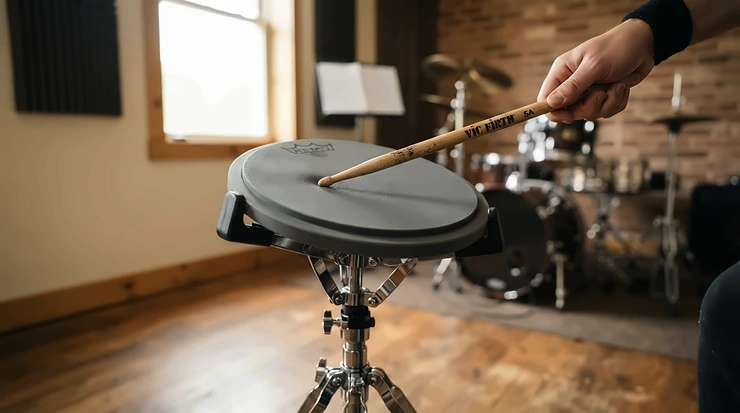
A Meinl Marshmallow pad is built to swallow stick noise in thick foam, while the hard side of a Vic Firth PAD12D is made to be heard, and both count as practice pads. Choose the wrong one for your room and you either annoy the people next door or drill habits that never carry over to a snare. For 2027, the five models below are matched to five different situations rather than ranked against each other, because the best practice pads for a shared wall are not the ones for a rehearsal room.
Spec pages from Evans, Vic Firth, Remo, Meinl and Drumeo, dealer listings, a DrumSpy roundup and owner reviews on Thomann and Long & McQuade supply every claim below; nobody hit these pads with a stick for this guide, so each comment about feel belongs to a named reviewer. Prices are ranges taken from dealer pages, and the current price on Amazon.com may differ.
Rebound, volume and footprint: what really separates practice pads
Rebound comes first. A gum-rubber pad throws the stick back quickly, a foam pad like Meinl’s keeps it low, and a real drumhead on a rim, as on the Remo Tunable 8-Inch, lands nearer to a snare. Vic Firth’s own exercise notes explain why that matters: at a soft, roughly three-inch tap height, the stick’s natural rebound fades and the wrist has to direct the stroke. A pad that returns less energy asks more of the wrist on every note.
Volume is mostly a matter of surface and base, and practice pads reviews rarely attach a decibel figure to it. DrumSpy’s roundup of pad options gives no numbers at all; it calls the gum side of the Evans RealFeel realistic at lower volume, its harder side louder and more articulate, and the mesh-head Remo Silentstroke quiet. The only figures come from makers. Sweetwater’s page says the Silentstroke head cuts volume by about 80%, and Drumeo says its Drumeo QuietKick cuts volume by up to 70% against a traditional bass drum. Treat both as marketing claims.
Footprint is the third split. George’s Music says outright that the 12-inch Evans RealFeel is not mountable, so it lives on a lap, a table or carpet, or inside a snare basket. The Remo Tunable 8-Inch mounts on a stand and has a rubber bottom for tabletops, and a dealer page for the Meinl Marshmallow lists an 8 mm threaded insert for a cymbal stand. Music & Arts’s student guide pushes a stand for proper playing height and posture, which is the practical argument for a mountable pad.
Model
Size
Surface
Stand mount
Noise claim
Dealer price range
Evans RealFeel RF12D
12 in
Gum rubber plus a second rubber side
No, per George’s Music
Quieter gum side, louder second side; no figure
Between $40 and $50
Meinl Marshmallow 12-Inch
12 in
Thick foam
Yes, 8 mm thread
Ultra-low volume per dealer copy; no figure
Between $45 and $60
Remo Tunable 8-Inch
8 in
Coated drumhead, tunable
Yes
None; reviewers flag volume
Between $25 and $40
Vic Firth PAD12D
12 in (a hair under, per one comparison)
Soft and hard rubber on a wood base
Dealers disagree
Soft side low noise, hard side louder; no figure
Around $55
Drumeo QuietKick Single
Metal base, three swappable strike pads
Rubber strike pads
Clamps to a pedal
Up to 70% quieter than a bass drum, per Drumeo
Around $80
Only the Remo Tunable 8-Inch and the Meinl Marshmallow are clearly stand-ready in their listings, and only the Drumeo QuietKick trains the foot. The two rubber 12-inch pads sit close together on price, so their choice is more about base finish and surface than money. Curious about one of them? Open its listing and compare the details against your room.
Best practice pads for each way you actually practice
Each entry starts from the situation and works back to the pad. Which practice pad best fits you depends more on the room than on any spec line.
Anyone starting rudiments at a kitchen table needs a big, forgiving surface more than an exact snare imitation, and that is the job of this 12-inch disc. It has a natural gum-rubber playing surface on one side and a second rubber surface on the other; listings disagree on that second surface, with some naming neoprene and others recycled rubber, so the exact compound is unsettled. George’s Music says every RealFeel pad is designed and made in the USA.
DrumSpy’s roundup describes the gum side as realistic rebound at lower volume and the other side as louder and more articulate. Its main criticism is that the pad doesn’t feel like a real drum, which the writer treats as expected at this price tier. Luke Petterson’s comparison on Drum Silent adds a hardware detail: the Evans base is unfinished pressed wood that feels rough and can snag cloth, while the Vic Firth’s is painted and smooth. He rates rebound and stick definition about the same on both and would choose the Evans for its slightly larger surface and lower cost.
Pros:
Dealer pages put it between $40 and $50, a modest outlay for a first pad
Two surfaces cover quiet work and louder, clearer strokes
The 12-inch face is a generous target for early sticking
Cons:
Not mountable, so snare height needs a basket or a separate solution
The rough wood base can catch on fabric
For a typical first-year player, this is the pad I would buy first, because one purchase covers both late-evening and daytime work.
Evans RealFeel RF12D Two-Sided Practice PadSee current price, sizes and reviews on Amazon.
Between $45 and $60 buys Meinl’s own quietest pad. A dealer page describes a thick foam surface that gives rebound at ultra-low volume, a padded underside so it can sit on any surface, and an 8 mm insert for a cymbal stand. Thomann lists the same thread and calls the rebound medium.
Foam changes how a stroke feels, not only how loud it is. One Thomann reviewer, writing in April 2026, says it is quieter than another Meinl pad they had used for years and has less rebound, which they expect to improve rebound control. That fits the tap-height logic above: less energy returned means more wrist. Thomann’s US page shows 4.4 out of 5 from 15 ratings, nine of them five-star, though only that one review has visible text, so the reasons behind the three-star and two-star ratings stay hidden.
The foam suits a pad that shares a room with a television or a sleeping child, a hypothetical but common arrangement. It will not teach you what a lively snare head does when you let go of the stick, so a player aiming at the kit may want a rubber pad alongside it. Stand mounting is the other upside, since the thread lets it sit at snare height.
Meinl Marshmallow 12-Inch Practice PadSee current price, sizes and reviews on Amazon.
Volume is the complaint that follows this one around, and it is worth knowing before you order. The pad uses an Ambassador coated drumhead on a rim, tunable with a flat screwdriver, with a rubber bottom for tabletops and a mount for a stand; dealers sell it between $25 and $40.
Thomann’s US page shows 4.3 out of 5 from 70 ratings, with 35 five-star, 14 three-star and none below three. Noise is the most common complaint there: one reviewer says it gets too loud when played hard, another that it is louder than a rubber pad. The same reviewers praise the feel, one likes tuning the head looser for chop work, one reports some wear after heavy use, and one criticizes the flat-head tuning bolts. DrumSpy tried the quieter mesh sibling, the Remo Silentstroke, and found rebound close to a snare with convincing buzz rolls and a small surface that encourages accuracy, though the tuning made no difference to the writer, who wouldn’t call it an everyday pad.
Pros:
A real head gives the nearest thing here to snare response
The eight-inch face rewards accurate aim
Replaceable head and stand mount
Cons:
Reviewers repeatedly call it loud for shared walls
Wear after heavy use, per one Thomann reviewer
Snare-minded players, such as a student prepping concert snare excerpts, will get the most out of it.
Remo Tunable 8-Inch Practice PadSee current price, sizes and reviews on Amazon.
Around $55 is where this pad sits across several dealer pages, a few dollars above the Evans. Soft rubber on one side gives low rebound and low noise, while the hard rubber side is clearly audible and more responsive, according to Sweetwater, and a dealer page for Tarpley Music pitches the harder side at marching and rudimental work. Sweetwater also credits a heavy wooden base with keeping the pad from running away, and Strait Music lists it as made in the USA.
Drum Silent’s comparison measures the Vic Firth at a hair under 12 inches, with a painted, smooth base that the writer prefers, and concludes that rebound and stick definition feel about the same as the Evans. That leaves finish, size and price as the real tie-breakers. For a permanent spot on a desk, where a pad that shifts is a nuisance, the weight and smooth finish are the argument for paying the extra few dollars.
Mounting is where dealers disagree. zZounds lists 8 mm stand threads across the PAD line, while Sweetwater’s listing for this model never mentions mounting, so confirm the exact model number before assuming it screws onto a stand. Drum Silent’s verdict is that the two 12-inch rubber pads are close enough that brand preference can decide it.
Vic Firth PAD12D Double-Sided Practice PadSee current price, sizes and reviews on Amazon.
Bass drum practice pads solve a different problem from every other pad here, because they quiet the foot rather than the hands. Drumeo’s shop page says the unit works with any standard pedal, or flat on the floor, and has a rubber bottom that resists sliding. The single package includes one reverse-angle beater, two ultra-quiet strike pads and one longer-lasting pad. A double-pedal setup needs a second beater, and Drumeo sells a separate double version. The single package costs around $80 at the maker’s shop and several dealers, and DrumSpy notes that launch pricing was lower, so check the current price on Amazon.com.
DrumSpy’s review found the pads thick enough to feel real without the bounce of some mesh heads, and the writer called the result “darn close” to a bass drum. Someone in the same room can still hear it, he adds, and he advises the ultra-quiet pads if you live above neighbors. The swap to the reverse-angle beater is required, and his own bulky pedal would not pack with it.
Owners are less uniform. Thomann’s page for the double version shows 4.1 out of 5 from 23 ratings, six of them three-star and two at two stars. Reviewers there report that noise carries through floors to neighbors below, that rebound is low for some and fine for others, that price feels high for a metal plate, two beaters and three rubber pads, and that one found it unstable enough to brace against a wall during double hits. Drumeo itself says it can shift on a hard floor and recommends a rug. For comparison, four reviews of the Gibraltar Practice Pad for Bass Drum on Long & McQuade average 3.4 out of 5, with one reviewer reporting the beater wore into the rubber and shed debris that could reach the pedal’s bearings or chain, and another saying the beater seems to sink in. Drumeo’s own pitch is that the swappable strike pads, one built to last longer, limit wear. Weighing the kick pad? Its Amazon.com listing will show whether the single or double bundle fits your pedal.
Drumeo QuietKick Single Bass Practice PadSee current price, sizes and reviews on Amazon.
Mistakes that send a practice pad back: loudness, size and slide
Buying the hard, lively surface for a thin-walled flat is the first. The Remo Tunable 8-Inch reviewers above are blunt about volume, and DrumSpy hears the Evans second side as the louder one.
Assuming a 12-inch pad will drop onto a stand is the second. The Evans RealFeel is listed as non-mountable, and Vic Firth dealers disagree about threads, so read the listing for the word mount before you count on it.
Skipping the floor is the third. Drumeo says the Drumeo QuietKick shifts on hard floors and recommends a rug, and Thomann reviewers say noise carries downward, so an upstairs flat may want the ultra-quiet strike pad and extra carpet.
How to use a drum practice pad: height, tempo and the step back to the kit
A pad rewards a boring routine done well. The steps below follow Vic Firth, Musora and the Percussive Arts Society.
Set the height. Sit with the pad at roughly snare height if you can, because Music & Arts ties a stand to proper height and posture.
Begin with full strokes. Vic Firth’s marching exercise notes recommend opening each session with relaxed full-rebound strokes, with the stick rising to about 12 inches.
Drop to tap height. Repeat at about 3 inches, where the wrist does more of the work, and try for a full sound from a small motion.
Add a click. Musora suggests starting near 60 BPM and raising the tempo only when the sticking is clean, with short focused sessions valued above long careless ones.
Choose rudiments. Its beginner tiers start with single and double stroke rolls, the single paradiddle and flams.
For a longer list, the Percussive Arts Society’s 40 International Drum Rudiments include the traditional 26 and recommend working each one from slow to fast and back to slow. Musora also says rudiments are meant to leave the pad: single strokes become tom fills, paradiddles become hi-hat and snare grooves, and flams add accents to backbeats. A pad such as the Evans RealFeel is where those patterns get learned, and the kit is where they turn into music.
Volume, size, stands and kick pedals: practice pad details settled
What size practice pad should I buy?
Twelve inches gives beginners a bigger target and suits a lap or table, while eight inches mounts on a stand and rewards accuracy. Choose 12 if the pad will mostly sit flat, and 8 if you want a stand-mounted pad beside the kit.
Are practice pads really quiet?
They are quieter than a drum but not silent. Makers claim roughly 70 to 80 percent volume cuts for a kick pad and a mesh-head snare pad, yet no source here gives decibel readings, and reviewers say harder surfaces and kick pads still carry through walls and floors.
Do bass drum practice pads work with double pedals?
Many do, but check first. One popular model works with single or double pedals, though a double setup needs a second reverse-angle beater, and one Thomann reviewer found it unstable enough during double hits to brace it against a wall.
How long should I practice on a pad each day?
Musora says short, concentrated rudiment sessions are worth more than long careless ones. Start near 60 BPM, raise the tempo only once your sticking is clean, and finish by applying one rudiment to a groove or fill on a kit.
Can a practice pad replace a drum kit?
A pad trains grip, stick height and sticking, but rudiments are meant to move onto a real kit, per Musora. Rebound differs from a drumhead, so use the pad for technique and the kit for balance, dynamics and feel.
Choosing among practice pads: one rule for each room
Decide by room first. The Evans RealFeel is the sensible single pad for most first-year players, the Meinl Marshmallow fits a house where volume decides everything, the Remo Tunable 8-Inch is for players who want drumhead response and can live with the noise, and the Vic Firth PAD12D is the steadier desk pad. If your trouble is your foot, the Drumeo QuietKick is the only option here that addresses it. Anyone hunting for the best practice pad 2027 can offer should therefore start with the room and the goal, then pair a quiet pad with a livelier one if the budget allows. Among practice pads, the right one is the pad that matches your wall, your stand and your pedal.
Disclaimer: This post contains affiliate links. As an Amazon Associate, I earn from qualifying purchases made through these links, at no additional cost to you.
Found a pad that suits your room? Check its current listing on Amazon.com and start counting out those paradiddles.