Swapping out the stock metal on a starter kit is one job, finding something a shared apartment wall will tolerate is another, and adding a first china for a heavier band is a third. Each calls for a different cymbal, and that is how this 2027 shortlist is organized: five picks, each tied to a situation instead of ranked against the others.
The sourcing is a mix of maker pages, dealer listings, MusicRadar’s published cymbal reviews and customer comments on Thomann and Equipboard, so every playing impression below is secondhand and credited to whoever reported it. Prices appear as ranges, so treat them as a starting point and check the current price on Amazon.com.
Ride cymbal, crash cymbal or china: which job needs filling first?
Sweetwater’s cymbal buying guide sorts the main voices by what they do. A ride cymbal keeps time, runs 20 to 24 inches in the traditional sizes, and takes over where hi-hats stop working, such as slow ballads or loud choruses. A crash cymbal marks accents and transitions, typically from 14 to 20 inches or larger. A china hangs upside down, throws a lingering burst of white noise, and usually measures 16 to 18 inches. The guide files it under accents and metal. The compromise piece is the crash/ride, normally 18 inches, which saves space and weight but doesn’t excel at either role.
The same guide treats 14-inch hi-hats plus an 18-inch crash/ride as the minimum kit, and a standard setup as 14-inch hats, a 20-inch ride, 16- and 18-inch crashes and a 10-inch splash. A china sits outside both lists, which is why the china pick comes last below.
Three physical traits explain most of what you hear. Per Sweetwater, thicker and heavier cymbals sound higher and louder, thinner ones lower and quieter, and a larger diameter pulls the pitch down. A bigger bell usually means a louder, harmonically richer sound. Alloy is the third lever: B8 bronze (8% tin) reads bright and cutting, B20 (20% tin) dark and complex, and brass, common in budget lines, brings a softer attack and lower output that suits room-sized playing.
The best cymbal for any one player is the one that fills a specific job in a specific room, and the guide’s main advice is to trust your ears over a spec sheet.
Where the five picks differ on metal, size and price
Model
Job it fills
Metal or weight per listing
Sizes in the listing
Price range
Main trade-off
Sabian SBR Performance Set
First full set
Brass
14″ hats, 16″ crash, 20″ ride
$290 to $315
Weak closed hi-hat chick, per MusicRadar
Zildjian L80 Low Volume 3-piece Cymbal Pack
Quiet practice
Perforated alloy (listings differ on the exact metal)
14″ hats, 16″ crash, 18″ crash ride
$410 to $430
Quiet, not silent
Zildjian 17″ A Custom Crash
Band-stage crash
Thin weight
17″
$320 to $380
Out of stock on Zildjian’s own page
Meinl 20″ Byzance Dark Ride
Session ride
B20 bronze, hand hammered
20″
$510 to $520
Heavy, so it clangs more than it washes
Sabian B8X 18″ Chinese
First china
B8 bronze
18″
$160 to $170
Dealers disagree on its weight
Only two of the five arrive as multi-piece sets. The other three are single cymbals meant to join pieces you already own, so their prices are not comparable to the packs on a per-piece basis. The ride alone costs more than the whole Sabian SBR Performance Set at the top of its range (my arithmetic), which says as much about hand hammering and B20 bronze as about the sound.
Spotted one you like? Take a closer look on Amazon.com.
The best cymbal for five situations, from a stock-kit swap to a first china
Each pick answers one buying situation, so read for the one that sounds like yours.
Cymbals that ship with starter kits are the usual reason a beginner kit sounds thin, and a boxed brass set is the cheapest way past that. The Sabian SBR Performance Set (model SBR5003) bundles 14-inch hi-hats, a 16-inch crash and a 20-inch ride, all hammered and lathed. Adorama’s listing says the three were tonally matched in Sabian’s Vault before shipping.
MusicRadar’s review of the SBr line calls it a clear step up from Sabian’s earlier Solar brass range and worth choosing over starter-kit cymbals, while conceding that brass can’t match bronze for complexity. The 14-inch hats were the standout: thick and hissy when played partly open, closest to bronze in the set, though the closed chick was weak. The 16-inch crash produced a fuller wash than the reviewer expected, with a fairly quick decay, and the 20-inch ride had a thin, high attack over real body and a bell strong enough to pass for bronze. The complaint was a slight shortage of character and edge.
Owner-side feedback is broad but shallow. Equipboard’s page for the set shows Amazon at 4.4 from 212 ratings, and its pros-and-cons digest names the 16-inch crash as the weak link, read by some as a thin ride or a medium crash. It also notes that the hi-hats carry no marking for top and bottom. Equipboard’s tracker put new prices between about $290 and $315 in mid-November 2026.
Pros:
✅ Three matched pieces in one box
✅ Hi-hats singled out by MusicRadar as the best part of the set
Cons:
❌ Weak closed hi-hat chick, per MusicRadar
❌ The 16-inch crash draws criticism in Equipboard’s digest
Sabian SBR Performance SetSee current price, sizes and reviews on Amazon.
Shared walls change the whole question. Sweetwater lists the pack under item LV468: 14-inch hi-hats, a 16-inch crash and an 18-inch crash ride, all perforated so they play at reduced volume. Zildjian claims up to 80% less noise, though the page for its smaller 13/18-inch L80 pack gives no decibel figures or test method. MusicRadar’s review of the LV468 set, written by David Holmes in January 2016, reports roughly 123 dB for a conventional cymbal against about 83 dB for the L80.
What you pair them with matters as much as the metal. In that review, with mesh heads fitted, the click of the stick on the surface seemed louder than the cymbal’s own ring. Thomann’s page for the set, which shows 4.8 out of 5 from 107 ratings, describes the same combination: several reviewers use Remo Silentstroke mesh heads, and one bought the set after neighbor complaints about an acoustic kit. The same page is consistent about the limit. Reviewers call the cymbals far quieter than normal ones, and one writes “They aren’t completely silent,” while a 2025 reviewer warns that the set stays clearly audible in a residential building.
Playability draws mixed notes. The ride is well received on Thomann, and the hi-hats win praise for foot response, although one reviewer finds them sharp and another calls them the loudest piece once silent heads are fitted. The crash takes the most criticism, needing hard hits to speak. MusicRadar’s reviewer found ride patterns acceptable but quick to decay, with little overtone, and named being too quiet for gigs as the main con.
Care is simple. Zildjian’s page for the 13/18 pack says the sandblasted finish may show fingerprints and should be cleaned with a clean, dry cloth, not cymbal cleaner. Sweetwater lists the pack in stock, with dealer prices running roughly $410 to $430.
Zildjian L80 Low Volume 3-piece Cymbal PackSee current price, sizes and reviews on Amazon.
One crash on the right side of a band kit has to cut through guitars without turning shrill, and a drummer on Audiofanzine describes this model as the one that finally did it. According to that review (machine-translated from French and published in 2013), the 17-inch beat a 16-inch K Custom that was too dark, a 16-inch Avedis that was too bright, and the 17-inch A Custom Fast Crash, whose sustain ran short and slightly sharper. The reviewer had owned it for two years, plays rock, pop and funk, thinks it could work for metal and doubts it suits jazz. That is one owner’s report, not a consensus.
Zildjian’s own description calls the Zildjian 17″ A Custom Crash bright and sweet, with a brilliant finish, tonal grooves and a lower profile that give a smoother, glassier sound and more give under the stick. It speaks quickly and carries warm undertones, and every size is listed in thin weight. Thomann’s US page shows 5 out of 5 from 27 ratings. Of the English-language comments there, one is from a player who says they have bought the same model repeatedly over about ten years and calls it a big, dark crash.
Descriptions split on brightness: Zildjian says bright, that Thomann owner says dark, and the Audiofanzine owner lands between them. Auditioning one beats trusting any single adjective. Zildjian’s page showed the 17-inch out of stock while Thomann’s US listing showed it in stock, which is why dealer prices run roughly $320 to $380. Dealer listings give A20515 as the model number for the 17-inch, but Zildjian’s page doesn’t print one for that size, so confirm the diameter on the order.
Pros:
✅ Thin weight that speaks quickly, per Zildjian’s description
✅ 5 out of 5 from 27 Thomann ratings
Cons:
❌ Tone descriptions conflict between sources, from bright to dark
❌ Out of stock on Zildjian’s own page when checked
Zildjian 17″ A Custom CrashSee current price, sizes and reviews on Amazon.
At roughly $510 to $520 this is the priciest single piece here, and the ride alone costs more than the complete Sabian SBR Performance Set (my arithmetic from the ranges above). Thomann’s page lists B20 bronze, hand hammered, and describes a dark, earthy tone with a very clear ping. MusicRadar’s roundup of cymbal ranges characterizes the Byzance family as dark, lush, Turkish-made and finished in Germany.
Reviewers return to the same two traits. Thomann’s page shows 4.9 from 11 ratings, and the four reviewers with comments there praise the stick definition and the bell. They split on crashing: one calls it a poor crash, another says it crashes well in louder styles. They also split on genre, with a 2009 reviewer seeing it as better for rock, pop and funk than jazz. Sweetwater carries a single customer review. The reviewer previously played a 20-inch A Custom ride and a Meinl Classics Custom Dark ride, says the Byzance cuts through any mix without harshness, and finds its bell loud and responsive. Crashing works, but the sound is a loud clang instead of an open wash, so that owner pairs it with a separate crash/ride. Jazz fit is contested here, since the same reviewer says it works across metal, big band and bop. Sweetwater’s sales engineer suggests wood-tip sticks to bring out the dark tone.
Availability needs attention. Sweetwater doesn’t normally stock the ride and lists it on backorder with an estimated December 2026 delivery, so check stock before planning around a date.
Meinl 20″ Byzance Dark RideSee current price, sizes and reviews on Amazon.
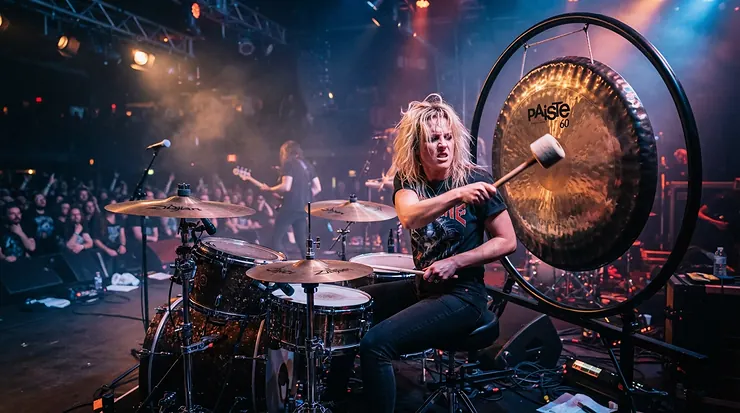
A china cymbal is an accent piece, not a timekeeper, which is why it ends the buying order. The Drum Ninja says most players mount it far left or far right of the kit, hit it occasionally because it is harsh for constant use, and sometimes stack another cymbal on top for a quicker or longer effect.
The Sabian B8X 18″ Chinese is B8 bronze. The Drum Ninja describes a bright, aggressive, edgy sound that doesn’t read as budget, while admitting that higher-priced chinas sound better. Equipboard’s tracker put it between $160 and $170 in November 2026, with Amazon at 4.4 from 55 ratings and Thomann at 4.3 from 6. Among the pros its digest lists a distinct, trashy sound for blast beats and a durable build, and among the cons a somewhat high pitch for an 18-inch china and a lack of spark for some players. Equipboard’s Reddit digest, which says Sabian’s B8 line sits a step above entry lines such as Zildjian ZBT and Sabian SBR, concerns the older B8 Pro China, not this model, so weigh it lightly. Dealers also disagree on weight, with Thomann listing medium and Adorama thin.
Spending more doesn’t guarantee a better china. Two Audiofanzine reviews of the pricier Sabian AAX 18″ Chinese, rated 3.5 out of 5 across both and dating from 2008 and 2011, split sharply. One owner valued how it cuts through a live mix. The other found it piercing and gongy, with sustain that builds into a loud wash, said a Wuhan costing around $40 sounded similar, and moved to a Sabian HHX 18-inch china.
Sabian B8X 18″ ChineseSee current price, sizes and reviews on Amazon.
Cymbal reviews: what ratings can and can’t tell you
Sample size varies enormously across these five. The Sabian SBR Performance Set has 4.4 from 212 Amazon ratings, per Equipboard, and the Zildjian L80 Low Volume 3-piece Cymbal Pack has 4.8 from 107 on Thomann. At the other end, the Zildjian 17″ A Custom Crash shows a perfect 5 from 27, the Meinl 20″ Byzance Dark Ride 4.9 from 11 on Thomann, and Sweetwater’s page for that ride holds just one review. Perfect scores from small samples say less than middling scores from large ones.
Individual cymbals differ, too. The Cymbal Wiki lists 11 recorded samples of the 18-inch AAX Chinese ranging from 1,055 g to 1,281 g, a spread of about 226 g (my arithmetic), though the page doesn’t say how the weights were gathered. A pair of identical model numbers can therefore sound different, which is another reason Sweetwater’s guide leans on trusting your ears.
Taste is the other fault line. Thomann reviewers of the L80 set disagree about the hi-hats, praising their feel while others call them sharp or too loud. Cymbal reviews are most useful when you read the written comments, not only the stars, and weigh a rating by how many people stand behind it.
Best cymbal brands: where these five come from
Electronic Drum Advisor describes the cymbal market as dominated by Zildjian, Sabian, Paiste and Meinl, and its brand profiles show how different their backgrounds are. Zildjian dates to 1623 in Constantinople, now Istanbul, and is based in Massachusetts, with ranges from beginner to professional. Sabian began in 1981 in Canada, founded by Robert Zildjian after a dispute with his brother. Meinl started in Germany in 1951, is credited by that article as the first to sell pre-packed cymbal sets (in 1974), and is described as low, dark and dry. Paiste began in 1906 in Saint Petersburg and has been in Switzerland since 1957, with a bright, full-bodied, clear voice.
Three of those four appear in this shortlist, two Sabian picks, two Zildjian and one Meinl. No Paiste model made the cut, but MusicRadar’s ranking of cymbal ranges places Paiste’s PST 8 line as well-made, good-value gigging metal and its 2002 line as a powerful classic favored by rock players, so both belong on a cross-shopping list. MusicRadar ranks by range, not brand, so treat it as a map of lines rather than a verdict on which of the four is best.
Where a good cymbal still disappoints: mismatches the sources warn about
A crash/ride is not a ride. Sweetwater’s guide says the hybrid doesn’t excel at either role, so a player who needs real ride definition is better served by a true 20-inch ride than by stretching an 18-inch crash/ride across both jobs.
A heavy ride will not wash like a crash cymbal. The Sweetwater reviewer of the Meinl 20″ Byzance Dark Ride says its weight limits how open it crashes, which is why that owner carries a separate crash/ride.
Low volume is not silence. NIOSH, the U.S. federal workplace-health institute, published guidance for musicians that keeps average noise exposure under 85 dB(A) over an eight-hour day and says a musician playing at about 94 dB(A) could reach that point in roughly an hour. It advises musicians to play at lower levels in rehearsal when possible and to wear hearing protection when appropriate. Quieter cymbals support the first part, but Thomann reviewers still describe the Zildjian L80 Low Volume 3-piece Cymbal Pack as audible through building walls.
Exotic pieces come after the core. The guide’s essential kit has no china cymbal in it, so a hi-hat, a crash and a ride come first. Finish care follows the same logic: Sweetwater says brilliant finishes show fingerprints and patina and need regular cleaning, while Zildjian’s L80 page restricts that line to a dry cloth.
Cymbal sizes, china mounting and quiet-practice answers
❓ What cymbals does a basic drum kit need?
✅ Sweetwater's guide treats 14-inch hi-hats and an 18-inch crash/ride as the minimum. A standard set adds a 20-inch ride, 16- and 18-inch crashes and a 10-inch splash. Everything else, a china included, is an add-on once the core pieces feel settled.
❓ What is a china cymbal used for?
✅ A china mounts upside down and gives a lingering burst of white noise, according to Sweetwater, which suits accents and metal. Most drummers hang it far left or far right of the kit, per The Drum Ninja, and hit it as an occasional effect.
❓ Are low volume cymbals actually quiet?
✅ Much quieter, not silent. MusicRadar's review cites about 123 dB for a conventional cymbal and 83 dB for Zildjian's L80. Several Thomann reviewers report no neighbor complaints, while one warns the set stays audible in a residential building.
❓ What is the difference between a crash and a ride cymbal?
✅ A crash marks accents and transitions and typically runs 14 to 20 inches. A ride keeps time, usually 20 to 24 inches, with defined stick sound and a bell. A crash/ride, usually 18 inches, compromises between the two and excels at neither, says Sweetwater.
❓ Which are the best cymbal brands for a first purchase?
✅ Zildjian, Sabian, Meinl and Paiste are the four names Electronic Drum Advisor says dominate the market. Zildjian and Sabian offer broad ranges, Meinl leans dark and dry, and Paiste bright and clear. Auditioning one matters more than the logo on it.
Choosing your cymbal by room first, then by job
Start with the walls, then the job. If the room is the limit, the Zildjian L80 Low Volume 3-piece Cymbal Pack is the route to playing at reduced volume, as long as you accept quiet instead of silent. If the kit still wears its stock metal, the Sabian SBR Performance Set is the lowest-cost way to a matched hat, crash and ride. For a band stage, the Zildjian 17″ A Custom Crash and the Meinl 20″ Byzance Dark Ride carry high Thomann ratings, though from small samples, and the Sabian B8X 18″ Chinese belongs last, once the core three feel settled. Whichever you pick, a cymbal is easier to judge by ear than by spec sheet, so audition when you can. Spotted the one that fits your room? Take a closer look at its Amazon.com listing.
Disclaimer: This post contains affiliate links. As an Amazon Associate, I earn from qualifying purchases made through these links, at no additional cost to you.
Hang the right metal on your stand, and keep the neighbors out of the chorus. 🥁