What is a bass amplifier? At its core, a bass amplifier is an electronic device designed to strengthen the low-frequency signals from a bass guitar, pushing enough air through a speaker to make those vibrations audible—and feelable. However, in 2026, top bass amps are far more than just “loud boxes.” They are sophisticated tonal hubs featuring integrated Impulse Responses (IRs), Class D power efficiency, and sophisticated DI outputs that bridge the gap between a sweaty basement rehearsal and a high-fidelity studio session.
Finding the right gear means balancing raw wattage with portability. Gone are the days when you needed a forklift to move a rig capable of rattling windows. Today’s market is dominated by lightweight combos that punch well above their weight class and smart heads that allow for silent practice without sacrificing “tube-like” warmth. Whether you are a bedroom hobbyist or a touring professional, the gear you choose defines your foundational groove. In this guide, we break down the leading contenders that offer the best return on investment for your sound.
Quick Comparison Table: 2026 Leading Bass Rigs
| Model | Power Output | Configuration | Weight | Best For |
| Fender Rumble 500 | 500W | 2×10 Combo | 36.5 lbs | All-around Gigs |
| Ampeg RB-210 | 500W | 2×10 Combo | 39 lbs | Vintage Grit |
| Boss Katana-210 | 160W | 2×10 Combo | 48 lbs | Built-in FX |
| Darkglass Microtubes 500 | 500W | Head/Combo | Various | Modern Metal |
| Orange Crush Bass 100 | 100W | 1×15 Combo | 53 lbs | Studio Warmth |
Looking at the comparison above, the Fender Rumble 500 remains the gold standard for weight-to-power ratio, making it the practical choice for the gigging bassist. However, if your style demands the specific harmonic saturation of a “driven” tube amp, the Ampeg RB-210 offers a dedicated overdrive circuit that the cleaner Fender can’t quite replicate. Those who prioritize digital flexibility will find the Boss Katana-210 hard to beat, even if it carries a bit more heft due to its robust cabinet construction.
💬 Just one click — help others make better buying decisions too!😊
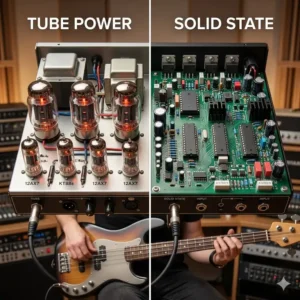
Top 5 Bass Amps: Expert Analysis for 2026
The following selections represent the pinnacle of current amplification technology. We’ve analyzed these based on circuit design, roadworthiness, and tonal flexibility.
1. Fender Rumble 500 V3 Combo
The Fender Rumble 500 V3 Combo continues to dominate the mid-tier market because it perfectly balances “old school” aesthetics with modern “Class D” efficiency. It delivers 500 watts of power (when used with an external cab) through two 10-inch Eminence speakers.
-
Key Specs: 500W (with extension), 2×10″ speakers, 3-button tone palette (Bright, Contour, Vintage).
-
Expert Commentary: What most buyers overlook is the “Vintage” button; it’s not just a EQ preset but a subtle compression and harmonic shift that mimics the sag of a 70s tube rig. In my experience, this is the safest “blind buy” for any bassist because it handles everything from jazz to punk with zero fuss.
-
Customer Feedback: Users consistently praise the lightweight design, often noting they can carry their entire rig in one hand while holding their bass in the other.
-
Pros: Incredible power-to-weight ratio; highly intuitive EQ; classic Fender “silverface” look.
-
Cons: The overdrive circuit is a bit “fizzy” for some tastes; internal fan can be audible in quiet studios.
-
Value Verdict: Around $600-$700; it’s the best value for a gigging professional who hates lifting heavy gear.
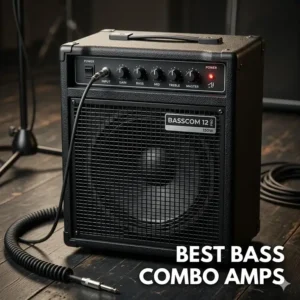
2. Ampeg Rocket Bass RB-210
The Ampeg Rocket Bass RB-210 is Ampeg’s answer to the modern portable era. It features the Super Grit Technology (SGT) overdrive circuit and a custom 2×10 setup that delivers that signature “round” Ampeg thump.
-
Key Specs: 500W, SGT Overdrive, XLR Direct Out, 1/8″ auxiliary input.
-
Expert Commentary: If you want the “Ampeg Sound” without the 80-pound weight of a traditional SVT, this is it. The SGT circuit provides a grit that feels organic—something many digital emulations miss. It’s perfect for rock players who need their bass to “cut” through two loud guitarists.
-
Customer Feedback: Owners love the vintage “checkered” Tolex look and the fact that the DI output sounds remarkably close to a mic’d cabinet.
-
Pros: Authentic vintage tone; excellent DI for recording; classic aesthetics.
-
Cons: Slightly heavier than the Fender equivalent; top-mounted controls can be hard to see on a dark stage.
-
Value Verdict: $650-$750 range; ideal for those who prioritize “character” over clinical transparency.
3. Boss Katana-210 Bass Combo
The Boss Katana-210 Bass Combo brings the legendary versatility of the Katana guitar line to the low-end world. It uses a sophisticated Class AB power amp section (rare for lightweight amps) to provide more “punch” and “feel.”
-
Key Specs: 160W, 60+ integrated Boss effects, 3 amp characters (Vintage, Flat, Modern).
-
Expert Commentary: Don’t let the “160W” spec fool you; the Class AB design pushes more “air” than many 300W Class D amps. The real selling point is the internal effects library. You can ditch your pedalboard entirely if you’re just doing a quick club set.
-
Customer Feedback: Reviewers highlight the “Tone Studio” software, which allows for deep editing of effects and compression settings.
-
Pros: Massive array of internal effects; very high build quality; supports foot switching.
-
Cons: Heaviest combo in this list; learning curve for the digital software.
-
Value Verdict: Around $550-$650; the ultimate choice for the tech-savvy bassist who loves experimenting with sound.
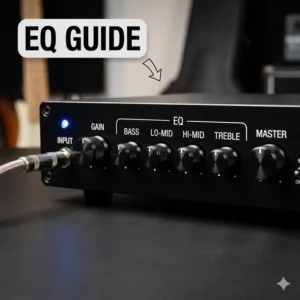
4. Darkglass Microtubes 500 V2
The Darkglass Microtubes 500 V2 (often paired with a DG210C cabinet) is the industry standard for modern metal and progressive rock. It’s a 500W head that fits in a backpack but sounds like a demolition crew.
-
Key Specs: 500W, B3K and VMT drive circuits, 6-band graphic EQ, MIDI input.
-
Expert Commentary: Darkglass changed the game by focusing on “mid-range clarity” under high distortion. The spec sheet says 500W, but the way it handles transients makes it feel much more powerful. It’s the only amp here with a built-in compressor that I would actually use on a professional recording.
-
Customer Feedback: Pro players adore the MIDI functionality and the ability to load their own Cabinet IRs (Impulse Responses) for a consistent sound every night.
-
Pros: World-class distortion; extremely compact; professional-grade features.
-
Cons: Expensive for the power rating; strictly “modern” voicing might not suit blues or jazz.
-
Value Verdict: $800-$950 range (head only); the professional’s choice for high-gain applications.
5. Orange Crush Bass 100
The Orange Crush Bass 100 is an all-analog beast that prioritizes tone over digital bells and whistles. It features a 15-inch speaker, which is a rarity in a world moving toward smaller drivers.
-
Key Specs: 100W, 1×15″ speaker, 3-band EQ with parametric mid, integrated tuner.
-
Expert Commentary: 100 watts might sound low, but because it’s paired with a 15-inch speaker, the “low-end bloom” is incredible. It feels “slow” in a good way—perfect for reggae, stoner rock, or classic motown where you want a thick, pillowy foundation.
-
Customer Feedback: Users note that this amp is surprisingly loud for its wattage and that the parametric mid control is a “secret weapon” for fixing room acoustics.
-
Pros: Thunderous low end; indestructible build; unique aesthetic.
-
Cons: Heavy for its power level; no built-in compressor.
-
Value Verdict: Around $500-$550; a fantastic studio amp or practice rig for those who love the “15-inch sound.”
✨ Don’t Miss These Exclusive Deals!
🔍 Take your low-end to the next level with these carefully selected products. Click on any highlighted item to check current pricing and availability. These tools will help you create authentic tones your family—and your bandmates—will love!
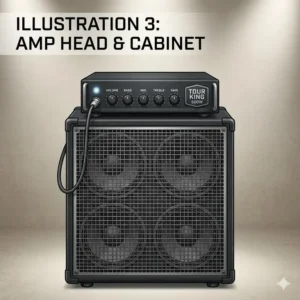
Buyer’s Decision Framework: Finding Your Low-End Match
Choosing between top bass amps isn’t just about who has the most knobs; it’s about matching the amp’s “behavior” to your lifestyle. Use this checklist to narrow down your search:
-
The “Schlep” Factor: If you live in a third-floor walk-up, look at the Fender Rumble or Darkglass. Weight is the silent killer of motivation.
-
The Tone Target: Are you playing “Clean and Punchy” (Fender/Boss) or “Gritty and Harmonic” (Ampeg/Orange)? Analog circuits generally provide better “grit,” while digital/Class D excels at “clean.”
-
The Venue Size: For coffee shops and home practice, 50-100 watts is plenty. For a loud rock drummer, you need at least 300-500 watts to maintain “headroom”—the ability to play loud without the clean signal distorting.
-
Recording Needs: If you record at home, ensure the amp has an XLR “Direct Out.” This allows you to plug the amp directly into your computer interface without needing a microphone.
💡 Expert Tip: If you’re on the fence about power, always go higher. You can always turn a 500W amp down, but you can’t push a 100W amp past its physical limits without damaging the speaker or sounding like a muddy mess.
Real-World Scenario: The Bedroom to the Barroom
Imagine you are a bassist who spends 90% of your time practicing at home but plays one “loud” gig a month at a local tavern.
-
The Problem: Buying a massive stack is overkill for your bedroom, but a tiny 15-watt practice amp will be drowned out by a drummer the moment you step on stage.
-
The Solution: Focus on 2×10 or 1×12 combos in the 200W-500W range.
-
Why? Amps like the Ampeg RB-210 have a headphone jack for midnight practice but enough “juice” to drive a room of 100 people. Furthermore, many modern amps have a “power soak” or “master volume” that allows you to get a “cranked” sound at whisper levels. This “transformation” of your gear from a practice tool to a stage weapon is the hallmark of the modern bass rig.
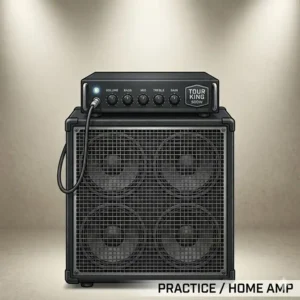
How to Choose top bass amps: A Masterclass in Specs
When you’re browsing the aisles (digital or physical), marketing terms can be misleading. Here is how to filter the noise:
1. Understanding Wattage vs. Volume
Wattage is a measure of power, not necessarily “loudness.” It takes ten times the power to double the perceived volume. This means a 500W amp isn’t five times louder than a 100W amp—it just has more “headroom.” Headroom is what keeps your low B-string sounding clear rather than like a fart in a bathtub. For 2026, we recommend a minimum of 200W for anyone planning to play with a drummer.
2. Speaker Configuration: 10s, 12s, or 15s?
-
10-inch speakers: Fast “transient response.” They feel “snappy” and are great for slap bass or fast metal.
-
12-inch speakers: The “Goldilocks” choice. They offer more low-end than a 10 but more clarity than a 15.
-
15-inch speakers: The “Soul” choice. They move slowly and produce a deep, fundamental bass tone that you feel in your chest.
3. Direct Out (DI) and Ground Lift
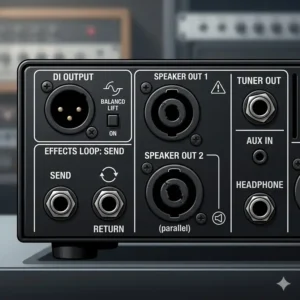
Any “top” amp must have an XLR output. Check if it has a “Pre/Post” switch. “Pre” sends your dry bass signal to the soundboard, while “Post” sends the signal after it has been colored by the amp’s EQ. A “Ground Lift” switch is also essential—it stops that annoying “hum” often caused by messy electricity in older bars.
Common Mistakes When Buying top bass amps
Based on years of “trial and error” (mostly error), here are the pitfalls to avoid:
Buying for the “Brand” instead of the “Use Case.”
I’ve seen many people buy a massive Ampeg 8×10 stack because their favorite 70s rock star used one, only to realize it doesn’t fit in their Honda Civic. Always measure your trunk before you buy your rig. In 2026, “portability” is a feature, not a compromise.
Ignoring the “Mids.”
Beginner bassists often “scoop” their mids (turn them all the way down) because it sounds cool alone in a room. However, the midrange is where the “definition” of the bass lives. If you scoop your mids in a live band, you will disappear. Look for an amp with a “Semi-Parametric Mid” control, which lets you choose exactly which frequency to boost.
Underestimating the “DI” Quality.
Many cheap amps have noisy DI outputs. If you plan to record, a noisy DI means you’ll have to spend another $200 on a separate DI box. Investing more upfront in an amp with a high-quality, transformer-isolated DI saves you money in the long run.
Features That Actually Matter (And Those That Don’t)
Marketing departments love to add “fluff” features. Here is the expert’s guide to what deserves your money:
-
Matters: An Aux In and Headphone Out. Essential for practicing along to tracks without waking the neighbors.
-
Matters: Effects Loop. If you use time-based effects like delay or reverb, putting them in the “loop” (after the preamp) keeps them from sounding “muddy.”
-
Doesn’t Matter: 1,000+ Watts. Unless you are playing stadiums without a PA system, 1,000 watts is mostly for bragging rights. 500W is the “sweet spot” for 99% of players.
-
Doesn’t Matter: Built-in Bluetooth Speakers. While convenient, the speakers in bass amps are designed for instruments, not for high-fidelity music playback. They usually sound “dark” and muffled for casual listening.
Long-Term Cost & Maintenance: Maximizing Your ROI
Modern top bass amps are largely “Solid State,” meaning they don’t have fragile glass tubes that need replacing every year. However, they aren’t maintenance-free.
-
Keep it Dry: Humidity is the enemy of electronics. A $30 padded cover can prevent moisture from corroding the input jacks over a decade.
-
Check the Screws: Bass amps vibrate… a lot. Every six months, take a screwdriver and gently ensure the speaker mounting screws and handle screws are tight. This prevents “cabinet rattle.”
-
Resale Value: Brands like Fender, Ampeg, and Darkglass hold their value remarkably well. If you buy a “no-name” budget amp to save $100, you might find it impossible to sell later. Buying a recognized brand is essentially “renting” the amp for a few years, as you can often sell it for 70% of what you paid.
Practical Usage Guide: Setting Up for Your First Gig
So, you’ve picked one of the top bass amps and it just arrived. What now?
-
The “Flat” Start: Set all EQ knobs (Bass, Mid, Treble) to 12 o’clock. This is the “true” sound of the amp. Play for 10 minutes before touching the knobs to let your ears adjust.
-
Gain vs. Master: Turn the “Gain” (or Drive) up until the little “Clip” light flickers slightly when you play hard, then use the “Master” volume to set the actual loudness. This ensures you are getting the full tonal richness of the preamp.
-
Room Correction: If the room sounds “boomy,” don’t just turn down the Bass knob. Try turning down the Low-Mids (around 250Hz). This usually clears up the “mud” without losing the “thump.”
-
The 30-Day Rule: Avoid using extreme EQ settings for the first month. Learn how your bass interacts with the amp’s natural voice first.
✨ Don’t Miss These Exclusive Deals!
🔍 Take your low-end to the next level with these carefully selected products. Click on any highlighted item to check current pricing and availability. These tools will help you create authentic tones your family—and your bandmates—will love!
Conclusion
The landscape of top bass amps in 2026 is defined by the marriage of classic tone and modern convenience. Whether you opt for the featherweight punch of the Fender Rumble 500 or the high-gain precision of the Darkglass Microtubes 500, the goal remains the same: finding a partner that inspires you to pick up your instrument.
Remember, the “best” amp isn’t the most expensive one; it’s the one that makes you want to play. Take the time to consider your transport situation, your tonal goals, and your budget. With the options listed above, you are well on your way to anchoring the groove with authority.
FAQs
❓ What is the best wattage for a bass amp?
✅ For home practice, 20-50 watts is sufficient. For rehearsals with a drummer and small club gigs, you should aim for 200-500 watts. This ensures you have enough “headroom” to stay clean at high volumes…
❓ Can I use a guitar amp for my bass?
✅ Strictly speaking, no. While it won’t explode instantly, bass frequencies carry much more energy and can easily tear the thin paper cones of guitar speakers. Always use a dedicated bass amplifier for safety…
❓ Are 10-inch or 15-inch speakers better for bass?
✅ Neither is “better,” they just serve different purposes. 10-inch speakers are punchier and faster, making them great for modern styles. 15-inch speakers provide a deeper, more vintage “bloom” that many blues players prefer…
❓ Do I need a separate head and cabinet?
✅ Combos (all-in-one) are more convenient and portable. However, a separate head and cabinet (stack) allow you to mix and match brands and upgrade your speakers without replacing your entire amplifier…
❓ Is a built-in compressor necessary?
✅ It is extremely helpful. Bass has a wide “dynamic range,” meaning some notes are much louder than others. A compressor levels these out, making your playing sound more professional and “polished” in a mix…
Recommended for You
- 5 Best Bass Guitar Practice Amplifier Models for 2026: Ultimate Pro Review
- Bass Guitar Onboard Preamp: 7 Best Power Upgrades for Epic Tone (2026)
- 7 Best Bass Guitar Preamp Pedals for Pro Tone in 2026: Expert Guide
Disclaimer: This article contains affiliate links. As an Amazon Associate, I earn from qualifying purchases. If you purchase products through these links, we may earn a small commission at no additional cost to you.
✨ Found this helpful? Share it with your friends! 💬🤗