

Let’s be real for a second. You’ve spent thousands on that vintage Strat, hours tweaking your tube amp, and months curating the perfect pedalboard. But if you ignore your electric guitar power source, you’re essentially putting low-grade fuel in a Ferrari. It doesn’t matter how good your chops are if your signal is drowning in a sea of 60-cycle hum and nasty ground loops.
The truth is, the way an electric guitar powers its signal chain is the unsexy, invisible hero of your tone. Whether you are a bedroom shredder or a touring pro, clean electricity is the difference between a professional sheen and an amateur buzz. Today, we are diving deep into the world of voltage, current, and isolation. We aren’t just talking about batteries; we are talking about the lifeblood of your sound.
✨Was this helpful? Spread the word! 🚀
Below, we break down the absolute best electric guitar power supplies and conditioners available on the market right now. We’ve dug through the specs, analyzed the noise floors, and checked the reliability so you don’t have to.
Quick Comparison: Clean Power vs. The “Daisy Chain” of Doom
Before we get to the heavy hitters, let’s look at why you need to upgrade. Using a cheap daisy chain is the quickest way to introduce noise. Here is how a proper isolated supply compares to the budget stuff.
| Feature | Isolated Power Supply (The Pro Choice) | Daisy Chain Adapter (The Budget Trap) |
| Noise Isolation | High (Each output is separate) | None (Noise bleeds between pedals) |
| Voltage Stability | Consistent and Regulated | Fluctuates with load |
| Digital/Analog Mix | Handles both silently | Digital noise often bleeds into analog |
| Reliability | Heavy-duty chassis | Prone to cable failure |
| Cost | $100 – $300+ | $10 – $30 |
Top 7 Electric Guitar Power Products: Expert Analysis
We have scoured the market to find the gear that delivers pure, unadulterated electricity to your board. These aren’t toys; they are professional tools.
1. Voodoo Lab Pedal Power 2 Plus
If there is an industry standard for electric guitar power, this is it. Walk onto any stage, from local clubs to stadiums, and you will likely see this brick mounted under a board.
-
Specifications: 8 completely isolated 9V outputs, SAG controls to simulate dying batteries, toroidal transformer.
-
Why It Wins: The Voodoo Lab Pedal Power 2 Plus is built like a tank. It addresses the specific needs of vintage fuzz pedals that sound better with lower voltage (using the SAG feature) while providing enough juice for standard Boss or MXR pedals.
-
User Feedback: Users consistently praise its silence. It eliminates the “whine” associated with digital delays.
-
Pros: Legendary reliability, dead silent operation, made in the USA.
-
Cons: Limited high-current outputs for modern, power-hungry digital multi-effects.
2. Strymon Zuma High Current DC Power Supply
For the modern player running complex digital reverbs and modelers, the Strymon Zuma High Current DC Power Supply is the gold standard. Strymon knows DSP, so they know how to power it.
-
Specifications: 9 high-current, fully isolated outputs (500mA per output), dual-stage topology, expandable via Ojai units.
-
The Vibe: This is the “Apple” of power supplies. Sleek, blue, and incredibly powerful. It uses a switching power supply design that is incredibly lightweight but filtered to be quieter than linear supplies.
-
Professional Application: Ideal for praise and worship boards or ambient shoegaze rigs where massive digital processors like the BigSky or Timeline are used.
-
Pros: Huge current capacity per tap, lightweight, expandable system.
-
Cons: Pricey; the form factor is slightly larger than standard bricks.
3. Truetone 1 Spot Pro CS12
Need to power a spaceship? The Truetone 1 Spot Pro CS12 is your command center. It offers a massive variety of voltages and currents.
-
Specifications: 12 isolated outputs, voltages ranging from 9V to 12V and 18V, variable AC input voltage (works worldwide).
-
Deep Dive: Truetone uses a unique switching power supply technology that allows them to pack more power into a smaller space without the heat of a traditional transformer.
-
Compatibility: Excellent for players mixing vintage 18V flangers with modern 9V overdrives.
-
Pros: Incredible value for the number of ports, includes mounting brackets, worldwide voltage compatibility.
-
Cons: The layout of the jacks can be tight if using bulky cables.
4. Cioks DC7 Future Power Generation
This is the future of electric guitar power. The Cioks DC7 Future Power Generation is ultra-thin (1 inch profile), allowing it to fit under the lowest pedalboards, like the Nano or Metro series.
-
Specifications: 7 outlets, each switchable between 9, 12, 15, or 18V. 660mA at 9V per outlet. USB outlet for charging tablets/phones.
-
Why We Love It: It’s smart. You don’t need special “doubler” cables; you just switch the dip switches to get the voltage you need.
-
User Analysis: Touring musicians love the “Advanced LED Monitoring” which alerts you if you are overloading a specific tap.
-
Pros: Highest current capability, fits anywhere, incredibly versatile voltage switching.
-
Cons: Uses RCA connectors for cables (included, but harder to find replacements at a gas station).
5. Donner DP-1 Guitar Pedal Power Supply
You don’t always have $200 to drop on power. The Donner DP-1 Guitar Pedal Power Supply is the budget king. While marketed as isolated, it is effectively a high-quality filtered supply, great for beginners.
-
Specifications: 10 outputs (9V, 12V, 18V), short-circuit protection, bright blue LEDs.
-
Budget Talk: If you are just starting to build a board and only run 4-5 analog pedals, this unit works wonders compared to a daisy chain.
-
Pros: Extremely affordable, small footprint, includes cables.
-
Cons: Not truly isolated (ground loops can still happen with mixed digital/analog rigs), LEDs are blindingly bright.
6. Furman SS-6B Pro Surge Block
Wait, this isn’t a pedal brick? Correct. But electric guitar power starts at the wall. The Furman SS-6B Pro Surge Block is essential for protecting your amplifier and your pedalboard supply from dirty venue power.
-
Specifications: 6 outlets, EMI/RFI noise attenuation, heavy-duty metal construction, 15-foot cord.
-
Safety First: This provides standard surge protection but also filters out radio frequency interference (RFI). If you’ve ever heard a radio station coming through your amp, you need this.
-
Pros: Rugged, long cable, reduces amp buzz significantly.
-
Cons: It is bulky and heavy for a power strip.
7. MXR M238 Iso-Brick Power Supply
A favorite for experimenters. The MXR M238 Iso-Brick Power Supply features variable voltage sag controls, letting you starve your pedals of power for unique textures.
-
Specifications: 10 fully isolated outputs, two variable outputs (6V-15V), lightweight.
-
Tone Tweaking: By dropping the voltage on a distortion pedal using the MXR M238, you can create a “gated” fuzz sound that cuts off abruptly—a very trendy sound in indie rock.
-
Pros: Variable voltage is a creative tool, small size, high output options.
-
Cons: The power adapter for the unit itself is a bit flimsy compared to the IEC cables used by Voodoo Lab.
💬 Just one click – help others make better buying decisions too!😊
Deep Dive: Why “Electric Guitar Power” Matters More Than You Think
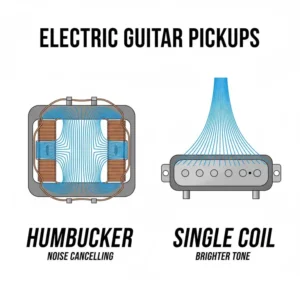
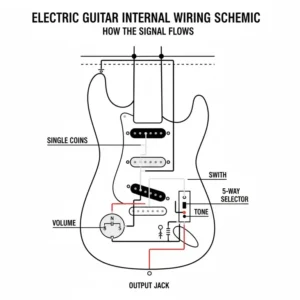
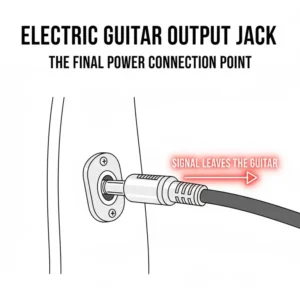
You might be thinking, “Electricity is just electricity, right?” Wrong. In the world of audio, power is part of the signal path. When you plug a guitar into an amp, you are essentially creating a circuit that amplifies the electric guitar power signal generated by your pickups.
If the power entering your pedals or amp is “dirty” (full of electromagnetic interference), that dirt gets amplified right alongside your sweet licks. According to electrical engineering principles, alternating current (AC) naturally oscillates, and without proper rectification and isolation, that oscillation becomes audible hum.
The Physics of Isolation
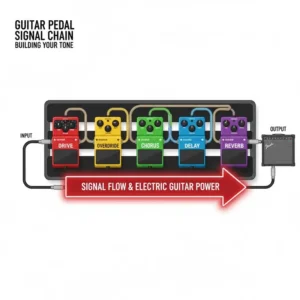
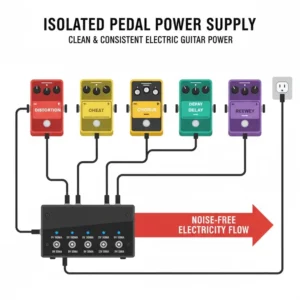
Why did we recommend so many “isolated” supplies? In a non-isolated chain, all pedals share a common ground. If one pedal (usually a digital one) dumps noise onto the ground connection, that noise travels to every other pedal.
“Think of isolated power like separate lanes on a highway. In a daisy chain, everyone is in one lane. If one car crashes (noise), everyone gets stuck. In an isolated supply, every pedal has its own private road.”
Voltage, Current, and Polarity: The Holy Trinity
When selecting a unit to ensure your electric guitar power needs are met, you must understand three metrics. Mixing these up can literally fry your pedals.
-
Voltage (V): Most pedals are 9V. Some are 12V or 18V. Never put 18V into a 9V pedal unless the manual says it’s safe. You will smell smoke.
-
Current (mA): This is the “flow.” Analog drive pedals sip power (10-20mA). Digital reverbs guzzle it (300-500mA). You can provide more mA than needed (the pedal will only take what it needs), but never less.
-
Polarity: Center Negative (-) is standard. Center Positive (+) is rare (vintage fuzzes). Mixing these requires special adapter cables.
Feature Comparison Matrix: Choosing Your Weapon
Here is how different power approaches stack up for the modern guitarist.
| Feature | Strymon Zuma | Voodoo Lab PP2+ | Donner DP-1 | Cioks DC7 |
| Technology | Switching (Modern) | Linear (Old School) | Filtered (Budget) | Switching (Modern) |
| Total Current | Massive (500mA/out) | Moderate (100-250mA) | Low/Shared | Massive (660mA/out) |
| Weight | Light | Heavy | Very Light | Ultra Light |
| Expansion | Yes (Ojai) | No | No | Yes (Cioks 4/8) |
| Best For | Large Digital Rigs | Vintage/Analog Rigs | Bedroom/Practice | Travel/Fly Rigs |
Benefits of Premium Power
Investing in high-end electric guitar power isn’t just about noise; it’s about dynamic range. A starved amp or pedal (receiving less than optimal voltage due to a cheap strip) will compress your sound, making it feel “spongy” and unresponsive.
| Benefit | Description | Traditional Alternative (Daisy Chain) |
| Dynamic Response | Pedals react instantly to pick attack. | Sound feels compressed and muddy. |
| Noise Floor | Near-silent operation even with high gain. | Constant background hum/hiss. |
| Reliability | Failsafe protection prevents surges. | A surge can fry all connected pedals. |
| Cable Management | Clean, custom-length cables. | Spaghetti mess of wires. |
Powering the Beast: Amp Considerations
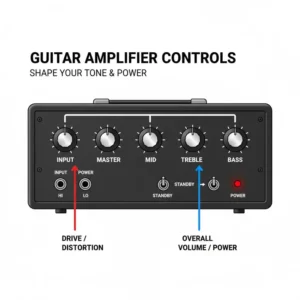
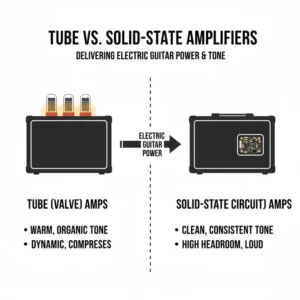
While we focus on pedals, let’s not forget the amplifier. The electric guitar power equation is incomplete without considering the amp’s connection to the wall. Ground loops often occur between the pedalboard and the amp.
If you hear a loud hum that goes away when you touch the guitar strings, you likely have a grounding issue. Using a unit like the Furman SS-6B helps, but sometimes the issue is the venue’s wiring. Never break the ground pin off your amp’s power cable (the “cheater plug” method). This is dangerous and can result in lethal shock. Safety standards from organizations like OSHA emphasize the importance of proper grounding.
Digital vs. Analog Power Requirements
It is crucial to distinguish between how an electric guitar powers analog circuits versus digital ones.
-
Analog (Overdrives, Fuzz, Wah): These are simple. They need steady voltage but very little current. They are susceptible to ripple noise (uneven voltage).
-
Digital (Delay, Reverb, Modulation): These are computers in a box. They demand high current (mA). If you starve them, they won’t just sound bad; they will crash, reboot, or freeze.
Power Consumption Guide
| Pedal Type | Typical Voltage | Typical Current (mA) |
| Overdrive/Distortion | 9V – 18V | 10 – 50 mA |
| Analog Chorus | 9V | 20 – 50 mA |
| Digital Delay | 9V | 150 – 300 mA |
| Complex Reverb (e.g., BigSky) | 9V | 300 – 500 mA |
| Looper Pedals | 9V | 100 – 400 mA |
| Multi-FX Units | 9V – 12V | 500 – 1000+ mA |
Troubleshooting: When Good Power Goes Bad
Even with the best gear, things go wrong. If your electric guitar power setup is acting up, follow this checklist:
-
Isolate the variable: Plug the guitar straight into the amp. Is the noise there? If yes, it’s the amp or guitar, not the board.
-
Check the cables: Patch cables fail far more often than power supplies.
-
Audit your mA: Did you just add a new digital pedal? Check if you exceeded the current limit of that specific output tap.
-
Proximity: Is your wah pedal sitting right on top of your power supply? The magnetic field from the transformer can induce hum into the wah inductor. Move them apart.
Reliable sources like Premier Guitar often highlight that physical layout is as important as the gear itself.
✨ Don’t Miss These Exclusive Deals!
🔍 Take your tone to the next level with these carefully selected products. Click on any highlighted item above to check current pricing and availability. These tools will help you create the professional sound your audience will love! 🛒
Conclusion
Your tone is a journey, not a destination. But you can’t travel far with a broken engine. Upgrading how your electric guitar powers its signal chain is one of the most impactful investments you can make. It’s not as flashy as a new Les Paul, but hearing absolute silence when you stop playing? That is priceless.
Whether you choose the rugged reliability of the Voodoo Lab Pedal Power 2 Plus, the high-tech wizardry of the Strymon Zuma, or the budget-friendly utility of the Donner DP-1, ensuring you have clean, isolated power will let your actual playing shine through.
So, stop fighting the hum. Give your rig the juice it deserves. ⚡🎸
FAQs
✅ If you don't provide enough milliamp (mA) current to a digital pedal, it will likely fail to boot up, cycle on and off repeatedly, or produce digital artifacts and glitches. Unlike analog pedals which might just sound weak, digital pedals need their full current requirement to function...
✅ Generally, no. Plugging an 18V power source into a pedal rated only for 9V can permanently damage internal components like capacitors and IC chips. However, some drive pedals are designed to handle 9V-18V for increased headroom. Always check the manual first...
✅ Isolated power supplies have separate transformer windings for each output, breaking the ground connection between pedals. Non-isolated supplies (daisy chains) share a common ground loop. Isolation is crucial for eliminating hum and noise, especially when mixing analog and digital effects on one board...
✅ Wah pedals use inductors to create their vocal-like sweep. These inductors are essentially antennas that pick up the electromagnetic field generated by the transformer in your power supply. Moving the wah pedal physically further away from the power brick usually solves this issue...
✅ Some purists argue that carbon-zinc batteries provide a smoother tone for vintage fuzz circuits due to voltage sag as the battery drains. However, modern isolated power supplies with voltage 'sag' controls (like the Voodoo Lab PP2+) can replicate this effect perfectly without the waste... ❓ What happens if I under-power a digital guitar pedal?
❓ Can I use an 18V output on a standard 9V pedal?
❓ What is the difference between isolated and non-isolated power?
❓ Why does my wah pedal hum when the power supply is near?
❓ Do battery snaps sound better than power supplies?
Recommended for You
- 5 Top 5 String Acoustic Electric Bass Guitar Options for Powerful Performance in 2025
- Electric Guitar and Amplifier: 7 Amazing Packs to Start Now (2025)
- The Ultimate Guide to Mini Electric Guitars: Portable Powerhouses for Players of All Levels 2025
Disclaimer: This article contains affiliate links. If you purchase products through these links, we may earn a small commission at no additional cost to you.
✨ Found this helpful? Share it with your friends! 💬🤗