As an Amazon Associate I earn from qualifying purchases. Links in this article may be affiliate links. How we choose gear
A bigger kalimba is not automatically a better first kalimba. Instruments du Monde, a European world-instrument shop, calls 15 tines or fewer the easiest place to start, treats 17 as a good choice because tabs and sheet music are easiest to find in that format, and steers beginners away from 21 because that layout differs from the 17-tine standard. That advice shapes this 2027 guide: six real models, from a Donner DKL-17 that one eBay listing puts near $25 to a Hugh Tracey Alto Kalimba that one dealer prices around $130, matched to different hands, songs and budgets.
Maker and retailer spec pages, BestReviews’ roundup, a Kalimba Magic review summary, an r/kalimba buying thread and owner reviews mirrored from retail listings supply every claim below. Nobody played these instruments for this guide, so each opinion about feel or tone belongs to a named source. Prices are ranges from pages that were opened, and the current price on Amazon.com may differ.
Hollow or flat, 17 tines or 21: what a higher price actually buys
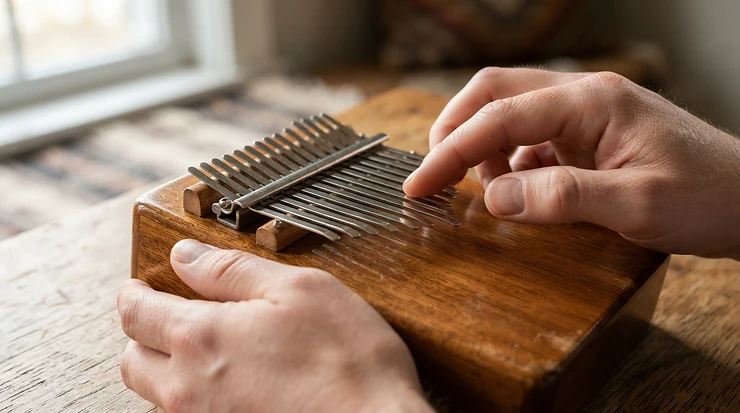
Start with the body. A hollow kalimba has a sound box under the tines; a flat-board model is a single slab of wood. Advice splits. Instruments du Monde says a first kalimba should have a sound box because it is usually lighter than a flat board and allows sound effects later. Commenters in an r/kalimba thread lean the other way for melodies: one says hollow bodies are louder but the high keys sustain much less, preferring hollow for rhythm and flat for melodic pieces, while another recommends a flat board for exactly that reason. A third likes a 17-key hollow Stagg for its deep low notes and says the stiff high tines loosen with practice.
Tine count comes next. The same shop says a 17-tine model is the most common format, so tutorials are easy to find, and that a newcomer can play only the 10 longest keys at first. Riffspot’s easy-kalimba music series, arranged for a 17-key kalimba in C major, adds that a standard 21-key layout contains the whole 17-key range plus extra tines. The two views can both hold: a 21-key kalimba plays 17-key tabs, but only if its layout is the standard one.
Material changes weight. Instruments du Monde recommends wood for beginners, since acrylic is heavier and costlier and can tire the wrists in long sessions. Listings show how wide the spread is: a retailer page gives the Moozica K21KS 889 g, and the LingTing LT-K17A is listed at 480 g, so the Moozica weighs about 1.85 times as much (my arithmetic). BestReviews counts that extra mass as a plus for sustain.
Then money. BestReviews sorts kalimbas into under $25 as budget, $25 to $50 as mid-range and usually 17-key, and over $50 as serious-musician territory. Instruments du Monde warns that instruments priced under about €20 may be lower quality and suggests €30 to €40 for a first one, with €50 as a sensible ceiling. The same roundup says the over-$50 tier is aimed at serious musicians, which is a reminder that a first kalimba rarely needs to cost that much.
Where the kalimba instrument comes from, and why it changes what you buy
The mbira is a family of plucked lamellophones traditional to the Shona people of Zimbabwe, and Wikipedia’s kalimba entry says metal-tined versions appeared in the Zambezi valley about 1,300 years ago. In the mid-1950s ethnomusicologist Hugh Tracey marketed a westernized version modeled on the mbira nyunga nyunga, tuned diatonically in G, with notes alternating between the right and left tines as they ascend. Most budget kalimbas today follow a different convention, the 17-key layout in C major. That split matters: it decides which tabs fit, as the tabs section below explains.
Keys, body and what ships in the box
| Model | Keys | Body | Key | Case or bag in listing | Price, per sources |
|---|---|---|---|---|---|
| Gecko K17MBR | 17 | Mahogany, hollow box | Check listing (Gecko also sells B-tuned models) | Waterproof EVA case | Check the current price on Amazon.com |
| Donner DKL-17 | 17 | Solid mahogany resonance box | C | Carry bag; one variant adds an EVA hard case | Near $25 on one eBay listing |
| Unokki 17-Key Kalimba | 17 | Mahogany or Okoume (sources differ) | Check listing | Flannelette bag per one roundup | About $30 to $35 per one owner and one price tracker |
| Moozica K21KS | 21 | Single-piece solid acacia koa, flat board | C, F3 to E6 | Hard case and bag | Check the current price on Amazon.com |
| LingTing LT-K17A | 17 | African padauk, flat board | C | Hard case and soft bag | About $75 to $150 depending on the shop |
| Hugh Tracey Alto Kalimba | 15 | Wood body on a resonator box | G | Not stated | Around $130 at one dealer |
Only one instrument here, the Hugh Tracey Alto Kalimba, is tuned in G with 15 notes, so it is the one to check against any tab written for a C-tuned 17-key kalimba. The LingTing LT-K17A lists the longest accessory bundle, while the Donner DKL-17 is the cheapest by a wide margin. Three of the six leave the key for you to confirm, which is a reason to read each listing’s tuning line before paying.
The best kalimba for each kind of player
Each entry starts from a situation and works back to the instrument, because the best kalimba depends more on your hands and your songs than on any ranking.
1. Gecko K17MBR — hollow box and a waterproof case
Two roundups put a Gecko first. BestReviews named the Gecko 17-key its “Best of the Best,” citing steel keys, a mahogany body and an included case, tuning hammer and instruction booklet, and ShopSavvy’s overview of reviewer opinion also calls a Gecko its overall pick. A retailer page mirroring the Amazon listing for the Gecko K17MBR shows 4.8 out of 5 from 8,867 reviews and lists a mahogany body with alloy steel tines, a waterproof EVA case, a tuning hammer and learning material with video support. One reviewer there says the keys were well tuned out of the box.
Complaints cluster at the top of the range. A reviewer on that page says the highest D sounded like a tine tapping wood rather than a clear note, and others describe the end tines ringing more softly than the long ones. ShopSavvy’s summary reaches a similar verdict, noting reports of top-key problems. BestReviews adds that the keys carry no note labels, so you will lean on stickers or a printed chart.
Key deserves a second look. A US shop lists one Gecko model as pre-tuned to B major, and a European importer’s page names B major for another, so a Gecko is not always in C. An r/kalimba commenter notes that most Western songs are written in C and that retuning is limited by tine length. Instruments du Monde names price as the Gecko line’s main drawback, and a 2020 KalimbaHQ article priced a standard 17-key between $40 and $70, above BestReviews’ $25 to $50 mid-range band.
2. Donner DKL-17 — the budget pick with a return window
Price comes first here. One eBay listing for the Donner DKL-17 shows about $25, and Donner’s own US page offers a 30-day return window, a one-year warranty with free repair or replacement and free tech support. The maker describes a solid mahogany resonance box and carbon steel keys. One package lists a tuning tool, carry bag and manual; another variant adds an EVA hard case, tune stickers, a tune chain and two finger sleeves.
Owner reports on retailer mirrors are favorable. One buyer who owns two 17-key Donners says the notes come already marked with letters and numbers, which saves hunting for stickers. Another says it held pitch without buzzing and had at least a full tone of tuning room, enough to retune toward another key. KalimbaHQ’s Gecko review frames Donner as $10 to $20 cheaper than Gecko without naming a quality gap. A 10-key Donner sells alongside it, and owners disagree about that smaller one: a retailer review calls it a good kid’s starter, while another owner finds its unmarked tines hard to read, so the 17-key is the version this guide means.
3. Unokki 17-Key Kalimba — light, cheap and tested before shipping
Sources disagree on what the Unokki 17-Key Kalimba is made of. BestReviews describes a solid Okoume body, while retailer pages say mahogany, so the species is worth confirming on the listing. BestReviews awarded it “Best Bang for the Buck,” praising engraved metal keys, finger protectors for beginners who have not built calluses and testing before shipping. Its one con was the missing waterproof bag.
ShopSavvy’s roundup adds that some users find the tines stiff and shows a low of $33.92 at one marketplace. An owner on a retailer mirror reports no dead tines, describes a sound between a music box and a harp and argues that most dead-tine complaints trace back to plucking technique, one owner’s view that matches the stiff-tine caveat. The same review lists a tuning hammer, a small booklet with songs and silicone finger sleeves, and Instruments du Monde’s product notes add that very short nails can make a thumb piano trickier to pluck. Weight is listed at 1.05 pounds, and one roundup names a flannelette bag as the only protection, a thinner kit than the Gecko’s hard case.
4. Moozica K21KS — a flat board with four extra tines
Extra keys help only after the first 17 feel comfortable. The Moozica K21KS has 21 keys in C major from F3 to E6, cut from a single piece of solid acacia koa that measures about 18.2 by 13.8 by 1.8 cm, and one retailer page lists a hard case, bag, tuning hammer, finger caps and a manual with a music score. BestReviews, which called it best for experts, says the heavier body holds notes longer and the engraved keys help beginners, but the extended scale may be harder to learn on.
Reports from owners are mixed. One owner who has kept several 21-key kalimbas calls it a favorite. Another says the first unit arrived with the G tine sitting noticeably lower than the F tine. A third calls the case and body solid but the finger caps small and uncomfortable and the hammer fragile. A retailer page shows 4.6 out of 5 from 667 reviews, and the listing includes a 90-day money-back guarantee, three times Donner’s window.
Instruments du Monde warns that 21-tine layouts differ from the 17-tine standard, so test a tab’s range against this layout before assuming it fits.
5. LingTing LT-K17A — padauk wood with a stack of extras
The accessory list is what separates the LingTing LT-K17A. A US kalimba shop’s listing names a hard case, velvet bag, tuning hammer, thumb guards, note stickers, cleaning cloth, songbook, a tremolo chain for a trickling-stream effect, a tassel and a patch pickup, though an owner points out that the instrument has no built-in pickup jack. The body is a single piece of African padauk, 18 by 12 by 2.6 cm and 480 g, tuned to C major. One owner notes that many sellers wrongly call the wood African rosewood.
Owners disagree about arrival condition. One buyer says more than half the tines needed tuning even though it shipped pre-tuned, and later found the tines stiff after a long session, a concern for anyone with arthritis or limited dexterity. Another found every tine resonated, including the highest side tines. A listing mirror shows 4.6 out of 5 from 988 reviews, and Instruments du Monde says LingTing’s thick bodies suit larger hands. Prices run from about $75 at one US shop to about $150 at a European importer’s US-dollar listing, so compare shops before buying.
6. Hugh Tracey Alto Kalimba — the original design, tuned in G
Hugh Tracey began selling kalimbas commercially in 1954, and the 15-note Alto is the larger, lower companion to his 17-note Treble. Kalimba Magic’s comparison says the Hugh Tracey Alto Kalimba has 15 tines of 5 mm tuned in G from G3 to G5, with more space between tines, which suits larger hands, beginners and less precise players. The Hugh Tracey Treble Kalimba is smaller, with 17 tines of 4 mm packed tighter. The same page says a 17-note kalimba in C mirrors the Alto’s layout but sits a fourth higher.
Praise for the Alto comes mostly from sellers. Kalimba Magic, which sells it, relays a YouTube reviewer who called it the first kalimba that stays in tune for a very long time and said its resonance beat every other he had played. A 2012 reviewer on a dealer page praised the tone but reported cracks in the top under some tongues and a base that wobbles on flat surfaces, a single report. The same dealer lists the Alto at around $130 and showed it sold out, so stock varies. Weight is stated as 13 to 14 ounces by one page and 1.15 pounds by the dealer, and neither says whether packing is counted.
Because it is tuned in G with two fewer tines than a 17-key, check a tab’s range and key before relying on it.
Kalimba reviews: three complaints that repeat, and one brand question
Reading kalimba reviews across roundups, retailer mirrors and r/kalimba, the same three issues recur. Tuning on arrival comes first: the LingTing LT-K17A owner’s out-of-pitch tines and the Moozica K21KS owner’s low G tine are the clearest examples, and Instruments du Monde says it is not uncommon for a new kalimba to arrive out of tune because the maker skipped tuning or the tines shifted in shipping. The top keys come second, with the Gecko K17MBR reviewers who found end tines soft and the Unokki 17-Key Kalimba tines described as stiff. Comfort is the third, from the Moozica K21KS finger caps to the LingTing LT-K17A stiff-tine report.
Is there a kalimba best brand?
Not as a single answer. Instruments du Monde’s brand guide, written by a retailer, ranks by price band: Cega for budget beginners under about €70, Hluru or LingTing for value, Gecko for premium wood and Seeds for a 34-tine chromatic layout. It does not cover Donner, Moozica or Hugh Tracey, and the praise quoted above for Hugh Tracey comes from Kalimba Magic, which sells the instrument. A commenter in a separate r/kalimba thread adds that Kalimba Magic is a store rather than a maker, so treat it as a place to buy from.
Keeping any of these in tune is cheap. Kalimba Magic’s care guide says to touch up tuning when notes sound off, about monthly for frequently played kalimbas, and says a drop can knock a Hugh Tracey bridge loose and make the instrument sharp. It adds that water can rust the tines, that sugary spills leave residue under them that deadens notes, and that a hot car can dry out and crack the wood. For humid or coastal climates it suggests wiping the tines with mineral oil every few weeks or months, and for the wood a little shea butter every few months. Wikipedia notes that tines can be pushed in or out to adjust pitch, which is all a tuning hammer does.
Kalimba tabs and kalimba songs: reading numbers, picking first tunes
Most kalimba tabs use numbered notation instead of staff notation. Numbers 1 to 7 map to do through ti, which in C major are C through B, and you read them left to right. A guide from the Kalimba Classes site says repeated numbers are told apart by dots, with more dots on higher keys. It shows chords three ways: in brackets such as (1 3 5), with dashes as 1-3-5, or stacked. Conventions are not universal: KalimbaTabs.net uses parentheses for notes played together as a slide, so check how a site writes its chords, and that site also offers an online converter to letter or solfege notation.
Key matters here. Tabs assume your tuning, so a number tab written for C major sounds right on a C-tuned 17-key and wrong on a B-tuned Gecko or the G-tuned Hugh Tracey Alto Kalimba. Retune a few tines by hammer if you want to match, but a commenter notes tine length limits how far you can shift.
For the first songs, beginner lists agree on short, repetitive melodies. Twinkle Twinkle Little Star is called the easiest by one practice site because it uses six notes in the middle of a 17-key layout, and its opening phrase in numbers is 1 1 5 5 6 6 5. Hot Cross Buns uses three notes. Gear4music’s list of easy kalimba songs for beginners names “Take Me Home, Country Roads,” “Edelweiss” and “Here Comes the Sun,” and its list also includes Amazing Grace, Happy Birthday and Ode to Joy. Many of these fit on 8-key and 10-key instruments too, as long as the notes stay in range.
Keys, sound boxes, tabs, tuning and first songs: short answers
❓ How many keys should a first kalimba have?
❓ Is a hollow or flat-board kalimba better for a beginner?
❓ Can I play the same kalimba tabs on every kalimba?
❓ How often does a kalimba need tuning?
❓ What are the easiest kalimba songs to start with?
Choosing your first kalimba
Match the instrument to your hands and your tabs. If you want the cheapest way in with a return window, the Donner DKL-17 is the low-risk start, and the Unokki 17-Key Kalimba is a similar tier with finger protectors. For the best-reviewed all-rounder, the Gecko K17MBR is where two roundups land, though its top keys draw complaints. The LingTing LT-K17A fits larger hands and extras, the Moozica K21KS suits someone who already plays and wants range, and the Hugh Tracey Alto Kalimba is the original in G for players who want that tone. Whichever kalimba you pick, confirm the key and the tuning before you buy. Compare the exact model number on each listing before ordering.
Recommended for You
- Best strings for 7 string guitar: 6 Sets and How They Differ
- Bass and Acoustic Guitar: 7 Top Picks That Rock Your World
- Bass Axe Guitar: 7 Best Axe-Shaped Basses That Rock 2026
Disclaimer: This post contains affiliate links. As an Amazon Associate, I earn from qualifying purchases made through these links, at no additional cost to you.
Planning a kalimba gift? Match the key to the songs before you check out.