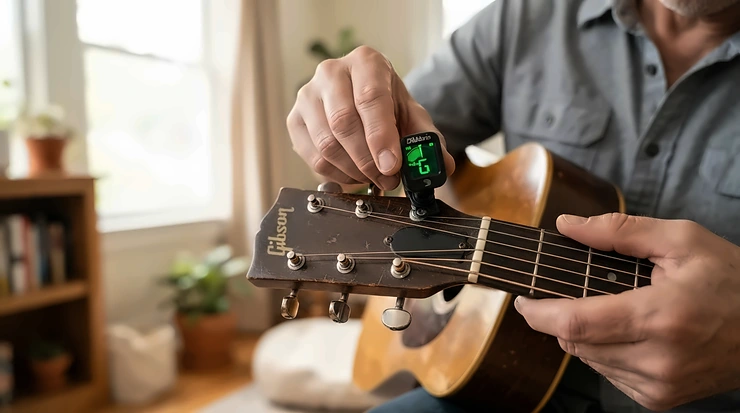
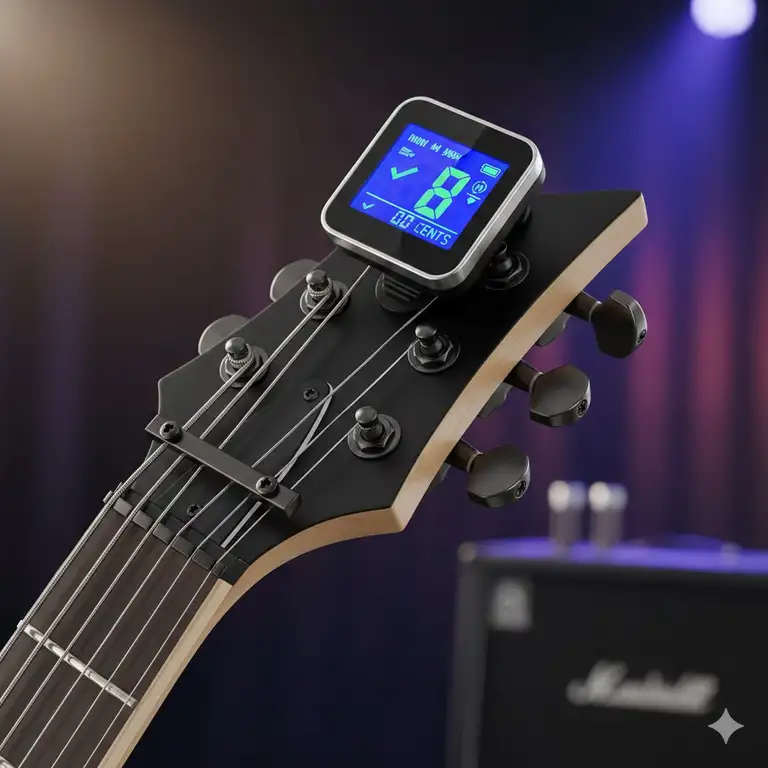
A green light on a tuner means one string sits near one pitch, which is not the same as the guitar being in tune with itself. That gap explains how a player can set all six strings, strum a big open G and still wince, and it is the first thing to grasp before shopping for guitar tuners in 2027.
Guitar World’s road-tested tuner guide supplies two useful anchors. Pedal-style tuners often reach about 0.1 cents of accuracy, which the magazine calls plenty unless you want perfection, and free phone apps trail dedicated tuners enough to be a last resort. No tuner below was bench-tested for this piece; the findings rest on that guide, maker spec pages, retailer review pages and owner threads, each named where it appears.
Short version: a clip-on such as the TC Electronic PolyTune Clip covers everyday tuning, the Snark ST-8HZ adds a Hz readout for fine adjustments, the Peterson StroboClip HD is the one for chasing intonation, and an onboard tuner like the one on the Oscar Schmidt OG2CE is a stage convenience rather than a replacement for a good clip-on.
Why a clean reading can still leave chords sour
Guitars use equal temperament, which splits the octave into twelve equal steps so one fretboard can play in every key. Acoustic Centre, an Australian retailer, explains the cost: intervals sit slightly off their pure ratios, so a perfectly set-up, perfectly tuned guitar still won’t sound flawless in every chord, and open shapes mixing open and fretted strings show it most.
Forum posters describe the same thing from the player’s side. In a thread on the Unofficial Martin Guitar Forum, one member answers a complaint about imperfect chords by saying fretted notes drift sharp once the open strings are set, which is typical without a compensated nut, and adds that sweetened tunings on electronic tuners imitate a trick players have used for years. That is a single thread, but it matches the retailer’s explanation.
Sweetened tunings are small, deliberate offsets from equal temperament. The Peterson page for the StroboClip HD lists 50 of them plus 11 historic temperaments, so the same tuner can switch between a textbook reading and a compromise built for guitar chords. One more thing worth knowing: some players tune the third string a touch flat to sweeten open chords, according to Acoustic Centre, and accept that other chords get slightly less pure.
The tuning routine, from reference pitch to chord check
Five moves cover almost any guitar and any tuner type:
Confirm the reference pitch. Concert A is normally 440 Hz, and clip-ons let you shift it: the Snark page at StewMac lists a 415 to 466 Hz calibration range, while Peterson’s page for the StroboClip HD lists 390 to 490 Hz.
Choose the mode. Chromatic reads one note at a time, polyphonic reads a strum, and strobe shows a moving pattern that appears to stop when you are in tune, per Guitar World.
Set transposition if you use a capo or tune down. Snark’s ST-8HZ has a transposition mode that gives a normal readout with a capo or dropped tunings, according to StewMac.
Bring each string up to pitch from below. If you overshoot, drop under the note and approach again, so the string settles against the tuning gear.
Strum the chords you play most and listen. If one sounds sour while every string reads in tune, the cause is temperament or intonation, not a faulty tuner, and a small offset or a sweetened preset is the fix.
Step 5 is the one people skip. A tuner can verify a string against a pitch, but it cannot hear your G chord.
Four reading mistakes that make a good tuner look wrong
A calibration that quietly reset
Equipboard’s pros-and-cons list for the Snark ST-8HZ notes that it falls back to A = 440 Hz after a power cycle, and its summary of Reddit threads adds that the tuner can lose calibration and give inaccurate readings. If a guitar suddenly reads flat across the board, check the reference pitch first.
A noisy room and the wrong sensor
Phone apps listen through a microphone, so Guitar World warns that background noise affects them. Clip-ons read vibration through the headstock instead, and BestReviews notes that this lets you tune in a noisy environment. Pick the sensor for your loudest room, not your quietest.
A dead zone
A few Reddit owners quoted on Equipboard report that the ST-8HZ shows a string in tune while it still sounds off, and that response on new units can feel slow. One thread is thin evidence, but the fix is cheap: if the display says green and your ear says no, trust the chord check in step 5 and retune from the note below.
A clip left on a nitrocellulose headstock
Gibson’s care FAQ says that many clip-on tuners may also damage nitrocellulose lacquer. Snark’s own manual, as quoted in a UMGF thread, tells owners not to use its tuners on nitrocellulose, polyurethane, French polish or oil finishes unless they accept possible denting, and Guitar World lists the same risk as a drawback of the TC Electronic PolyTune Clip. Two posters in that thread say they tune and then remove the clip, and one reports no damage on any of his guitars, so the habit looks like cheap insurance.
Hz, cents, and strobes: what the numbers on a tuner display mean
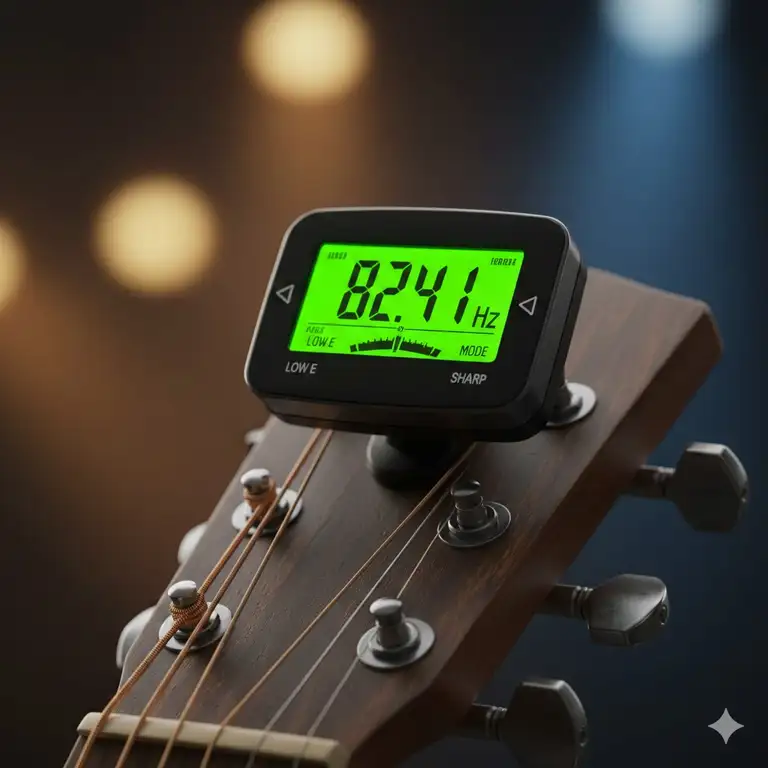
A cent is one hundredth of a semitone, and Guitar World puts 100 cents at one semitone. Cents describe how far off you are relative to the note. A hertz reading describes the string’s actual vibration speed, and a guitar tuner with frequency display like the Snark ST-8HZ lets you read it directly.
The two scales do not line up evenly. One cent at the low E string (about 82.41 Hz) is roughly 0.05 Hz, while one cent at the high E (about 329.63 Hz) is roughly 0.19 Hz (my arithmetic). So a 0.1 Hz step is about 2 cents wide on the low E but about half a cent wide on the high E, which means a Hz readout is a finer tool on the treble strings than on the bass strings.
That arithmetic should temper expectations. Reverb’s listing says the ST-8HZ tunes to a tenth of a hertz, and Equipboard’s owner summary adds that the Hz feature works on open strings only and needs the strings roughly tuned first. A Hz display helps when you want to see the actual frequency while setting intonation; it does not make a chromatic tuner more accurate at the low end.
Strobe displays sit at the other extreme. Guitar World says pedal tuners reach about 0.1 cents and calls that enough, while the Peterson StroboClip HD claims 0.1 cents on its own page. Spec tables in guitar tuners reviews lead with this figure, but the practical question is whether the display is readable on your stage and the response is quick.
Where each type of tuner fits
Guitar World’s buying advice separates clip-on, pedal and rackmount tuners, and BestReviews adds handheld, soundhole and automatic types; the choice follows where you play and what you plug into. The table keeps the five that matter for a typical guitarist.
Type
Reads from
Where it earns its place
What to watch
Clip-on, such as the TC Electronic PolyTune Clip or Snark ST-8HZ
Vibration through the headstock
Quick tuning, acoustics, noisy rooms
Finish contact, coin-cell batteries
Pedal tuner
The instrument’s signal
Gigging electric players who want mute and buffering
Board space, power
Soundhole, such as the D’Addario NS Micro Soundhole
Vibration through the soundhole
Acoustics, nitro-finish headstocks
Acoustic only, about ±0.3 cents per Guitar World
Phone app
The phone’s microphone
A last resort
Background noise, lower accuracy
Onboard, as on the Oscar Schmidt OG2CE
The pickup, through the preamp
Plugging in and tuning at once
Uses the guitar’s 9V battery
Clip-ons and pedals are the two families most guitarists choose between; the soundhole model is the odd one out because Guitar World lists it as acoustic only. An onboard tuner is the only type that never gets left in a gig bag. Compare the exact model number before buying, because Snark and Peterson each sell close cousins that differ in power and features.
The best guitar tuners for each step of the routine
Each tool below solves a specific step above, so the order follows the routine rather than a ranking.
Between songs there is rarely time to pluck six strings one at a time, which is the gap polyphonic mode fills on the TC Electronic PolyTune Clip: strum once and the display shows which strings are flat or sharp. Premier Guitar’s reviewer found it fast and accurate in both polyphonic and single-string use, and Guitar World’s table lists three modes, a large bright display and strobe accuracy of ±0.02 cents.
The same reviewer disliked how the clip adds about 1¼ inches to the headstock and swings instead of swiveling, which makes it harder to line up with your eyes. A forum poster on The Fretboard also found the plastic body felt cheap, though they judged it a good tuner overall. Battery life draws mixed comments: Performer says a coin cell lasts up to 18 hours, while reviewers on Long & McQuade’s page complain about batteries going quickly.
Pros:
Polyphonic, chromatic and strobe modes in one clip
Bright display, easy to read in sunlight per Performer
Capo and flat-tuning support
Cons:
Rubber jaws can harm nitrocellulose finishes, per Guitar World and Performer
Swinging joint rather than a full swivel
Coin-cell battery drain reported by some reviewers
Guitar World’s price check puts it at around $35 to $40.
TC Electronic PolyTune ClipSee current price, sizes and reviews on Amazon.
2. Snark ST-8HZ — a Hz readout for fine adjustments
Players who want to see frequency, not just needles, are the audience for the Snark ST-8HZ. You tune with the colored needles first, then press the Hz button on the back to refine to the hertz, according to StewMac, which also lists a 415 to 466 Hz calibration range, vibration sensing, spring-loaded rubber-padded jaws and a CR2032 battery that powers off after two minutes.
Owner feedback is mixed in ways that matter. Equipboard’s summary of Reddit threads reports a dead-zone complaint, calibration resets, ball-socket flanges breaking after long use, and the Hz feature being limited to open strings. The positives it lists are durability against drops and an intuitive display. One owner in those threads preferred a Peterson strobe for consistency.
Availability needs a check before you rely on this pick. StewMac and zZounds show it as no longer available, and GAK calls it discontinued, while smaller shops and Reverb still list it at around $25 to $30. Spotted one in stock? Take a closer look at the current Amazon.com listing.
Snark ST-8HZSee current price, sizes and reviews on Amazon.
When a guitar reads in tune but sounds sour in the chords you play, the Peterson StroboClip HD is the tool aimed at that problem. Peterson’s page lists 0.1-cent accuracy, a 192-segment backlit LCD visible in direct sunlight, 50 sweetened tunings, 11 historic temperaments, a 16 Hz to 1975 Hz frequency response and a two-year warranty, plus firmware updates.
Peterson’s own review page shows 924 reviews averaging 4.9 out of 5, with 89 percent at five stars, which will skew favorable on a maker’s site. Reviewers there praise responsiveness, one contrasting it with clip-ons that take a second or two to settle, along with the sweeteners and customer service. The complaints are small: the controls are awkward for larger fingers, and one reviewer says the jaws marked a headstock finish despite the maker’s non-marring claim.
Peterson’s page lists a CR2032 battery and no rechargeable option, while zZounds lists a separate Peterson StroboClip HDC as the rechargeable version. Check the current price on Amazon.com.
Peterson StroboClip HDSee current price, sizes and reviews on Amazon.
A search for an Oscar Schmidt guitar with built in tuner review turns up pages where the tuner is one line in a spec list rather than a headline feature. On the Oscar Schmidt OG2CE, a dreadnought cutaway acoustic-electric, the maker’s page says the preamp has a digital tuner built in, and a Best Buy reviewer of an Oscar Schmidt full-size acoustic-electric counted a built-in tuner among the pluses. The maker’s page does not describe the display, accuracy or battery.
Listings disagree on details, so check the label. The maker’s page names a Barcus Berry EQ4T preamp and mahogany back and sides, while Best Buy and Austin Bazaar name a WT92 preamp, and Best Buy lists catalpa back and sides. LA Music’s page says it takes a 9V battery. For scale on battery cost, Taylor’s support page for its own ES-B electronics, a different guitar, gives over 500 hours with the preamp alone and over 50 hours with the tuner running, so keep a spare 9V and keep tuning sessions short.
Dealer listings ran from around $200 to $290. It is a sensible pick for tuning silently on stage and a poor reason to leave a clip-on at home.
Oscar Schmidt OG2CESee current price, sizes and reviews on Amazon.
Bass guitars without head tuners: tuning at the bridge instead
Bass guitars without head tuners, usually called headless basses, move the tuning hardware to the bridge end. Premier Guitar’s Bass Bench column explains that the tuner is a screw, a cup that holds the string’s ball end and a simpler housing, and that the gear ratio comes from the screw’s thread. The final Steinberger L2 had a 1:40 ratio, which the column credits with very precise tuning, against roughly 1:12 or 1:18 for standard tuners.
The Steinberger Spirit XT-2 shows the design in an affordable bass: zZounds lists a 40:1 direct-pull tuning system, fine tuning at the bridge, a 34-inch scale and factory setup with DoubleBall strings. One dealer lists it near $600.
Where does the tuner go? Sources split. A how-to on Music Strive says clip-ons are out of the question and suggests pedals or apps, while one WWBW reviewer reports that a Snark clip was a little difficult to attach to the headless neck but worked well enough. Treat the single review as a possibility, not a promise, and keep a pedal tuner or an app as the fallback.
A TalkBass member with a Hipshot headless bass says he turns the tuning barrels as far as possible toward the headstock end when stringing. That is one owner’s habit; my reading is that it keeps travel in reserve, since the barrels sit on a screw with a limited run.
Accuracy, finishes, apps and onboard tuners: short answers
What is the most accurate type of guitar tuner?
Strobe tuners are the most precise, according to Guitar World, though they take some getting used to. Pedal tuners often reach about 0.1 cents, which the magazine calls sufficient unless you want perfection. Strobe precision matters mainly when you are chasing intonation.
Do clip-on tuners damage a guitar's finish?
They can on nitrocellulose. Gibson's care FAQ warns that clip-ons may react with that lacquer, and Snark's manual cautions against several finishes. Some posters tune and then remove the clip. Check the finish type, or use a soundhole tuner or pedal instead.
Are tuner apps as good as a dedicated tuner?
Guitar World says phone apps rely on the microphone, are affected by background noise and are less accurate than dedicated tuners, so they suit last-resort use. A clip-on reads vibration through the headstock and avoids the noise problem in busy rooms.
How do you tune a headless bass?
Fine tuning happens at the bridge, where Steinberger's XT-2 uses 40:1 direct-pull tuners. Clip-on placement is awkward without a headstock, so a pedal tuner or an app works as a backup, according to Music Strive, and one reviewer managed to clip a Snark on.
Do I still need a tuner if my guitar has one built in?
A built-in tuner covers quick checks, but it depends on the guitar's 9V battery, and the maker's page for the Oscar Schmidt OG2CE doesn't state its accuracy. A clip-on is a sensible backup because it also works when the preamp is off.
Which guitar tuners to start with
If you play mostly acoustic or tune by the couch, start with a clip-on and check the finish before you clamp it. The TC Electronic PolyTune Clip is the safer all-rounder, the Snark ST-8HZ suits players who want Hz readouts and can find one in stock, and the Peterson StroboClip HD is the choice for anyone who hears sour chords on a guitar that reads in tune. An Oscar Schmidt OG2CE gives you an onboard tuner for stage use, and a Steinberger Spirit XT-2 reminds you that headless basses call for a pedal or app plan from day one.
Among the guitar tuners above, none replaces your ear on step five of the routine. Weigh the listing’s finish warning and battery type before the clip goes on your headstock.
Disclaimer: This post contains affiliate links. As an Amazon Associate, I earn from qualifying purchases made through these links, at no additional cost to you.
Read the finish and battery notes on the listing before the tuner touches your headstock.