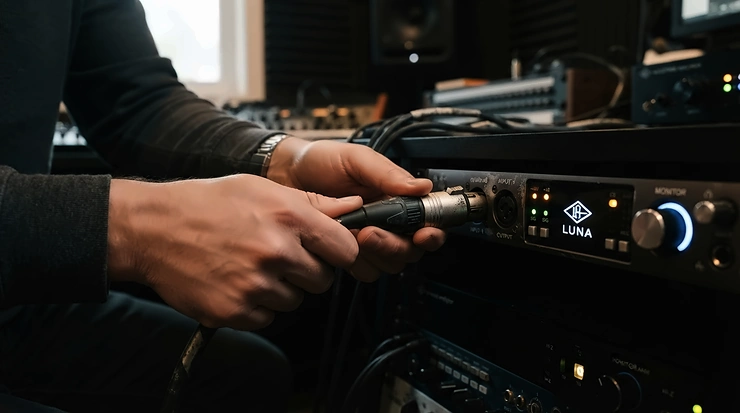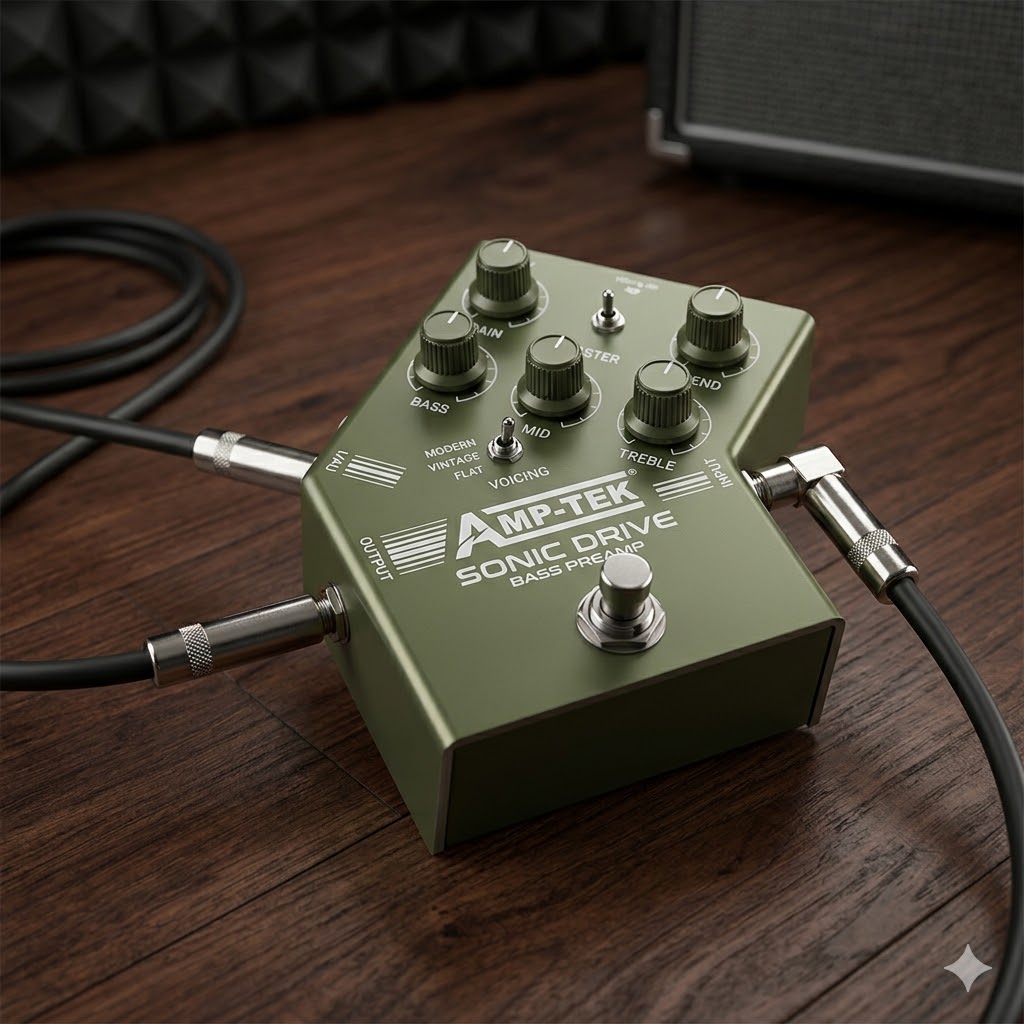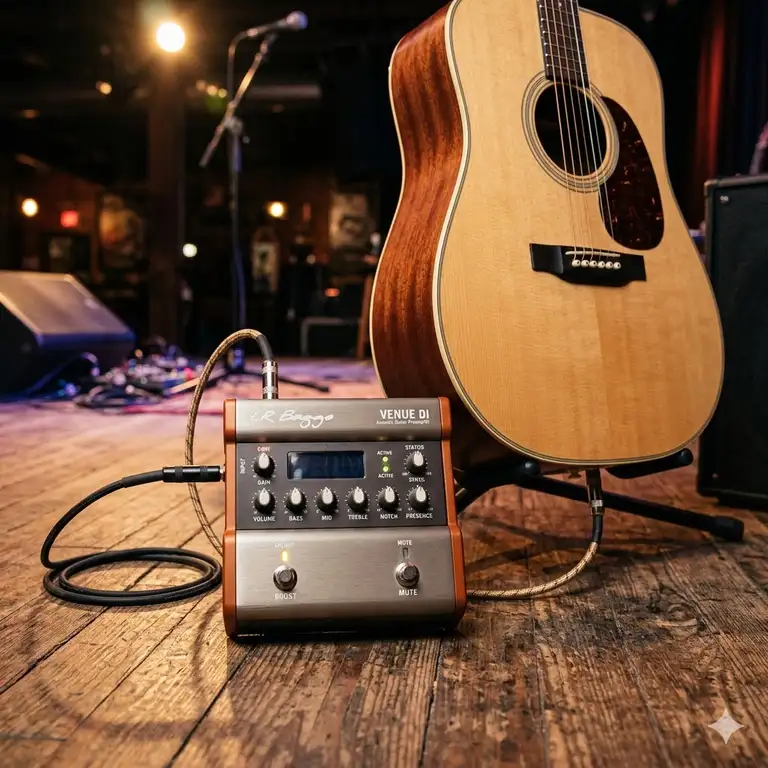
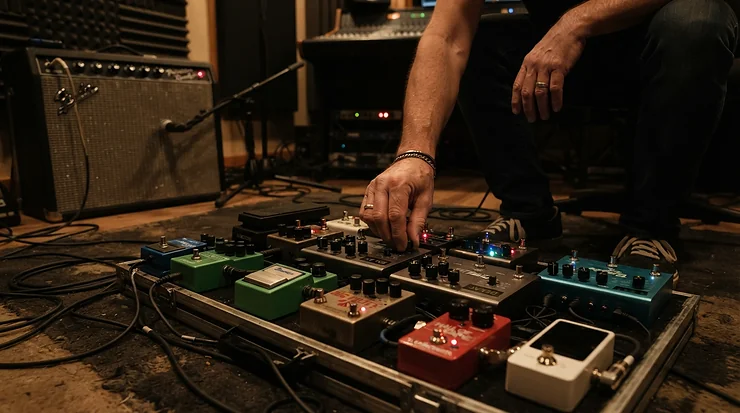
A bassist arriving at a gig with an unknown backline amp and a sound engineer asking for a direct feed has a one-box answer to both problems: bass preamp pedals. Andertons describes the idea as a compact DI that carries the tone controls of an amp’s preamp, so you can shape the sound before it reaches a mixer or recording interface. This 2027 guide starts with where your signal is headed, then matches four pedals and one graphic EQ to the jobs they do, including what most bass preamp pedals cannot do on their own.
The short version: a pedal with built-in grit such as the Tech 21 SansAmp Bass Driver DI V2 suits players who want a colored tone sent straight to the PA, a flat and quiet unit such as the MXR M81 Bass Preamp suits players who want the bass to sound like itself, and a plain EQ such as the Boss GEB-7 suits players whose problem is one frequency rather than a whole voice. Magazine tests, maker and retailer spec pages, and owner reviews at Sweetwater and Thomann carry every fact below, and no one here has handled these pedals, so each judgment is reasoning from that evidence. Prices are ranges taken from music retailers; check the current price on Amazon.com before ordering.
Where the signal goes decides which pedal fits
Five checks, taken in this order, narrow the field faster than any spec table.
- Name where the sound ends up. Guitar World explains that venues often take a DI feed before the amp, which bypasses the amp’s gain and EQ; a preamp pedal lets the sound desk receive your shaped tone instead. The same guide says a preamp pedal can also stand in for an amp you do not own or do not like, or act as a second channel beside a favorite amp. If the signal only ever goes to your own amp, an EQ pedal may be all you need.
- Decide whether the pedal should color the bass. A TalkBass poster puts it bluntly: preamp pedals are almost always colorful, EQ pedals usually fairly neutral. That is one thread’s view, not a rule. Sweetwater reviewers show the spread, since most describe the MXR M81 as adding little coloration while some say it will not deliver the character of a Tech 21 or Darkglass pedal.
- Match the pedal to the bass. A clean preamp can lift a passive instrument: Premier Guitar’s reviewer got an immediate improvement from a big input boost and a small bass bump on the MXR M81, and heard it help even a bass with its own onboard preamp. Active basses are touchier, and one Sweetwater reviewer found the seven-band Boss GEB-7 too much for them.
- List the jacks and the power you need. An XLR out feeds a PA, a pre/post switch decides whether that XLR hears the EQ, a ground lift fights hum, and a headphone jack covers silent practice, which Andertons says many models offer. Power matters just as much. Guitar World lists phantom power, a 9V battery or a 9V supply for the Tech 21 SansAmp Bass Driver DI V2, so a phantom-powered desk input can run it with no battery at all.
- Place it with a reason. Neither Guitar World nor Andertons gives a fixed position in the chain. A TalkBass poster argues that an EQ pedal after a drive pedal can repair tone an onboard preamp never touches. By the same logic, a preamp pedal with a DI usually belongs near the end, because its XLR out is the feed the sound desk actually hears; that is reasoning from the jacks, not a rule any of these sources states.
Bass EQ pedal or preamp pedal: what each one fixes
The two overlap, and forum regulars say so. One TalkBass poster says there is no firm line between a preamp and an EQ pedal, while a BassBuzz forum reply describes a preamp pedal as an amp-style preamp lifted into a box, with three or four bands, and an EQ pedal as the same idea without the extras and usually with more bands.
A working rule follows from those posts. Reach for a bass EQ pedal when a stack of drive pedals has thinned the low end, when a room booms at one frequency, or when you simply need a transparent correction; another TalkBass poster calls an EQ pedal a good friend for restoring lost bass or taming shrill treble. Reach for a preamp pedal when you need a DI, level matching or a voice. Among the four pedals below, the Boss GEB-7 is the only dedicated EQ, so the question of the best bass EQ pedal is answered here by default rather than by a head-to-head test.
Mistakes that sour a preamp pedal, and how to recover
Expecting it to replace the amp is the first. Andertons points out that these pedals have no speakers, so a gigging player still needs a PA or an amp and cabinet to plug into. The same article says some players feel older units do not feel convincingly like an amp, while newer models with cabinet emulation come closer.
Pushing the drive is the second. A Sweetwater reviewer of the Tech 21 SansAmp Bass Driver DI V2 finds the Drive control too strong past about the 10 o’clock position, and another hears some noise with Presence turned high; both are single reports. Reviewers of the Darkglass Microtubes B7K Ultra V2 at Thomann say several times that it is not a beginner’s pedal, and Premier Guitar’s test of the original Ultra notes that dialing in drive and levels takes time. The recovery is the same for all three: start with every knob flat, add drive in small steps, and use the Blend control to keep the low end, a trick one Thomann reviewer credits with keeping bass weight while distortion comes in.
Chasing hum with the wrong fix is the third. One Sweetwater owner of the MXR M81 heard noise through a 9V AC adapter, blamed the building’s wiring, and found the ground lift made no difference. A battery or phantom power gives a second route to try before blaming the pedal.
Buying an EQ when a DI was needed is the fourth. Sweetwater’s listing for the Boss GEB-7 shows an input, an output and an adapter jack and nothing else, so it cannot feed a desk without a preamp, amp or DI box after it.
Reliability reports are scattered. One Thomann owner says an MXR M81 cut out during gigs after twelve months and went back to the older MXR M80, and a two-star Sweetwater reviewer of the SansAmp reports a footswitch failure that could not be repaired. Against that, Sweetwater’s M81 reviews list no failures.
The best bass preamp pedals for each step
Each pedal below answers a different check from the method above. Spec details come from Guitar World, Premier Guitar, Sweetwater, Thomann and retailer listings.
| Pedal | Job | EQ | Outputs | Power | Price tier |
|---|---|---|---|---|---|
| Tech 21 SansAmp Bass Driver DI V2 | Tube-style grit to the PA | 3-band, switchable mid and low end, Drive and Blend | XLR, 1/4″ and parallel 1/4″ | Phantom, 9V battery, 9V DC | Around $280 to $300 |
| MXR M81 Bass Preamp | Clean tone shaping | 3-band, mid sweeps 250 Hz to 1 kHz | XLR DI with pre/post, 1/4″ | 9V battery or adapter; phantom per reviewers | Between $170 and $190 |
| Darkglass Microtubes B7K Ultra V2 | Modern drive and cab sim | 4-band | Balanced DI, headphone with cab sim | 9V DC | Roughly $390 to $500 |
| Boss GEB-7 | Fixing single frequencies | 7 bands, plus or minus 15 dB | 1/4″ in and out only | 9V battery or adapter | Around $130 to $150 |
Only the Boss GEB-7 lacks a DI, which is the clearest dividing line: three of these can feed a desk alone, while the Boss GEB-7 needs something after it. The SansAmp and the Darkglass add color on purpose and the MXR adds as little as it can. Cost climbs with features, and the Darkglass runs about three times the price of the Boss.
1. Tech 21 SansAmp Bass Driver DI V2 — tube-style grit straight to the PA
Going direct to the house system is the job this pedal was built around. Guitar World credits it with tube-style tones and a build made to last, calls the design a little dated beside newer rivals, and notes there is no cab sim and no headphone output, since the tone is modeled to suggest a cabinet. It offers a bass control, a switchable midrange, Drive, Blend and a pad or boost switch, with balanced XLR, a quarter-inch jack and a parallel quarter-inch out. Expect around $280 to $300.
Owner evidence is strong. Sweetwater shows 4.8 out of 5 from 88 reviews, 86 percent of them five-star, and reviewers there praise its use as a DI into PA systems with no bass amp, plus the phantom-power option. Their complaints are individual rather than a pattern: the Drive that runs hot, the noise at high Presence, the one unrepairable footswitch. Silent practice needs an amp or interface that has its own headphone jack.
2. MXR M81 Bass Preamp — flat, honest EQ plus a studio DI
At between $170 and $190, this is the cheaper of the two preamps here, and its controls explain the price: input and output levels, bass, treble and a midrange that sweeps from 250 Hz to 1 kHz, per Heid Music’s listing. Premier Guitar’s 2014 review of the M81 found it improved every bass tested. A boost of 3 dB near 500 Hz added aggression to a Jazz bass bridge pickup, and the pedal cut the harsh mids on two upright basses. The same review says the ground lift and pre/post switches can be hard to reach.
Sweetwater’s owner reviews average 4.9 out of 5 from 32 reviews, with 81 percent five-star and none below four. Reviewers call it clean, one says it is “built like a tank”, and it weighs about half a pound. They also report a loud footswitch, and some find it flatter than a SansAmp. Phantom power over the XLR is a bonus for silent stages.
Pros:
- ✅ Sweepable mid and a pre/post DI switch for studio or stage
- ✅ Light enough for a crowded pedalboard, with a clean, quiet voice
Cons:
- ❌ Little color, which some Sweetwater reviewers find flat next to a SansAmp
- ❌ Awkward switch placement and a loud footswitch, per Premier Guitar and Sweetwater reviewers
Spotted one you like? Take a closer look at its current listing before it leaves your shortlist.
3. Darkglass Microtubes B7K Ultra V2 — modern drive with cab-sim headphones
Priced roughly between $390 and $500, this is the dearest pedal here and the most demanding. Premier Guitar’s review of the original Ultra describes bass and treble at plus or minus 12 dB, switchable low-mid and high-mid bands, Attack and Grunt switches that shape saturation, and a separate footswitch for the distortion. The reviewer called it an excellent upgrade over the first B7K, but flagged an unintuitive switch layout, slow drive and level setup, and a high price.
The V2 adds a loadable cabinet impulse response through a micro-USB port and a headphone output with cab sim, according to Kirstein and Altomusic, and Kirstein lists the weight at 430 grams. Thomann’s U.S. page for the sibling Ultra v2 Aux shows 4.8 out of 5 from 31 ratings, with praise for build and versatility. One reviewer there notes the cab sim runs only through the DI and the impulse response is chosen on a computer beforehand, so it cannot change mid-performance. Another says the headphone output shares the master volume with the line output, which made sensitive in-ear monitors too loud.
Guitar World’s roundup lists a sibling, the Darkglass Alpha Omega Ultra V2, with a six-band graphic EQ and two distortion circuits at about $500, and says it may be too modern for some.
4. Boss GEB-7 — seven sliders for fixing the mix
Not every tone problem needs a preamp. This pedal covers seven bands from 50 Hz to 10 kHz, which Audiofanzine’s reviewers list as 50, 120, 400, 500, 800, 4,500 and 10,000 Hz, each cut or boosted by up to 15 dB, with a level control with the same range. Sweetwater adds a nine-volt battery or adapter and a five-year warranty. Expect around $130 to $150.
Sweetwater’s header shows 4.7 out of 5 from 25 reviews. Reviewers describe it as clean, durable and good at adding depth and clarity, and one uses it on acoustic guitar. The recurring caveat is sensitivity: some find the sliders touchy enough that a bumped one changes the sound noticeably, and one reviewer wished the lowest and highest bands were shelves rather than bells.
Pros:
- ✅ Seven bass-focused bands and a level control with plus or minus 15 dB range
- ✅ Five-year warranty, per Sweetwater
Cons:
- ❌ No DI or XLR, so it cannot send a signal to a desk alone
- ❌ Touchy sliders, and one reviewer found it too much for active basses
Guitar World names several more in its roundup: the Orange The Bass Butler as best all-round, the Origin Effects BassRig ’64 Black Panel for Fender-style tone, the Ampeg SCR-DI for classic Ampeg sound, and the Laney Digbeth DB-PRE at about $270 with an effects loop and a ground lift but no cab sim. Each rests on that one review here.
Bass preamp pedals reviews: where owners agree and where they split
Owners agree on build. Reviewers describe the M81 as tough, Thomann reviewers call the Darkglass sturdy, and Sweetwater reviewers call the Boss durable. They also agree that a DI-equipped pedal makes a PA gig simpler, and that a battery-free phantom option is useful.
The split is about voice. Sweetwater reviewers of the M81 prize its flatness and some find the SansAmp richer, while Guitar World’s reviewer calls the SansAmp a little dated. Which is the bass preamp pedal best for you depends on whether you want the box to disappear or to add a character. Learning curve is the other divide, with Thomann owners warning that the Darkglass takes time to master.
Fastest double bass pedal: a different instrument entirely
Searches for the fastest double bass pedal land here by accident, since that phrase belongs to drummers. A double bass pedal drives a kick drum with two beaters. The Drum Ninja’s roundup of seven double pedals names the Pearl Eliminator Demon Drive as its fastest pick and the Tama Speed Cobra 910 as best value. If that is what you came for, that drum-teacher test is a better starting point than anything on this page.
Preamp pedal questions: amps, PA feeds, active basses, power
❓ Do I need a bass preamp pedal if I already have an amp?
❓ What is the difference between a bass preamp pedal and a bass EQ pedal?
❓ Can I run a bass preamp pedal straight into a PA without an amp?
❓ Does a bass preamp pedal work with an active bass?
❓ Do bass preamp pedals need a 9V power supply?
Choosing bass preamp pedals by where the signal lands
Start with the destination. If the sound desk is your audience, the Tech 21 SansAmp Bass Driver DI V2 gives a colored, tube-style tone and a balanced feed in one box. If you want the bass to stay itself, the MXR M81 Bass Preamp shapes tone with little coloration at a lower price tier. Players who chase modern saturation and silent practice with cab sim can look at the Darkglass Microtubes B7K Ultra V2, accepting a steeper learning curve, and anyone whose problem is a single frequency can fix it with the Boss GEB-7. Choosing among bass preamp pedals gets easier once the jacks, the power and the bass itself are on the list, because the rest is taste.
Spotted a pedal that matches your rig? Take a closer look at its listing and confirm the model name matches the one you read about here.
Recommended for You
- Best mini bass amp — What to Buy at Every Budget
- 7 Best Bass Guitar Preamp Pedals for Pro Tone in 2026: Expert Guide
- 7 Best Acoustic Guitar Preamp Pedal Options for 2026: Pro Tone Guide
Disclaimer: This post contains affiliate links. As an Amazon Associate, I earn from qualifying purchases made through these links, at no additional cost to you.
Know where your signal ends up, and the right box almost picks itself. 🎸