
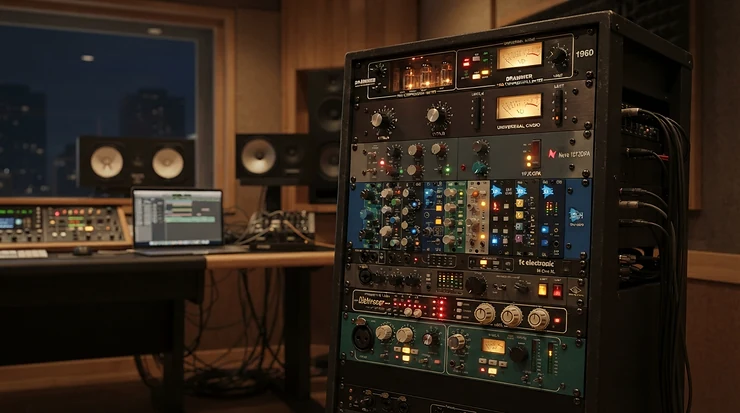
Bass amp heads ship without a speaker, so one wrong guess about ohms, watts or voltage can force a second purchase to fix the first. Premier Guitar’s amp primer explains why: a solid-state bass amp driven below its minimum load can overheat and shut down. This 2027 guide lays out a method for choosing, then names four bass amp heads that each solve a different step of it, from a 1.6-pound micro unit to a hybrid with a tube preamp.
The recommendations rest on maker spec sheets, retailer listings at Sweetwater, zZounds, Thomann and Guitar Center, magazine reviews, and owner threads on TalkBass and BassChat. Where two pages disagree on a rating, the text says so, since the label on the back panel settles it.
From room size to cabinet load: a method for choosing a head
Six checks, taken in this order, narrow the field faster than any spec table.
- Name the loudest room and the busiest drummer you play with. A head’s job is to stay clean at your loudest moment, so the target is headroom, not the number printed on the front. Reviewers give a sense of scale: a Premier Guitar reviewer says an earlier Aguilar Tone Hammer 500 and a Glockenklang 1×12 cab filled a 700-seat theater without PA support, while a blind bassist reviewing an 800-watt head on BassChat likes class D heads of 800 watts or more for their balance of power, headroom and weight. Both are single opinions, not rules.
- Read the cabinet’s back panel before the head’s spec page. Premier Guitar’s primer says the rule is to keep the total load at or above the amp’s minimum rating, and that cab and amp ratings need not match exactly. It also supplies the arithmetic that trips people up: a solid-state amp rated at 400 watts at 4 ohms might produce only about 250 at 8 ohms, and two 8-ohm cabs wired together present 4 ohms.
- Decide what the head should add to your tone. A neutral head leaves the bass alone. A hybrid puts a tube in the preamp for warmth or grit and keeps a class D power section to save weight, the layout Guitar World describes for its hybrid pick. Distortion that flatters a guitar amp can be damaging to a solid-state bass rig, according to Premier Guitar’s primer, so a built-in drive control deserves restraint.
- List the jacks you will really use. A balanced XLR out feeds the house system, a headphone jack covers quiet practice, an effects loop suits pedal users, and Speakon outputs carry full power to the cab. Whether the XLR can tap the signal before the EQ matters to some players; Premier Guitar’s reviewer noted that one head below offers only a post-EQ feed.
- Weigh the weight and the fan. The heads below run from 1.6 pounds to roughly 10, and the lightest rely on fans. Fan noise shows up in owner reviews of two of the four.
- Price the whole rig. Add a cabinet (Premier Guitar puts two Aguilar SL 112 cabs at about 25 pounds each), a Speakon speaker cable and a gig bag if the head lacks one, then confirm the head’s mains voltage suits US outlets.
Most of the regrets below come from skipping steps two and six.
Mismatches that send players back to the shop
Too low a load heads the list. Premier Guitar’s primer describes a PA setup in which a power amp with an 8-ohm minimum in bridge mode saw a 4-ohm load from two 8-ohm cabs, which brought distortion and then failure. Going the other way is gentler: Guitar World’s impedance guide says a solid-state head with a 4-ohm minimum is fine driving an 8-ohm load, only with less output.
Wattage quoted without ohms is the second. The Aguilar head below is rated at 500 watts into 4 ohms and 250 into 8, so a single 8-ohm cab receives half the number on the front panel. Spec pages also disagree with each other: Adorama and zZounds list the Phil Jones Bass BP-800 at 450 watts into 8 ohms, while Thomann and a Bass Player review list 400.
Voltage is the third. Thomann’s U.S. storefront labels its Orange Terror Bass listing and a limited-edition Aguilar as 230-volt units that need a transformer here, and Guitar Interactive’s reviewer noted the Orange has no voltage switch. Retail listings for the current Aguilar describe universal mains, so the safe move is a unit sold for the US market.
Fans are the fourth. Guitar Center reviewers of the Trace Elliot ELF name fan noise as the most consistent complaint, with fan speed rising and falling as they play, even over headphones. A German-language Thomann review of the Aguilar describes sending the unit back because the fans spoiled an otherwise good sound, though that is one report.
Treating a drive knob as a distortion pedal is the fifth. A Thomann buyer of the original Aguilar Tone Hammer 500 says its drive control turns muddy past roughly nine o’clock, and Premier Guitar’s Orange review found the overdrive comes up a little short of what the maker’s Orange OB1 delivers. Owners summarized on Equipboard add that class D heads often need a pedal for a more personal sound.
The last one is expecting a current product where none exists.
Marshall bass amp heads: a discontinued line, not a current one
Shoppers who search for a Marshall bass amp land on an odd gap. Marshall’s U.S. amplifier page currently shows guitar, acoustic and micro-stack amps plus preamp modules, and no bass amps or MB Series at all. The Marshall MB450H was that series’ only head: a 450-watt hybrid with two footswitchable channels, a Modern one with bass, treble, a parametric mid and a switchable compressor, and a Classic one built around an ECC83 preamp valve, per Marshall’s own catalogue text. Blue Book dates it to 2008 through 2012 and lists it at 33 pounds, and zZounds shows it as no longer available, a status the retailer says usually means the maker discontinued it.
Sources split on the power rating. A Seymour Duncan forum post lists 300 watts at 4 ohms and 450 at 2 ohms, while Blue Book’s entry pairs 300 watts with 450 at 4 ohms. The back panel of the unit in hand decides it.
Evidence on this head is thin and mostly single posts. A 2013 zZounds buyer called it a waste of money. A TalkBass newcomer who bought the head with a Marshall cab kept fiddling with settings without finding a crunchy rock tone. A Music-Electronics-Forum thread describes one unit that pops loudly at shutdown, and a Gibson forum owner of the Marshall MB4410 combo, which houses a Marshall MB450H head, called it a tough performer. Audiofanzine’s value estimate, flagged as more than six months old, sits in the mid-$300s.
For British overdriven tone in a head that is still sold, the nearest candidate below is the Orange, whose earlier version a Sweetwater reviewer described as classic British rock bass.
The best bass amp heads for each step of the method
Each head answers one step, and the order below follows the method. Prices are ranges taken from music retailers, because Amazon.com listings for these models could not be checked, so confirm the current price on Amazon.com.
| Head | Power | Weight | Notable jacks | Price tier |
|---|---|---|---|---|
| Orange Terror Bass | 500 W at 4 ohms, 250 W at 8 | About 10 lb | XLR DI (post-EQ), effects loop, Speakon | Between $800 and $900 |
| Aguilar Tone Hammer 500 V2 | 500 W at 4 and 2.67 ohms, 250 W at 8 | 4.2 lb | Dual XLR, headphones, aux, USB-C IR loader | Between $950 and $1,050 |
| Phil Jones Bass BP-800 | 800 W at 4 ohms; 400 to 450 W at 8 (sources differ) | 5.7 lb | DI, line, headphones, aux, effects loop | Between $770 and $1,000 |
| Trace Elliot ELF | 200 W at 4 ohms, 130 W at 8 | 1.6 lb | XLR with ground lift, headphones | Around $300 to $350 |
Weight climbs with features, but not evenly. The Aguilar Tone Hammer 500 V2 and Phil Jones Bass BP-800 sit within two pounds of each other, yet the Phil Jones lists 800 watts at 4 ohms against the Aguilar’s 500, a gap that matters mostly with inefficient cabs. Only the Aguilar supports a 2.67-ohm load, which accepts three 8-ohm cabs or an 8-ohm and a 4-ohm cab wired together.
1. Orange Terror Bass — tube preamp with a 4/8 ohm switch
Cabinet matching is where this head earns its place in step two. A rear switch selects 4- or 8-ohm operation, Speakon outputs feed the cab, and the redesigned unit is rated at 500 watts into 4 ohms and 250 into 8, according to zZounds and Thomann. A 12AX7 tube sits in the preamp and a 12AT7 drives the effects send. Controls are volume, three-band EQ, gain and a clean/dirty switch. At about 10 pounds it is the heaviest of the four, and it costs between $800 and $900.
Versions matter. Sweetwater lists an earlier Orange Terror Bass 500 as no longer available, and its reviewers praised the ohm switch, one calling it the only head found that delivers a full 500 watts at either 4 or 8 ohms. Spec pages for the redesign list 250 watts at 8, so treat that praise as belonging to the older unit.
Premier Guitar’s 2018 review of the Orange head and its matching cab liked the clean setting for revealing a hollowbody’s nuances and described the dirty setting as a tempered grit, while wishing it got as nasty as the Orange OB1. A zZounds buyer of the earlier model reported six months with a Fender Pro 810 cab and no need for outside gain. One Thomann buyer rated the build quality three stars and pointed out it is made in China.
Pros:
- ✅ A 4/8-ohm switch and tube-driven gain from the 12AX7 preamp
- ✅ An effects loop with a tube-driven send, plus a ground lift on the XLR
Cons:
- ❌ The DI is post-EQ and post-volume only, with no pre/post choice, per Premier Guitar
- ❌ Thomann’s spec list shows no headphone connection and no compressor
2. Aguilar Tone Hammer 500 V2 — warm voice with IR cab loading
At between $950 and $1,050 this is the dearest head here, and the extra money buys features the original lacked. Guitar World’s roundup of bass amps names the original its best head overall, praising the range of tones and an interactive EQ, while noting there is no headphone output and that it is loud, so less suited to home practice. The V2 answers both points: retailer listings show a headphone jack, an aux input, dual XLR outs and a USB-C port that loads cabinet impulse responses, either Aguilar’s SL and DB cabs or your own files.
Power is 500 watts at 4 and 2.67 ohms and 250 at 8, and the weight is 4.2 pounds, with two thermally controlled fans for cooling. Premier Guitar’s review of the original found it could outdo many mini-amps. A TalkBass poster warns that the head is not the pick for a bright, punchy top end, and owners summarized on Equipboard report a thumpy, powerful sound with two Aguilar SL 112 cabs, suited to blues and alt rock. Thomann’s V2 page shows 4.3 out of 5 from three ratings, one of them the fan-noise return mentioned earlier, and lists the V2 as available since June 2024.
Compare the exact model number before buying, since the original and the V2 differ in jacks and cab loading.
3. Phil Jones Bass BP-800 — five-band control in 5.7 pounds
Home recording is where this head’s jack panel pays off. Adorama’s listing shows speaker, DI, line and headphone outputs, an aux input, effects send and return jacks, and a high-current Speakon, alongside a Class A preamp and a five-band EQ. zZounds says it works on any AC voltage from 100 to 240, and Adorama lists a two-year parts and labor warranty. A Bass Player review reprinted on Phil Jones Bass’s site gives 5.7 pounds, 7.5 by 12.5 by 2.5 inches, and a build in China.
Availability varies by retailer: Adorama’s page says the head is no longer available, while American Musical and Musician’s Friend list it between roughly $880 and $1,000 and Thomann shows a figure near $770. A blind BassChat owner calls the sound clean and uncolored, hi-fi rather than tube-warm, and says it handled fuzz, overdrive, chorus, octave and wah without trouble, with triangular knobs and center detents that read well by touch. He ran it into a single 600-watt 8-ohm cab at home. Thomann shows 4.6 out of 5 from nine ratings, and one French-language buyer there notes silence from the fan during quiet home use and values the adjustable aux input and headphone jack for late sessions.
Pros:
- ✅ Five-band EQ with a Class A preamp, plus DI, line, headphone, aux and effects-loop jacks
- ✅ Runs on 100 to 240 volts, per zZounds
Cons:
- ❌ No built-in compressor, a gap the BassChat reviewer noted
- ❌ Stock and the 8-ohm rating differ from listing to listing
4. Trace Elliot ELF — a palm-sized head for tight rigs
Weight is the argument: 1.6 pounds, 6.75 by 4.1 inches and 200 watts at 4 ohms, with 130 at 8, per Guitar Center’s listing and Guitar World. Controls are a three-band EQ, gain and volume, with a balanced XLR out that has a ground lift and a headphone jack, and a carry bag comes in the box. Guitar World names it the best budget head, crediting the EQ and gain controls and a build with thermal and surge protection, while flagging limited features and no aux input. Expect around $300 to $350.
Guitar Center shows 4.6 out of 5 from 20 reviews, with 94 percent of respondents saying they would recommend it. The same reviews carry the head’s two real complaints. Fan noise is the most consistent, and one reviewer found the gain knob engages a compressor that sounds squashed at higher settings, especially with active basses, with no way to switch it off. Premier Guitar’s reviewer wanted a mute switch and suggested a pedal for dirt.
A Dutch-language reviewer at Bax Music says the headphone output sounds worse than the speaker output. This head’s minimum load is 4 ohms, so a single 4-ohm cab or two 8-ohm cabs is its ceiling.
Three more heads appear in Guitar World’s roundup: the Orange Little Bass Thing (500 watts at 4 ohms, 6.5 pounds, aimed at rock tones, with limited headroom), the Markbass Little Mark Vintage 500W (a hybrid with a tube preamp at 5.5 pounds) and the Darkglass Microtubes 900 v2 (900 watts at 4 ohms, 6.39 pounds, built for modern saturation). Each rests on that one review here.
Phil Jones bass amp options and a small bass amp for the desk
A head is overkill for a bedroom, and Phil Jones makes the case for going smaller. The Phil Jones Bass Nanobass X4 is a 35-watt class D combo with a 4-inch speaker, three-band EQ, an aux input and a headphone jack, weighing 5.3 pounds, per Guitar Player and Peghead Nation, which also notes Bluetooth. It sells around $360. Mixdown found it beats 100 dBA with the input pinned, enough for the home, and Peghead Nation warns it will not fill a large room or compete with stage volume. A zZounds owner who gigs through a Markbass head bought one for his desk and was surprised by the punch, a single account. A blind BassChat owner wishes a later version would add a line or DI out.
A step up, the Phil Jones Bass Cub Pro is a 120-watt 2×5-inch combo that weighs about 16.7 pounds, per Bass Direct, and sits between $740 and $870 at American Musical. Neither is a head, but both are the sort of small bass amp that makes more sense than a rig for a living room.
Bass amp heads reviews: what owners repeat and where they split
Across these sources the pattern is consistent. Praise lands on weight and volume; complaints land on fans, on built-in dirt that does not replace a pedal, and on features left off the panel, such as the Phil Jones head’s missing compressor and the Orange’s post-EQ-only DI.
The split is about voice. The BassChat owner describes the Phil Jones as hi-fi and uncolored, while Premier Guitar describes the Aguilar as vintage warmth with modern clarity and the Orange keeps a tube in the signal path. Neither camp is wrong; it depends on whether you want the head to disappear or to color the bass. Reviews of lighter heads also run to personal tolerance: a fan that is background noise on a stage ruins a quiet recording.
Bass amp head 2027: what is new, and what is only announced
The Aguilar Tone Hammer 500 V2 is the freshest model here. Beyond it, the news is announcements. No Treble’s report from NAMM 2026 says Ashdown renewed its commitment to UK manufacturing and launched new ranges, among them the UK-RBM-800 and UK-RBM-500 heads, the UK-OBM-500 and UK-OBM-300 heads, and the UK-PBM-200 Pocket Bass Magnifier, a palm-sized 200-watt micro head with three-band EQ, DI and headphone outputs and a line input. The report gives no price or ship date, so none of those can be compared with the four above yet. Guitar World’s NAMM 2026 bass roundup also flags a Laney preamp co-designed with Nathan East and a Blackstar practice amp, though neither is a head.
Nothing announced changes the method. A new head still needs the same six checks.
Quick answers on ohms, watts, fans and Marshall
❓ Can a bass amp head run into a cabinet with higher ohms than its rating?
❓ What is the difference between a bass amp head and a combo amp?
❓ How many watts does a bass amp head need?
❓ Does Marshall still make a bass amp head?
❓ Which small bass amp head weighs the least?
Choosing among bass amp heads: the short version
Start with the cabinet. Its ohms and power rating decide which bass amp heads can run safely, and the rest is preference. A gigging player who wants tone-shaping and cab loading in 4.2 pounds has a strong candidate in the Aguilar Tone Hammer 500 V2. A home recorder who needs jacks should look at the Phil Jones Bass BP-800, a rock player chasing tube grit can try the Orange Terror Bass, and anyone counting ounces gets the Trace Elliot ELF at the cost of fan noise. A used Marshall MB450H is a gamble backed by thin evidence. Whichever head you land on, price the cabinet and the cable alongside it.
Check the voltage and minimum impedance on the listing before ordering.
Recommended for You
- 5 Top-Rated & Best Amp Heads for Unbeatable Tone (2026 Guide)
- 5 Best bass cabinet and head Setups for 2026: Pro Performance Guide
- 5 Best Ampeg Bass Amp Head Options That Dominate Stages Worldwide in 2025
Disclaimer: This post contains affiliate links. As an Amazon Associate, I earn from qualifying purchases made through these links, at no additional cost to you.
Measure the cabinet’s ohms first, then let the head follow. 🎸