
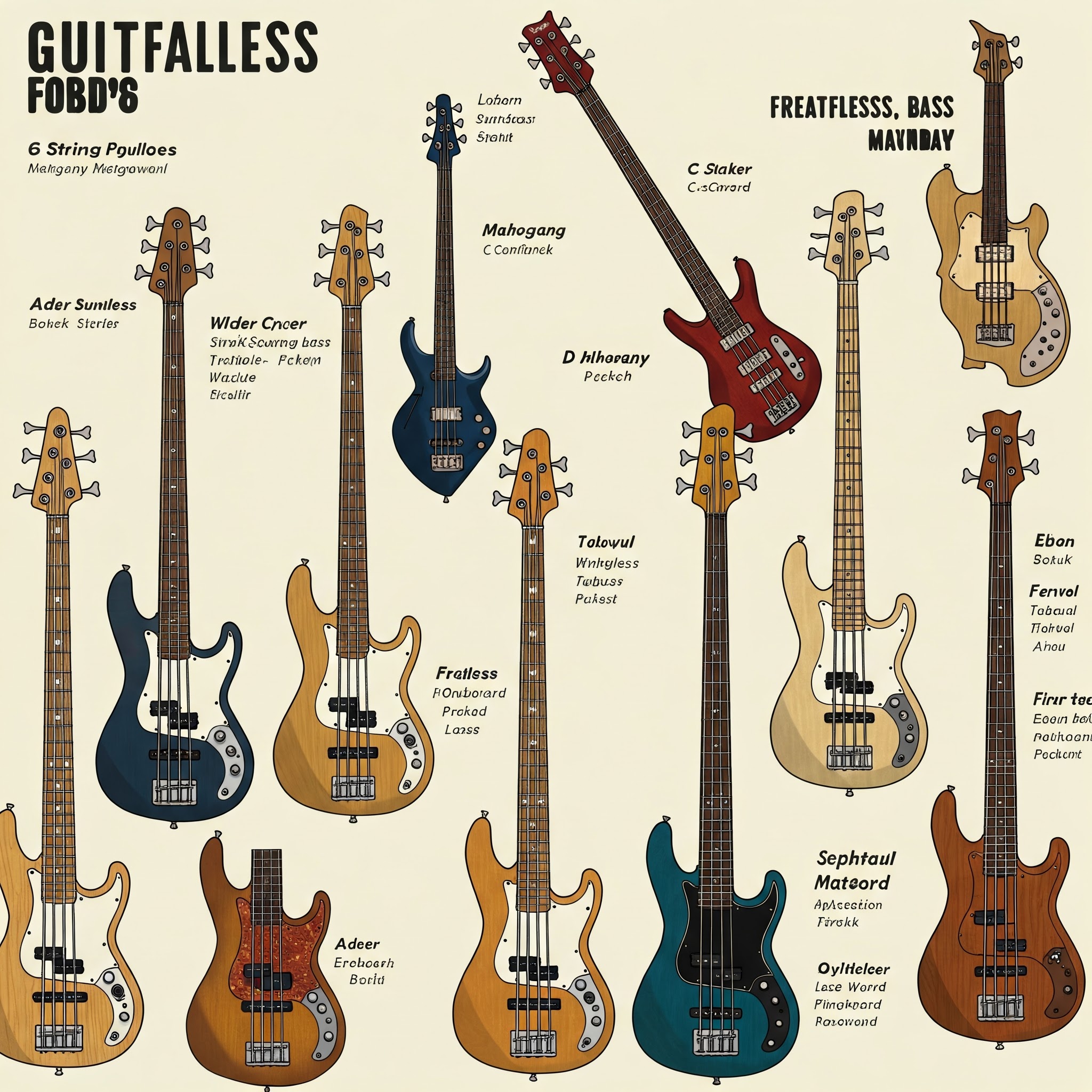
Thirty positions of bare wood: that is how Bass Musician Magazine describes the fingerboard on the Ibanez SRF706 Portamento Fretless, a six-string whose board runs all the way to the neck pickup, and every one of those positions has to be found by ear. It is a fair picture of what fretless bass guitars ask of a player, and it explains why the instrument you pick matters more here than it does on a fretted bass.
This 2027 guide works through four decisions in order (lined or unlined, how many strings, which board and strings, what setup to demand), adds the ear training owners swear by, and then matches three instruments to those decisions. The findings rest on spec sheets, retailer owner reviews, specialist-magazine reviews and forum threads, and no instrument was handled for this piece. Amazon’s own review pages could not be opened, so every rating quoted below comes from Sweetwater or Thomann and is named as such.
The short version: a lined board, four strings, flatwound strings and a professional setup make the gentlest start. A six-string or an unlined neck suits someone who already hears pitch well, and the sections below explain why.
Four moves that narrow the field before you read a model name
Step one: Decide how much your eyes get to help
Lines on the fingerboard are the first fork. Bass Musician Magazine’s piece on intonation says lines make intonation easier because they give visual cues, and that an unlined board brings a steeper learning curve. The same author adds that comfort and creativity should decide the purchase.
Owners do not agree on the trade-off. In a No Treble thread about switching to fretless, three commenters report that unlined boards pushed them toward ear and muscle memory, and that watching lines actually hurt their pitch. Two others found lines useful for learning where the fingers belong. Compromises surface in the same thread: partial lines at the octave and fifth, or lines stained a shade lighter.
That split is a reason to buy lined for a first fretless. You can learn to ignore lines, but a bare board cannot grow them. A second No Treble discussion also describes temporary side markers, including small squares of gaffer’s tape that peel off easily, for players who want a lighter touch of help.
Step two: Count the strings you will actually use
Four strings remain the default. Every instrument in Guitar Center’s fretless section is a 34-inch-scale four-string, and Guitar Lobby’s buying guide notes that five- and six-string basses usually move to a 35-inch scale to keep the low strings from feeling floppy. A longer scale also means a longer reach to every note, and on fretless you place each one yourself.
A six string fretless bass adds two strings and a wider neck. Anyone hunting for the best six string fretless bass guitar reviews will find that the owner pages for the two six-strings read here point at the same spot: the B string. One Sweetwater reviewer of the six-string Ibanez says the piezo’s mwah is clear on every string except the B. Owners of the Harley Benton B-650FL, a budget 6 string fretless bass sold through Thomann with a jatoba board and 4.4 out of 5 from 159 ratings there, report nut trouble at the B-string end more than once, including a nut that broke off during a string change. Setup reports on that bass are mixed, and one owner says the narrow string spacing suits fingerstyle fretless playing.
A No Treble commenter suggests choosing a fretless with the same neck spacing and feel as your daily fretted bass. For a six-string player that argument favors a six; for everyone else it favors four.
Step three: Match the board to the strings
Fingerboards are usually rosewood, maple or ebony, and Guitar Lobby’s guide says the best are smooth, hard and dense, so they wear slowly. Strings matter as much as the wood. Roundwounds sound brightest but are rougher, which means more finger noise on slides and more potential wear. Flatwounds are warmer and described as the safer choice. Coated and tapewound strings are gentlest on the board and sound more muted.
The Ibanez models in this guide come with flatwounds. Bass Musician Magazine says the six-string Ibanez ships with D’Addario Chromes, and No Treble’s review of the four-string model treats flatwounds as the trade-off that rosewood boards ask for, while noting that roundwounds would change the sound.
Owner opinion on roundwounds is split. One reviewer of the six-string Ibanez on Sweetwater says the board was not designed for them and recommends flat or tapewound sets; others switched to roundwounds and report no damage. That is one caution against several experiments, so read it as a warning rather than a rule. Softer woods show wear sooner: one Sweetwater owner of the Squier found its Indian laurel board badly dried out and in need of conditioning, and Thomann reviewers of the Harley Benton describe its fingerboard as soft and prone to scratches.
Step four: Ask for a setup before judging the bass
Setup explains much of the swing in fretless bass guitars reviews written by owners. Many Squier owners on Sweetwater say the bass arrived well set up, with good intonation and no buzz, while one had persistent buzzing and needed the action raised and the truss rod adjusted. One buyer of the four-string Ibanez says the bass arrived well set up, yet another owner reports the neck shifting slightly over time and needing a truss rod tweak. For the six-string Ibanez, one reviewer calls the bass unplayable out of the box, with buzzing on open strings and up to the fourth fret; another praises Sweetwater’s setup as spot-on.
So a bad first evening does not always mean a bad bass. Budget a tech visit before deciding. One Harley Benton owner did report that intonation stayed off even after a luthier’s work, which is why the return window matters as much as the price.
Training your ear: routines owners and teachers lean on
Practice habits do more for intonation than any gear choice, and the advice overlaps across sources even where the details differ. Bass Musician Magazine lists five routines: check fretted notes against the matching open string, run scales and arpeggios past a tuner, hold a drone or pad note and listen for clashes, record a fretted bassline on a looper and match it note for note on fretless, and resist covering wrong notes with vibrato or slides. On that last one, the author says to work out whether the note was sharp or flat, then replay it in tune.
No Treble’s guide to making the switch adds a working bassist’s view. Damian Erskine recommends slow scales or melodic patterns against a tuner, one finger per fret position, and advises against chasing perfect pitch every second; he treats slight slips as expressive inflection. Commenters split on the tuner. Several began with a chromatic tuner, while others warn that the musicians around you may not sit exactly where it does, and suggest drones, where an off note produces audible beating.
A second No Treble discussion records a commenter who learns lines on a fretted bass first and moves them to fretless once they feel easy, which makes the wrong notes stand out. Drone practice and slow, deliberate work come up in all three sources. The tuner’s role stays disputed.
Where first fretless purchases go wrong, and the repair for each
Roundwounds on day one. A rough string on an untested board wears it, and Sweetwater owners disagree on how fast. Fit flatwounds or tapewounds first, then experiment once you know how hard the wood is.
Judging the bass after one evening. See step four: a tech visit is cheaper than selling a good instrument over a high nut.
Forgetting the battery. Active circuits and piezo systems need a 9-volt; Bass Musician Magazine describes a 9-volt active circuit on the six-string Ibanez, and one owner of the four-string model on Sweetwater says the battery dies sooner than expected while another wishes for a drop-in compartment. Carry a spare.
Buying unlined to look serious. The learning-curve note from Bass Musician Magazine applies. Lines or side markers buy time while the ear catches up.
Best fretless bass guitars matched to those steps
Guitar Center’s 2026 roundup, the page many shoppers land on when they search for a fretless bass guitar center recommendation, names only two fretless basses: the Squier below and the Rogue LX200BF Fretless Series III, an entry-level model around $200 that the writer suggests for trying fretless without spending much. The three picks here follow the steps above, from a lined four-string to a six-string piezo bass.
1. Squier Classic Vibe ’60s Jazz Bass Fretless — lined board, gentle entry price
Lines are the whole reason this bass sits first. Guitar Center’s roundup calls the marked fret positions helpful for bassists crossing over from fretted instruments, and Sweetwater’s spec page confirms a lined Indian laurel board with dot inlays, a 34-inch scale, a 9.5-inch radius and a 1.5-inch nut. The slim C-shaped neck, poplar body and two Fender-designed alnico single-coil pickups are standard Jazz Bass fare, all passive, so there is no battery to remember.
Owners on Sweetwater give it 4.6 out of 5 across 20 reviews, with roughly 85 percent at five stars. Many say it arrived well set up and some played it without any adjustment. The complaints are specific and mostly singular: one buyer found the laurel board dried out, another saw fret lines pop out of the wood, and one needed the action raised after persistent buzzing. Hum is the more repeated theme. Several owners swapped the pickups for quieter ones, though one who kept the stock set was content. One owner returned the bass over warping concerns, and another felt the neck does not give the most vocal fretless wah and was unhappy with what they paid.
Expect around $500 to $550 at the retailers that showed it in stock; check the current price on Amazon.com before deciding.
2. Ibanez SRF700 Portamento Fretless — piezo blend, thirty positions
This is the step-up pick, at roughly double the Squier’s spend: around $950 to $1,050 at the dealers that showed it in stock. The money buys a neck-through build with a five-piece maple and bubinga neck, a mahogany body, a 34-inch scale and a 38 mm nut, per No Treble’s review of the instrument. The electronics are the point: two Bartolini MK-1 split-coil pickups plus an AeroSilk piezo in a custom bridge, with each piezo saddle balanced by a small screwdriver through micro pots at the back.
That review’s writer found the bass excellent out of the box, with a smooth rather than harsh piezo that works alone or blended. The reviewer also says it gets close to an upright voice without sounding identical to one. Readers added dissent: one reported stiff string tension and weak sustain, one claimed the board is panga panga rather than the rosewood in the spec table, and the two sides disagreed about whether the piezo mutes the magnetics. Treat the fingerboard wood as unconfirmed.
Sweetwater owners average 4.8 out of 5 across 26 reviews, about 92 percent at five stars, praising the tone range, the light weight and the smooth board. The lone 1-star review says the neck warped after a couple of years, another owner says it shifts slightly and needs a truss rod adjustment, and a few want a master volume, a better battery compartment or lines on the board. The case is sold separately.
Compare the exact model number before buying: this Ibanez line comes in four-, five- and six-string versions with near-identical names.
3. Ibanez SRF706 Portamento Fretless — six strings, same piezo idea
Six strings plus a board that reaches the neck pickup make this the most ambitious pick here. Bass Musician Magazine’s review praises its quality, tone and playability and says it holds its own against pricier six-string fretless basses. The reviewer’s favorite sound blends the piezo with the Bartolini pickups for a deep, dark tone. The build mirrors the four-string Ibanez above: five-piece maple and bubinga through-neck, mahogany wings, two Bartolini MK-1 split-coil pickups and the AeroSilk piezo, with flatwounds fitted.
Sources disagree on several details. Bass Musician Magazine says the fingerboard is rosewood with dot and line markings on top; Sweetwater lists Panga Panga, and one Sweetwater reviewer says the side markers are nearly invisible outside bright light. Sweetwater describes a 3-band active EQ, while the magazine describes bass and treble controls on the magnetics plus a piezo tone control. Neither page gives a scale length, nut width or weight, so a player with large hands or a bad back should confirm those before ordering.
On Sweetwater, 12 owners average 4.4 out of 5. They praise the piezo mwah, the fast neck and a light feel for a six-string. The doubts cluster where the earlier B-string reports did: in the six string fretless bass reviews on retailer pages, the B is the recurring question mark, from one Ibanez owner’s weak B-string mwah to the Harley Benton’s nut complaints. Other single reports include a piezo A string that did not work, two owners finding the passive pickups underwhelming, and one reviewer who found the bass heavy for standing gigs with an awkward right horn.
Expect around $1,150 to $1,300 for the bass alone at the retailer that showed it in stock; bundles with a bag or case cost more. Read the current listing’s fingerboard and EQ description before you order.
What each costs and what it asks of you
| Model | Strings | Fingerboard | Pickups | Rough price band | Owner-reported watch-out |
|---|---|---|---|---|---|
| Squier Classic Vibe ’60s Jazz Bass Fretless | 4 | Indian laurel, lined | Two alnico single-coils, passive | Around $500 to $550 | Dry board, hum, setup |
| Ibanez SRF700 Portamento Fretless | 4 | Rosewood or panga panga (sources differ), side markers | Two Bartolini MK-1 plus AeroSilk piezo | Around $950 to $1,050 | Battery, neck adjustment |
| Ibanez SRF706 Portamento Fretless | 6 | Panga Panga or rosewood (sources differ) | Two Bartolini MK-1 plus AeroSilk piezo | Around $1,150 to $1,300 | B string, out-of-box setup |
The jump from the Squier to the Ibanez SRF700 Portamento Fretless roughly doubles the spend and buys the piezo and the neck-through build. The step to the six-string adds around $200 more for two strings and a longer board. The Squier asks for the least electronics knowledge, while both Ibanez models ask for a battery and some patience with piezo balance. Retailer prices move, so check the current price on Amazon.com before committing.
Straight answers on lined boards, six strings and flatwounds
❓ Is a fretless bass harder to play than a fretted one?
❓ Should a beginner buy a lined or unlined fretless bass?
❓ Do you need flatwound strings on a fretless bass?
❓ Is a six string fretless bass a good first fretless?
❓ How much do fretless bass guitars cost?
A rule of thumb for your first fretless
For most first-time buyers, the sensible order is lines, four strings, flatwounds, then a professional setup, and the Squier Classic Vibe ’60s Jazz Bass Fretless fits that order at the lowest cost of the three. Move to the Ibanez SRF700 Portamento Fretless when the piezo’s upright-style voice matters to you, and to the Ibanez SRF706 Portamento Fretless only when six strings are already part of how you play. Whichever of the best fretless bass guitars you choose, plan a setup visit and expect a few humbling weeks of listening before it sounds the way you hoped. Before ordering, read the string count, fingerboard material and lining on the current listing, since sources disagree on some of those details.
Recommended for You
- Tc electronics bass amp Made Simple: Steps and Tools
- 7 Best 6 String Fretless Bass Options That Will Transform Your Sound in 2025
- Aria pro ii bass: The 5 Worth Buying Right Now
Disclaimer: This post contains affiliate links. As an Amazon Associate, I earn from qualifying purchases made through these links, at no additional cost to you.
Heading to a shop or a checkout soon? Bring a tuner and a patient ear, because both will earn their keep.