
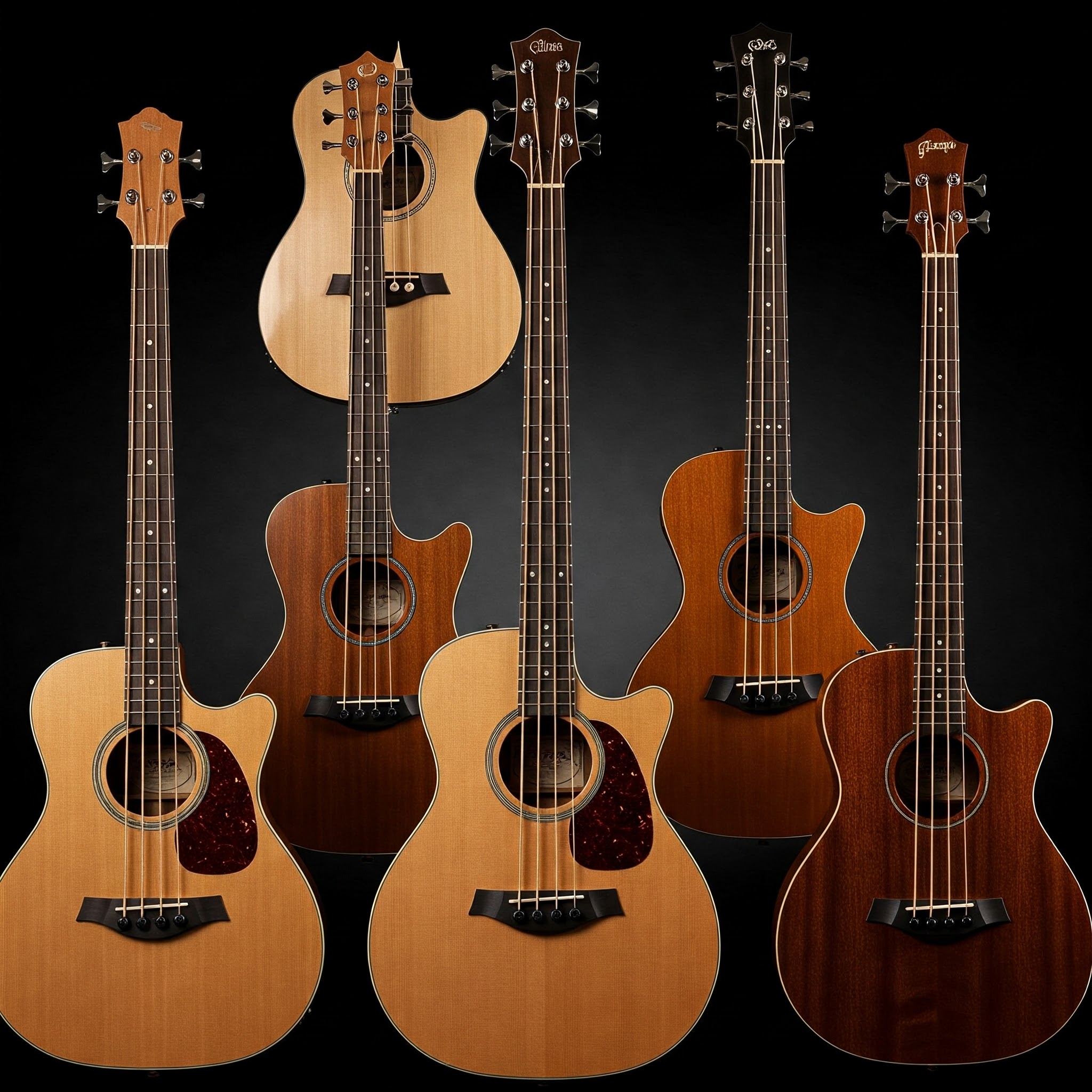
Will an acoustic bass actually be heard next to a strummed guitar? Owners posting on TDPRI and BassChat keep landing on the same answer: not unplugged, and not by much. That changes how to read any shortlist of acoustic bass guitars in 2027, because the decision rests less on tonewood than on scale length, strings and the preamp that feeds an amp. Six models follow, running from a Fender in the $400 neighborhood to a Martin that costs several times as much. These acoustic bass guitars were chosen for different kinds of players, not ranked on a single scale.
The findings rest on maker spec sheets, retailer listings from Sweetwater and Guitar Center, magazine reviews such as Guitar World’s acoustic bass roundup, and owner threads; where two sources disagree on a spec, the text says so, and prices appear as ranges only.
Who an acoustic bass suits, and how these models were picked
An acoustic bass earns its place in four situations: writing songs without an amp humming in the corner, quiet practice, small acoustic sets where a full electric rig would be too much, and recording straight into a DAW through the onboard preamp. Guitar World’s roundup describes the same appeal, noting that the instruments give useful low end at a more manageable volume than an electric rig but need amplification to project.
It is a poor stand-in for an upright. Several TDPRI posters treat these basses as a distinct plugged-in voice rather than an upright substitute, and a few advise keeping a regular bass around for louder gigs.
Roundups of the best acoustic bass guitars from Guitar World, American Songwriter and Gearnews keep returning to Fender, Martin, Taylor, Guild and Takamine, so those five makers anchor the list. Each model was cross-checked against at least two sources, a maker or retailer page plus an independent review or owner thread. The six cover five different scale lengths (23½, 23¾, 30.3, 32 and 34 inches) and a price spread from roughly $400 to well past $2,000.
Scale, body and price: how the six differ
| Model | Scale length | Body | Electronics | Price tier |
|---|---|---|---|---|
| Fender CB-60SCE | 32″ | Concert, cutaway | Fishman Classic Design | Around $400 |
| Guild Jumbo Junior Bass | 23¾” | Jumbo Junior, no cutaway | Guild AP-1 active piezo | Between $500 and $600 |
| Fender Kingman Bass V2 | 30.3″ | Concert-style, cutaway | Fishman Presys+ with tuner | Around $500 to $600 |
| Takamine GB72CE | 34″ | Jumbo, Venetian cutaway | Takamine TK-40B | Around $750 |
| Taylor GS Mini-e Bass | 23½” | GS Mini, no cutaway | Taylor ES-B with tuner | Check the current price on Amazon.com |
| Martin BC-16E | 34″ | M-14 fret cutaway | Fishman or Martin E1, by version | Between $2,200 and $2,400 |
Scale length splits the lineup into camps. The Taylor GS Mini-e Bass and Guild Jumbo Junior Bass sit near 23½ inches and need strings made for that length, the two Fenders land in the middle, and the Takamine GB72CE and Martin BC-16E match the 34-inch length most electric bassists already know. Body size follows price less than you might expect: the jumbo Takamine costs roughly a third of what the Martin does.
The picks, from the budget-friendly to the premium
1. Fender CB-60SCE — the sensible entry point
At around $400, this is the cheapest of the six, and Guitar World recommends it for players who want an acoustic bass as an occasional change of pace rather than a main instrument. The Fishman electronics earn praise there for feeding a DAW cleanly.
Fender’s spec sheet lists a concert body with a solid spruce top and scalloped X-bracing, laminated mahogany back and sides, a 32-inch scale, 22 frets and a 1.69-inch nut. It ships with Fender phosphor bronze strings in a .045–.100 gauge. Fingerboard wood differs by listing, walnut on Fender’s own page and laurel on some retailer versions, so check the version you are buying.
Sweetwater’s category page shows 4.5 out of 5 from 38 reviews. Buyer reviews on Thomann split sharply: one buyer found almost no volume and unimpressive playability, while another called it good quality with plenty of gain, a built-in tuner and EQ. That split matches the owner threads, where this style of bass sounds best when it is plugged in.
Pros:
- ✅ Solid spruce top and Fishman electronics at the lowest price of the six
- ✅ A 32-inch scale that sits between short-scale and full-length basses
Cons:
- ❌ Buyer reviews split on unplugged volume and playability
- ❌ The gig bag is sold separately
Check current availability on Amazon.com for the finish you want.
2. Guild Jumbo Junior Bass — short scale, small body, big voice
Short scale is the whole story here. At 23¾ inches, it feels like a different instrument from a standard bass, and Premier Guitar’s reviewer found that the fourth string felt somewhat floppy because of it. The same review rated unplugged volume modest but adequate for solo playing, and described the plugged-in tone as deep, warm and woody.
A second review, from Mixdown, reached similar conclusions from a long-time short-scale player: ten minutes was enough to adjust to the neck length and body size. Its complaints were a single tone control with little range (an EQ pedal was the suggested fix) and a feedback risk at loud live volumes. Mixdown also advised against flatwound strings, arguing they would leave the sound flatter and muddier. Two independent reviewers agreeing on the low-E looseness and the limited tone control makes those findings fairly solid.
The spec sheet lists a solid Sitka spruce top, layered flame maple back and sides, a Guild AP-1 active piezo with volume and tone dials, and nylon-core phosphor bronze strings in a .037–.090 gauge. It is built in China, per one retailer’s listing. Sources disagree on the case: Premier Guitar counts a bundled gig bag as a plus, while dealers list the case as sold separately, so check the listing. Expect a price between $500 and $600. Guitar World pegs it as a mid-range option for advanced beginners and for experienced players adding a second bass.
Guild’s own Guild B-240E offers a 30¾-inch scale in a larger body, and Sweetwater shows it at 4.5 out of 5 from 19 reviews.
3. Fender Kingman Bass V2 — electric-bass feel in a spruce top
A bassist coming from a Jazz Bass will recognize this neck. The Kingman pairs a slim C-shaped Jazz Bass profile with a 30.3-inch scale, 20 frets, a walnut fingerboard, a GraphTech NuBone nut and saddle, a cutaway and a Fishman Presys+ preamp with a built-in tuner. A gig bag comes in the box. Guitar World credits it with strong playability and projection.
The materials depend on the production run. An earlier black version is listed with laminated mahogany back and sides and a mahogany neck, while Fender’s shop listing for the Shaded Edge Burst model shows sapele and a nato neck. The price sits around $500 to $600.
Owner reports on a BassChat thread are the most useful evidence here. Several owners say it is louder than an electric bass played unplugged but cannot hold its own against an acoustic guitar. One needed a soundhole suppressor to tame feedback. A 2023 poster found that standard short-scale tapewound strings were about half an inch too short for the ball-end and bridge setup, and medium-scale sets slightly too long; the recommended fix was 33–34 inch ball-to-silk strings. Others mention neck dive when the bass stands upright, a deep body that can tire the right forearm, and a tuner that drains the battery in transit unless the bass travels in a hard case. One owner sold theirs because it sounded close to a P-bass in a mix and took up room.
A TalkBass poster who compared every acoustic bass in a Guitar Center acoustic room against a guitar found the Kingman held up best, and still advised playing it unplugged only solo or with one other guitar.
Sweetwater shows 11 reviews for it but no star rating.
4. Takamine GB72CE — jumbo body for stage volume
One Sweetwater reviewer replaced a Fender CB60 with this bass because the Fender CB60‘s low E sounded dead next to the other strings. He reports clean tone across the neck and a jumbo body that resonates well, and says the 34-inch scale feels close to his electric basses. That is a single owner’s account, and Sweetwater’s product page shows only that one review, so treat it as a lead rather than a verdict.
The Sweetwater listing describes a jumbo body with a Venetian cutaway, a solid spruce top, flame maple back and sides, and a TK-40B preamp with three-band EQ, gain, a mid-shift and a bass-boost switch. Neck wood is where sources conflict: Sweetwater lists maple with a rosewood fingerboard, while Guitar World lists mahogany with an ebony fingerboard and 21 frets. Check the label on the exact one you order. Pricing runs around $750.
Guitar World calls it a versatile workhorse for songwriting, stage and busking, with strong projection and low end and a bright voice. The same review notes that the large body may put some players off.
Pros:
- ✅ Jumbo body and a preamp with a bass-boost switch, aimed at stage and studio use
- ✅ A 34-inch scale that one Sweetwater owner says feels close to an electric bass
Cons:
- ❌ The large body may deter some players, per Guitar World
- ❌ Thin review evidence, with one detailed owner account
Check current availability on Amazon.com before you commit.
5. Taylor GS Mini-e Bass — travel-sized with dedicated strings
Strings come first with this one. Taylor’s page lists a 23½-inch scale, D’Addario coated phosphor bronze strings in a .037–.090 gauge, and a specific replacement set, while also approving a Pyramid set made for 23.5 inches. A BassBuzz forum member who tried the koa version came away noting the same thing: the scale needs strings built for it.
The maker’s page describes a solid torrefied spruce top, layered sapele back and sides, a mahogany neck with a 1-11/16-inch nut, an ebony fretboard, X-bracing and ES-B electronics with a digital tuner. It is a non-cutaway four-string, a lightweight gig bag is included, and left-handed versions are available through retailers.
Guitar World reviewed the koa-top version and praised the big sound from a small body, wishing only for a hard case; that variant runs around $1,000. For the spruce-top model described here, check the current price on Amazon.com.
Taylor ships it with a gig bag rather than a hard case.
6. Martin BC-16E — the premium pick with a premium bill
Roughly five to six times the cost of the Fender CB-60SCE, this Martin sits between $2,200 and $2,400. For that, retailer listings show a Sitka spruce top, East Indian rosewood back and sides, an ebony fingerboard with 23 frets, a 34-inch scale, an M-14 fret cutaway body, Martin Authentic Acoustic Bass Strings and a soft case. A zZounds listing says it is handcrafted in Nazareth, Pennsylvania.
Electronics depend on the version. Guitar World lists Fishman Matrix V, while a newer zZounds listing shows Martin E1 and notes that the Fishman edition is no longer available there. Guitar World rates it best overall, praising tone, durability and electronics that amplify without harsh highs.
Real-use evidence is mixed. A summary of owner comments on Equipboard says the size is a challenge, with the far end of the fretboard feeling distant, and that owners see it as a premium bass even though comparable alternatives exist for less. A Thomann buyer found the higher string action of an acoustic bass took a little getting used to, though the thin neck felt comfortable and fast. And a poster on the Ernie Ball forum said every acoustic bass tried in person, including expensive Taylors and Martins, lacked the volume to be heard over a vocalist playing acoustic guitar; that is one poster’s experience, but it echoes the other threads.
Pros:
- ✅ Solid Sitka spruce top over rosewood back and sides, with a handcrafted build
- ✅ A 34-inch scale and a neck that a Thomann buyer found thin and fast
Cons:
- ❌ Several times the price of the other basses here
- ❌ Owners flag the body size and the long reach to the end of the fretboard
What acoustic bass guitars reviews and owner threads agree on about volume
Three findings repeat across nearly every source.
First, unplugged volume sits between an electric bass and an acoustic guitar. BassChat owners say the Kingman beats an electric bass unplugged without matching a guitar, and TDPRI posters call acoustic basses much quieter than a guitar. One of them said a bassist’s acoustic-electric was almost useless apart from solo practice. A TDPRI poster found that a budget Rogue bass blended quietly with a Silvertone archtop acoustic guitar that was itself too quiet to hang with dreadnoughts.
Second, feedback shows up early. Mixdown found the Guild’s pickup very loud through a small powered wedge. Guitar World warns that fully hollow bodies feed back at high gain or volume. TDPRI posters describe foam soundhole plugs as the fix, and a BassChat owner needed a soundhole suppressor.
Third, these basses work with one companion instrument. The TalkBass poster limited unplugged playing to solo or a single guitar, and a TDPRI poster said a heavy pick gets one close enough for a porch jam.
For buying, that makes the preamp more important than the wood. Look for a preamp with a tuner and EQ, and budget for a small bass amp or a direct box. For quiet practice, the acoustic bass guitar best suited is the one whose scale and body feel right in your hands, since volume hardly enters the choice.
Scale length and strings: the two specs that change how it feels
Guitar World notes that short-scale basses feel slinkier and make wide stretches easier, though it gives no string tension figures. Premier Guitar’s note about the Guild’s floppy low E is the other side of that: slack tension helps the left hand and can blur the lowest string.
Strings differ across the six. Fender lists phosphor bronze in .045–.100 for the CB-60SCE, Taylor ships coated .037–.090 sets built for 23½ inches, and Guild’s short-scale model uses a similar .037–.090 set. The Kingman is the awkward one: a BassChat poster found that neither short-scale nor medium-scale sets fit its bridge cleanly.
Material matters too. TDPRI posters report that flatwounds gave one player a smooth sound while phosphor bronze roundwounds added growl for another, and Mixdown warns against flats on the Guild. In other words, try the strings it ships with first, and change one variable at a time.
Rogue and Carlo Robelli: what the budget names offer
Two house-style brands come up whenever someone hunts for a cheap acoustic bass, and neither made the numbered list because the evidence on them is thinner.
On the Rogue guitar acoustic side, Musician’s Friend points to the Rogue RA-100D dreadnought as one of the brand’s most popular instruments. The brand’s acoustic-electric bass, the Rogue AB304, is described on Equipboard as having a spruce top, mahogany back, sides and neck, a piezo pickup with 4-band EQ and tuner, and die-cast machine heads. One Reddit discussion summarized there worries that Rogue basses often use plywood and that some owners found frets that were not leveled well, which made action adjustment hard. A TDPRI poster who tried a Rogue found it meh unplugged at first but, plugged in, “lo-fi and woody and warm.”
A Carlo Robelli acoustic guitar is a house-brand instrument. Guitar Center owns the name, and a Reverb listing says the instruments are designed and inspected in the United States but built in Asia, aimed at beginner to intermediate players. The Carlo Robelli SB100E acoustic-electric bass is described by Guitar Center’s used listing as full-size with a 34-inch scale and an onboard preamp, and it turns up mainly in used listings, so treat it as a secondhand option and check the condition.
Both are worth a look for experimenting with the format at low cost, as long as you accept that you may outgrow them.
What the sticker price leaves out: strings, cases, humidity and an amp
The shopping list grows after the instrument. A case comes first: Taylor, Kingman and Martin ship with a gig bag or soft case, while Guild’s dealers list the case as sold separately and Fender sells its gig bag as an option. A BassChat owner said the Kingman’s tuner can drain its battery in transit unless the bass sits in a hard case. Add replacement strings, a soundhole cover and either a small bass amp or a direct box, and a setup visit if the action feels high.
Humidity is the cost people forget. Solid spruce tops react to dry air, and Premier Guitar’s humidity guide explains that a top can shrink by nearly an eighth of an inch, leaving sharp fret ends and low, buzzing action. It recommends keeping the guitar in its case, aiming for roughly 40–50% humidity measured with a digital hygrometer, and rewetting a case humidifier every few weeks in winter. A bass with a solid top, whether a Fender CB-60SCE or a Martin BC-16E, benefits from the same routine.
Quick answers on volume, strings and upkeep
❓ Are acoustic bass guitars loud enough without an amp?
❓ What is the difference between an acoustic bass and an acoustic-electric bass?
❓ Is a short-scale acoustic bass easier for beginners?
❓ What strings do acoustic bass guitars use?
❓ Do acoustic bass guitars need humidity care?
Choosing among acoustic bass guitars: the short version
Most first-time buyers will be well served by the Fender CB-60SCE: a solid spruce top, real electronics and the lowest price of the six, with the caveat that it shines best plugged in. A bassist coming from electric should try the Fender Kingman Bass V2 for its Jazz-style neck, while the Takamine GB72CE suits stage players who want a jumbo body and a long scale. The Guild Jumbo Junior Bass and Taylor GS Mini-e Bass fit couches, tour buses and anyone who likes short scale, and the Martin BC-16E is for players who value the build and can afford it. Whichever of these acoustic bass guitars you pick, put an amp, strings and a case in the budget.
Check current availability below for the model and finish you have in mind.
Recommended for You
- Aria pro ii bass: The 5 Worth Buying Right Now
- Bass Trumpet: 7 Best Bb Models for 2026 (Buying Guide)
- Cort acoustic guitars: 6 Picks Worth Your Money (2027)
Disclaimer: This post contains affiliate links. As an Amazon Associate, I earn from qualifying purchases made through these links, at no additional cost to you.
Found a bass that fits your hands? Plug it in before you judge it. 🎸