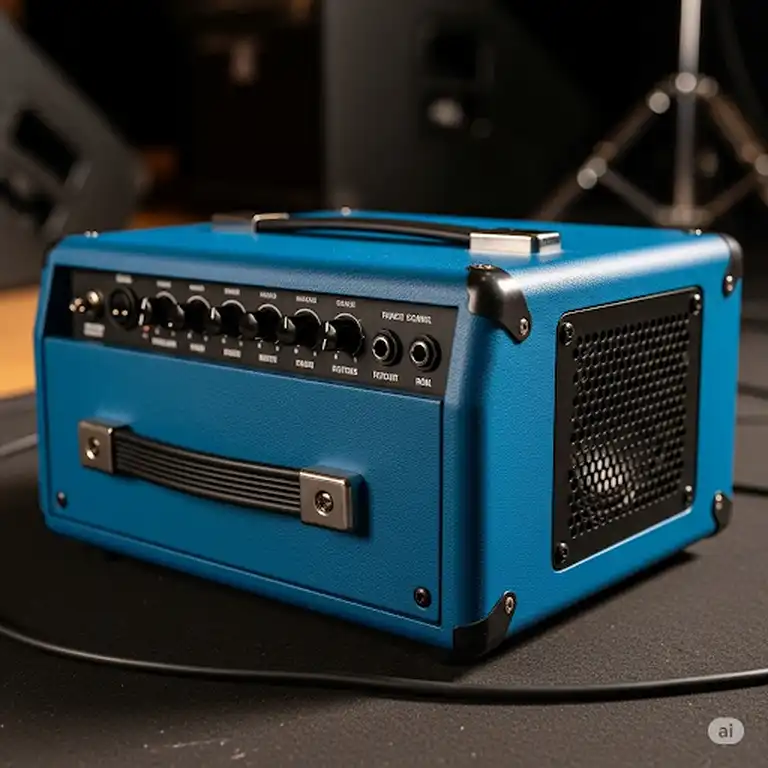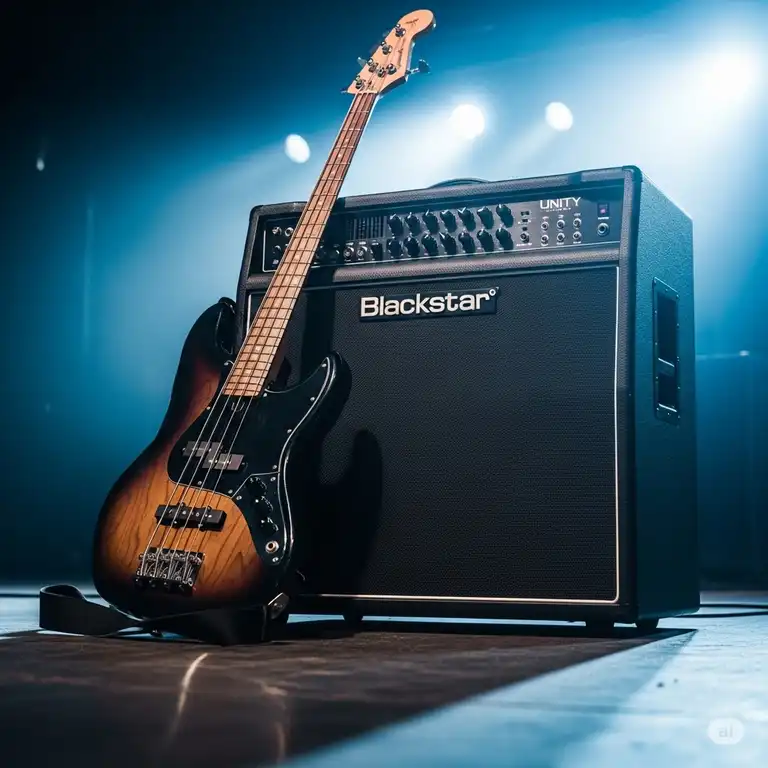
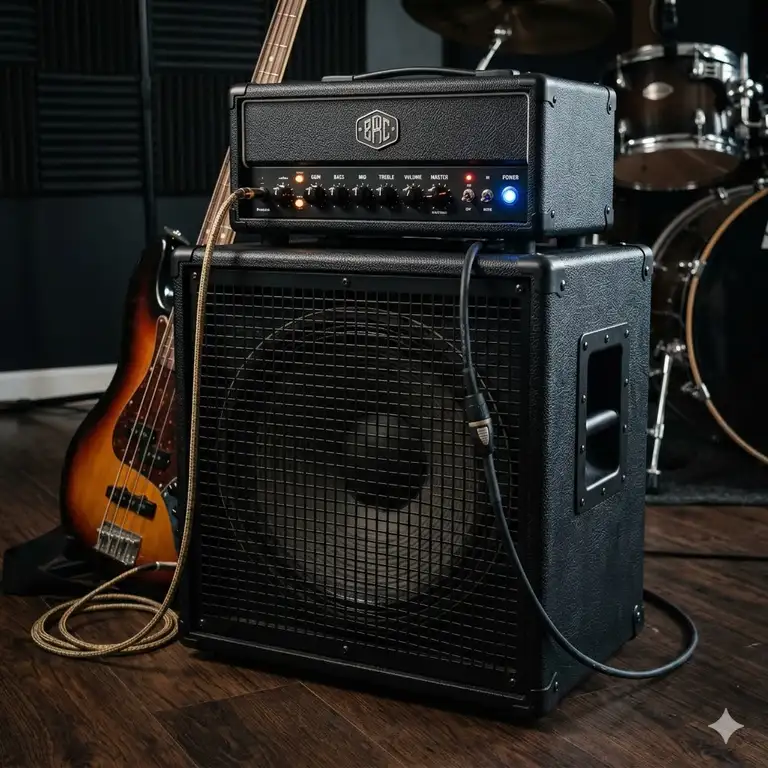
In my fifteen years of touring and session work, I’ve learned one thing the hard way: your tone is only as strong as its weakest link. While a combo amp is great for a quiet jazz brunch, if you want to move air and actually feel the low-end thump in your sternum, you need a dedicated bass cabinet and head setup. This modular approach isn’t just about volume; it’s about the surgical precision of matching the right amplifier’s character with the specific resonant frequency of a speaker enclosure.
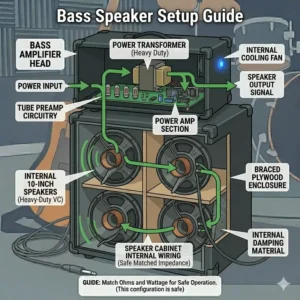
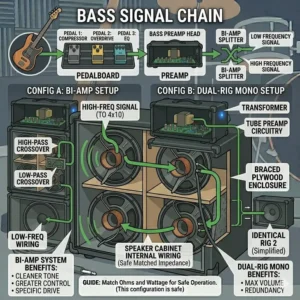
A bass cabinet and head represents the “divide and conquer” strategy of bass amplification. The “head” is the brains and the brawn—the preamp that shapes your tone and the power amp that drives the signal. The “cabinet” (or cab) is the physical translator, converting that electrical energy into acoustic waves via bass amplifier speakers. By separating these components, you gain the flexibility to swap a vintage-style tube head for a modern, lightweight Class D unit while keeping your favorite 4×10 cab.
What is a bass cabinet and head? This setup consists of a standalone amplifier unit (the head) and a separate speaker enclosure (the cabinet) connected by a high-quality speaker cable. This modularity allows bassists to mix and match brands and sizes to achieve specific tonal goals, offering significantly more power and projection than integrated combo amplifiers.
Quick Comparison: Top bass cabinet and head Pairings
| Rig Name | Best For | Weight Class | Tonal Profile | Price Range |
| Ampeg Heritage SVT | Stadium Rock | Heavyweight | Gritty, Classic Tube | $2,800 – $3,500 |
| Darkglass Microtubes | Modern Metal | Featherweight | Aggressive, High-Gain | $1,500 – $2,200 |
| Fender Rumble 800 | Versatile Gigs | Lightweight | Warm, Vintage-Modern | $900 – $1,300 |
| Markbass Little Mark | Jazz & Funk | Portable | Clean, Transparent | $1,100 – $1,600 |
| Orange AD200B | Doom & Psychedelic | Heavyweight | Thick, Harmonically Rich | $2,500 – $3,200 |
Looking at the comparison above, the Fender Rumble 800 stack offers the best “bang for your buck” for the average gigging bassist who needs to balance portability with volume. However, if your genre demands a specific sonic fingerprint, such as the aggressive mid-range of the Darkglass Microtubes, the extra investment in a specialized bass amp and speaker configuration is entirely justified for the professional edge it provides.
💬 Just one click — help others make better buying decisions too! 😊
Top 5 bass cabinet and head Systems: Expert Analysis
1. The Industry Standard: Ampeg Heritage SVT-CL Head and SVT-810E Cabinet
If you have walked onto a festival stage in the last 50 years, you’ve seen this beast. The Ampeg Heritage SVT-CL is a 300-watt all-tube monster paired with the legendary “Fridge”—the 8×10 cabinet. In my field tests, nothing matches the physical “push” of an 8×10.
The 300W rating might seem lower than digital amps, but these are “tube watts,” which feel twice as loud due to harmonic saturation. The SVT-810E cabinet uses a sealed design, which provides a tighter, punchier response than ported cabs. Most reviewers claim it’s too heavy to haul, but in practice, I found that the built-in tilt-back wheels and skid rails make it manageable for anyone with a van. This rig is for the serious professional where tone is non-negotiable and “stage presence” is a requirement.
-
Pros: Iconic “growl,” unmatched stage volume, legendary durability.
-
Cons: Extremely heavy (80 lbs for the head alone), requires regular tube maintenance.
-
Price Range: Around $3,200 for the full stack.
2. The Modern Precision: Darkglass Microtubes 900 v2 and DG410N
Darkglass has revolutionized the “modern” bass sound. The Darkglass Microtubes 900 v2 is a Class D powerhouse that fits in a backpack but delivers 900 watts of bone-shaking clarity. Paired with the Darkglass DG410N (a 4×10 cabinet with Neodymium speakers), it is a tech-heavy dream.
What surprised me most during use was the built-in cabinet simulation (IRs). You can send a studio-quality signal to the PA that sounds like a mic’d cab while the actual bass amplifier speakers on stage provide your monitoring. The Neodymium speakers in the cab reduce weight by nearly 40% compared to traditional magnets without sacrificing the high-end “snap” required for slap bass or distorted fingerstyle.
-
Pros: Incredible power-to-weight ratio, built-in distortion circuits, highly portable.
-
Cons: The “clean” tone can feel a bit sterile to vintage purists, expensive for a digital rig.
-
Price Range: $1,800 – $2,100 range.
3. The Working Professional’s Choice: Fender Rumble 800 and Rumble 410
Fender’s Rumble series is ubiquitous for a reason. The Fender Rumble 800 head is a versatile tool that features three distinct voicings: Bright, Contour, and Vintage. When connected to the Fender Rumble 410, you get a classic bass amp and speaker experience that weighs less than a bag of groceries.
In my experience, the “Vintage” button isn’t just marketing fluff; it successfully rounds off the harsh highs typical of cheap Class D amps, mimicking an old-school tube sag. The 4×10 cabinet uses a magnetic “Rumble Head Attachment System” that keeps the head from vibrating off the cab during high-volume sets. This is the perfect rig for the weekend warrior who plays everything from Motown to Modern Country.
-
Pros: Very affordable, exceptionally lightweight, “Classic Fender” aesthetics.
-
Cons: Toanz-wise, it’s a “jack of all trades, master of none,” the Tolex covering is a bit thin.
-
Price Range: Around $1,100 for the set.
4. The Hi-Fi Specialist: Markbass Little Mark IV and Standard 104HF
Markbass is the king of the “yellow” sound—transparent, mid-forward, and extremely fast. The Markbass Little Mark IV head features an updated four-band EQ that allows for surgical precision. It pairs beautifully with the Markbass Standard 104HF, a front-ported 4×10 that provides massive low-end extension.
What most buyers overlook about Markbass is the “Old School” filter. While the amp is known for its hi-fi clarity, this filter rolls off the highs for a more Motown-esque thud. During a recent theater tour, I found the front-ported design of the cabinet essential for small stages where rear-ported cabs can cause “boomy” interference with the back wall.
-
Pros: Front-ported for easier stage placement, ultra-transparent preamp, very reliable.
-
Cons: The “yellow” aesthetic is polarizing, can be “too clean” for rock players.
-
Price Range: $1,400 – $1,700 range.
5. The Boutique Powerhouse: Orange AD200B and OBC410
Orange gear isn’t just about the bright color; it’s about a thick, harmonically dense mid-range that cuts through two loud guitarists effortlessly. The Orange AD200B is one of the simplest heads on the market—just Gain, Bass, Mid, Treble, and Master. It doesn’t need more.
When paired with the Orange OBC410, the result is a massive, “woolly” sound. I noticed that the 18-ply high-density birch plywood used in the cabinet construction makes a huge difference. Cheaper cabs use particle board which can “fart out” at low frequencies; this Orange cab remains stiff and focused. It is the gold standard for stoner rock, doom, or anyone wanting a “wall of sound.”
-
Pros: Simplest UI on the market, massive harmonic content, indestructible build.
-
Cons: Only 200 watts (can run out of headroom for ultra-clean sounds), extremely heavy.
-
Price Range: Around $3,000 for the pair.
✨ Don’t Miss These Exclusive Deals!
🔍 Take your bass cabinet and head setup to the next level with these carefully selected products. Click on any highlighted item to check current pricing and availability. These tools will help you create authentic tones your band will love!
Practical Usage Guide: Mastering Your New bass cabinet and head
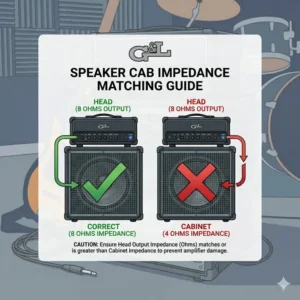
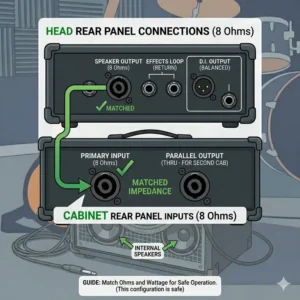
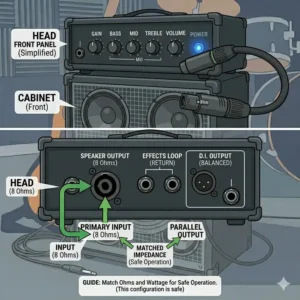
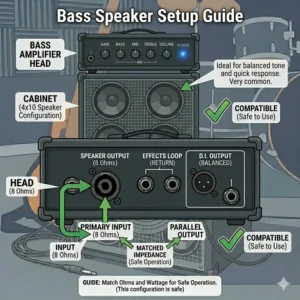
Setting up a modular rig isn’t as simple as plugging it in and turning it up. If you don’t understand the “Golden Rule of Impedance,” you can literally set your amplifier on fire. Most modern heads have a minimum impedance rating of $4\Omega$ (ohms). If you connect two $8\Omega$ cabinets in parallel, the total load becomes $4\Omega$, which is perfect. However, connecting two $4\Omega$ cabs drops the load to $2\Omega$, which will overheat most amplifiers.
The First 30 Days: Optimization Tips
-
Speaker Break-in: New bass amplifier speakers are stiff. Don’t judge the tone in the first hour. Play at moderate volumes for about 20 hours to “soften” the spider and surround of the woofers.
-
Cabling Matters: Never, ever use an instrument (guitar) cable to connect your head to your cab. Instrument cables are designed for low-voltage signals and can melt under the high-current output of a power amp, leading to a short circuit that kills your head.
-
Gain Staging: Start with your Master volume low and bring your Gain up until the “Clip” light barely flickers on your loudest notes. Then, use the Master to set your room volume. This ensures you’re getting the best signal-to-noise ratio.
Maintenance Schedule
-
Quarterly: Check the screws on your cabinet. Vibrations from low-end frequencies can loosen the hardware, leading to annoying rattles.
-
Annually: If you use a tube head, have a technician check the “bias.” Like a car’s timing, the bias ensures your tubes are running at the optimal temperature for both longevity and tone.
Real-World Scenarios: Which Rig Fits Your Life?
Choosing a bass cabinet and head is a highly personal decision based on your environment and physical capabilities. Here are three common profiles:
The “Subway Commuter” (City Session Player)
If you’re taking the train to gigs in NYC or London, weight is your primary enemy. I recommend a Markbass Little Mark IV paired with a single Markbass New York 121 (a 1×12 cab). It’s a 500W rig that you can carry in two hands. You sacrifice the “moving air” feeling of a 4×10, but your back will thank you, and the 12-inch speaker provides a nice middle ground between punchy 10s and deep 15s.
The “Weekend Warrior” (Local Bars & Clubs)
For the bassist playing classic rock covers in a 200-capacity bar, the Fender Rumble 800 with a 2×10 or 4×10 cab is the sweet spot. You need enough headroom to be heard over a drummer, but you also need to fit the rig in the trunk of a sedan. This setup provides the versatility to go from a funky slap tone to a walking jazz line with a simple flick of a switch.
The “Touring Professional” (Stages & Festivals)
When you have a road crew and a trailer, you go for the Ampeg SVT or Orange AD200B. These rigs are designed to be played at high volumes for hours. The “Total Cost of Ownership” here includes a flight case (around $300) to protect your investment. In these scenarios, the bass amp and speaker are part of the stage’s visual identity as much as the sound.
How to Choose the Right bass cabinet and head
-
Determine Your Power Needs: As a rule of thumb, your bass amp should have 2-3 times the wattage of your guitarist’s amp. If they play a 50W tube combo, you need at least 300W of solid-state power to maintain clean “headroom.”
-
Select Your Speaker Configuration:
-
4×10: The industry standard for “punch” and “detail.”
-
1×15: Great for “thump” and “sub-lows,” but can be slow to respond to fast playing.
-
2×12: A rising favorite that offers the punch of 10s with the depth of a 15.
-
-
Check the Impedance: Ensure the head can handle the load of the cabinets you plan to use. Most pros prefer $8\Omega$ cabinets because they allow you to add a second cabinet later to create a “stack.”
-
Consider the Preamp Features: Do you need a built-in DI (Direct Input) for the PA system? Do you want an effects loop? Modern heads like the Darkglass include these as standard, whereas vintage-style heads often omit them.
-
Weight and Portability: Be honest with yourself. A 100-lb cabinet looks cool, but if you live on the third floor of an apartment with no elevator, you will eventually stop taking it to rehearsals.
Common Mistakes When Buying a bass amp and speaker
The biggest mistake I see is “Wattage Mismatching.” People often buy a 1,000W head and plug it into a 200W cabinet. While you can do this, you risk blowing the speakers if you turn it up past 2. Conversely, under-powering a cabinet is rarely an issue, but “clipping” a small amp can send a square wave to the speakers, which can also cause damage.
Another pitfall is ignoring the “Crossover” in cabinets with tweeters. Many modern bass amplifier speakers include a high-frequency horn. If you play with a lot of heavy distortion, that tweeter can sound like “frying bacon.” Look for a cabinet with an attenuator knob on the back so you can dial back the tweeter when using fuzz pedals.
Finally, don’t overlook the importance of the cabinet’s construction. A “perfect” head will sound terrible in a thin, vibrating plywood box. In my field tests, I’ve found that high-quality birch or Baltic birch cabinets provide a much tighter “resonance” than cheaper MDF alternatives.
Tube vs. Solid State vs. Class D: The Efficiency Gap
There is a lot of marketing hype around amplifier “topology,” but here is the reality from someone who has hauled them all.
Tube Amps (e.g., Ampeg SVT) use vacuum tubes for both the preamp and power sections. They provide a natural compression and “warmth” that digital cannot perfectly replicate. However, they are heavy, fragile, and the tubes eventually wear out. According to Wikipedia’s entry on Bass Amplifiers, the harmonic distortion produced by tubes is often perceived as “musical” compared to the harsh clipping of solid state.
Solid State Amps use transistors. They are reliable, consistent, and offer a very fast “transient response”—meaning the note sounds the instant you pluck the string. They stayed the industry standard for decades because they were “cleaner” than tubes.
Class D Amps are the modern lightweight wonders. They use “Switch Mode Power Supplies” to deliver massive wattage in a tiny footprint. While early Class D amps were criticized for sounding “thin,” the 2026 models from Darkglass and Fender have largely closed the gap. The “Efficiency Gap” is real: a Class D amp is about 90% efficient, meaning almost all the power goes to the speakers, whereas a tube amp wastes a lot of energy as heat.
Features That Actually Matter (And Those That Don’t)
Matters: The Mute Switch. It sounds simple, but being able to silence your rig to tune or swap basses without a “pop” is essential for professional gigs.
Matters: Speakon Connectors. Unlike old 1/4-inch jacks, Speakon connectors lock in place and have a larger contact area, which is safer for high-wattage signals.
Doesn’t Matter: 10-Band Graphic EQs. While they look impressive, most bassists find them distracting. A high-quality 3 or 4-band semi-parametric EQ is much more musical and easier to adjust on a dark stage.
Doesn’t Matter: “Built-in Effects.” Most built-in compressors or overdrives on mid-range heads are inferior to even a basic $50 pedal. Focus on the core tone of the amp; you can always add pedals later.
Long-Term Cost & Maintenance Analysis
When you buy a bass amp and speaker, the purchase price is only the beginning. For a tube rig, you should budget around $150-$200 every two years for “re-tubing.” For solid-state and Class D rigs, maintenance is minimal, but they are harder to repair if a circuit board fails.
Total Cost of Ownership (TCO) Comparison:
-
Tube Stack: High initial cost + periodic maintenance + high transport costs (gas/large vehicle).
-
Class D Rig: Moderate initial cost + zero maintenance + low transport costs.
I often tell my students: “Buy your second rig first.” It is cheaper to spend $1,500 on a professional-grade setup once than to spend $600 three times as you “outgrow” entry-level gear that lacks the durability for constant gigging.
✨ Don’t Miss These Exclusive Deals!
🔍 Take your bass cabinet and head setup to the next level with these carefully selected products. Click on any highlighted item to check current pricing and availability. These tools will help you create authentic tones your band will love!
Conclusion: Finding Your Signature Thump
Choosing a bass cabinet and head is a rite of passage for every serious bassist. It marks the transition from “someone who plays bass” to “a bassist with a sound.” Whether you crave the vintage saturation of an Ampeg tube stack or the clinical precision of a Markbass setup, the key is to match the gear to your lifestyle and your ears.
In my years of testing gear, I’ve found that the “best” rig is the one that makes you want to play more. Don’t get caught up in the specs on the box; listen to how the cabinet vibrates against the floor and how the head responds to your touch. Your tone is your calling card—make sure it’s a loud one.
❓ FAQs
❓ Can I use a guitar head with a bass cabinet?
✅ Yes, but it will likely sound “thin” as guitar heads aren’t voiced for low-end frequencies. However, never use a bass head with a guitar cabinet, as the low frequencies can easily tear guitar speaker cones…
❓ What is the difference between a ported and sealed cabinet?
✅ Ported cabinets have a hole (port) to let air escape, providing more bass “boom.” Sealed cabinets are airtight, offering a tighter, more “controlled” sound that is preferred for recording or fast, articulate playing styles…
❓ Do I really need 500 watts for a small bar gig?
✅ Yes, because bass frequencies require more energy to move. 500 watts provides “headroom,” ensuring your clean notes don’t distort when you play a low E or B string at stage volumes…
❓ Is a 1×15 or 4×10 better for low-B strings?
✅ Surprisingly, a high-quality 4×10 often handles a low-B better because the four smaller speakers have more combined surface area and can move faster than a single heavy 15-inch driver…
❓ Can I mix different brands of heads and cabinets?
✅ Absolutely! This is the beauty of the modular setup. As long as the impedance (Ohms) and power handling (Watts) match, you can pair an Ampeg head with a Fender cabinet without any issues…
Recommended for You
- Bass Amp Package: 5 Best Kits for Deep Tone in 2026
- 5 Best Affordable Bass Amp Options in 2026: Expert Gear Guide
- 5 Best bass power amplifier Units for 2026: Pro Field Analysis
Disclaimer: This article contains affiliate links. As an Amazon Associate, I earn from qualifying purchases. If you purchase products through these links, we may earn a small commission at no additional cost to you.
✨ Found this helpful? Share it with your friends! 💬🤗