Believe it or not, I’ve spent more time looking for a dropped pick on a dark stage than I have practicing my actual scales. It is a universal guitarist struggle. We spend thousands of dollars on vintage-voiced humbuckers and hand-wired tube amps, yet we often overlook the one piece of plastic (or bone, or wood) that actually makes contact with the strings. Finding the best plectrums isn’t just about grabbing whatever is sitting on the counter at the local music shop; it is about finding the ultimate bridge between your soul and your instrument. 🎸
✨Was this helpful? Spread the word! 🚀
Whether you are shredding neo-classical metal or strumming folk songs by a campfire, the thickness, material, and shape of your pick change your tone more than you might think. In this guide, I’m diving deep into the world of best plectrums to help you find that “holy grail” feel. We aren’t just talking about “plectrums best” for the money; we are looking at the professional-grade gear that 2026 technology and craftsmanship have to offer.
📊 Comparing Plectrums to Traditional Alternatives
Before we jump into the specific models, let’s look at why choosing a dedicated plectrum beats using your fingers or improvised tools.
| Feature | Standard Plectrums | Fingerstyle | Thumbpicks |
| Attack Sharpness | High / Crisp | Mellow / Warm | Hybrid / Punchy |
| Speed Potential | Extreme (Tremolo) | Moderate | Moderate |
| Tone Control | Material Dependent | Flesh/Nail Dependent | Consistent |
| Ease of Use | High (Universal) | Steep Curve | Moderate |
| 2026 Trend | Boutique Materials | Hybrid Picking | Ergo-Designs |
🏆 Top 7 Best Plectrums: Expert Analysis
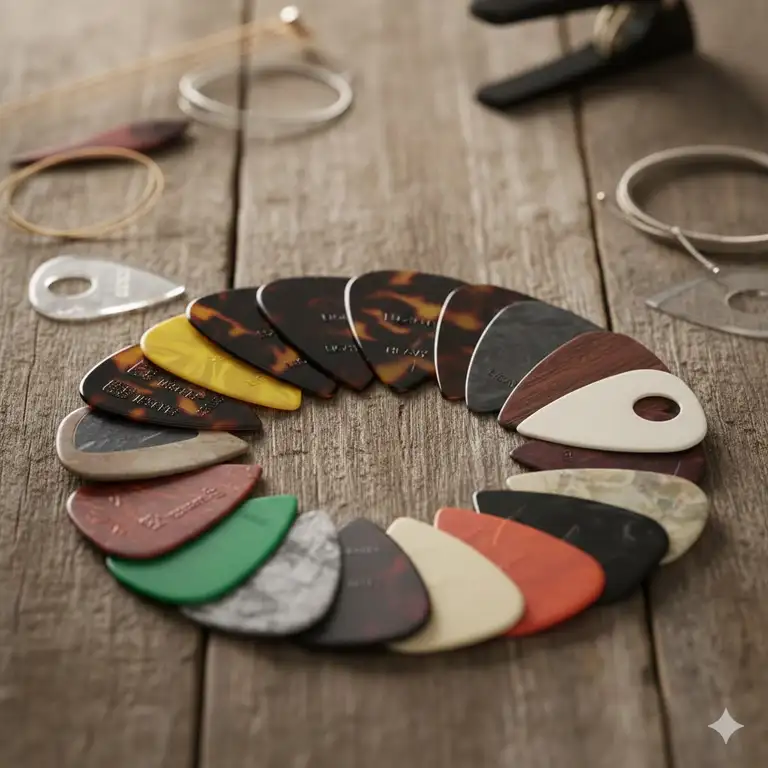
Choosing the right gear is personal, but some products simply stand above the rest due to their durability and tonal clarity. Here are the top 7 best plectrums currently dominating the market in 2026.
1. Jim Dunlop Tortex Standard .73mm Yellow (Model: 418P.73)
If there is a “gold standard” in the guitar world, this is it. The Jim Dunlop Tortex Standard .73mm Yellow is ubiquitous for a reason. Originally designed to mimic the feel of tortoiseshell (back when that was legal), the Tortex material offers a matte grip that stays in your hand even when things get sweaty during a long set.
-
Technical Specifications:
-
Material: Proprietary Delrin/Tortex.
-
Thickness: 0.73mm (Medium).
-
Shape: Standard Rounded Tip.
-
Color: Bright Yellow.
-
-
Customer Review Analysis: Users consistently praise its “memory”—the way the pick returns to its original shape after heavy use. Some complain that the logo wears off quickly, but the grip remains.
-
Professional Application: Ideal for indie rock, alternative, and rhythmic strumming.
-
Pros:
-
Extremely durable.
-
Iconic “snap” on the strings.
-
Very affordable.
-
-
Cons:
-
Can feel a bit “chalky” when brand new.
-
Not pointy enough for extreme shredding.
-
2. Fender 351 Shape Premium Celluloid Picks (Model: 0980351300)
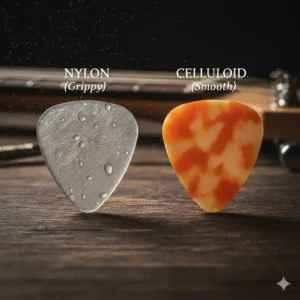
For that classic 1950s and 60s vibe, you cannot go wrong with the Fender 351 Shape Premium Celluloid Picks. Celluloid was the first man-made substitute for natural shell, and it provides a warm, round tone that many purists still swear by today.
-
Technical Specifications:
-
Material: High-quality Celluloid.
-
Thickness: Available in Thin, Medium, Heavy, Extra Heavy.
-
Shape: Classic 351.
-
-
Customer Review Analysis: Customers love the “traditional” feel. However, celluloid is notoriously flammable (don’t play near a candle!) and can wear down faster than modern plastics.
-
Professional Application: The go-to for blues, jazz, and classic rock.
-
Pros:
-
Beautiful aesthetic (tortoise/moto).
-
Smooth release from strings.
-
-
Cons:
-
Wears out faster than Delrin.
-
Slippery when wet.
-
3. Dunlop Jazz III Nylon Red (Model: 47P3N)
The Dunlop Jazz III Nylon Red has a cult following that borders on a religion. It is smaller than a standard pick, forcing you to hold it closer to the tip, which significantly increases accuracy and speed. If you are looking for the best plectrums for lead guitar, this is usually the winner.
-
Technical Specifications:
-
Material: Stiff Nylon.
-
Thickness: 1.38mm.
-
Shape: Small, Sharp Tip.
-
-
Customer Review Analysis: “Changed my playing forever” is a common sentiment. It’s a polarizing pick—you either love the small size or find it impossible to hold.
-
Professional Application: Shred, Metal, Jazz Fusion.
-
Pros:
-
Unmatched precision.
-
Molded tactile grip.
-
-
Cons:
-
Too small for some acoustic strumming styles.
-
4. D’Addario Chris Thile Signature Casein Pick (Model: 1CC7-01)
Entering the boutique territory, the D’Addario Chris Thile Signature Casein Pick is made from milk protein. Yes, you read that right. Casein feels almost exactly like natural hawksbill turtle shell, offering a glassy, organic attack that plastic cannot replicate.
-
Technical Specifications:
-
Material: Casein (Synthetic Bone/Protein).
-
Thickness: 1.4mm.
-
Shape: Large Triangle with rounded corners.
-
-
Customer Review Analysis: High-end players note the “richness” of the tone. It is expensive for a single pick, but users say the tone justifies the cost.
-
Professional Application: Bluegrass, Mandolin, High-end Acoustic performance.
-
Pros:
-
Incredible tonal depth.
-
Polished edges for speed.
-
-
Cons:
-
Fragile if bent.
-
High price point.
-
5. Gravity Picks Classic Standard 1.5mm (Model: GCLS15P)
Gravity is a leader in the handmade acrylic market. The Gravity Picks Classic Standard 1.5mm is translucent, neon-colored, and offers a “sticky” grip. Because acrylic is so hard, it glides across the strings with almost zero friction.
-
Technical Specifications:
-
Material: High-grade Acrylic.
-
Thickness: 1.5mm.
-
Shape: Standard.
-
-
Customer Review Analysis: Users love how they “glow” on stage. They are noted for having a very “bright” attack.
-
Professional Application: Rock leads and fusion.
-
Pros:
-
Excellent visibility (hard to lose).
-
Very fast string release.
-
-
Cons:
-
Can produce a “chirp” sound on the strings.
-
6. Graph Tech TUSQ Bi-Angle Standard Pick (Model: PQP-0088-W6)
Graph Tech took their famous nut and bridge material and made a pick out of it. The Graph Tech TUSQ Bi-Angle Standard Pick is engineered to enhance specific harmonics. They even categorize them by tone: “Bright,” “Warm,” and “Deep.”
-
Technical Specifications:
-
Material: Man-made Ivory (TUSQ).
-
Thickness: 0.88mm.
-
Shape: Bi-Angle (three different usable corners).
-
-
Customer Review Analysis: People appreciate the “scientific” approach to tone. It’s a very stiff pick for its thickness.
-
Professional Application: Recording artists looking for specific EQ shifts.
-
Pros:
-
High harmonic content.
-
Versatile shapes.
-
-
Cons:
-
Can feel brittle to some.
-
7. BlueChip TP40 Guitar Pick (Model: TP40)
The BlueChip TP40 Guitar Pick is the “Ferrari” of the pick world. Made from a high-tech composite material used in aerospace, it costs over $35 for one pick. But ask any pro, and they will tell you it never wears out and never slips.
-
Technical Specifications:
-
Material: Proprietary Aerospace Composite.
-
Thickness: 1.0mm (40/1000 of an inch).
-
Shape: Large Triangle.
-
-
Customer Review Analysis: “The last pick I’ll ever buy.” It has a self-lubricating quality that makes it incredibly fast.
-
Professional Application: Professional touring musicians.
-
Pros:
-
Zero wear over years of use.
-
Natural grip.
-
-
Cons:
-
Heartbreaking if you lose it.
-
✨ Don’t Miss These Exclusive Deals!
🔍 Elevate your tone to professional standards with these carefully selected products. Click on any highlighted item to check current pricing and availability on Amazon. These guitar plectrums are the secret weapon of the world’s greatest players! 🎸✨
💬 Just one click – help others make better buying decisions too!😊
📊 Technical Specifications Matrix (The Spec Matrix)
To make your decision easier, I’ve laid out the data for these best plectrums side-by-side.
| Product Name | Material | Main Benefit | Ideal Genre |
| Dunlop Tortex | Delrin | Durability | Alternative Rock |
| Fender Celluloid | Celluloid | Vintage Tone | Blues / Jazz |
| Dunlop Jazz III | Nylon | Precision | Metal / Shred |
| D’Addario Casein | Protein | Organic Feel | Bluegrass |
| Gravity Picks | Acrylic | Brightness | Fusion |
| Graph Tech TUSQ | Man-made Ivory | Harmonics | Studio Recording |
| BlueChip TP40 | Composite | Lifetime Use | Professional Touring |
🛠️ Elevate Your Playing: A Deep Dive into Awesome Guitar Picks
When we talk about awesome guitar picks, we are looking at more than just a piece of plastic. We are looking at ergonomics. In 2026, the industry has shifted toward “smart” designs. Some awesome guitar picks now feature 3D-molded textures that lock into your fingerprint.
I remember playing a summer festival in 100-degree heat. My standard smooth picks were flying out of my hand like wet soap. That’s when I discovered the importance of “grip tech.” Whether it is the raised sand-paper feel of a Cat’s Tongue pick or the laser-etched grooves on a boutique acrylic, the “awesome” factor often comes down to how much confidence the pick gives you. If you aren’t worried about dropping it, you can focus on that complex polyrhythm or that blazing fast sweep-picking run.

🛡️ Feature vs. Benefit Analysis for High-Performance Picks
Why invest in something more expensive than a 50-cent pick? Let’s break it down.
| Feature | Physical Mechanism | Benefit to You |
| Beveled Edges | Pre-worn angle at the factory | No “break-in” period; instant speed |
| Ventilation Holes | Physical air gaps in the pick | Reduces sweat buildup between fingers |
| High-Density Materials | Lower internal vibration | More “pure” note fundamental; less noise |
| Oversized Shapes | Increased surface area | Better for players with large hands or arthritis |
🎸 The Quest for the Coolest Guitar Picks
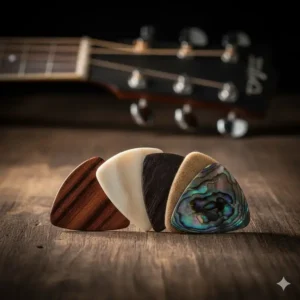
Let’s be honest: part of being a guitarist is the “cool” factor. The coolest guitar picks in 2026 are often pieces of art. We’ve seen a massive surge in picks made from semi-precious stones, reclaimed wood from historic shipwrecks, and even glow-in-the-dark resins.
But what makes a pick truly cool? For me, it’s the story. Imagine telling your audience that your pick was carved from a 100-year-old Bourbon barrel. Or maybe it’s a “glow-peel” pick that illuminates your hand during a dark stage intro. These coolest guitar picks serve as conversation starters. Brands like Iron Age or Hense are pushing the boundaries of what a plectrum can look like, using abalone inlays and intricate engravings that make the pick look like a piece of jewelry.
📉 Budget vs. Premium: Is It Worth the Jump?
Many beginners ask if “best plectrum” variations really matter. Can a $35 pick make a $300 guitar sound like a $3,000 one? Not exactly, but it helps.
| Category | Price Range | Longevity | Best For… |
| Budget | $0.50 – $1.00 | Low (Weeks) | Practice / Losing them at gigs |
| Mid-Range | $2.00 – $8.00 | Medium (Months) | Serious students / Local Pros |
| Premium | $15.00 – $50.00 | High (Years) | Studio Recording / Lifelong tone |
🔍 Understanding Guitar Plectrums: Terminology and Science
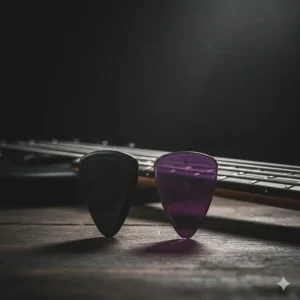
The term guitar plectrums is often used interchangeably with “picks,” but “plectrum” is technically the more formal, ancient term. Historically, plectrums were made from quills or tortoise shells. Today, we have the benefit of materials science.
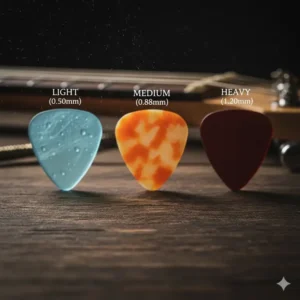
When choosing guitar plectrums, you must consider the “Point of Attack.” A sharp, pointed tip provides a bright, chirpy sound with lots of definition. A rounded tip provides a warmer, “thumpier” sound. Furthermore, the thickness (measured in millimeters) determines how much “give” the pick has.
-
Thin (.40mm-.60mm): Great for acoustic strumming where you want a percussive “click.”
-
Medium (.70mm-.80mm): The all-rounder.
-
Heavy (1.0mm+): Necessary for lead playing to ensure the pick doesn’t bend while you’re trying to play fast.
📈 Performance Metrics: Material Comparison
How do different materials stack up against each other in terms of sound and feel?
| Material | Attack (Bright/Warm) | Grip Level | Wear Resistance |
| Nylon | Warm | High (usually textured) | Moderate |
| Delrin | Balanced | Moderate | High |
| Acrylic | Very Bright | High (sticky feel) | Moderate |
| Casein | Natural / Organic | Moderate | Low |
| Metal | Ultra Bright | Low | Extreme |
🛠️ Why You Need Multiple “Best Plectrum” Variations
I never carry just one type of pick. In my gig bag, I have a “plectrum best” for every scenario. If I’m playing an acoustic ballad, I grab a thin nylon pick to get that airy, fluttering sound. If I’m switching to a Les Paul for a heavy riff, I reach for a 2.0mm acrylic pick. Having a variety of best plectrums in your arsenal is like having different brushes as a painter. You wouldn’t paint a fine portrait with a house-painting brush, right?
🏁 Step-by-Step: How to Choose Your Perfect Plectrum
-
Identify your genre: Metal players need stiffness; folk players need flex.
-
Check your hand size: If you have large hands, look at “Triangle” or “346” shapes.
-
Assess your sweat level: If you’re a “sweaty shredder,” prioritize textured grips.
-
Listen to the acoustic click: Drop the pick on a table. The higher the pitch of the “clink,” the brighter it will sound on your guitar.
-
Test the “Boutique” waters: Buy one premium pick (like a BlueChip or Gravity) just to see the difference. It might change your life.
📊 User Compatibility Guide
| Player Type | Recommended Pick | Why? |
| The Beginner | Dunlop Tortex .73mm | Forgiving and easy to hold. |
| The Speed Demon | Dunlop Jazz III | Sharp tip for minimal movement. |
| The Acoustic Singer | Fender Thin Celluloid | Beautiful percussive “wash.” |
| The Jazz Maestro | D’Addario Casein | Warm, sophisticated “woody” tone. |
✨ Don’t Miss These Exclusive Deals!
🔍 Elevate your tone to professional standards with these carefully selected products. Click on any highlighted item to check current pricing and availability on Amazon. These guitar plectrums are the secret weapon of the world’s greatest players! 🎸✨
🚀 Conclusion: Finding Your Signature Sound
At the end of the day, the best plectrums are the ones that make you want to play more. Whether you prefer the classic snap of a Dunlop Tortex or the high-end luxury of a BlueChip, your pick is the most intimate part of your signal chain. It’s the direct link between your brain and the music. Don’t be afraid to experiment with awesome guitar picks that look a bit weird or coolest guitar picks that cost more than a sandwich. Your tone is worth it!
Every time I try a new best plectrums candidate, I discover a new riff or a new way of phrasing a melody. It is the cheapest way to “upgrade” your guitar without buying a new instrument. So, go out there, buy a variety pack, and find your voice.
❓ Frequently Asked Questions
✅ Modern composites like those used in BlueChip picks or high-grade Delrin are the most durable. These materials resist 'bevelling' from string friction, meaning the pick stays sharp and smooth for months or even years of constant play...
✅ Generally, yes. Thicker plectrums (1.14mm and above) do not bend when hitting the string, providing an instantaneous response. This lack of 'flex' allows for more precise tremolo picking and faster lead lines compared to thin, floppy picks...
✅ High costs usually stem from material rarity and hand-finishing. Materials like Casein or aerospace-grade polyimides are difficult to source and machine. Additionally, hand-buffed 'speed bevels' require skilled labor, ensuring the pick glides off the strings effortlessly...
✅ Absolutely. A heavy, stiff pick transfers more energy to the string, resulting in a louder, more punchier sound. Conversely, a thin pick absorbs some of the impact, producing a quieter, more compressed tone ideal for background strumming...
✅ Many pros recommend it. Electric guitars often benefit from the precision of smaller, stiffer picks, while the larger body and higher string tension of an acoustic guitar often feel better with a larger, slightly more flexible plectrum... ❓ What is the most durable material for guitar plectrums in 2026?
❓ Do thicker guitar plectrums make you play faster?
❓ Why are some boutique plectrums so expensive?
❓ Can the choice of plectrum affect my guitar's volume?
❓ Should I use a different pick for electric and acoustic guitar?
Recommended for You:
- Best Guitar Accessories: 11 Game-Changing Essentials You Need in 2026
- Jazzmaster Bass: 7 Incredible Reasons Musicians Choose This Powerhouse Instrument
- Best Guitar Accessories: 11 Game-Changing Essentials You Need in 2026
Disclaimer: This article contains affiliate links. If you purchase products through these links, we may earn a small commission at no additional cost to you.
✨ Found this helpful? Share it with your friends! 💬🤗