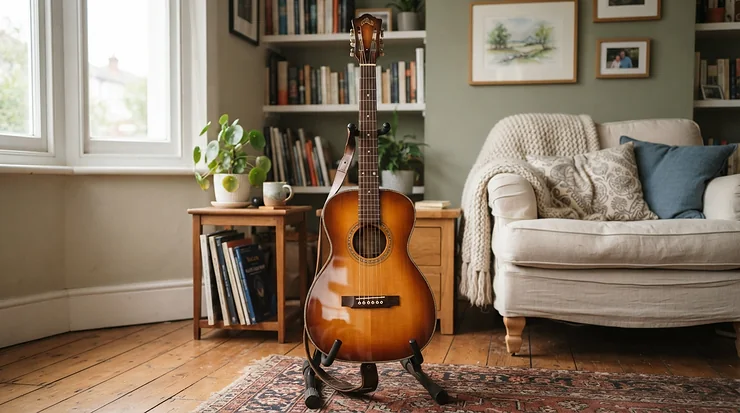
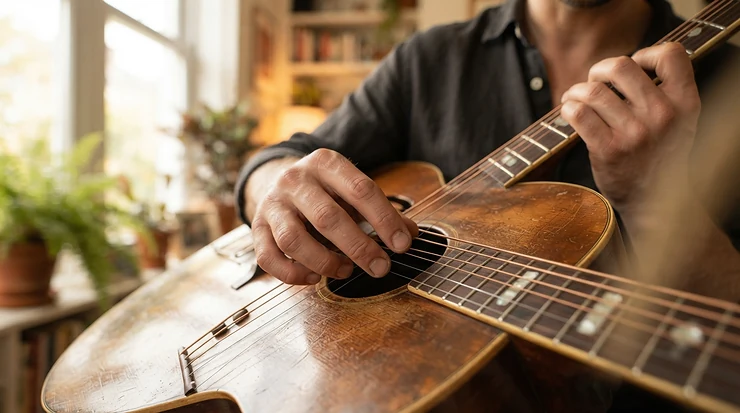
Buying the wrong small guitar costs you in specific ways: a scale too short for your hands, a laminate top when you wanted solid wood, or no pickup the week someone asks you to play out. Parlor guitars invite all three mistakes, because the category runs from a Gretsch at roughly $190 to $250 up to a Martin around $2,450 to $2,800, and for 2027 there is one new wrinkle in the form of Martin’s own parlor, covered below.
The six picks came together from maker spec pages, US dealer listings and published reviews at Guitar World, Premier Guitar and MusicRadar; no guitar was played for this guide, so every opinion about feel belongs to a named reviewer. Prices are ranges taken from those pages, and the number on Amazon.com may differ.
A quick orientation before the detail. The Yamaha CSF3M is the all-solid-wood choice at mid-tier money. The Gretsch G9500 Jim Dandy is the cheapest way into the shape. The Martin 0-X2E is the plug-in Martin, and the Martin 0-18 is the one built for fingerstyle players with a bigger budget.
Scale length, top wood, pickup: what separates these six
Guitar World’s parlor roundup describes the shape as the smallest standard acoustic body, with a narrow waist, a body length around 18.25 inches and short scales between 24 and 24.75 inches. Those short scales lower string tension, which eases fretting and bending. The same piece adds a warning: parlors respond best to a light touch, and hard strumming can turn the sound boxy or compressed.
History explains the appeal. Acoustic Guitar’s buying guide traces parlors to late-1800s American homes, notes that they faded after Martin’s dreadnought arrived in 1931, and credits better amplification and recording for the revival, since a small guitar no longer has to fill a room on its own.
Four differences matter more than any ranking:
Scale and nut width. The six range from 23 inches (the Martin LX1E Little Martin) to 24.9 inches (both 0-body Martins), and nut widths run from 1.6 to 1.75 inches. A longer scale feels firmer; a wider nut gives fingerpickers room.
Solid or laminate top. Five of the six have solid spruce tops. Guitar World’s roundup says the laminate Gretsch lacks the sound of a solid top.
A pickup or not. Three of the six have one built in. The other three are acoustic-only.
What ships in the box. Four include a case or bag in the listings; two do not.
One more wrinkle for a parlor guitar 2027 buyer: “parlor” is partly a marketing word. Wikipedia’s parlor entry says the term usually means something smaller than Martin’s size 0, which Martin itself calls a concert size, yet retailers and reviewers apply the label to 0-size guitars all the time. The two 0-body Martins here are therefore the largest guitars on the list, and Guitar World’s roundup places the Martin 0-X2E between parlor and compact concert.
Where the six differ on wood, wiring and scale
Model
Top
Back and sides
Scale length
Pickup
Case or bag
Price range
Gretsch G9500 Jim Dandy
Laminate
Laminate
24″
None
None mentioned
$190 to $250
Fender CP-60S
Solid spruce
Laminated mahogany
24.75″
None
None
$190 to $200
Martin LX1E Little Martin
Solid spruce
HPL
23″
Fishman Presys VT
Soft gig bag
Around $550
Martin 0-X2E
Solid spruce
Cocobolo-pattern HPL
24.9″
Martin E1
Softshell case
$700 to $750
Yamaha CSF3M
Solid Sitka spruce
Solid mahogany
23 5/8″
Passive undersaddle piezo
Hard bag per dealer listings
$700 to $750
Martin 0-18
Solid Sitka spruce
Solid mahogany
24.9″
None
Ply hardshell
$2,450 to $2,800
The jump from laminate to solid wood happens between the first and second rows, and the jump to all-solid construction between the fifth and sixth. Pickups cluster in the middle of the price range: the Martin LX1E Little Martin, Martin 0-X2E and Yamaha CSF3M have them, while the cheapest and most expensive guitars do not. Anyone who plans to play with other people, then, is choosing from the middle three.
The best parlor guitars here, cheapest to priciest
Price is the whole pitch. Guitar World’s review shows around $189 at its own retail links and about $245 to $250 for other finishes, so plan on $190 to $250. The guitar is a nod to Gretsch’s Rex parlors from the 1930s through the 1950s, with a 24-inch scale, 18 frets and a nato neck, according to Guitar World and zZounds.
Sources disagree on the wood. Guitar World lists basswood for the top, back and sides, while zZounds and Chorder list agathis; both agree the whole body is laminate. Fingerboard listings also vary between walnut and rosewood.
The sound, per Guitar World, is bright when strummed without turning harsh, surprisingly loud, and short on the bass and resonance of a dreadnought. The reviewer also flags a fretboard that feels cramped to some players and a reduced scale that feels tight on open chords.
Tuning reports split. Guitar World’s reviewer got a unit that arrived almost in tune and stayed there. A Harmony Central member, posting in 2016, described his as hard to tune and unwilling to hold pitch, and a reply in that thread suggested a technician look at it before any money went into upgrades. That is one reviewer against one owner, so test tuning stability the first week.
With no electronics, this is a porch guitar; Guitar World’s own review points gigging players to the Gretsch Gin Rickey instead.
Gretsch G9500 Jim DandySee current price, sizes and reviews on Amazon.
2. Fender CP-60S — a solid-top starter that stays acoustic
No electronics and no case: that is the trade the Fender CP-60S makes to put a solid spruce top, scalloped X-bracing and laminated mahogany back and sides at around $190 to $200. The spec sheets list a 24.75-inch scale, a 1.69-inch nut, 20 vintage-style frets and rolled fingerboard edges. Long & McQuade’s listing shows no case or bag, and the guitar ships strung with Fender’s coated 80/20 bronze in .012 to .052.
Fender’s own page lists a walnut fingerboard, while Adorama carries versions described with rosewood, so compare the exact model number before buying. MusicRadar’s review of the Fender CP-60S calls it an amazing choice for beginners and arguably a better option than the Fender CD-60S. Guitar World’s roundup scores it 4.5 out of 5 and describes it as a solid-top, acoustic-only, budget couch guitar.
Pros:
✅ Solid spruce top at a budget price, with scalloped bracing
✅ MusicRadar’s reviewer found the build flawless and the neck very comfortable
✅ Narrow waist sits easily on a lap, and the tone cuts through with mid-range energy
Cons:
❌ MusicRadar’s reviewer found it gets overwhelmed under hard strumming
❌ Bending takes effort on the small vintage frets, even for experienced players
❌ The narrow neck may feel cramped for large hands
The reviewer also found it quieter than a dreadnought, which is the normal bargain for the shape.
Fender CP-60SSee current price, sizes and reviews on Amazon.
A 23-inch scale and a 3.5-inch-deep body put this guitar closer to travel gear than to a classic parlor, since Guitar World’s parlor range starts at 24 inches. What it gives you is a Martin with a solid spruce top, HPL back and sides, a 1.6-inch nut, a Fishman Presys VT pickup with soundhole controls, a soft-shell gig bag and a weight of 3.6 pounds, per Guitar World’s review. The price there is around $550 at several major retailers, and the guitar is made in Mexico.
Guitar World’s reviewer scored it 4 out of 5 for build, playability and sound. The tone has a clear midrange and, as expected from the small body, limited low-end depth; adding a little bass at the amp helps. It responds to both light and firm strumming, and feedback is easier to control than on a bigger acoustic.
Two complaints are worth weighing. The reviewer noticed a slight neck dive when seated, and the pickup’s volume control drops steeply from about three-quarters to near silence, which makes small adjustments tricky mid-song. Both come from a single review, so try the balance on your own knee if you can.
The HPL back and sides will not appeal to everyone’s eye, though Guitar World’s list of strengths includes impressive sustain for the size and an excellent factory setup.
Martin LX1E Little MartinSee current price, sizes and reviews on Amazon.
4. Martin 0-X2E — a solid-top Martin you can plug in
Premier Guitar’s Charles Saufley reviewed the Martin 0-X2E in July 2024, scoring it 4.1 and putting its street price at $699. His review says the big change is a solid spruce top in place of the HPL tops on earlier 0-X models, which he considered worth the roughly $200 premium, at least sonically. Retail pages put it between $700 and $750.
Martin’s spec page lists a 0-14 fret body, cocobolo-pattern HPL back and sides, a 1 3/4-inch nut and a softshell case; retailers add a 24.9-inch scale and Martin E1 electronics with a built-in tuner plus volume, tone and phase controls.
Saufley describes a midrange-heavy voice with bright overtones that can turn strident under hard strumming, not much bass but a sustaining sixth string, and a guitar that suits lower alternate tunings. Fingerstyle felt comfortable and less tiring, which he credits partly to the wider nut.
Owners’ reports echo the durability pitch. Equipboard’s digest of owner discussions notes that the HPL construction resists humidity changes better than an all-wood Road Series guitar. A Sweetwater customer who owns a PRS parlor as well says the Martin sounds much better, though that is one buyer’s opinion.
Pros:
✅ Solid spruce top with Martin’s wide 1 3/4-inch nut
✅ Onboard E1 electronics with a tuner and a soft case in the box
Cons:
❌ Saufley found the cocobolo-look HPL back plasticky up close
❌ Bass is modest, and hard strumming can sound bright and strident
The guitar is built in Mexico.
Martin 0-X2ESee current price, sizes and reviews on Amazon.
All-solid construction is the reason to look at the Yamaha CSF3M: a solid Sitka spruce top, solid mahogany back and sides, a nato neck, a rosewood fingerboard and bridge, and scalloped bracing. Yamaha’s spec page gives a 600 mm (23 5/8-inch) scale, a body 450 mm long and 85 to 105 mm deep, and a 43 mm nut. The pickup is a passive undersaddle piezo, and dealer listings mention a hard bag. Sweetwater’s page shows a price near $730, so expect $700 to $750.
The most detailed review dates from 2018. Premier Guitar’s Charles Saufley praised the build quality, low action, spot-on intonation and tonal balance, and called it a standout value. He also flagged boxy low-mids, a midrange that can sound dull and limited low-end body, which he treats as typical for the size. Heavy strumming came across as punchy without compression, and fingerpicked arpeggios took on a harpsichord-like shine.
A Sweetwater buyer who plays dreadnoughts wrote that he wanted something easier to hold, more portable and less valuable, and picked this guitar for the solid spruce top, solid mahogany back and sides and rosewood fingerboard. That is one buyer, but the reasoning is a fair summary of who shops for it.
Only the Martin LX1E Little Martin has a shorter scale among the six, so players coming from 25.4-inch guitars will notice the slack.
Yamaha CSF3MSee current price, sizes and reviews on Amazon.
6. Martin 0-18 — the fingerstyle Martin, all solid wood
Premier Guitar notes that the Martin 0-18 has moved in and out of Martin’s catalog several times over the past century, and the current version is a 14-fret model with a 24.9-inch scale and a 1 3/4-inch nut. Elderly Instruments’ spec sheet lists a solid Sitka spruce top, genuine mahogany back and sides, ebony fingerboard and bridge, a bone nut, a dovetail neck joint, nickel open-gear tuners and a ply hardshell case. Premier’s street figure was $2,499, MusicRadar’s page shows $2,459 and Elderly lists $2,799, so budget $2,450 to $2,800.
Premier Guitar’s review says the build is close to perfect and credits the guitar with killer midrange punch and a complex but concise voice. The wider nut makes it a short-list item for fingerstyle players. Its drawbacks: the sixth and first strings can sound slightly muted in standard tuning, the reviewer would have preferred lower action, and players with small hands should try it first.
MusicRadar’s 2017 review reached a related verdict: balanced for its size, with extra upper-mid emphasis, strong projection when strummed and great definition when fingerpicked, but big loud ballads are not its strength.
Equipboard’s digest of forum threads adds a dissent: some posters prefer the larger Martin 00-28 family for richer bass and find the Martin 0-18 boxy.
Pros:
✅ Solid wood throughout with a dovetail neck joint
✅ Defined fingerpicking tone, and a comfortable neck even for small hands per MusicRadar
Cons:
❌ Muted sixth and first strings at standard pitch, per Premier Guitar
❌ Priced far above the rest of the list
Elderly’s listing also notes a Plek setup, which matters when you cannot try the guitar first.
Martin 0-18See current price, sizes and reviews on Amazon.
Martin parlor guitar models: the P-10 and the 0 family
Does Martin make a parlor shape acoustic guitar? Since 2026, yes. Martin’s Shenandoah page introduces the Martin P-10 Parlor as a new 14-fret body “sized between Martin’s traditional 0 and 00 bodies,” with a solid spruce top, scalloped spruce X-bracing, a 24.75-inch scale, a Shenandoah C neck, a satin burst finish and a gig bag. A Martin P-10E adds Fishman electronics. Martin’s page does not give a price or the back-and-side wood, and no independent review exists yet, so treat its specs as the maker’s claims.
Everything else a shopper sees under the Martin parlor guitar label is a 0-body model. Martin’s catalog size is the 0-14 fret, called a concert size on the Martin 0-18 page even though the same page uses the word parlor. The current 0 lineup includes the solid-wood Martin 0-18, the Martin 0-X2E with a spruce top and HPL back, and the Martin 0-X1E, which Martin lists with an HPL top, back and sides and a 1 3/4-inch nut. Guitar World’s 2020 review calls the Martin 0-X1E parlor-bodied, which shows how loosely the word is used.
Anyone building a parlor guitar 2027 shortlist should note that the Martin P-10 Parlor is the only dedicated Martin parlor on Martin’s new-models page. A step up in size, the 00-body Martin 00-28 is Martin’s Grand Concert model; it is a larger guitar, so it suits readers who want a little more body than a true parlor.
What parlor guitars reviews keep saying, and where they disagree
Across the sources above, the reviewers agree on three points. First, the voice is midrange-forward and short on bass: Guitar World says so for the category, Premier Guitar says it of both the Yamaha CSF3M and the Martin 0-X2E, and MusicRadar says it of the Fender CP-60S. Second, hard strumming is the weak spot. Third, the short scale makes them comfortable, with Guitar World, MusicRadar and Premier Guitar all praising playability.
Parlor guitars reviews split on two things. One is wood: Guitar World’s roundup says laminate lacks a solid top’s sound, yet its own review of the Gretsch G9500 Jim Dandy praises its sound and projection, so a laminate guitar at the right price can satisfy. The other is hand fit. The Gretsch G9500 Jim Dandy and Fender CP-60S read as cramped to large-handed reviewers, while the Martin 0-18 gets a recommendation for small hands and a flag from Premier that its wider nut may feel flat to newer players. Try before you buy where possible.
Lists of the best parlor guitars increasingly lean plug-in. Guitar World’s roundup ranks the Fender Highway Series Parlor, with a Fishman Fluence pickup system and loud acoustic volume, as its overall pick, while noting it is not for traditionalists. If amplification matters to you, that is the direction parlors have taken.
Steel strings are fine on modern builds. Acoustic Guitar’s guide warns that vintage parlors were often built for nylon or light gut and may not tolerate heavy steel, but the guitars here are made for it, and Martin recommends light phosphor bronze for its 0 body.
Parlor shape, steel strings, and solid tops: quick answers
❓ Does Martin make a parlor shape acoustic guitar?
✅ Yes. Martin's 2026 lineup added a dedicated parlor with a 14-fret body that its own page sizes between the traditional 0 and 00. Its 0-size guitars are catalogued as concert size, though Guitar World calls one of them parlor-bodied.
❓ Are parlor guitars good for beginners?
✅ Their short scales (24 to 24.75 inches in Guitar World's roundup) lower string tension, which eases fretting and bending, and the narrow waist sits nicely on a lap. The trade-off is less bass and a sound that gets crowded when you strum hard.
❓ Are parlor guitars loud enough for playing with others?
✅ Volume depends on the build rather than the label. Reviewers at MusicRadar and Guitar World found the Gretsch and Fender models punchy for their size, yet neither rivals a dreadnought, and hard strumming can overwhelm small bodies. For band settings, pick a model with a pickup.
❓ Can parlor guitars take steel strings?
✅ Modern parlors from Martin, Fender and Yamaha ship with steel sets, with Martin recommending light phosphor bronze for its 0 body. Vintage parlors are the exception: Acoustic Guitar notes many were built for nylon or light gut and may not tolerate heavier steel.
❓ Is a solid top worth paying for in a parlor?
✅ Guitar World's roundup says the laminate Gretsch lacks the sound of a solid top, so the answer depends on budget and ear. Five of the six guitars here have solid spruce tops; only the Yamaha and the priciest Martin are solid wood throughout.
Which parlor to buy first
If hand comfort and price rule, start with the Fender CP-60S: a solid top and a 24.75-inch scale for a little under $200. Add a pickup and you are choosing between the Martin 0-X2E, with Martin’s 24.9-inch scale and cocobolo-pattern HPL, and the Yamaha CSF3M, with a shorter scale and solid mahogany. The Martin 0-18 is the one to save for if fingerstyle is the point and you want solid wood throughout, while the Gretsch G9500 Jim Dandy and Martin LX1E Little Martin cover the cheapest and most portable ends. Whichever of these parlor guitars you shortlist, check what is in the box, because only four of the six include a bag or case.
Disclaimer: This post contains affiliate links. As an Amazon Associate, I earn from qualifying purchases made through these links, at no additional cost to you.
Weigh scale, top wood and pickup against how you actually play before you add any of these to your cart.