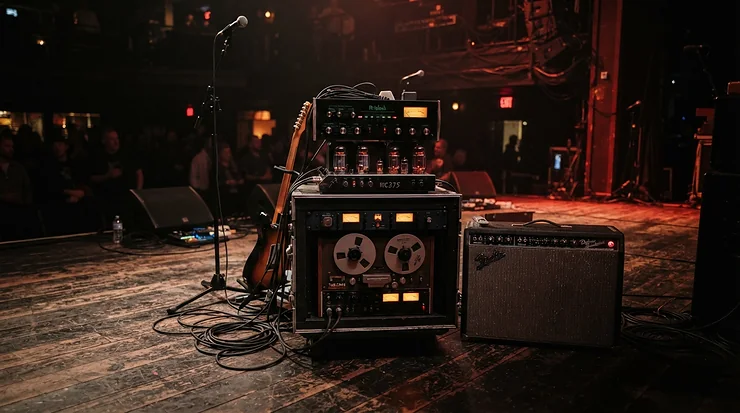
If you want the most control per pound from an advanced bass amplifier, start with the Darkglass Microtubes 900 v2. If you would rather spend less time dialing, the Aguilar Tone Hammer 500 V2 gets close with fewer knobs. Both fold a drive or dynamics stage, a balanced direct output and cabinet simulation into a head you can carry in one hand, which is what “advanced” means on most 2027 spec sheets. A plain bass amp gives you gain, three tone knobs and a power section. Choosing an advanced bass amplifier means deciding which of the extras you will actually touch.
I haven’t plugged any of these in. Everything below comes from manufacturer pages and manuals, retailer spec lists and published reviews, and I point out where those sources disagree with each other.
The six picks run from a 4 lb head to a 48 lb combo, so the first job is working out which kind of advanced you need.
What “advanced” should mean on a bass amp
Guitar World’s best bass amps 2025 roundup sorts its picks by job: a head for built-in effects, a head for modern tones, a hybrid for vintage warmth. That is a more useful way to shop than sorting by wattage. For this list, an amp had to offer at least three of these: an equalizer with sweepable or semi-parametric mids, built-in compression or limiting, a balanced direct output with a pre/post switch, an effects loop, cabinet simulation or a headphone output, and remote switching.
The direct output deserves a word, because it is where most of these amps earn their keep. A pre-EQ feed sends your bass to the mixing desk before the amp’s tone controls touch it, while a post-EQ feed sends what you hear on stage. The Mesa, the Markbass and the Fender put that choice on a switch, the Boss offers a direct, pre or post selector, and the Darkglass switches between a bypassed signal and a cabinet-simulated one. Cabinet simulation then stands in for the speaker for whoever is listening through the desk or headphones.
It suits players who run a pedalboard into the amp, record direct, or play rooms where the stage sound and the house sound have to be set separately. For home practice, MusicRadar’s guide points to the Fender Rumble 40 instead, and this list isn’t aimed at that job.
Each amp has a maker’s page or manual I read, plus at least one second source. The Fender and the Boss also appear in the Guitar World and MusicRadar guides, and the Darkglass and Aguilar appear in both.
The six at a glance
Amp
Type
Power (maker’s rating)
Weight
Headline feature
Darkglass Microtubes 900 v2
Class D head
900 W at 4 ohms
6.39 lb (manual)
Three cab sims, six-band EQ, compressor
Aguilar Tone Hammer 500 V2
Class D head
500 W
About 4 lb
Onboard IR loader, semi-parametric mid
Markbass Little Mark IV
Class D head
500 W at 4 ohms
About 5.4 lb
Bi-band limiter, Old School filter
Mesa/Boogie Subway D-800+
Class D head
800 W at 4 ohms
6.3 lb
High-pass filter, sweepable mids
Fender Bassman 800
Hybrid head
800 W at 4 ohms
17 lb
Tube preamp, two footswitchable channels
Boss Katana-210 Bass
2×10 combo
160 W RMS (300 W peak)
48 lb
Onboard effects, six memories
The power column can’t be read straight across. Boss rates its combo at 160 W continuous, while Darkglass quotes its 900 W under a two-minute, 20 percent distortion test, so the numbers describe different things. Weight is the cleaner comparison: the Aguilar is a quarter of the Bassman’s weight, and the Bassman is the only head here with a tube in the signal path.
Stock moves around, so see what’s available on Amazon.com before you commit to one.
Darkglass’s own pages disagree on what this head weighs. The manual says 2.9 kg (6.39 lb), while the product page lists 2.4 kg (5.3 lb). Either way it is small for 900 W RMS into 4 ohms, with 450 W into 8.
The reason to buy it is the signal path. A drive circuit Darkglass calls the Microtubes engine sits ahead of a six-band graphic EQ. A blend knob mixes the clean and driven signals, a tone knob acts as a low-pass filter on the driven side, and a switch chooses between two voicings: B3K, which the maker describes as aggressive and percussive, and VMT, which pushes the mids forward for a warmer sound. A compression knob sets how much squeeze the engine adds, and the makeup gain adjusts itself.
Three cabinet impulse responses live inside the head, and one switch decides which feeds the XLR and headphone outputs. A USB port connects to Darkglass’s Suite software, and an optional footswitch or a third-party MIDI controller handles remote switching.
Neither review faults the sound. Guitar World’s complaints are price and a voicing that doesn’t suit retro tones, and MusicRadar praises the clean tone and distortion control while noting it isn’t cheap. Retailer prices I checked ran around $1,250 to $1,500, and a few listings showed it backordered or sold out.
Pros:
✅ Three stored cabinet sims and pre/post DI outputs for recording
✅ Compressor, drive and six-band EQ in one head
Cons:
❌ Voiced for modern tones, so vintage players may fight it
Darkglass Microtubes 900 v2See current price, sizes and reviews on Amazon.
Two generations of this head are on sale, and the published reviews describe the older one. Guitar World and MusicRadar both list a 500 W class D head with a three-band EQ, a drive control and a balanced XLR with a pre/post switch, and both fault it for lacking a headphone output. Guitar World adds that it is loud enough to make a poor home practice amp.
The Aguilar Tone Hammer 500 V2 keeps that core and adds what the older one lacked: a headphone output, an aux input, a second XLR and an onboard loader for cabinet impulse responses. Sweetwater says it ships with Aguilar’s SL and DB cabinet tones and accepts third-party files over USB-C. Guitar Center’s listing adds a 2.67 ohm load rating, an all-analog preamp and a semi-parametric mid. The weight stays around 4 lb, so the head fits in a gig-bag pocket.
The drive control is the part worth understanding. MusicRadar says it interacts with the EQ, so the two are best set together instead of one after the other. MusicRadar also ranks the original among the best solid-state heads you can buy, and the V2 retains that voicing. Retailers I checked sat between $900 and $1,000. When you shop, look for TH500V2 or Gen 2 in the title, because listings for the original TH500 are still around.
Aguilar Tone Hammer 500 V2See current price, sizes and reviews on Amazon.
At around $600 to $650 on retailer listings, this is one of the cheaper amps here, and it spends its features on tone and dynamics. Four EQ bands sit at 68 Hz, 360 Hz, 800 Hz and 10 kHz with up to 16 dB of boost or cut. An Old School knob rolls off the highs for a rounder sound, and a three-way switch picks flat, scooped mids or a footswitchable mode that can toggle the scoop and the mute from the floor.
The bi-band limiter reacts faster than a conventional one, according to Guitar Center’s spec text. The rear panel carries an effects loop, a tuner out and an XLR line out with pre/post and ground-lift switches. The power section is Markbass’s own MPT design, rated 500 W at 4 ohms and 300 W at 8, and the head is built in Italy. Guitar Center lists 5.4 lb; a European retailer gives 2.8 kg, a little over 6 lb.
Guitar World’s pick from this family is the tube-preamp Little Mark Vintage 500, which makes the IV its solid-state sibling. For the IV I could only read retailer spec lists, not Markbass’s own page, and none of them mention cabinet simulation or a headphone jack.
Look elsewhere if you record direct and want cabinet simulation on board.
Markbass Little Mark IVSee current price, sizes and reviews on Amazon.
If your problem is a boomy room or a stage that turns the low end to mush, the filter on the Mesa/Boogie Subway D-800+ is the reason it exists. Mesa’s spec page describes an adjustable high-pass filter from 30 Hz to 150 Hz for tighter response and more headroom in a band or a large venue.
The rest of the preamp backs that up. A voicing control moves from flat to a vintage scoop, and the four-band EQ gives plus or minus 12 dB with a sweepable low-mid (150 Hz to 1.8 kHz) and high-mid (300 Hz to 5 kHz), plus deep and bright switches. The back panel has a balanced XLR out with pre/post, line/mic and ground-lift switches, a fully buffered series effects loop, a tuner output and a jack for a mute footswitch, which is sold separately. A headphone output and an aux input are listed too.
Mesa rates it at 800 W at 4 or 2 ohms and 400 W at 8, in a 6.3 lb aluminum chassis measuring 2.625 by 13.25 by 10.15 inches, and it is built in Petaluma, California. Retailer prices ran around $1,100 to $1,200.
Pros:
✅ Sweepable mids and a high-pass filter for taming rooms
✅ Headphone output and aux input for quiet practice
Cons:
❌ Mesa’s page doesn’t mention a compressor
Mesa/Boogie Subway D-800+See current price, sizes and reviews on Amazon.
Tubes are the whole argument for the Fender Bassman 800. Fender lists two 12AX7 preamp tubes ahead of a solid-state Class D power amp rated 800 W RMS at 4 ohms. The preamp splits into a Vintage channel and an Overdrive channel, and the included one-button footswitch toggles between them. Guitar Center’s description says the Vintage channel uses a passive tone circuit that cuts frequencies instead of boosting them, while the Overdrive channel adds gain and blend knobs and a mid control with selectable frequency and level.
On the back are an effects loop with a preamp out and a power amp in, a tuner output, and an XLR line out with a level knob, ground lift, pre/post switch and a Silent Recording mode. The two speaker jacks accept both speakON and quarter-inch plugs.
At 17 lb (7.7 kg) per Fender, it is the heaviest head here, though Sweetwater’s page says 15 lb. Against the eleven-valve Ampeg SVT-CL that MusicRadar lists at 36.3 kg, it still looks light. MusicRadar names it the best overall pick but warns that hi-fi tone lovers won’t take to it, and says you may need an adapter for speakON cables, which Fender’s combination jacks make unnecessary. Sweetwater’s listing, which looks dated, sat around $1,250 to $1,350, so check the current price on Amazon.com.
Fender Bassman 800See current price, sizes and reviews on Amazon.
Every other amp here is a head; this one arrives with its own speakers. The combo carries two 10-inch woofers and a tweeter that switches off for a more traditional sound, driven by a class AB power amp. Boss’s headline text says 300 W, but its spec line gives 160 W continuous and 300 W peak, so read the spec line.
Tone shaping starts with three voicings (Vintage, Flat, Modern) and a Shape switch for mid scoop, bright or extended range, followed by a four-band EQ whose low-mid and high-mid frequencies can be selected. Compressor and drive buttons sit ahead of two effects slots, a blend control mixes in dry signal, and six memories store the results. Boss Tone Studio edits everything over USB. A Power Control steps down to 1 W for quiet playing, and a phones/recording output applies microphone-style cabinet emulation. An XLR output can send the direct, pre or post signal, and an external speaker jack takes a 4 ohm cabinet.
Guitar World names it the best pick for built-in effects, and lists the same drawbacks I’d weigh: the footswitch is sold separately and there is no onboard tuner. It weighs 48 lb 1 oz, so it is a combo for loading in, not for carrying on. Check the current price on Amazon.com.
It makes sense if you want one box instead of a head, a cabinet and a pedalboard.
Boss Katana-210 BassSee current price, sizes and reviews on Amazon.
Where a hi fi bass power amp fits, and where it doesn’t
Every head on this list can be split into a preamp and a power amp, which is the door a hi fi bass power amp would walk through. The Darkglass Microtubes 900 v2 manual lists a preamp output (1200 mV into 1 kilohm) and a power amp input (1500 mV RMS in its 4 ohm mode). The Fender Bassman 800 exposes the same pair on its effects loop jacks. Mesa also sells a pedal-sized Subway DI-preamp derived from the D-800+, with line-level outputs it says will drive any power amp.
How a given home-audio power amp behaves with a bass cabinet is not documented in the sources. None of these makers’ pages say, so ask the amp maker and the cabinet maker before pairing anything. The hi-fi question is also about voicing. MusicRadar’s best bass amps guide says the Bassman won’t suit hi-fi tone lovers; read that as a preference for a clean, uncolored sound over tube character. The closest thing to that clean approach among the six is the Markbass Little Mark IV, whose proprietary power section Sweetwater says is voiced for high headroom and a clear tone. Markbass’s founder argues, in Guitar Center’s brand guide, that a bass power amp has to be built differently from one for high frequencies.
Watts, ohms and the cabinet you pair with it
Ratings only compare when the impedance matches. The Markbass Little Mark IV is rated 500 W at 4 ohms and 300 W at 8, and the Mesa/Boogie Subway D-800+ drops from 800 W to 400 W at 8 ohms. The Aguilar V2 listings quote 500 W at 2.67 ohms. Two cabinets that look identical on a shelf can pull very different power from the same head.
An advanced bass amplifier at 900 W also deserves a cabinet that can take the power. Darkglass’s manual sets a 4 ohm minimum load, or 2 ohms in its 2 ohm mode, and notes that the rear-panel 2 ohm mode lowers the output. It also warns that the head can pass 115 dB, which can damage hearing, and recommends protection. The Boss is the exception, since its speakers are built in and only the extension jack needs a 4 ohm cabinet.
Questions bassists ask before buying a head
❓ Which of these work for silent practice?
✅ The Darkglass, the Aguilar V2 and the Mesa list headphone outputs, and the Darkglass runs its cabinet simulation through that jack. The Boss has a phones/recording output with cabinet emulation plus a 1 W Power Control setting. The Markbass and Fender listings don't mention a headphone jack.
❓ Is 500 watts enough for a gig?
✅ A wattage figure depends on impedance: the Markbass is rated 500 W at 4 ohms but 300 W at 8, and the Mesa's 800 W halves to 400 W at 8. Cabinet efficiency and the room matter as well, and every head here has an XLR output that can feed the house PA when the stage runs out of steam.
❓ Do I need a built-in compressor?
✅ Only the Darkglass and the Boss list a compressor. The Markbass offers a limiter, and the Mesa and Aguilar lists I read mention neither. All six have an effects loop or a send and return, so a compressor pedal can sit after the preamp instead.
Which one to pick if you can only pick one
An advanced bass amplifier is worth the money when you use its extra controls at every rehearsal. Pick the Darkglass Microtubes 900 v2 for drive, compression and cabinet sims in one chassis, or the Aguilar Tone Hammer 500 V2 for a similar job with a simpler front panel. Take the Markbass Little Mark IV when the budget is firm and a fast limiter and a warm filter are enough. Choose the Mesa/Boogie Subway D-800+ when the room is the problem, the Fender Bassman 800 for tube warmth with a footswitch, and the Boss Katana-210 Bass when you want speakers and effects in one box.
Whichever you choose, match its watts and ohms to your cabinet before you order. See what’s in stock on Amazon.com.
Disclaimer: This post contains affiliate links. As an Amazon Associate, I earn from qualifying purchases made through these links, at no additional cost to you.
Next time your amp can’t keep up with your pedalboard, you’ll know which spec to check first.