The Korg MA-2 is rated for about 400 hours of continuous use on two AAA batteries, according to Korg, while one buyer of the wind-up Wittner Taktell Piccolo 836 reports that it runs down after roughly 15 minutes. That gap is the first thing worth knowing about any metronome in 2027: the cheapest plastic box and the classic swinging pendulum solve the same timing problem in opposite ways, and each suits a different practice room.
Five models cover the situations that actually split buyers: a guitarist who wants a tuner in the gig bag, a student with little to spend, a pianist who likes to watch the beat, a drummer who needs subdivisions, and a player who cannot hear a click over a loud band. The comparisons rest on spec pages from Korg, BOSS and Soundbrenner, buying guides from MusicRadar and American Songwriter, and owner reviews posted on retailer pages; no unit was played or timed for this article, so every comment on feel is credited to the reviewer who made it.
Click tone, power and a beat you can feel: what separates these five
MusicRadar’s buying guide draws the first line between mechanical and digital units. Pendulum models run on clockwork, need no batteries, offer few features and have a limited run time. Digital ones are battery-powered, generally more accurate, and add extras such as tuners and visual cues. The same guide advises checking for auto power-off, because a unit left on drains its batteries, and wanting more than one click sound, since an identical tick becomes tiring.
Volume and visibility come next. MusicRadar suggests a louder unit for drums or electric guitar and a visual cue for anyone who loses the click inside a track or learns better by sight. American Songwriter’s guide adds precision, time signatures beyond 4/4, and a plain question: do you follow the beat best by hearing it, seeing it or feeling it? Those answers sort the five models below faster than any star rating.
Metronome reviews side by side: type, range, power and price
The table pulls the maker and retailer figures behind these metronome reviews into one place. The entries after it explain what the numbers mean in use.
Model
Type
Tempo range
Power
Extras worth knowing
Price range
Korg TM-70T
Digital tuner combo
30–252 BPM
Battery, up to 250 hours
Tuner C1–C8, 15 rhythms, transpose
About $40 to $45
Korg MA-2
Digital pocket unit
30–252 BPM
Two AAA, about 400 hours
Tap tempo, 1–120 minute timer
About $25 to $40
Wittner Taktell Piccolo 836
Mechanical pendulum
40–208 BPM
Wind-up key
No bell, Italian tempo terms
Check the current price on Amazon.com
BOSS DB-90 Dr. Beat
Digital, drum-machine style
30–250 BPM
9V battery or AC adapter
Subdivision sliders, voice count, Rhythm Coach
Around $140 to $170
Soundbrenner Pulse
Wearable, vibrating
20–400 BPM
Rechargeable, 6+ hours
Vibration and LEDs, app optional
Roughly $95 to $120
Price spreads by a factor of about six between the cheapest Korg and the BOSS, yet the tempo ranges barely differ, so the extra money buys control over the click rather than speed. The pendulum’s 40–208 window is the narrowest of the five, which matters if a slow subdivision drill calls for a click below 40. Power deserves as much attention as price: Korg lists 250 and 400 hours per set of batteries for its two pocket units, while the other three depend on a 9V, a charging cable or a winding key.
The best metronome for each kind of player
Each entry starts from a situation and works back to the unit. The best metronome for one player is a poor fit for another, because room, instrument and patience change the answer more than any spec does.
1. Korg TM-70T — metronome for guitar, tuner included
A guitarist who already carries a clip-on tuner and a phone has two things to lose before a rehearsal. The Korg TM-70T puts both jobs on one screen. Korg’s product page gives the click a 30–252 BPM range, three ways to set the tempo (pendulum-style steps, single-BPM steps or tap) and 15 rhythms spanning zero to nine beats plus duplets, triplets and quadruplets. The tuner reads from C1 to C8, enough for a six-string guitar and a bass, and it can run beside the click, though triplets and quadruplets switch off while both are active.
Korg also lists up to 250 hours of battery life, a foldable stand, memory backup, a headphone jack and an input for the separately sold CM-400 contact mic. B&H describes that mic as a clip-on piezo sensor that sends vibration straight from the instrument to the tuner, which is why it helps in a noisy room. The unit succeeds the Korg TM-60, which American Songwriter named its best compact metronome for gig bags, and Korg calls the newer one a size smaller with a bigger display of note names.
One buyer review syndicated on Desertcart notes that the backlight on the Korg TM-70T is dimmer than on the older Korg TM-60. The same reviewer describes these combos as built to sit on a stand rather than be held. Retailer pages put the Korg TM-70T between about $40 and $45, and Adorama’s listing says it is made in Japan.
Korg TM-70TSee current price, sizes and reviews on Amazon.
2. Korg MA-2 — the cheap pocket click with a timer
Between about $25 and $40 on the retailer pages checked, the Korg MA-2 is the least expensive route to a dedicated unit with no notifications competing for your attention. Korg’s feature page lists tap tempo, a numeric pendulum-style entry, 0 to 9 beats across eight rhythm types, and a practice timer that runs from 1 to 120 minutes before an alarm sounds and the click stops. MusicRadar gives the range as 30–252 BPM and the weight as 68 grams including two AAA cells.
The tone is where complaints land. MusicRadar’s reviewer lists the single beep as the main drawback and steers complex rhythms elsewhere. A Long & McQuade owner calls it a harsh chirp that turning the volume down does not soften, and says a scrap of foam over the speaker port took off the edge. On Guitar Center’s page the unit averages 3.75 from eight reviews, and one reviewer compares the beep to a smoke detector. Three independent sources describing the same trait make it a known characteristic, not a one-off.
Long & McQuade’s listing mentions a headphone output, the sensible workaround if the beep wears on you. Guitar Center gives the body as about 2.8 by 4.3 inches.
Check current availability on Amazon.com.
Korg MA-2See current price, sizes and reviews on Amazon.
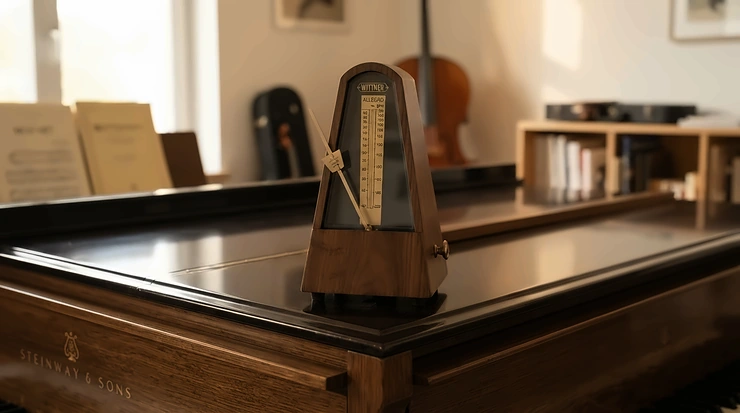
Some players learn tempo better by watching a pendulum than by reading digits, and the Wittner Taktell Piccolo 836 is the compact version of that idea. MusicRadar files mechanical units under piano and classical study, and points out that clockwork means no batteries but a limited run time and few features. This one slides a weight along a metal arm across 40–208 BPM and prints Italian tempo terms beside the numbers, according to Adams Music Centre; Music Store lists it without a bell. Boullard’s spec sheet gives about 7 by 4.5 by 15.5 centimeters and 0.21 kilograms in a plastic housing, and a Dutch retailer lists it as made in Germany.
Run time is the trade-off. A buyer review syndicated on Desertcart says it winds down after maybe 15 minutes, with the key stored in the face so it cannot go missing. Another buyer there finds it loud enough for acoustic guitar and piano but not against a loud guitar amp. Music Store advises winding it only right before use and not leaving the spring fully wound for long, which it says extends service life.
This pendulum is sold in several colors under different numbers, from 831 to 837; the 836 is the black, bell-free version, so match the number before ordering. The current price is best checked on Amazon.com.
Wittner Taktell Piccolo 836See current price, sizes and reviews on Amazon.
Price frames the BOSS DB-90 Dr. Beat: around $140 to $170 on the retailer pages checked, several times what the Korg pocket units cost. On a Steve Weiss Music review page, cost is the most repeated complaint, mentioned in five of eight reviews, yet the same reviewers keep praising what the unit does. Sweetwater’s reviewer goes further and calls it “truly the Rolls Royce of metronomes.”
What it adds is control. BOSS specifies 30–250 BPM with ±0.1% accuracy, four click sounds including a human voice count, 30 built-in patterns from 8-beat and shuffle to funk, jazz, techno and Latin styles, and 50 stored setups. Sweetwater describes four sliders that mix quarter notes, eighth notes, sixteenths and triplets, a footswitch jack for start and stop, and a Rhythm Coach that checks your timing through the built-in microphone or a practice pad on the trigger input. A direct input lets it double as a small practice amp for guitar or bass, and the box includes a soft case, a 9V battery and an M8 nut for mounting on a cymbal stand. It measures 122 by 164 by 38 millimeters and weighs 450 grams.
Power is the sore spot. BOSS lists a 9V battery or an AC adapter and a 60-minute auto power-off. Two of the eight Steve Weiss reviewers say the 9V drains quickly, and a third reports the battery connector failing, adding that two other owners he spoke with had the same problem. Their shared advice is to buy the AC adapter. Sources also disagree on the screen: MusicRadar says it has no backlight, while Sweetwater and B&H list one.
Pros:
Subdivision sliders and a voice count make unusual groupings audible (Sweetwater)
Footswitch start and stop plus an amp input free both hands
50 stored setups for different exercises or songs
Cons:
Reviewers report fast 9V battery drain
MusicRadar finds the PCM drum sounds underwhelming
The highest price of the five
MusicRadar’s verdict points the unit at drummers who want to practice timing.
BOSS DB-90 Dr. BeatSee current price, sizes and reviews on Amazon.
There is no display on the Soundbrenner Pulse, so anything beyond tap tempo and play or pause goes through the free companion app, according to the maker’s page. The device is a 47-gram, 50-millimeter disc worn on a wrist band. A haptic motor taps the beat, eight RGB LEDs flash it, and the range runs 20–400 BPM. Soundbrenner lists 6+ hours of playback per charge, a magnetic USB-C cable with no wall adapter in the box, sweat resistance rated IP62, and syncing for up to five Soundbrenner wearables to one phone, which is the band-rehearsal case. The maker also sells the Soundbrenner Core 2 with a screen at a higher price.
MusicRadar recommends the unit for gigging solo musicians who want to feel the beat, though it warns that it takes time to get used to and can feel chunky on the wrist. Owner opinion is split. Thomann’s page averages 3.7 out of 5 across 242 ratings, with 85 five-star and 14 one-star. Drummers disagree: one reviewer calls it a cool way to feel the beat during loud drumming, another finds the vibrations nearly impossible to feel while playing hard. Several say it takes a while to get used to, and one says the first unit arrived with an unresponsive outer ring.
Some Thomann reviewers mention a subscription for full app features, although Soundbrenner’s product page lists no paid tier, so confirm the app’s current terms before counting on it. Soundbrenner’s page shows roughly $95 to $120 depending on whether a sale is running.
Pros:
No audible click, so nothing leaks into a shared room or a recording
Adjustable vibration strength and LED colors (Thomann reviewers)
Up to five units sync to one phone
Cons:
No screen, so precise changes need the app
Feedback from drummers is mixed
Costs several times more than the Korg pocket units
Thomann’s page counts 14 one-star ratings out of 242.
Compare current prices on Amazon.com before you decide.
Soundbrenner PulseSee current price, sizes and reviews on Amazon.
Start below your limit. If a passage feels rushed, drop to a speed where every note lands cleanly between clicks. If that still fails, begin with a single note at a comfortable tempo to learn how an off-beat note sits against the click.
Move the click to beats 2 and 4. Premier Guitar calls this the snare approach: it removes reliance on beat 1 and exposes the spots where you rush or drag. The tempo math changes, since 120 bpm on the half note equals 240 bpm at the quarter-note level.
Drill subdivisions at a slow click. The lesson sets the click to 40 bpm and plays one note per click, then two, three, four and more, keeping the subdivision going even during rests. Both Korg units and the BOSS reach 30 BPM, while the Wittner Taktell Piccolo 836 bottoms out at 40, which just covers that exercise.
Raise the speed in small steps. Premier Guitar’s own exercises step through 100, 125 and 150 bpm but give no fixed rule, so a sensible approach is to move up only after several clean passes in a row.
Check against your own pulse. Soundbrenner’s blog notes that players tend to speed up when they get excited about a melody. Recording a short take and listening back shows whether the click or your hands set the tempo.
For a guitarist, the Korg TM-70T headphone jack makes late-night drills practical, and the BOSS DB-90 Dr. Beat lets you plug the guitar in directly.
Metronome online, an app, or a box in the case?
MusicRadar calls phone apps convenient and inexpensive but notes that dedicated hardware lets you practice without distraction. A Steve Weiss Music reviewer made the same trade-off from the other side: smartphone apps offer more for less, though another reviewer there valued a unit that cannot show notifications.
Free tools are not toy versions. MusicRadar describes an iOS-only app that covers 2–999 BPM, 100+ click sounds and polyrhythms, and American Songwriter lists a free Soundbrenner app with tap tempo, 15 beat variations and tempo libraries, with some advanced features behind a purchase. A free metronome online or on a phone covers basic tempo work, tap tempo and subdivisions without spending anything.
Hardware earns its place in three cases: the phone is the thing pulling you off task, the click has to cut through a loud instrument, or you need a footswitch, a timer or an amp input. If none of those apply, start with a free app and buy a unit only when it starts to limit you.
Where a metronome purchase goes wrong
The first misstep shows up in the reviews: paying for features that never get used. On the Steve Weiss page, a reviewer suggests a cheaper model from the same Dr. Beat line for home practice and keeping the BOSS DB-90 Dr. Beat for school or teaching, and another says apps offer more for less.
Power is the second. A 9V that drains quickly, a pendulum left fully wound and a rechargeable that needs care all appear in the sources above. Prefer a unit with auto power-off, as MusicRadar advises, and keep the AC adapter near your practice spot if you buy the BOSS.
Tone is the third. A single harsh beep tires the ear, which is why MusicRadar urges more than one click sound; when a unit offers only one, a headphone jack is the practical workaround.
Fourth, wearables are not a fix for every drummer, given how split the Thomann reviews are on feeling the beat during hard playing.
Fifth, precision. American Songwriter warns that low-quality units may drift and that even a few milliseconds are audible, and BOSS quotes ±0.1% for its own unit.
A note for anyone who searches for a “metronome under 1000”: check the currency first. In US dollars every model here sits far below that line, topping out near $170; in another currency, convert it and compare against the ranges in the table above.
Quick answers on guitar clicks, free tools and tight budgets
What is the best metronome for guitar?
A tuner combo is the simplest fit, because one unit handles tuning and timing and slips into a gig bag. Players who want hands-free control and amp input should look at a unit with a footswitch jack and a direct instrument input instead.
How do you use a metronome if you are just starting out?
Choose a tempo slow enough that every note lands cleanly, play a short passage against the click, and raise the speed only after several clean repeats. Later, moving the click to beats 2 and 4 exposes rushing and dragging.
Is a free online metronome good enough?
For basic tempo work a free app or browser tool covers the essentials, including tap tempo and subdivisions. Hardware earns its place when notifications distract you, the click must cut through a loud instrument, or you need a footswitch or timer.
Are mechanical metronomes more accurate than digital ones?
MusicRadar's guide says digital units are generally more accurate, while mechanical ones are clockwork-powered with limited run time and fewer features. A pendulum still suits players who like watching the beat, but accuracy alone is not a reason to buy one.
Is there a good metronome under 1000?
If that figure means US dollars, every model in this guide costs far less, from roughly $25 for a pocket digital unit to about $170 for a drum-oriented one. If it means another currency, convert it first and compare against those ranges.
Matching a first purchase to your room in 2027
Start from the room, not the feature list. A guitarist who practices at home and carries a gig bag is well served by the Korg TM-70T. Someone spending as little as possible can live with the Korg MA-2 if the beep is tolerable or goes through headphones. A pianist who likes watching time pass should look at the Wittner Taktell Piccolo 836 and wind it just before sitting down. A drummer or teacher who needs subdivisions will get the most from the BOSS DB-90 Dr. Beat with its AC adapter. Anyone who cannot hear a click over a band can try the Soundbrenner Pulse with the app’s sound on at first, as one Thomann reviewer suggests.
The decision rule for any metronome is the same: buy the simplest unit that matches your instrument and your room, then use it every day. Check current availability on Amazon.com.
Disclaimer: This post contains affiliate links. As an Amazon Associate, I earn from qualifying purchases made through these links, at no additional cost to you.
Whichever unit you choose, set it slower than feels necessary and let the click do its job.